Partnering with scandiweb’s team allowed us to bring a site to market that has 3–4 times better performance than any other site.
Jason Barney, eCommerce Technology Consultant
About PUMA
PUMA is a global sportswear brand operating eCommerce in multiple regions, languages, currencies, and regulatory environments. As eCommerce expansion accelerated, new market launches became a critical growth lever – but only if performance, compliance, and operational complexity could be handled without slowing teams down or inflating costs.
Problem
Despite global demand, performance limits, rollout complexity, and local compliance requirements were blocking PUMA’s eCommerce expansion.
Each region introduced unique constraints, including performance expectations, government regulations, payment methods, logistics integrations, and data structure requirements. Without a repeatable, high-performance delivery model, every new launch for PUMA risked becoming slow and expensive.
The issues showed up as:
- Page performance that limited conversion and user experience at scale
- Market launches slowed by custom build effort and local complexity
- Regulatory and compliance requirements that could not be handled with standard eCommerce patterns
- Fragmented integrations across ERP, OMS, PIM, payments, and logistics
- High coordination cost to launch and manage multiple regional stores.
Solution
Headless PWA delivery model
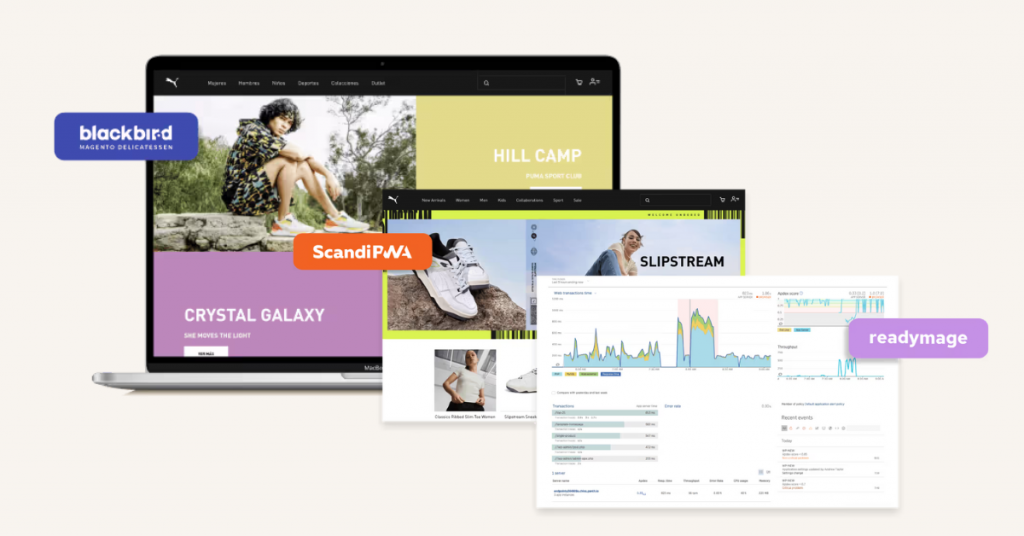
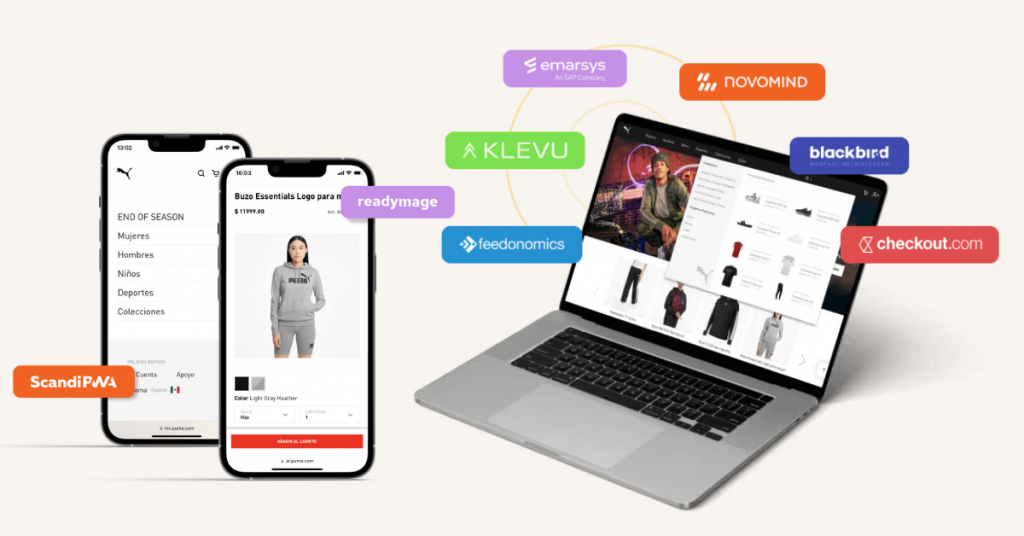
We introduced a ScandiPWA-based headless architecture on Magento 2, creating a high-performance frontend layer that could be reused across markets while still meeting local requirements, removing frontend performance as a limiting factor for expansion.
Performance-first execution
Time-to-interactive (TTI) and SPA transition scenarios were optimized across stores. Varnish caching was pushed to the edge with Fastly, reducing page and media load times and ensuring consistent performance under traffic.
Repeatable market rollout framework
A standardized launch approach enabled the delivery of new markets quickly without requiring the rebuild of core functionality. Mexico, Argentina, the UAE, and KSA were launched on the same foundation, reducing incremental effort per market.

Local compliance
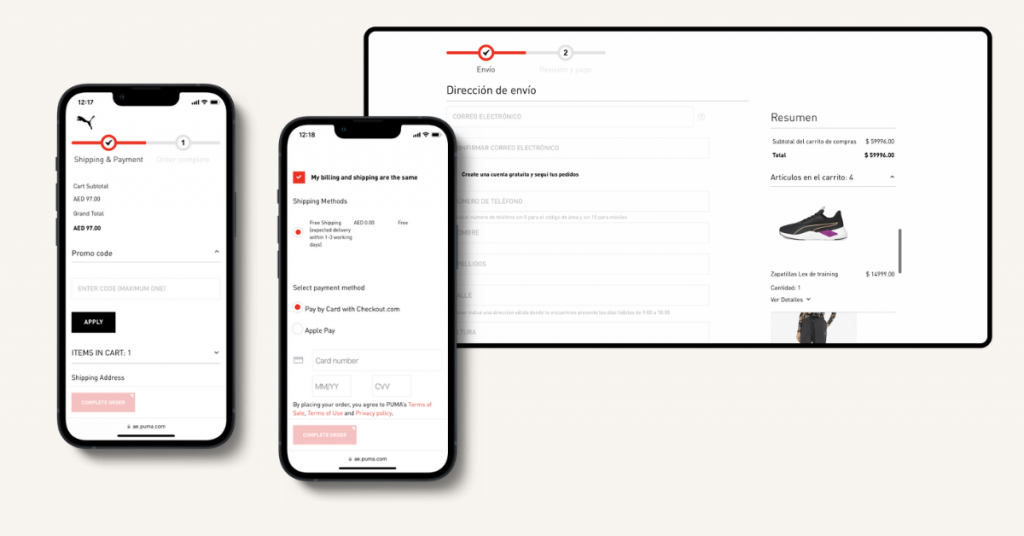
Country-specific requirements were implemented directly into the platform, including:
- Government-compliant invoicing and ID validation for Argentina
- Order regret logic aligned with local consumer law
- Automatic customs and tax calculation for KSA.
Multi-market control
Multiple regional stores run from shared Magento installations where appropriate, with logic to manage inventory, pricing, and availability per country. A single Middle East team can manage both UAE and KSA stores without additional overhead.
Integrated eCommerce ecosystem
Each store is connected to PUMA’s broader ecosystem, which includes ERP, OMS, PIM, CRM, payments, logistics, and marketing tools. This way, orders, fulfillment, communication, and reporting work consistently in all regions.
Outcome
- 4 new ecommerce markets launched in 95 days, from project sign-off to live stores.
- 3x better performance, with 80+ Lighthouse scores achieved without third-party scripts.
- 27% faster page and media loading after edge caching implementation.
- First orders placed within minutes of each go-live.
- 5,000+ orders processed in Argentina within the first months after launch.
- 700–800+ SEO health scores across markets, ensuring organic growth was not blocked.
- A repeatable, performance-driven expansion model replacing one-off, market-by-market builds.
Growth slowing while costs keep rising? We help teams identify what’s blocking scale, reduce wasted effort, and restore efficient growth. Book a 50-min ROI roadmap session with scandiweb.