4.9
Salesforce Commerce Cloud development and support
An official Salesforce partner that builds Commerce Cloud storefronts, writes the custom cartridges behind them, and runs the platform after launch.


Trusted by 700+ leading brands worldwide


Trusted by 700+ leading brands worldwide
Salesforce Commerce Cloud at scandiweb
23+
Years building eCommerce stores
700+
Clients since 2003
$4B+
Processed a year by our clients
%20(1)-p-800.png)
.svg)
.svg)
When you need a Salesforce Commerce Cloud agency
Most Commerce Cloud work does not start on a blank instance. It starts with a license already bought, a deadline already set, and a decision about how much of the platform you are willing to change.

Building your first Commerce Cloud store
You hold the license and a go-live date. What the build needs next is an architect who has sized a Commerce Cloud catalog at your volume before.
Adding what the platform does not do
Standard cartridges cover the common cases. The workflows that make your business different are the ones that need custom development above base.
Taking over someone else's build
The previous agency left no documentation, so we start by writing down every cartridge, job and override your storefront currently runs on.
What our Salesforce Commerce Cloud development covers
Development is priced as a project and then handled as a ticket queue almost everywhere. We scope the build and the years after it together, so the engineers who choose your architecture are the ones still answering for it in year three.

SFRA and Composable Storefront builds
We build on the Salesforce Reference Architecture or the React-based PWA Kit, keeping every change in overlay cartridges so upgrades do not become rebuilds.

Custom cartridge development
When a process is specific to your business, we write the cartridge for it above base and hand over the documented repository at the end.

B2B Commerce development
Price books, entitlements and approval rules for wholesale buyers, with bulk upload and reorder from history on Salesforce B2B Commerce Cloud.

Integrations and data flow
Commerce Cloud connected to your ERP, OMS or PIM. Browse the connector library on our Salesforce Commerce Cloud integrations page.

Commerce Cloud consulting
An architecture review in writing before anyone writes code, covering catalog structure, integration contracts and what your license actually needs to cover.

Support, releases and monitoring
After launch the same engineers stay on a named rota, handling Salesforce release upgrades, security patching and uptime monitoring under agreed response times.
Scope your Commerce Cloud build
Salesforce B2C and B2B Commerce Cloud
B2C Commerce and B2B Commerce are separate Salesforce products with separate data models, so the code that ships a consumer storefront does not carry over to a trade portal. We build on both, and the sequencing matters when you need them running on the same instance.

Einstein personalization
Product recommendations and sorting rules tuned on your own traffic, so the model reflects how your customers actually browse.

Checkout and payments
We configure the payment methods each of your markets expects, with the checkout flow kept inside Commerce Cloud.

Multi-site and multi-currency
One Commerce Cloud instance can carry several storefronts. We set up the site hierarchy so a new market launches without a new build.

Contract pricing and quotes
Because B2B buyers negotiate, we build the price books and approval rules that put those agreements into the storefront.

Bulk and repeat ordering
When a buyer reorders 400 lines a month, the cart has to handle it. We build CSV upload and reorder-from-history into the B2B storefront.

ERP-driven catalogs
Your ERP stays the source of truth for stock and pricing, and Commerce Cloud reads from it on a schedule your operations team sets.
How a Salesforce Commerce Cloud implementation works
The order matters more than the list. We sign off the data model and the integration contracts before any cartridge is written, because those two decisions are the expensive ones to reverse once a Commerce Cloud storefront is live.

Discovery and architecture

We review your catalog size and the systems the storefront has to connect to, then write the target architecture as a document you approve.

Data model and integrations
Attribute structure and price books are designed here, alongside the integration contracts each connected system will honor.

Build and custom development
Our developers write the cartridges and configure Business Manager in two-week sprints, with your team able to see the work in progress.

Testing and release readiness
Every integration is tested against the live system it will talk to, and the full data load is rehearsed on a staging instance before it runs in production.

Launch and managed support
After go-live the same engineers stay on for releases and improvements, and you can extend the rota through our eCommerce support services.
.png)
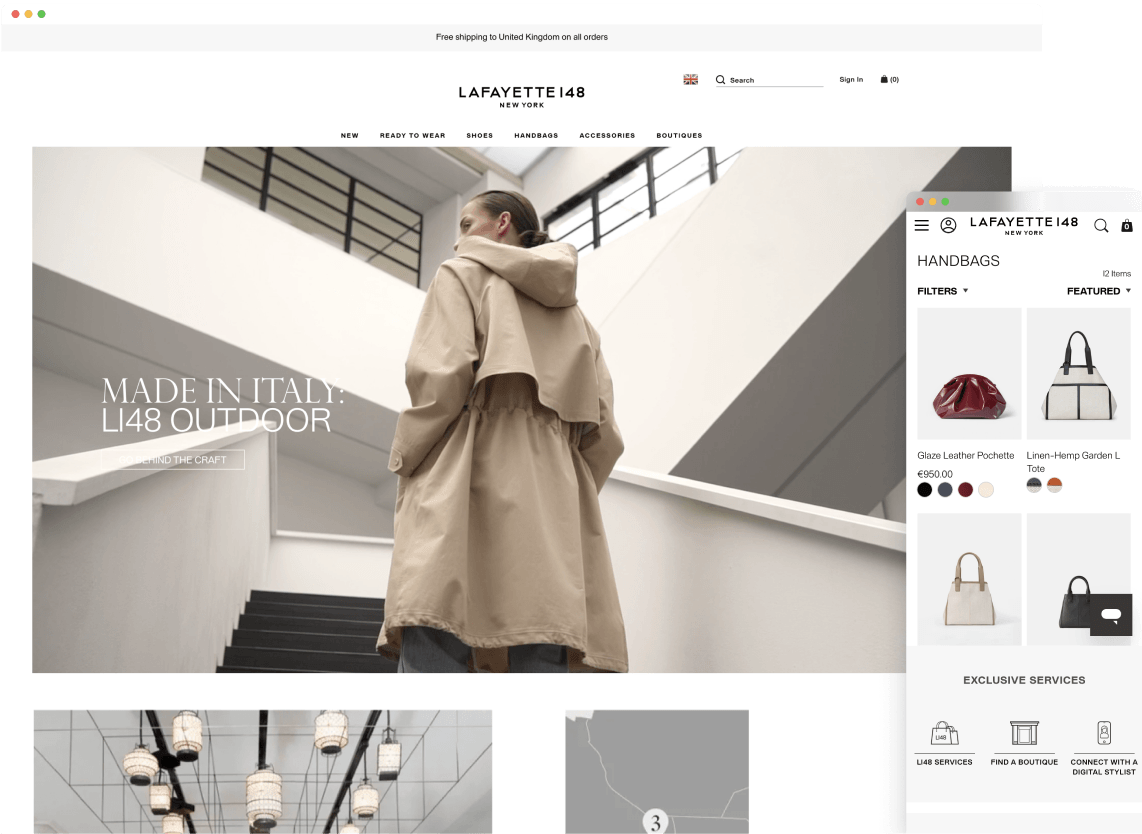
Salesforce Data Cloud for a New York luxury fashion house
A New York luxury fashion house had five years of customer data inside a CDP their team could not reconfigure without vendor tickets, and a contract about to expire.
We rebuilt identity resolution on Salesforce Data Cloud with an AWS pipeline behind it. Targeted email and SMS now drive over 40% of their online revenue, and 85% of revenue comes from customers they already had.
Why choose scandiweb for Salesforce Commerce Cloud
Any agency on your shortlist will claim Commerce Cloud capability. What separates them is who stays accountable when a release breaks, and what happens to the code if you decide to leave.
Official Salesforce partner
Our Salesforce partnership is held at company level, so the partner support channels behind your build belong to scandiweb itself.

ISO 27001, 27017 and PCI DSS
Enterprise procurement asks for these before it asks about price. We hold all three at company level.

600+ in-house specialists
No part of your build is subcontracted. The developers and architects on your project are scandiweb employees.

Only the top talent
The hiring bar of 0.4% of applicants hired is the reason the bench is deep enough to staff a Commerce Cloud project without pulling people off another one.

One accountable Delivery Manager
When a release breaks, you contact one named person who owns the fix, and coverage across 45 countries means it is working hours somewhere.

You own the code
Your cartridges and configuration are yours, and the repository is handed over at the end of the project.
What our clients say

.webp)







.png)
Frequently asked questions about Salesforce Commerce Cloud
What does a Salesforce Commerce Cloud agency do?
A Salesforce Commerce Cloud agency designs your store architecture and builds the storefront, then supports it after launch. Most of the effort goes into the integration layer that connects Commerce Cloud to the ERP or OMS your business already uses. scandiweb handles both halves under one contract.
How long does a Salesforce Commerce Cloud implementation take?
Most Salesforce Commerce Cloud implementations take 4 to 12 months. A single-market B2C storefront on close to standard configuration needs about four. Multi-market catalogs with deep ERP integration push toward twelve. We give you a dated plan after discovery.
How do you customize Commerce Cloud without breaking platform upgrades?
Every change we write sits in an overlay cartridge above the base platform rather than inside it, so a Salesforce release upgrade touches base and leaves your code alone. Where a customization cannot be kept above base, we document why in the handover, because that is the line an inherited build usually fails on.
What does Salesforce Commerce Cloud support include?
Support here means Salesforce release upgrades applied and tested on your instance, security patches, and a named rota with agreed response times. The engineers on it are the ones who wrote your cartridges, and a single Delivery Manager owns any incident from report to fix. Most clients run it as a monthly retainer sized to how often they release.
Do you build on SFRA or the Composable Storefront?
Both. The Salesforce Reference Architecture is the faster path and the one most Commerce Cloud stores still run on, so it suits teams that want a conventional storefront live sooner. The Composable Storefront, built on the React PWA Kit, suits teams with front-end developers who want to own the presentation layer. We recommend one after seeing your team structure and your roadmap, not before.
How much does Salesforce Commerce Cloud development cost?
Salesforce charges its license as a share of gross merchandise value, and that is separate from what the build costs. On the development side the two things that move the number most are how many storefronts you need and how much of the platform you are changing above base. We scope and price in writing after discovery, so you see the range before committing.
Do you work with both B2B and B2C Commerce Cloud?
Yes. Salesforce B2B Commerce Cloud and B2C Commerce are separate products with different data models, and we staff developers on both. The build work differs more than buyers expect: a trade portal needs price books, entitlements and approval rules that a consumer storefront has no concept of, so the two are scoped as separate streams even on one license.
Are your Salesforce Commerce Cloud developers in-house?
Yes. Every developer, architect and QA engineer on your project is a scandiweb employee, from a team of 600+ across 45 countries, and nothing is subcontracted. scandiweb is an official Salesforce partner, and the partnership is held at company level rather than through an individual. You keep the code and the repository at the end of the project either way.

Book a Salesforce Commerce Cloud consultation
Tell us your catalog size and when you want to be live, and we will come back with a scoped plan.

Prefer to talk now? Book a call straight away, or email us at: [email protected]
More resources
Salesforce Commerce Cloud guidance from our team.

.webp)
Related Salesforce services
Need a team to build and run Commerce Cloud? Talk to a Salesforce architect.
Consultations are booked directly with the engineers who would deliver the project.
36 countries worldwide
23+ years in the eCommerce
10+ years leadership