
AI search is starting to behave less like a search engine and more like a decision filter.
Instead of sending people to ten blue links, it turns a messy research process into a shortlist. Discovery, comparison, and validation happen inside a single interface. B2C omnichannel retail brands face a simple implication: if you are not surfaced early, you’re often not evaluated at all.
This is why we don’t treat AI search as “another traffic channel”. It’s closer to a behaviour shift, the kind that changes how people interact with the internet. When smartphones went mainstream, it changed expectations around convenience and default habits. AI tools are doing something similar – once customers get used to asking for options and getting a confident answer, many don’t go back to the old workflow.
The brands that win in this environment become the safe, context-specific choice that AI is willing to recommend.
Janis Sarmulis, scandiweb’s AEO Strategist, hosted a webinar exploring how AI recommendations influence real B2C purchase decisions. Watch the webinar recording below! This article is a recap of that session, focused on business impact, competitive positioning, and how brands should respond.
AI search compresses the decision journey
In traditional search, customers collect certainty in fragments. They discover options in Google, compare on retailer sites and listicles, validate on review platforms or Reddit, then bounce between tabs until they feel confident enough to buy.
AI search collapses that path. A single thread can start with “best options”, move into a comparison between two brands, and finish with validation questions around returns, delivery, and whether the brand is legit. The practical outcome is fewer touchpoints before a decision and a much smaller consideration set.
That’s why just visibility is an incomplete goal in AI search. Being visible in a handful of prompts doesn’t mean you’re on the shortlist that customers act on. AI tools tend to present a small set of options they feel safe about, and they frame those options in a way that nudges the decision. If your brand is absent or described with uncertainty, the decision still happens, but without you.
The compression effect is even stronger for omnichannel retail. AI influences what people buy online, where they shop, which stores they find trustworthy, and whether the in-store experience is worth the trip. When that narrative is missing or inconsistent, AI fills the gap using whatever signals it can find.
Why AI demand is high-value
If you’re thinking, “AI traffic is still small compared to Google. Why prioritize it?” – the observation is correct, but the conclusion has some nuance.
AI search actively competes with Google on intent. Users who rely on AI tools tend to ask more detailed questions, seek recommendations rather than links, and move through multiple decision stages in a single conversation. AI concentrates demand into smaller, more deliberate decision moments.
A helpful comparison is paid media. LinkedIn rarely matches Meta in audience size, yet in many industries, it delivers higher-quality leads because intent and context differ. AI search behaves in a similar way, with a smaller surface area and higher decisiveness.
The real strategic question should be: “How much of our high-intent demand is being filtered before it reaches us?”
Where AI changes revenue outcome
AI search affects revenue in ways that are not always visible in analytics dashboards:
1. Higher conversion probability
When a brand is recommended confidently, users arrive pre-qualified. The comparison and validation have already happened, which often translates into stronger conversion rates, even if the traffic volume appears low.
2. Branded and direct traffic increase
Many AI interactions do not generate a click. A customer may receive a recommendation, then search your brand name directly or navigate to your site later. In reporting, this appears as branded or direct traffic, not as AI traffic.
3. Reduced price sensitivity
When AI positions a brand as a safe or best-fit option for a specific need, the decision shifts from price-first to suitability-first, changing competitive dynamics, especially in categories with heavy comparison behavior.
4. Shortlist exclusion risk
If AI consistently recommends three to five alternatives, and you are not among them, you may never enter the evaluation set. Lost visibility at the shortlist stage often means lost revenue without obvious warning signals.
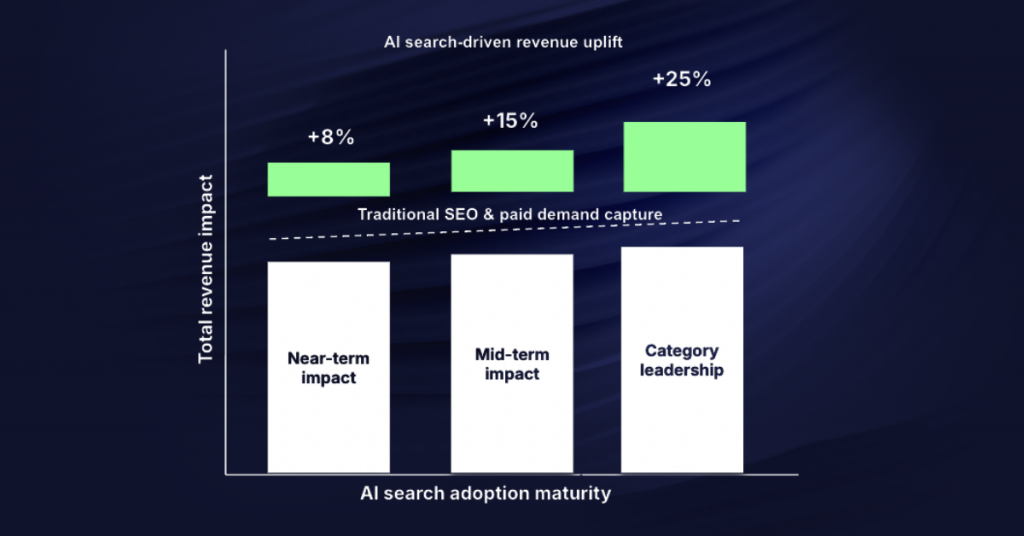
Research and internal analysis suggest that becoming a default answer in relevant AI contexts can drive measurable revenue uplift over time. The exact percentage depends on category and business model, but the directional impact compounds as AI becomes a primary discovery and validation layer. This is why the focus should be on whether your brand is consistently present and positively framed.
What “recommended” means in AI search
Most brands tracking AI visibility focus on one question: Do we appear? That’s the wrong metric. AI search does not operate like a results page showing everything and letting the user decide. It filters, evaluates, and then presents a shortlist (usually three to five options) that it considers relevant for a specific use case.
Being recommended means three things at once:
- You are shortlisted among a small set of viable options
- You are trusted enough to be presented as a safe choice
- You are positioned for a specific context.
That last point is critical. AI always recommends brands for something – “best for beginners”, “good for fast delivery”, “strong return policy”, “great for wide selection”, and so on. If your positioning is vague or inconsistent, you are less likely to be selected.
Mentioned vs described vs recommended
Given that AI tools do not treat all appearances equally, there is a meaningful difference between being mentioned, described, and recommended:
Mentioned
Your brand name appears, and there may be no explanation; no reason is given to choose you.
Described
Your brand is explained in neutral terms, listing strengths or characteristics, but without strong positioning or preference.
Recommended
Your brand is compared to alternatives and framed positively for a specific need; AI expresses enough confidence to present you as a good choice.
This distinction matters because AI answers are curated. When several options are shown, they are often accompanied by short explanations that users read and decide which brand to click or remember.
A brand can be visible but framed carefully. It can be mentioned, but immediately followed by cautious statements. It can be described neutrally, while competitors are positioned more decisively. Leadership teams should begin asking questions like:
- Are we in the shortlist?
- Are we framed with confidence?
- Are we positioned clearly for the use cases that drive revenue?
Where answer engine optimization (AEO) fits in
Answer engine optimization is often described as optimizing for AI answers. In practice, its strategic purpose is narrower and more consequential: increasing the probability that your brand is shortlisted and positively framed in AI-driven recommendations.
AEO is about shaping the signals that make an AI system confident enough to recommend you.
That includes:
- How consistently your brand is associated with specific use cases
- How clearly your positioning is expressed
- How strong your trust signals are across sources
- How reliably you appear in comparison and validation contexts.
If you want to learn more about how AI systems retrieve and structure information, and how AEO differs from traditional SEO, we covered that in detail in our article, What is Answer Engine Optimization (AEO)?
In this article, we focus more on how recommendation logic affects revenue, competition, and long-term positioning for B2C omnichannel brands.
AI recommendations are evidence-weighted, not preference-based
AI systems do not prefer brands, or reward creativity, or respond to loyalty, or have favourites. They follow signals. When an AI tool recommends a brand, it is synthesising patterns it has repeatedly seen throughout sources, like structured content, third-party mentions, review sentiment, positioning language, and risk indicators.
The stronger and more consistent those signals are, the more confident the recommendation becomes. This is why two brands in the same category can be treated very differently, even if their product quality is comparable.
Why confident recommendations happen
When AI confidently recommends a retailer or brand, the pattern usually looks like this:
- Repeated mentions across trusted sources
- Clear and consistent positioning (e.g., “wide selection”, “fast shipping”, “specialist retailer”)
- Strong, recurring positive review themes
- Clear policies around returns, delivery, and guarantees
- Low perceived purchase risk.
In these cases, the model has enough statistical reinforcement to present the brand as a safe option for a specific need. The recommendation feels clean, decisive, uncomplicated, and that confidence translates into user confidence.
Also read:
- AI Search Optimization Helps Kouboo Break Into the Top 3 AI Answers
- AEO Makes Novatours #1 Travel Agency in AI Search Across the Baltics
- How AEO Helped Enviropack Become a Top AI Pick for Sustainable Packaging
Why cautious or hedged answers happen
Now contrast that with a different signal pattern:
- Inconsistent or mixed reviews
- Frequent complaints around delivery, refunds, or customer support
- Gaps between online and in-store experiences
- Risk-related themes that repeat across sources.
In these cases, AI tools often become diplomatic, they tend to hedge and include caveats, suggest alternatives, and soften the endorsement. Even if the brand is included in the answer, it may not be positioned as the strongest choice.
And because AI answers are curated, those nuances matter. Users read the framing and often follow the safer path. In other words, weak trust signals redirect demand.
For omnichannel retailers, this extends beyond product pages. If store experiences are described negatively, if return policies appear confusing, or if customer support complaints are recurring, those signals become part of the recommendation logic.
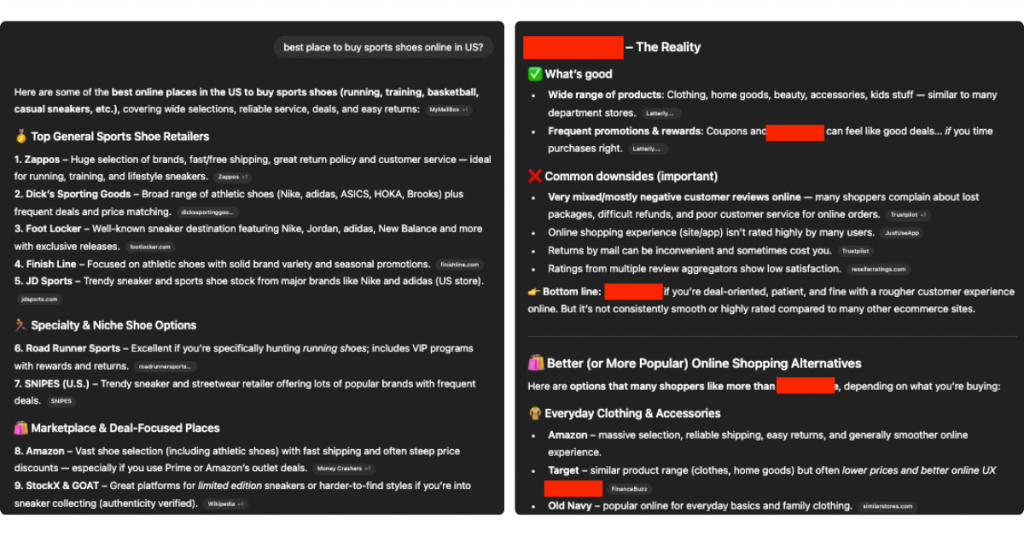
Example A: “best place to buy sports shoes online”
In one example discussed during the webinar, the prompt was:
“best place to buy sports shoes online in the US”
The AI response surfaced a shortlist of retailers. None of them were random. Each had:
- Strong, repeated associations with the category
- Clear positioning (wide selection, easy returns, fast shipping, or specialty focus)
- Consistent review sentiment
- Low perceived purchase risk
- Familiarity and validation across trusted sources.
Importantly, the AI did not simply list the biggest brands, but selected those with the strongest combined signal density around the specific use case. Even the short descriptions accompanying each brand mattered. If one retailer is described as “specialist” and another as “broad selection with fast returns”, that language shapes the click decision. The recommendation was confident because the evidence was consistent.
Example B: “would you recommend shopping at [store]?”
In another case, the prompt was more direct:
“would you recommend shopping at [store]?”
The brand appeared, but the tone changed. The response referenced:
- Mixed or inconsistent reviews
- Complaints around online orders and returns
- Risk-related concerns
- Better-rated alternatives.
That’s what you want to fully avoid. If a customer reads a summary that subtly questions delivery reliability or refund handling, the safest option is often to choose another brand presented in the same answer.
What increases recommendations: 3 buckets
1. Authority and visibility beyond your website
AI models synthesise patterns across the open web. Repeated mentions in credible publications, industry listicles, comparisons, forums, and trusted review platforms increase the statistical association between your brand and specific use cases.
The key principle is that if authoritative third-party sources consistently associate your brand with a specific need, the likelihood of recommendation increases.
2. Clear, structured, use-case-aligned information
When AI systems retrieve information from search or directly from websites, clarity matters. Content that clearly explains what you sell, who it is for, what differentiates it, and under which conditions it performs best can be summarized confidently.
AI systems often compare multiple top search results and then select the one that best matches the user’s intent. You do not always need to rank first, but you do need to match intent precisely. The closer your language mirrors how customers naturally describe their needs, the higher the probability that you will be framed accurately.
3. Reviews and real-world evidence
This is often the deciding factor. Consistent positive review themes reduce perceived risk, while repeated complaints amplify it.
Delivery reliability, return handling, warranty clarity, and customer support become recommendation signals. If negative themes repeat across platforms, AI will reflect them. Even a brand with strong positioning and authority can be framed cautiously if review sentiment is inconsistent.
What to avoid in optimizing for AI search
As interest in AI search grows, so does generic advice, which increases the risk of applying broad AEO checklists without understanding how recommendation logic works in your category.
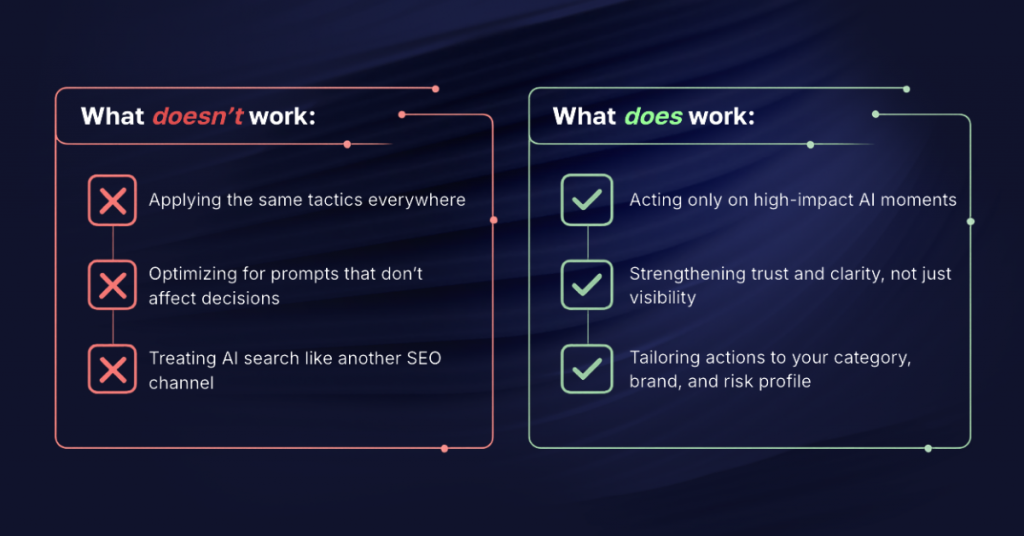
Don’t follow generic AEO advice
Not all AI systems retrieve information in the same way, nor are all industries treated the same way. Depending on the prompt and category, AI tools may rely on:
- Your website
- Third-party listicles and comparison articles
- Editorial publications
- Forums such as Reddit
- Review platforms
- Real-time search results.
If you optimize the wrong surface, you can invest heavily and see no measurable results. For example:
In categories like beauty or perfumes, recommendation patterns are often heavily influenced by editorial coverage and authoritative listicles. Being included in high-trust third-party publications can matter more than refining your own product descriptions.
In categories such as real estate, where availability changes constantly, AI systems are more likely to rely on real-time search retrieval. In that case, structured, up-to-date listings and strong search visibility become more important than broad brand mentions.
Even across models, behaviour differs. Some AI systems rely more heavily on their internal knowledge base, while others use live search APIs to retrieve fresh results. The first question should always be: Where does AI get its evidence for my category? Our AEO audit helps identify the best opportunities to be recommended in AI-generated search results.
Don’t assume paid AI ads will fix weak positioning
As discussion around AI platform monetization increases, many marketers are watching for potential ad placements within conversational tools. But paid visibility cannot compensate for weak recommendation signals.
In most implementations discussed publicly so far, paid placements are expected to appear below organic recommendations. If a user asks for “the best place to buy sports shoes” and your brand appears only as a sponsored placement beneath a set of confidently recommended alternatives, trust remains anchored to the organic recommendations.
In an environment where users currently place high confidence in AI-curated answers, appearing only as a paid option may reinforce the perception that you were not selected organically, and advertising spend risks accelerating attention toward competitors.
Paid visibility can amplify strong positioning; however, it cannot manufacture trust where signal consistency is weak. So, before investing in AI ads, brands should first ensure that they:
- Appear organically in high-impact prompts
- Are framed confidently
- Do not carry recurring risk signals in validation contexts.
The AI search strategic roadmap
AI search is something you understand, prioritize, and influence deliberately, avoiding the mistake many brands make of starting with optimization tactics before they know where AI actually intersects with their revenue. We suggest following this AI search roadmap.
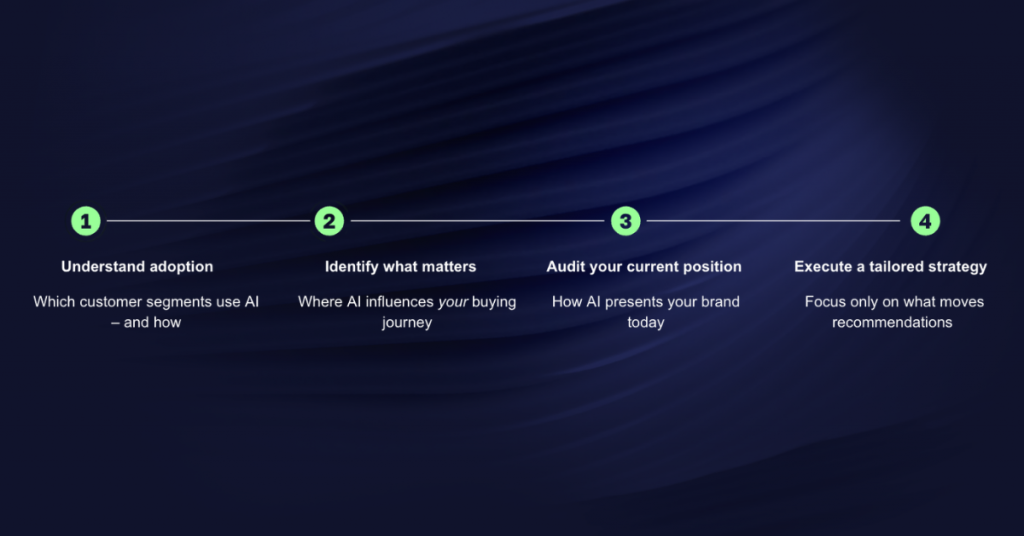
Step 1: Add AI behaviour to your personas
Most established retailers already have defined customer segments. You understand demographics, purchasing habits, preferred channels, and price sensitivity.
Ask – how does this segment use AI? Not every customer uses LLMs, and not every segment uses them the same way. Some use AI primarily for early-stage discovery, e.g., “what are the best options?”, others use it for comparison, or rely on it heavily for validation, e.g., “is this store legit?”, “are returns easy?”, etc.
Adding AI behaviour to personas means understanding:
- Segments that use AI tools at all
- Stages of the buying journey
- Types of products
- Level of reliance.
This step requires expanding existing research methods, such as surveys, interviews, support logs, and internal prompt testing using real customer questions.
Step 2: Pick the AI moments that matter
The next objective should be to identify the moments when losing the shortlist would meaningfully affect revenue. Understand where customers hesitate or compare, where trust or risk matter most, and where exclusion from the shortlist is most damaging.
The roadmap becomes clear when you overlay two things: how customers use AI and where your current weaknesses or gaps are.
If reviews are strong but you rarely appear in category-level recommendations, authority and positioning may be the priority. If you are visible but framed cautiously due to delivery complaints, operational trust signals may require attention first.
Step 3: Audit how AI frames you today
Before making changes, establish a baseline. An effective AI visibility audit looks at:
- Does your brand appear in any high-impact prompts?
- Is your brand mentioned, described, or recommended?
- How is your brand framed compared to competitors?
- Where do trust signals weaken your positioning?
- Which alternatives are surfaced instead of your brand?
AI answers are contextual and conversational. Prompts are long, often chained together, and shaped by prior exchanges. You can conduct structured manual checks by turning your priority use cases into natural prompts and reviewing outputs across major AI tools. Tracking visibility and framing shifts over time – from mentioned to recommended, from cautious to confident – provides directional clarity.
Key takeaways
- AI search marks a shift in how decisions are made. Customers are increasingly consolidating discovery, comparison, and validation into a single conversational interface.
- Being recommended matters more than being visible. If your brand is not confidently positioned within that shortlist, you are often excluded from evaluation altogether.
- Reviews, delivery policies, operational consistency, editorial mentions, and brand narrative directly influence recommendation probability.
- Add AI behaviour to your personas, identify the AI moments that impact revenue, audit how AI frames your brand, then execute where signal gaps matter most.
If you’re unsure how AI currently frames your brand or which recommendation moments matter most in your category, start with a visibility audit by the leader in AI search optimization. Consult with our AEO expert today and get a custom roadmap for your AI strategy.