
- Who builds Magento now? A five-year count of its code, ahead of a record holiday season.
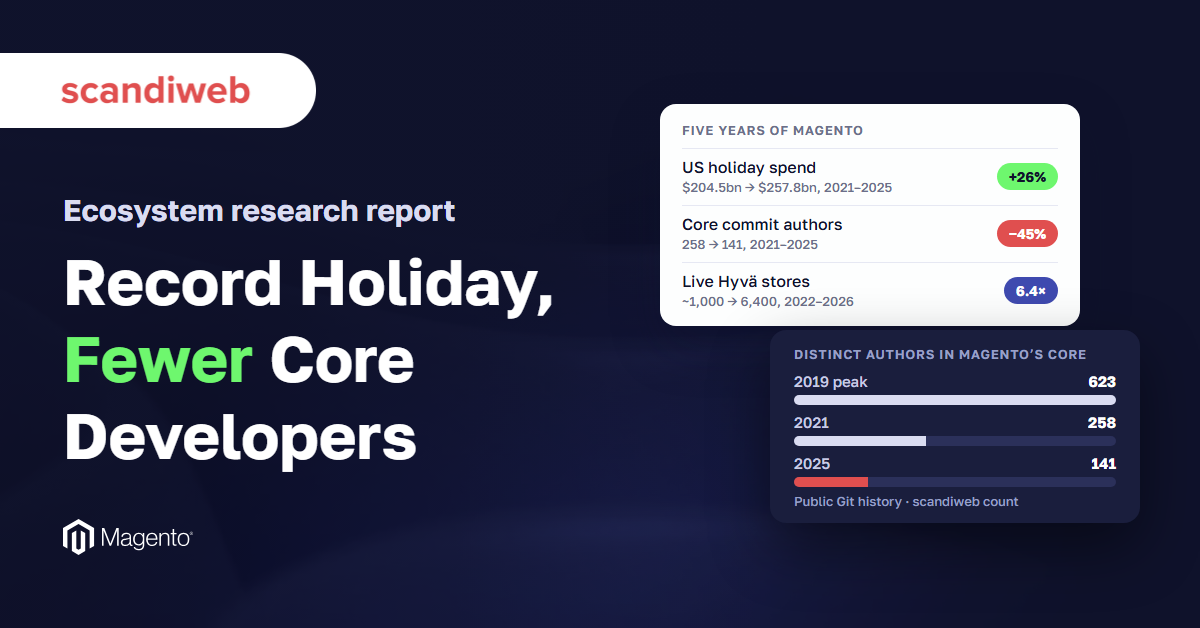
- Holiday spending up 26%, Magento core contributors down 45%
Holiday spending rose 26% from 2021 to 2025. Over the same years, distinct commit authors in Magento Open Source’s public code fell 45%, while partner projects such as Hyvä grew from about 1,000 stores to 6,400.
Riga, Latvia – November 2026. US shoppers are forecast to spend a record $275.1 billion online this holiday season, according to Adobe. More than 100,000 online stores run on Magento, available as the free Magento Open Source and as Adobe’s commercial Adobe Commerce. A review published today by scandiweb, a Latvian eCommerce agency founded in 2003 specializing in Magento, finds two trends over five years. Activity in the platform’s public core declined, while adoption of partner-built projects grew.
scandiweb counted every change in Magento Open Source’s public code history since 2015. It set those counts against five years of Adobe spending data, store counts and the projects partners built around the platform.
Five years, three directions
- Spending went up. US online holiday spending rose 26%, from $204.5 billion in 2021 to $257.8 billion in 2025, Adobe’s figures show.
- Fewer authors committed to the core. Magento Open Source’s public history shows 258 distinct commit authors in 2021 and 141 in 2025, down 45%. At the 2019 peak there were 623. First-time authors fell from 100 to 45. Commits have held between 4,150 and 4,800 a year since 2021, down from 10,821 in 2019.
- Partner projects grew. Live stores on the Hyvä theme rose from about 1,000 in 2022 to 6,400 at the start of 2026. The community-run Mage-OS distribution, founded in 2022, has released four major versions since 2023.
The outside share of core commits fell furthest. Commits from authors with no Adobe-linked email address dropped from about 1,800 in 2021 to about 460 in 2025, from 37% of all commits to 11%. Adobe’s own open-source storefront project, PWA Studio, went from 62 distinct commit authors in 2021 to nine in 2025. Adobe now recommends its Edge Delivery Services storefront for new Adobe Commerce projects.
Partner projects grew over the same period. Hyvä’s main theme repository had 33 distinct commit authors in 2025, almost four times PWA Studio’s. Distinct authors of Mage-OS’s own changes rose from six in 2022 to 27 so far in 2026.
The number of active Magento stores fell 28% over the period, from 161,970 at the end of 2021 to 117,075 at the end of 2025, according to Store Leads.
“Holiday shoppers spend more every year, and Magento still runs many of the stores taking that money,” said Glebs Vrevsky, Executive Board at scandiweb. “In 2019, more than 600 distinct authors committed to Magento’s public core. In 2025 it was 141. Over the same years, partners shipped more of the tools merchants use. Merchants should know who maintains each part of their store before the busiest days of the year.”
What the ecosystem shipped in the past year
In the 12 months to October 2026, partners and the community released open-source tools for most layers of a Magento store:
- Platform, October 2025 to October 2026. The community distribution Mage-OS released 2.0 in October 2025 and 3.0 on 18 May 2026. Version 3.0 is built on Magento 2.4.9, with an interactive installer, returns management and an admin activity log. Version 4.0 followed on 30 October 2026.
- Frontend, November 2025. Hyvä made its theme free and open source on 10 November 2025.
- AI access, October 2025 to 2026. Agencies released open-source modules that let AI agents read a self-hosted store’s catalog and orders, including Magenable and Angeo.
- Server, October 2026. scandiweb released Expedio and made its core open source. Expedio speeds up how Magento builds each page on the server. In scandiweb’s own benchmark of one merchant’s store with every cache empty, category pages were built in 57 milliseconds instead of 181. Results on other stores will differ.
In September 2026, Magento sites built on Hyvä passed all three of Google’s Core Web Vitals on mobile 66% of the time, against 45% for Magento sites overall, according to HTTP Archive data analyzed by scandiweb. The share with a good time to first byte was similar for both, about 23%, against 46% of all websites.
The full review, data and method are available here.
Notes to editors
- Commit and author counts are scandiweb’s analysis of the public magento/magento2 repository (branch 2.4-develop, to 4 November 2026). Commits are counted by author date, with merge commits excluded. Authors are distinct commit authors identified in public Git history, matched by email address and name. That matching is approximate. Adobe develops privately and publishes to GitHub, so the counts cover work that reached the open-source code.
- The split between Adobe-linked and outside authors is also approximate. An author counts as Adobe-linked if any of their addresses is at adobe.com, magento.com or ebay.com, at known Adobe contractor domains (globallogic.com, transoftgroup.com), or is a machine-generated “.local” address. Authors who used only personal addresses count as outside authors, so the outside share may be overstated.
- Spending figures are Adobe Digital Insights totals for US online spending, 1 November to 31 December; 2026 is Adobe’s forecast. Store counts are global. The review shows these indicators side by side; it does not claim one caused another.
- Hyvä store counts are Hyvä’s own published figures. Mage-OS author counts cover only the main fork repository. The September 2026 Core Web Vitals figures are scandiweb’s reading of the HTTP Archive Core Web Vitals Technology Report. The release list is a selection of public announcements, not a complete count. All repository counts can be reproduced from the public repositories.
Disclosure
scandiweb develops Expedio, a server-side page-build tool for Magento mentioned in this release, and offers Magento development services. scandiweb has no commercial relationship with the other tools and vendors named here. scandiweb is an official Adobe Gold Partner.

































Share on: