
For the past decade, most companies building AI systems have relied on the same infrastructure stack: American cloud providers, globally distributed data centers, and proprietary foundation models hosted outside Europe. That architecture is increasingly colliding with a new reality.
Across the European Union, regulation, geopolitics, and procurement requirements are converging around a single idea. Digital sovereignty. The ability to control where data is processed, who operates the infrastructure, and which jurisdictions govern the technology stack is becoming a strategic concern for governments and enterprises alike.
In modern businesses, where AI increasingly processes customer data, internal analytics, operational workflows, and decision-making tools, this shift has direct implications. The critical question is where AI runs and who ultimately controls the infrastructure behind it.
Europe is building a sovereign AI ecosystem
Digital sovereignty has become a central goal of EU technology policy. The concept refers to Europe’s ability to develop and operate digital infrastructure, such as cloud platforms and AI systems, without relying entirely on external providers.
Initiatives include:
- Large-scale investments in European AI infrastructure
- New regulatory frameworks governing data and algorithms
- Policies encouraging the development of European AI ecosystems.
For example, the EU’s broader AI strategy includes significant investment programs designed to expand compute infrastructure and support domestic AI innovation. At the same time, European organizations are placing greater emphasis on control over data and infrastructure, accelerating demand for sovereign AI solutions.
This movement reflects practical concerns about:
- Data protection obligations
- Cross-border data transfers
- Supply chain dependency
- Resilience of critical digital infrastructure.
AI infrastructure choices under EU regulation
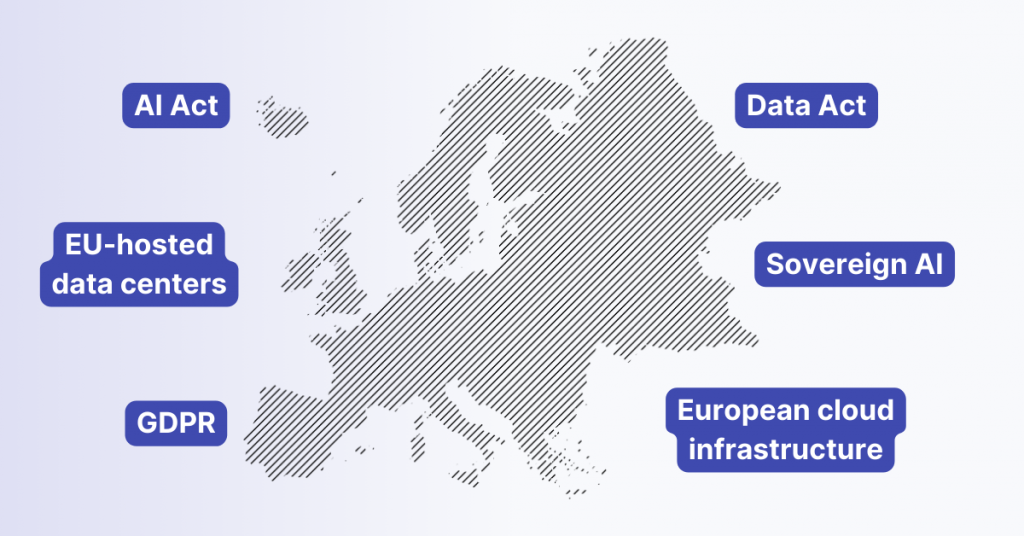
Europe’s regulatory environment is often discussed in isolation – GDPR here, the AI Act there, but the real shift emerges when these frameworks are considered together. Several key regulations impact how AI systems can operate in Europe.
GDPR – sovereignty over personal data
The General Data Protection Regulation governs the collection, processing, and transfer of personal data. Its extraterritorial scope means companies operating in the EU must ensure lawful processing and adequate protection even when data moves across borders.
For AI systems trained on customer behavior, product interactions, or marketing analytics, this has direct implications for where training and inference workloads can occur.
The EU AI Act – sovereignty over algorithms
The AI Act introduces a risk-based framework for AI systems. AI applications are categorized by risk level, ranging from minimal to unacceptable, with higher-risk systems subject to strict requirements around transparency, monitoring, and governance. Companies deploying AI within the EU must ensure that models and systems comply with these obligations regardless of where the technology originates.
Also read:
EU AI Act for eCommerce: 10 Questions Every Business Is Asking Right Now
The Data Act – sovereignty over data flows
Additional regulations, including the Data Act and the Data Governance Act, address how data can be accessed, shared, and transferred across jurisdictions.
Together, these policies reflect a broader strategy of ensuring that European data and algorithms operate under European legal control.
What this means for eCommerce
If you are responsible for technology in an eCommerce business, AI has likely already become part of your platform architecture.
You may be using AI for:
- Product recommendations and personalization
- Pricing optimization
- Demand forecasting
- Fraud detection
- Customer support automation
- Marketing segmentation and targeting.
All of these systems process large volumes of customer and behavioral data, often continuously.
If your AI stack relies on external providers, you may need to consider several risks:
- Customer data leaving EU jurisdiction
- Dependency on external cloud providers
- Unclear regulatory exposure when models are trained or hosted outside Europe
- Additional scrutiny when working with enterprise or public-sector clients.
These concerns are becoming particularly relevant if your company sells to regulated industries or works with government organizations. In those environments, AI infrastructure decisions are increasingly evaluated through the lens of data residency, security, and regulatory compliance. More companies are beginning to assess where those AI systems run and who controls the underlying infrastructure.
Sovereign AI is becoming a procurement requirement
If you are selling to enterprise clients, regulated industries, or the public sector, AI infrastructure is starting to appear in procurement reviews. In addition to performance and features, buyers increasingly ask vendors to demonstrate:
- EU data residency
- Transparent AI governance
- Infrastructure independence from foreign jurisdictions
- Secure and controlled deployment environments.
This means AI architecture decisions can affect whether your company is eligible for certain contracts in the first place. Organizations that cannot clearly demonstrate where their AI runs, how customer data is handled, and which jurisdiction governs the infrastructure may face additional scrutiny during vendor evaluation or be excluded from procurement processes altogether. As a result, more companies are beginning to explore sovereign AI architectures that keep data, models, and infrastructure within European control.
Three deployment models for sovereign AI
Organizations approaching AI sovereignty typically adopt one of three architectural models (they differ primarily in how data moves and where processing occurs).
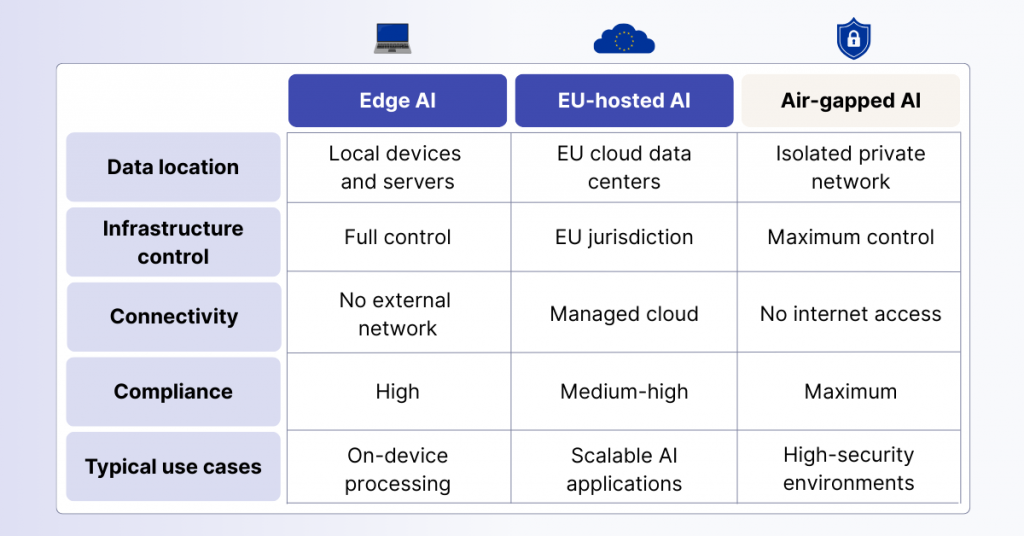
1. Edge AI: processing on-device
In edge deployments, AI models run directly on devices or local systems. Examples include:
- Recommendation models in commerce platforms
- Fraud detection systems in payments or financial systems
- AI assistants embedded into internal business tools.
The data never leaves the local environment, there are minimal external dependencies, and strong privacy guarantees. However, edge deployments often require smaller models and limited compute resources.
2. EU-hosted AI infrastructure
A second approach involves hosting AI workloads in European data centers operated within EU jurisdiction, balancing scalability and regulatory compliance while preserving access to larger models and compute capacity. In this model:
- Data processing occurs within EU-hosted cloud environments
- Infrastructure providers comply with European data protection frameworks
- Cross-border data transfers can be minimized or eliminated.
3. Air-gapped sovereign AI
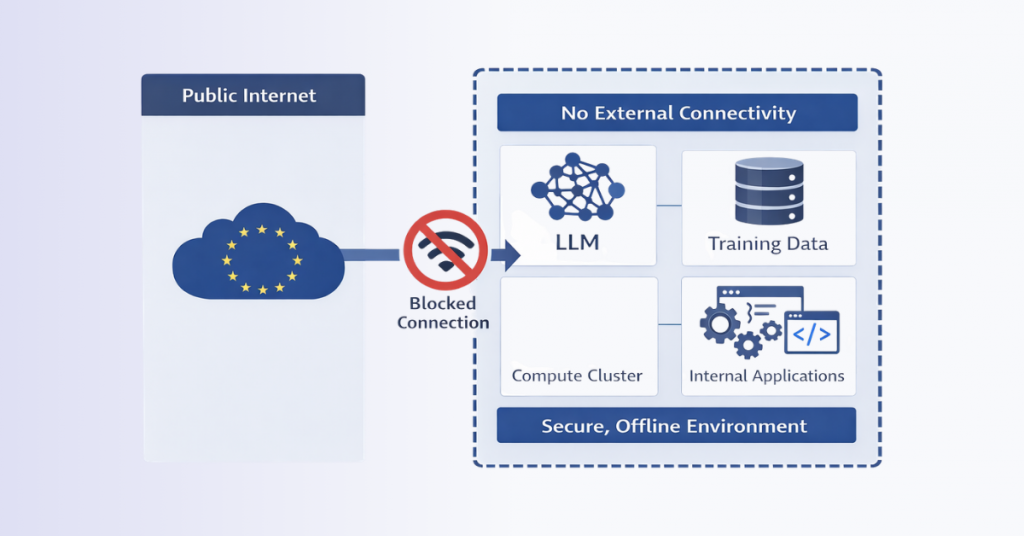
The most secure architecture involves air-gapped AI systems commonly used in government systems, defense and critical infrastructure, and financial services and regulated industries. While more complex to implement, this architecture provides the highest level of control over data residency and system integrity:
- Infrastructure operates in a completely isolated network
- Systems are disconnected from public internet access
- Models and data remain fully contained within the organization’s environment.
Implementing sovereign AI in practice
Building sovereign AI systems requires a combination of infrastructure design, compliance expertise, and model engineering.
Typical implementation components include:
- EU-hosted compute infrastructure
- Open-source or locally deployed LLMs
- Secure data pipelines and storage
- Audit and monitoring frameworks
- Integration with existing digital systems, including eCommerce platforms, analytics environments, and internal business tools.
How scandiweb supports sovereign AI deployments
As AI becomes a core layer of digital commerce infrastructure, you need a partner who understands AI architecture and regulatory constraints, allowing you to adopt AI capabilities while maintaining full control over customer data, infrastructure, and compliance obligations.
scandiweb works with organizations to design and deploy sovereign AI environments tailored to their requirements, including:
- EU-hosted AI infrastructure for data-residency compliance
- Private LLM deployments integrated with eCommerce platforms
- Air-gapped AI systems for highly regulated environments
- AI-powered commerce tools running within controlled infrastructure.
The future of AI infrastructure in Europe
Europe is defining an AI model built around transparency and governance. AI infrastructure decisions are becoming strategic, encompassing sovereignty, compliance, and long-term market access.
Organizations that adapt their architecture early will be better positioned to work with enterprise clients and regulated industries as the sovereign AI processes continue to grow.
If you are evaluating how to deploy AI, scandiweb can help design and implement sovereign AI solutions tailored to your business architecture. Contact our AI consultants to learn more about sovereign AI and EU-hosted LLM solutions.


Share on: