
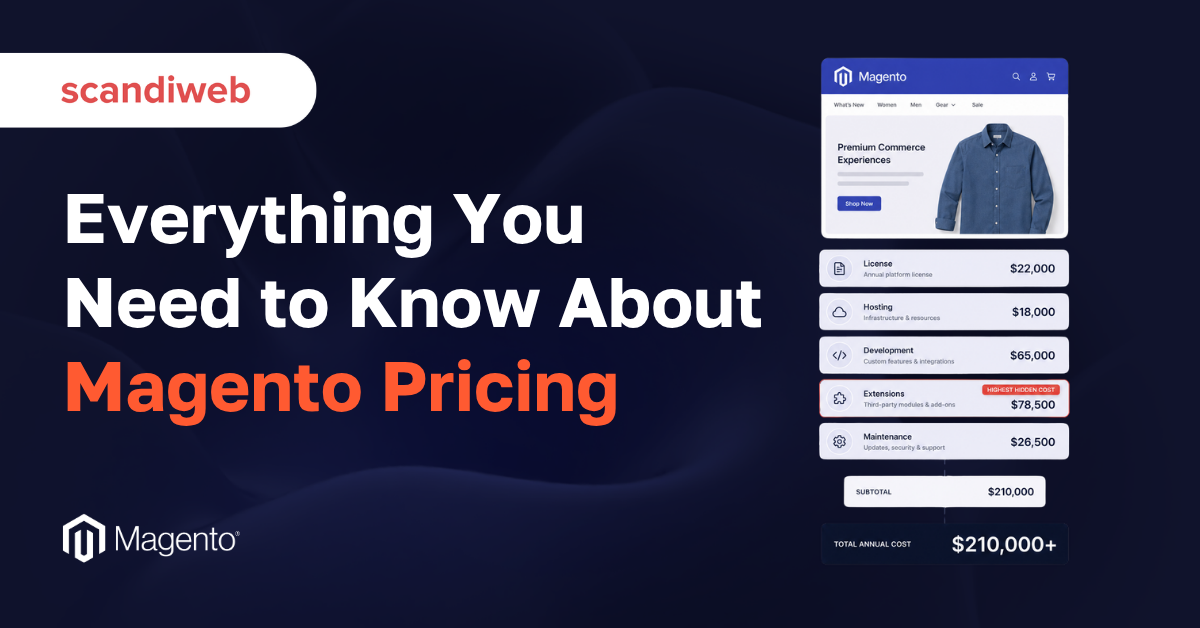
Everyone fixates on the license fee. The first question in almost every Magento pricing conversation is “what does Adobe charge per year,” as if that number settles the matter. It does not. The license is often the most predictable, and sometimes the smallest, line on a five-year Magento budget. The real cost of running Magento (now Adobe Commerce) is somewhere else entirely: in hosting, in the development hours behind every custom feature, in the extensions and integrations that make the store actually work, and in the maintenance that keeps it secure and fast long after launch.
This guide breaks down the full total cost of ownership of a Magento store for 2026, with realistic ranges and the sources behind them. It is written for heads of eCommerce, CFOs, and founders trying to size a real budget. By the end, you will know where the money actually goes and how to map your own numbers.
🚀 Quick takeaway
Magento Open Source has no license fee, and Adobe does not publish Adobe Commerce license prices at all. The number that actually decides your budget is total cost of ownership: hosting, build, extensions, integrations, and ongoing maintenance. For a serious mid-market store, plan for a six-figure first year and a recurring annual run rate in the tens of thousands, with the license being only one part of it.
Magento pricing starts with the edition: Open Source vs Adobe Commerce
Magento comes in two editions, and they start from very different places. Magento Open Source is genuinely free to download and use, with no license fee, ever. Adobe Commerce (formerly Magento Enterprise) is a commercial, licensed product with added B2B tooling, advanced merchandising, AI-driven product recommendations, and Adobe support baked in.
The mistake is reading “free” as “cheap.” Open Source removes a license invoice, but every other cost category below still applies in full. You still pay for hosting, you still pay for the build, and you still pay for security patching. We cover the feature-by-feature differences in depth in our guide on Adobe Commerce vs Open Source, so this article focuses on the money rather than the feature list.
It also helps to separate two things that often get blurred. One is the edition decision, which is a question of features and license model. The other is the deployment decision, which is a question of who runs the infrastructure. Adobe Commerce can run on your own servers (on-premises) or on Adobe Commerce Cloud, and that choice changes both your hosting line and your license band. We unpack that trade-off in detail further down, because it is one of the biggest swings in any Magento pricing exercise.
Does Adobe publish Adobe Commerce pricing?
No. Adobe does not publish Adobe Commerce license prices publicly and never has. Every figure you see online is an estimate compiled by partners and agencies from real quotes, and the actual number requires a direct conversation with Adobe sales.
Adobe Commerce uses a custom, success-based license tied to your annual Gross Merchandise Value (GMV), the total value of goods sold through the store. The more you sell, the higher the tier. Because Adobe quotes privately, the only honest way to talk about these numbers is as ranges drawn from aggregated partner data, which is exactly how we present them below.
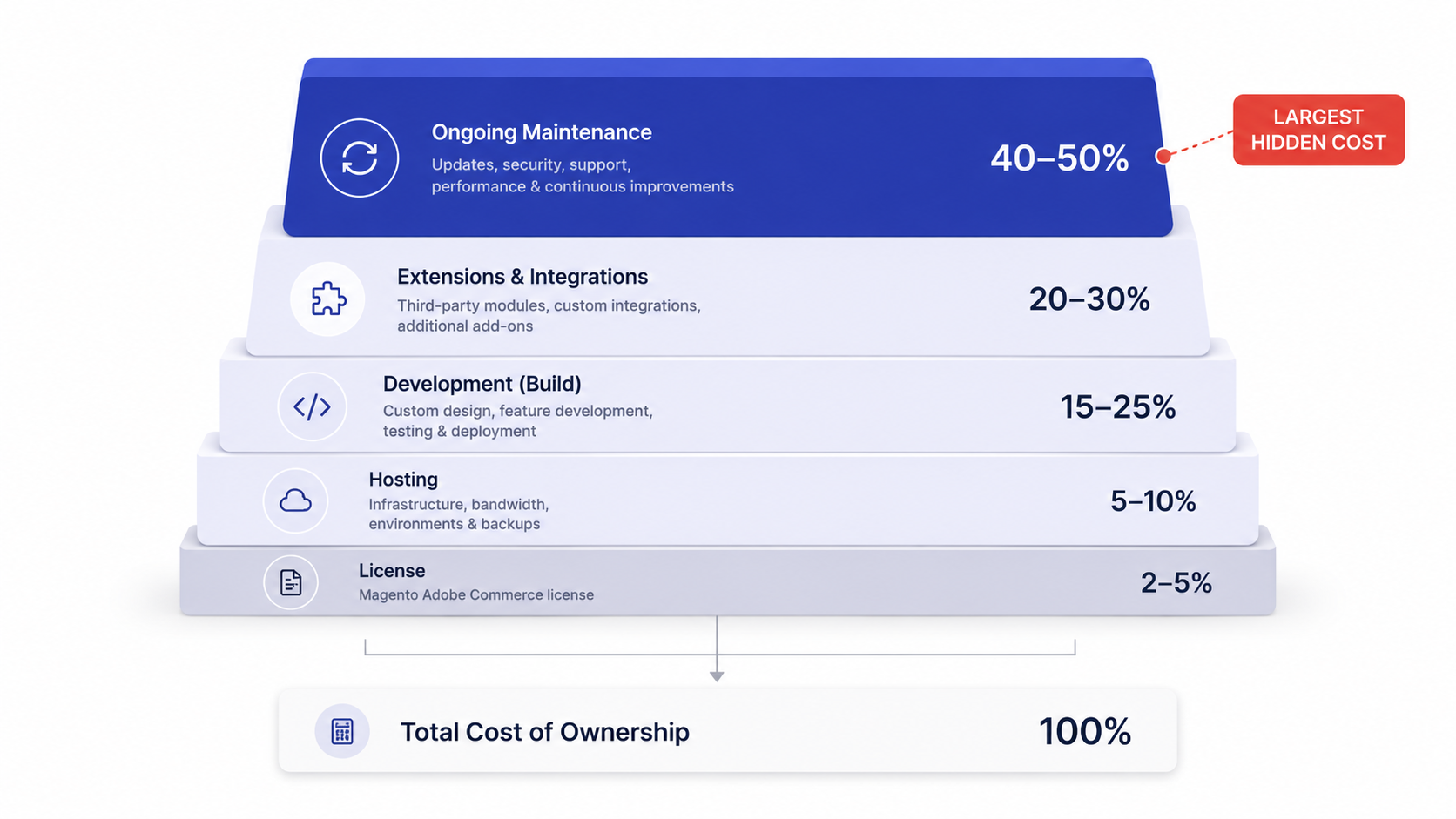
The seven cost categories that make up Magento total cost of ownership
A realistic Magento budget is the sum of seven moving parts. Treating any one of them as the whole picture is how stores end up underfunded six months after launch. Here is each category with a current range and the reasoning behind it.
1. License (the part everyone overweights)
Magento Open Source: zero. Adobe Commerce: estimated, based on aggregated 2026 partner data, at roughly $22,000 to $125,000 per year for the on-premises license and roughly $40,000 to $190,000 per year for Adobe Commerce on Cloud, which bundles managed infrastructure. These bands scale with GMV.
To put the tiers in context, the on-premises estimates that circulate among Adobe partners run from under $22,000 for stores below $1M GMV up to around $125,000 for stores past $25M GMV, per Webkul’s published edition breakdown. Treat these as planning anchors, not quotes. Your real figure depends on your GMV band, your environment, and what you negotiate.
One nuance that trips up budgets: the license is billed annually and rises as you grow, so it is not a fixed cost you can model once and forget. A store that crosses a GMV threshold mid-contract can see its renewal step up sharply. When you compare Adobe Commerce to the apparent zero of Open Source, you are really comparing a predictable, growing subscription against a set of capabilities you would otherwise have to build and maintain yourself. The right answer is rarely about the license number in isolation.
2. Hosting and infrastructure
Magento is resource-hungry, so shared hosting is not an option for a real store. For Magento Open Source on a managed VPS or cloud setup, plan for roughly $1,200 to $7,000+ per year depending on traffic and catalog size. Adobe Commerce on Cloud folds hosting into the license, which is part of why the cloud tier costs more.
Where many budgets go wrong is treating hosting as a commodity line. Magento performance under real traffic depends heavily on infrastructure tuning, caching, and CDN setup, which is its own discipline. If you want the speed without owning the operations, managed hosting and DevOps built for Magento removes most of that risk.
It also helps to think in tiers rather than a single number. A low-traffic catalog store can run comfortably on a tuned single-server setup at the bottom of that range. A store with seasonal traffic spikes, a large catalog, and dozens of concurrent admin users needs autoscaling, a read replica, dedicated cache nodes (Redis or Valkey), and a proper CDN, which pushes the annual figure toward and past the top of the range. Peak events like Black Friday are where under-provisioned stores either pay for emergency capacity or lose revenue to downtime, so the cheapest hosting line on paper is frequently the most expensive one in practice.
3. Development and the initial build
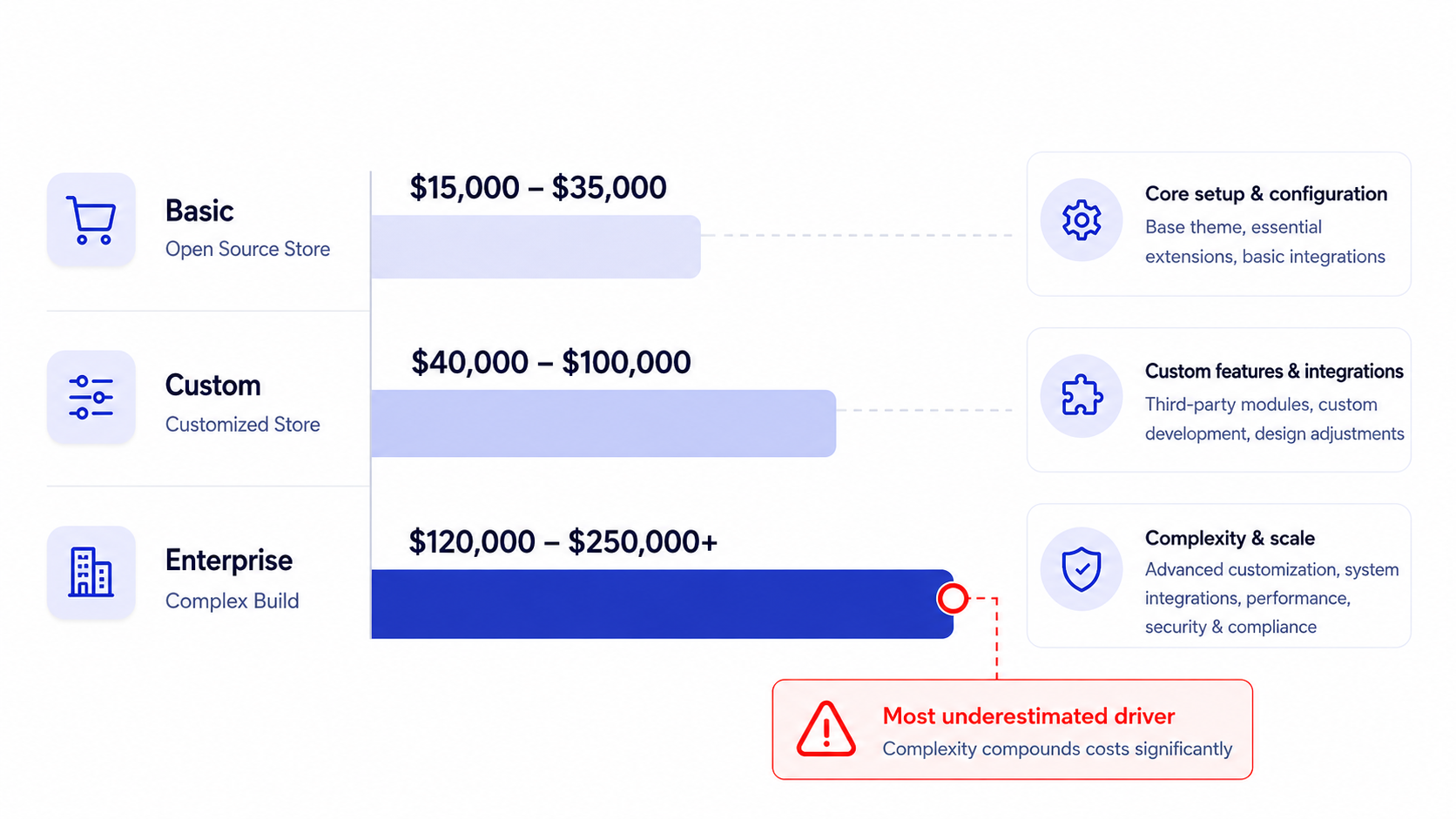
This is usually the single largest line in year one. For an Open Source build, the market consensus across 2025 and 2026 pricing guides (Elementor, Hostinger, magestore) lands around $20,000 to $60,000 for a straightforward store, $60,000 to $150,000+ for a heavily customized site, and $100,000 to $500,000+ for complex enterprise builds with deep ERP or CRM integration.
The driver is not the platform, it is your requirements. A clean catalog with standard checkout is one thing. Bespoke pricing logic, multi-store setups, headless front ends, and custom B2B workflows are another. Hourly rates vary widely by region, from roughly $40 per hour in parts of APAC to $125+ per hour in North America, which is why the same scope can carry very different invoices.
A practical way to read the build estimate is to break it into work streams rather than one lump sum. A typical mid-market build splits roughly into discovery and architecture, theme and front-end implementation, custom module development, third-party integrations, data migration, and quality assurance. The integration and QA streams are the ones most often underestimated, because they scale with the number of external systems and the messiness of the source data. A store with a clean product feed and two integrations will land near the bottom of its band, while the same visual scope with a legacy ERP, dirty SKUs, and five integrations can double the hours without changing a single pixel of the design.
4. Theme and front-end
You can launch on a pre-built theme for $0 to a few hundred dollars, but most serious brands invest in custom design. A custom Magento theme typically runs $0 to $5,000+ for a template-based approach and well into five figures for a fully bespoke, conversion-focused front end, often 40 to 160+ design and build hours.
The front-end decision also touches performance. Modern stacks like Hyvä themes are popular precisely because they cut page weight and improve Core Web Vitals, which feeds directly into both conversion and search rankings. The design spend is rarely just aesthetic, it is a revenue lever.
There is also a long-term cost angle here that rarely makes it into a first quote. A heavily customized default Luma theme accumulates technical debt and gets more expensive to maintain through Magento upgrades, while a leaner modern front end tends to upgrade more cleanly. Choosing the front-end architecture is therefore as much a maintenance decision as a design one, and it is worth pricing both the build and the five-year upkeep before you commit.
5. Extensions
Individual Magento extensions commonly cost $60 to $600 each, and a real store runs many of them: search, reviews, advanced pricing, marketing automation, tax, and more. Premium or subscription-based extensions add recurring fees on top of the one-time purchase.
The hidden cost here is not the license, it is compatibility. Every extension has to be tested against your version of Magento and against every other extension, and conflicts surface during upgrades. Budget for the integration and QA time, not just the sticker price of each module.
A useful discipline is to treat every extension as a recurring liability, not a one-time purchase. Each module you add is something that has to be re-tested on every platform upgrade, may need its own paid support contract, and can block a security patch if its vendor is slow to update. Stores that keep a tight, well-justified set of extensions spend far less over five years than stores that install a new module for every minor requirement, even when the upfront sticker prices look similar.
6. Integrations
Most mid-market stores connect Magento to an ERP, a CRM, a PIM, a tax engine, payment gateways, and a marketing stack. Each connection is custom work, and complex ERP integrations alone can run from several thousand to well into five figures depending on the system and the data flows.
Payment processing also belongs here as an ongoing cost. Gateways typically charge around 2.9% plus $0.30 per transaction, which at scale becomes one of the larger recurring numbers on the entire budget, often dwarfing the license. If your architecture is integration-heavy, planning the integrations layer early prevents expensive rework later.
The figure that surprises finance teams is payment processing, so it is worth making it concrete. A store doing $5M a year in card sales pays around $145,000 annually in processing at a blended 2.9%, before you add gateway monthly fees, fraud tools, and chargeback handling. That single recurring line can exceed the entire Adobe Commerce license, which reframes which numbers actually deserve negotiation attention. Reducing processing cost through better gateway terms or alternative payment methods often returns more than squeezing a development quote.
7. Ongoing maintenance and support
This is the category most often missing from a first budget, and it never ends. Magento needs regular security patching, version upgrades, performance monitoring, bug fixes, and feature work. Across 2026 pricing guides, ongoing maintenance and support commonly runs from around $4,000 per year for a small Open Source store to $50,000+ per year for an active, business-critical Adobe Commerce store.
Skipping maintenance is not a saving, it is deferred risk. Unpatched Magento stores are a known target, and a single security incident or a broken checkout during peak season costs far more than a year of support. A predictable support and maintenance plan turns that risk into a fixed monthly line you can plan around.
Maintenance also splits into two distinct budgets that are easy to conflate. The first is keep-the-lights-on work: security patches, version upgrades, monitoring, and bug fixes that protect the store you already have. The second is evolution: new features, optimization, and experiments that grow revenue. Healthy stores fund both. Stores that fund only the second eventually pay for the first all at once, in the form of an emergency upgrade project after they fall several versions behind and patches stop being straightforward.
Adobe Commerce Cloud vs on-premises hosting: which costs less?
Adobe Commerce Cloud bundles hosting, CDN, and managed infrastructure into a higher license fee, while on-premises Adobe Commerce keeps the license lower but leaves hosting and operations to you or your agency. Cloud is rarely cheaper on paper, but it can be cheaper in total once you account for the operations work you no longer have to staff.
The trade-off is real and worth modeling rather than assuming. On-premises gives you control: you choose the provider, you tune the stack, and you can often run leaner infrastructure for a given workload. The cost is that someone has to own that infrastructure, including incident response, scaling for peak, and the DevOps expertise to keep it fast. For a team that already has, or can buy, strong managed hosting, on-premises frequently wins on total cost.
Adobe Commerce Cloud earns its premium for teams that do not want to run infrastructure at all. The higher license folds in hosting, Fastly CDN, and a managed platform, which removes a whole hiring problem and a category of risk. The watch-out is that you are buying convenience at a fixed margin, and you have less freedom to optimize the underlying stack. The honest answer is that neither is universally cheaper. The right choice depends on whether running infrastructure is a strength you want to own or a cost you would rather outsource.
When does on-premises make financial sense?
On-premises tends to win when you have predictable traffic, in-house or agency DevOps capacity, and a desire to control infrastructure cost directly. It rewards teams that can keep the stack tuned and right-sized rather than paying for managed convenience.
Cloud tends to win when peak traffic is spiky and hard to predict, when you have no appetite to staff infrastructure operations, and when the simplicity of a single Adobe relationship is worth a premium. For many growing mid-market brands the deciding factor is not the spreadsheet, it is whether they want to be in the hosting business at all.
A worked Magento TCO example over five years
Ranges are useful, but a single worked example makes the total cost of ownership concrete. Consider a mid-market brand doing roughly $8M in annual GMV, moving from a dated platform to a customized Magento Open Source store with two integrations (an ERP and a marketing stack), managed hosting, and a fixed maintenance plan. The numbers below are illustrative planning figures, not a quote, but they show how the categories stack up across five years.
Year one carries the heavy one-time spend: a customized build at around $90,000, a custom front end at around $25,000, initial extensions and integration work at around $35,000, plus hosting and first-year maintenance. That puts year one near $170,000. Years two through five are dominated by recurring lines: hosting at around $5,000, maintenance and support at around $30,000, and incremental feature work at around $20,000 a year, which lands each of those years near $55,000.
Across five years the Open Source path totals roughly $390,000, with the build representing under half of it and recurring operations representing the rest. Notice what is absent: there is no license line at all. Now model the same store on Adobe Commerce on-premises. Add a GMV-tiered license at roughly $50,000 a year, which is $250,000 over five years, and the total moves to around $640,000. The build and operations barely change. The license is the swing factor, and it buys native B2B, advanced merchandising, and Adobe support that the Open Source store would otherwise approximate with extensions and custom work.
The lesson from the worked example is not that one path is right. It is that the build, which dominates the first conversation, is under half of the five-year number, while hosting, maintenance, payment processing, and (on Adobe Commerce) the license make up the majority. Any Magento pricing decision made on the year-one build alone is being made on a minority of the real cost.
| Cost category (annual unless noted) | Open Source store | Adobe Commerce store |
|---|---|---|
| License | $0 | ~$22,000 to $190,000+ (GMV-tiered, est.) |
| Hosting and infrastructure | ~$1,200 to $7,000+ | Bundled in cloud license |
| Initial build (one-time) | ~$20,000 to $150,000+ | ~$60,000 to $500,000+ |
| Theme and front-end (one-time) | ~$0 to $25,000+ | ~$5,000 to $40,000+ |
| Extensions and integrations | Varies widely, often $5,000 to $50,000+ | Varies widely, often $10,000 to $80,000+ |
| Maintenance and support | ~$4,000 to $25,000+ | ~$15,000 to $50,000+ |
What does a realistic Magento budget look like over time?
A serious mid-market Magento store typically costs a six-figure sum in year one (build plus license plus setup) and a recurring annual run rate in the tens of thousands after that for hosting, maintenance, and license. The exact figure depends entirely on edition and complexity.
The table above pulls the category ranges into two store profiles. These are planning estimates synthesized from current 2025 and 2026 pricing guides, not quotes, and your numbers will move based on scope, region, and negotiation. The most reliable way to use them is to place your own store in a band for each row, then sum the realistic case rather than the best or worst case for every line at once.
Is Magento still worth the cost in 2026?
Yes, for the right store. Magento is built for catalog complexity, multi-store and multi-region operations, deep B2B workflows, and total control of the customer experience, which is exactly what high-volume and complex brands need and what cheaper SaaS platforms struggle to deliver.
The “is anyone still using Magento” anxiety is understandable. BuiltWith and Store Leads data through 2025 show the live store count declining from prior peaks, with various trackers placing it somewhere in the 100,000 to 130,000 range and trending down year over year. That is real, but it is not the same as the platform dying. We unpack the actual numbers and what they mean in our analysis of whether is Magento dying, and the short version is that it remains a strong fit for complex, high-GMV commerce.
The more useful framing is fit, not survival. If your requirements are simple, a SaaS platform may be cheaper to run, which is why the Magento vs Shopify comparison matters before you commit. If your requirements are genuinely complex, Magento’s cost buys flexibility you cannot easily get elsewhere.
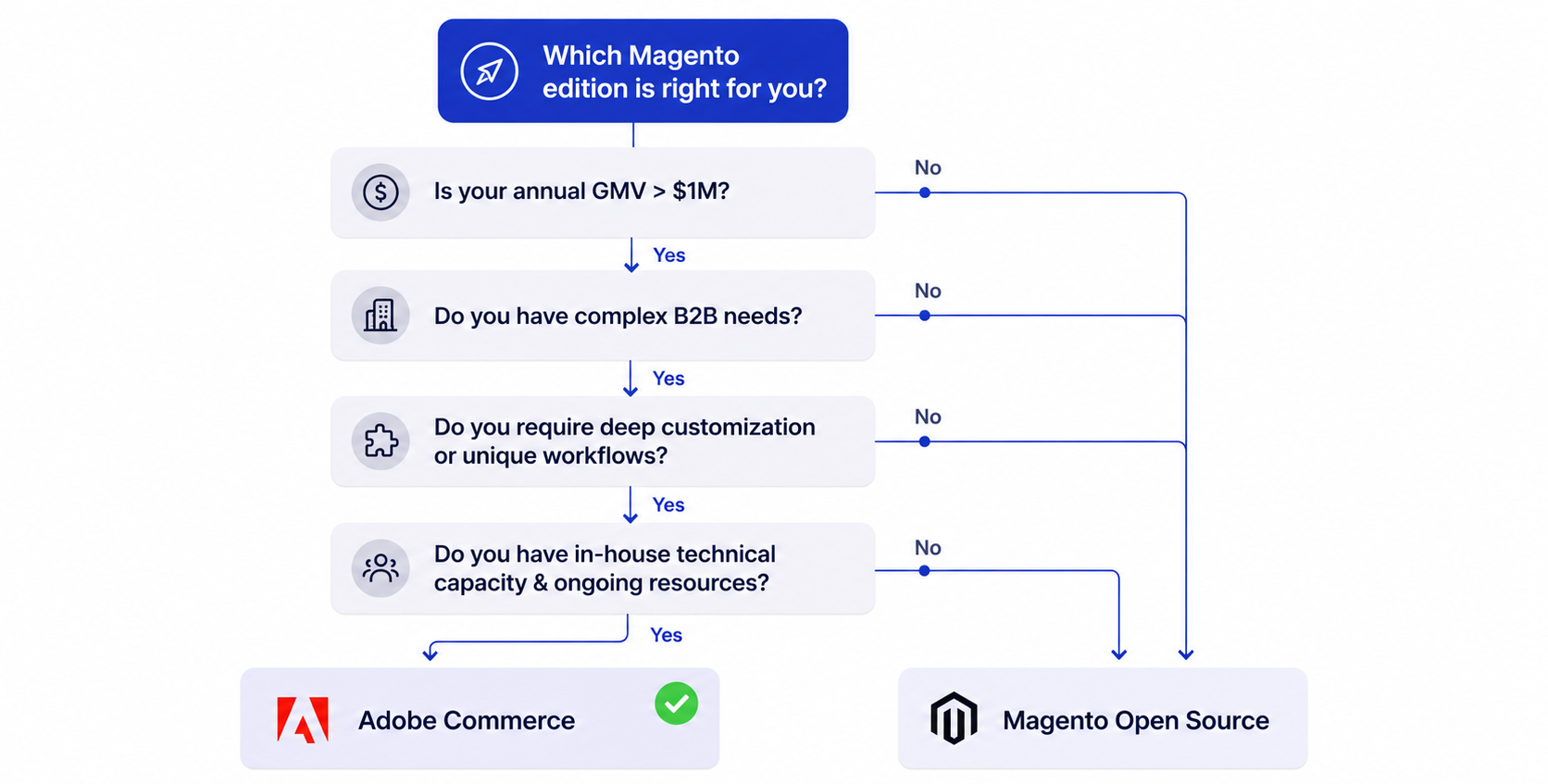
The hidden costs most Magento budgets miss
The published cost categories are the easy part. The numbers that surprise merchants are the ones nobody quotes upfront. Watch for these.
- Developer scarcity. Skilled Magento developers are getting harder to find, which pushes up both agency rates and the time to hire in-house, a point raised repeatedly by merchants in the r/Magento community.
- Upgrade and patch cycles. Major version upgrades are projects in themselves, not free updates, and they recur on Adobe’s release cadence.
- Extension conflict resolution. The QA time to keep a stack of modules working together rises with every extension you add.
- Re-platforming or migration debt. If you are coming from a legacy platform or moving between Magento versions, the one-time migration is its own line. Plan it as a real project rather than treating it as a side task.
- Performance and SEO remediation. A slow store quietly costs conversions and rankings, and fixing it after launch is more expensive than building it right.
- Internal team time. Discovery workshops, content and catalog preparation, user acceptance testing, and training all consume your own staff’s hours, which is a real cost even when it never appears on an agency invoice.
How to control the true cost of running Magento
You cannot make Magento cheap, but you can make it predictable. A few decisions move the total cost of ownership the most.
First, choose the edition on fit, not fear. Open Source plus a strong agency covers a large share of mid-market needs without a license bill, while Adobe Commerce earns its fee when you genuinely need its B2B and merchandising depth. Second, scope ruthlessly: every custom feature is a build cost and a forever maintenance cost. Third, budget maintenance from day one as a fixed line, not a surprise.
A fourth lever is phasing. Trying to launch every feature at once inflates the year-one build and delays revenue. Launching a strong core store, then funding enhancements from the revenue it generates, spreads cost over time and lets real customer behavior guide where the next dollar goes. This is often the single biggest difference between a budget that holds and one that doubles.
Finally, the partner you choose moves the number more than any single line item. A strong agency reduces rework, writes clean code that is cheap to maintain, and prevents the expensive mistakes that bloat year-two budgets. If you are weighing options, our roundup of Magento development companies is a useful place to start.
Frequently asked questions about Magento pricing
Is Magento free?
Magento Open Source is free to download and use, with no license fee. Adobe Commerce is a paid, licensed product. In both cases you still pay for hosting, development, extensions, and maintenance, so no Magento store is truly free to run.
How much does Adobe Commerce cost per year?
Adobe does not publish prices. Based on aggregated partner data for 2026, the on-premises license is estimated at roughly $22,000 to $125,000 per year and the cloud license at roughly $40,000 to $190,000 per year, scaling with your GMV. The only accurate figure comes from an Adobe quote.
How much does it cost to build a Magento website?
A straightforward Open Source build commonly runs $20,000 to $60,000, a customized store $60,000 to $150,000+, and a complex enterprise build $100,000 to $500,000+. The driver is the depth of customization and integration, not the platform itself.
Is Magento more expensive than Shopify?
Usually, yes, at the entry and mid levels, because Magento carries more development and maintenance overhead. The trade-off is control and flexibility. For complex catalogs, B2B, and multi-store needs, Magento can be more cost-effective than forcing those requirements onto a SaaS platform.
What is the cheapest way to run a Magento store?
Magento Open Source with efficient managed hosting, a lean theme, a tight set of well-tested extensions, and a fixed maintenance plan is the most cost-controlled route. The savings come from disciplined scope, not from cutting maintenance.
What is Magento’s total cost of ownership?
Total cost of ownership is the full multi-year sum of license, hosting, build, theme, extensions, integrations, maintenance, and any migration, not just the license. For a serious mid-market store, expect a six-figure first year and a recurring annual run rate in the tens of thousands.
Does anyone still use Magento in 2026?
Yes. Live store counts have declined from earlier peaks to somewhere in the 100,000 to 130,000 range per BuiltWith and Store Leads, but Magento remains widely used by complex, high-volume, and B2B brands that need its flexibility. It is consolidating around the merchants it fits best, not disappearing.
The sticker price is the cheapest part of running Magento. If you want a clear, realistic number for your store across license, hosting, build, and maintenance, our team can map your Magento costs against your actual requirements.