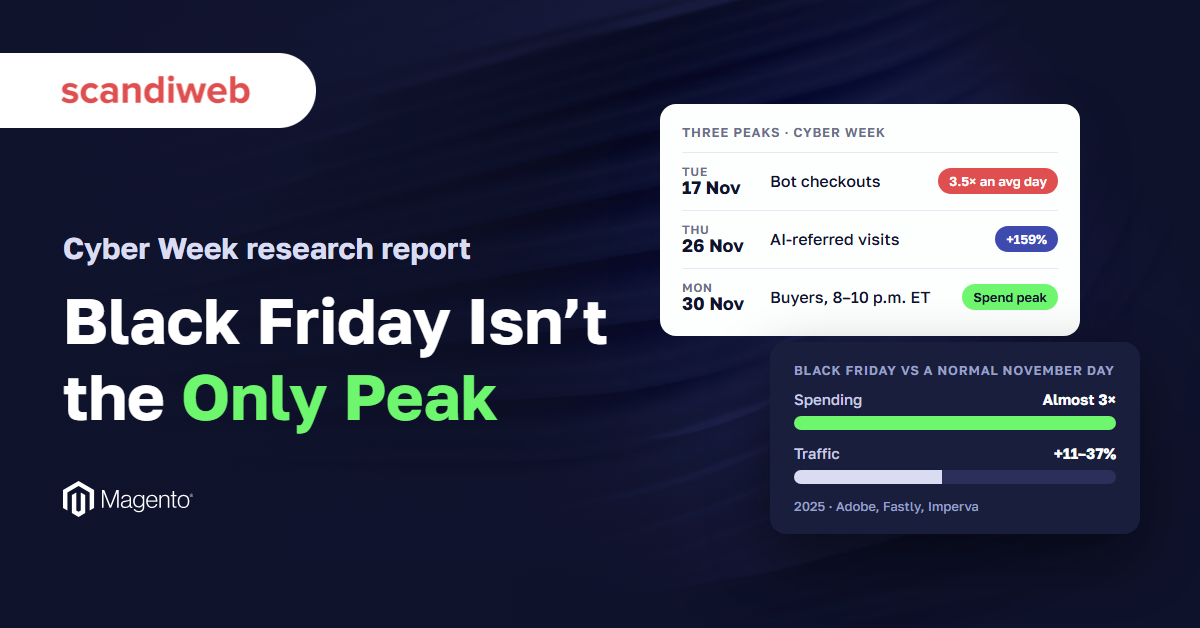

Bot checkouts are projected to peak on 17 November based on the 2025 pattern, AI-referred visits are forecast to grow fastest on Thanksgiving, and spending peaks on Cyber Monday evening. On Black Friday, spending runs at almost three times the November daily average while measured traffic rises 11–37%, so the extra load falls on cart and checkout pages, which Magento’s default full-page cache does not cache.
- Cyber Week 2026 has three peaks, and none of them is on Black Friday
- Bots on 17 November, AI agents on Thanksgiving, buyers on Cyber Monday night: the 2026 Cyber Week Load Calendar
Downloads
Riga, Latvia – November 2026. Online retailers plan for Black Friday as one big day. Their servers face three, according to the Cyber Week Load Calendar 2026, published today by scandiweb, a Latvian eCommerce agency founded in 2003 specializing in Magento and digital optimization for global brands.
The calendar combines public data from Adobe, Kasada, Imperva and Fastly, mapped onto the 2026 dates. It tracks three signals that peak on different days: bot checkouts, visits from AI services, and spending.
Three peaks, three dates
- Bots: Tuesday 17 November (projected). In 2025, the most bot checkout attempts came nine days before Thanksgiving, not on Black Friday. That single day carried about 11% of all bot checkouts between 1 November and 2 December, roughly 3.5 times an average day; Black Friday carried about 3.5%. The same pattern puts this year’s peak on 17 November.
- AI-referred shoppers: Thursday 26 November (Thanksgiving). Adobe’s 28 September forecast expects visits to US retail sites from AI chat and browser services, counted as shoppers clicking a link, to rise 159% year on year on Thanksgiving, the fastest growth of any Cyber Week day.
- Buyers: Monday 30 November, 8 to 10 p.m. Eastern. Adobe forecasts a record $15.1 billion in US online spending on Cyber Monday 2026. Last year, spending peaked between 8 and 10 p.m. Eastern at $16 million a minute, more than five times the average minute of November 2025.
Black Friday is a buying peak, not a traffic peak
In 2025, Adobe recorded $11.8 billion of US online spending on Black Friday, almost three times the November daily average. Traffic measured against the same November average rose far less: Fastly measured Black Friday 10.8% above it and Imperva 37%. Adobe forecasts $12.9 billion for Black Friday this year.
Spending rising much faster than traffic means more of the day’s visits end in a cart or checkout, and those are pages Magento’s default full-page cache does not cache. In Magento, the platform behind Adobe Commerce, each one is built fresh by the server unless the store has added its own caching layer.
“Retailers spend weeks preparing for Black Friday traffic, but the calendar shows a different problem,” said Glebs Vrevsky, Executive Board at scandiweb. “The bots come a week early, AI-referred shoppers grow fastest on Thanksgiving, and the real strain on Black Friday is checkout, which a standard cache doesn’t cover. What becomes important is how many pages your server can build in a second.”
What merchants can do
The calendar comes with a checklist and an importable calendar file that marks each peak:
- Turn on scraper and card-testing bot protection by 16 November, not on Black Friday.
- Test checkout under load separately from the homepage and category pages.
- Check how AI tools see the store: most AI crawlers and assistants read the server’s raw HTML and do not run JavaScript.
- Measure how fast the server builds an uncached page, and how many it can build at once.
Making uncached pages cheaper
Magento’s default full-page cache doesn’t cover carts and checkouts, so for those pages the limit is how quickly the server builds each one. A store that builds pages twice as fast can serve roughly twice as many uncached requests on the same hardware. Merchants have four broad ways to raise that limit, each with a trade-off:
- Keep bots off the checkout. Bot filtering at the CDN leaves server capacity for real buyers. Rules that are too strict can block real shoppers and the AI agents that now shop on their behalf.
- Take work out of each page. Profiling tools such as Blackfire or New Relic show which extensions and blocks slow the cart and checkout down, so developers can fix or remove them. This takes developer time, and changes to checkout are risky this close to Cyber Week.
- Add servers. More capacity is the quickest fix, but it costs the most, and fixed servers have to be booked and tested before the peaks. Auto-scaling hosting adds capacity automatically when traffic climbs and removes it when the rush passes, so the store pays for peak capacity only while the peak lasts.
- Build each page faster on the same hardware. A newer group of tools speeds up the server’s page-building step itself without changing the storefront. One is Expedio, made by scandiweb, which runs under a store’s existing theme and has an open-source core. In scandiweb’s own benchmark of one merchant’s store, the store handled about three times more traffic on the same server before response times started to rise. Results on other stores will differ.
The full calendar, data and method are available here.
Notes to editors
- 2026 dates are mapped from 2025 patterns by days before or after Thanksgiving (27 Nov 2025; 26 Nov 2026). Spending figures for 2026 are Adobe forecasts; bot figures are 2025 actuals from Kasada and Imperva.
- “Normal November day” is scandiweb’s calculation from Adobe’s forecast: November’s $145.1 billion minus Cyber Week’s $47.5 billion, spread over the other 25 days, or about $3.9 billion a day.
- Adobe’s forecast PDF gives Thanksgiving AI traffic growth as 141%; its press release gives 159%.
- Kasada’s daily shares of bot checkouts are read from the daily chart in its 2025 Holiday Bot Attack Trends report.
Disclosure
scandiweb develops Expedio, a server-side page-build tool for Magento mentioned in this release, and offers Magento development services. scandiweb has no commercial relationship with the other tools and vendors named here. scandiweb is an official Adobe Gold Partner.

































Share on: