
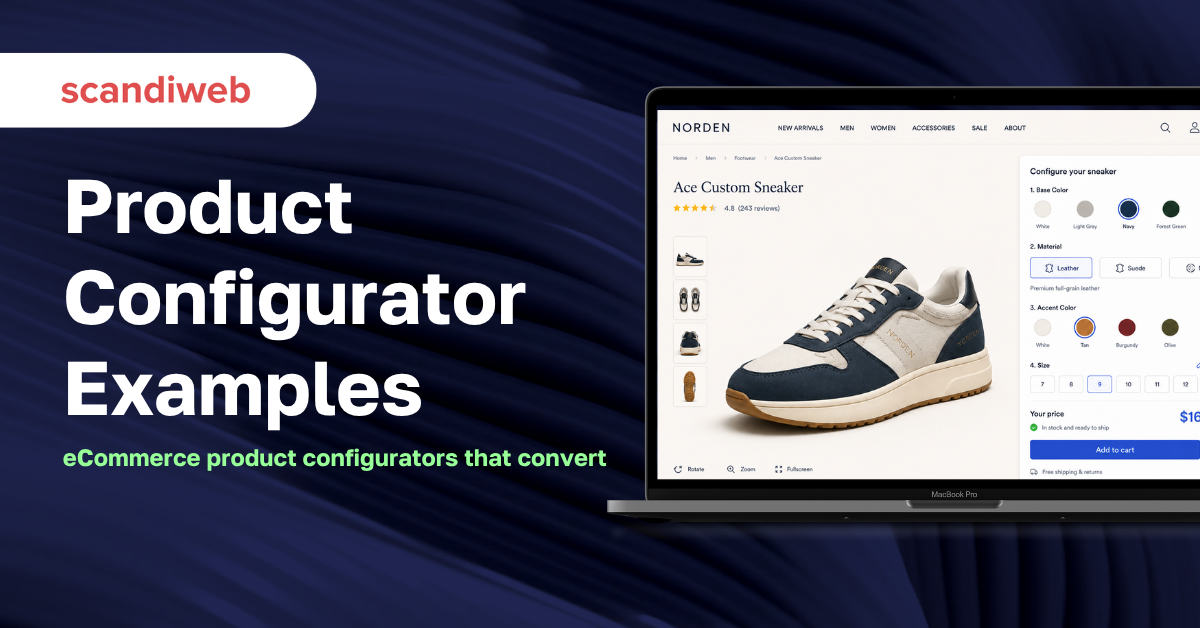
An eCommerce product configurator is an interactive tool that lets a shopper build a product from a set of options, with the price and preview updating in real time as each choice is made. Picture it in action. A shopper lands on a product page for a watch, taps the bezel, and switches it from steel to rose gold. The strap follows, brown leather to black rubber, and the case engraving updates to their initials. The price ticks up in the corner with every choice, and the photo in the middle redraws itself in real time. By the time they reach the bottom of the page, they have not bought a watch off the shelf. They have built one, and they are far more attached to the version they made than to anything a catalog could have shown them.
That moment is what an eCommerce product configurator sells. Not a feature, but the feeling of ownership before the order is even placed. The question for most merchants is which tool to use, how it fits the existing platform, and whether the increase in average order value justifies the build.
Overview
- A product configurator lets shoppers customize a product in real time, with a rules engine validating each choice before the next one becomes available.
- The strongest commercial case is on customized or high-consideration goods, where configurators raise average order value, cut returns, and reduce reliance on held inventory.
- Choosing one comes down to platform fit, the type of visualization you need (2D, 3D, or photo-swap), and how cleanly it writes a valid order back into your store.
What is an eCommerce product configurator?
A product configurator is an interactive tool that lets a shopper assemble a product from a set of options, with each choice checked against a rules engine before the next option opens up. According to configit.com, configuration is the process where a user selects a feature, the system validates it against the configuration rules, and only then offers the remaining valid choices. The result is a buildable, orderable product that cannot be combined into something the merchant can’t actually make.
That validation step is the part people underestimate. A configurator is the logic that stops a customer from ordering a frame size that does not fit the components they chose, or a finish that the supplier discontinued last quarter. Product configuration is one expression of a broader shift toward unified commerce personalization, where the store adapts to the shopper rather than the other way around.
On Magento (Adobe Commerce) it helps to map a configurator onto the product types the platform already supports. Adobe Experience League documents six native Magento product types, simple, configurable, virtual, downloadable, bundle, and grouped (Adobe Experience League). A configurable product handles a single choice such as size or color, and a bundle product lets the shopper assemble a kit from selectable components. A configurator runs on top of that data model, driving the same valid combinations through a richer visual front end rather than replacing the underlying catalog.
🚀 Quick takeaway
The rules engine is the product. A pretty 3D view with no validation behind it generates orders your operations team cannot fulfill.
Magento 2 product types explained
Because a configurator runs on top of your catalog data model, the Magento 2 product types you choose decide what a configurator can validly assemble and write back as an order. The platform has six native types, and getting the mapping right is the difference between a configurator that produces fulfillable orders and one that does not. Here are the Magento product types explained, with what each one is and when to reach for it.
Simple product
A simple product is a single physical item with one SKU and no selectable options, such as a fixed-spec coffee mug. It is the building block of the catalog. Every configurable, grouped, and bundle product is ultimately assembled from simple products underneath. Use it when the item stays as-is with nothing for the shopper to choose, and lean on it as the underlying inventory a configurator draws from when it resolves a build into real SKUs.
Configurable product
A configurable product presents one item with selectable variations, like a t-shirt offered in several sizes and colors, where each combination maps to its own simple product and SKU behind the scenes. This is the type most people picture when they think of catalog modeling for choice. Use it when the shopper picks from a defined set of attributes, and you need accurate per-variant stock and pricing. A photo-swap configurator most often runs directly on top of configurable products, driving the same valid attribute combinations through a richer visual frontend.
Grouped product
A grouped product gathers several standalone simple products on one page so a shopper can buy them together in any quantity, such as a set of matching kitchen utensils sold individually or as a group. Each item keeps its own SKU and can be purchased alone. Use it when the products are related, and shoppers benefit from seeing them together, but each piece still needs to stand on its own in the catalog rather than being locked into a single fixed kit.
Virtual product
A virtual product is a non-physical item with no weight and no shipping, such as a membership, a service, or a warranty. It behaves like a simple product in the catalog but skips the shipping step at checkout. Use it when you sell something intangible, and pair it with a configurator when a configured physical build needs an attached service or extended warranty added as a separate line.
Bundle product
A bundle product lets the shopper assemble a kit from selectable components, like a made-to-order computer where you choose the processor, memory, and storage, with the price updating as selections change. This is the native type closest in spirit to a configurator because it already enforces which components are available and combines them into one purchasable product. Use it when the shopper builds from a defined menu of parts and you want Magento itself to handle the valid combinations a lightweight configurator can then visualize. See our full guide to the Magento bundle product type.
Downloadable product
A downloadable product is a digital file that the customer receives after purchase, such as an eBook, software, or an audio track. It carries no shipping and can gate access behind the completed order. Use it for any digital deliverable, and treat it the way you would a virtual product when a configured order needs to attach digital extras like a design file or a license alongside the physical build.
Mapping a configurator onto these Magento 2 product types is the work that keeps configured orders valid. The configurator drives the frontend experience, while the product type underneath defines what is buildable, how stock is tracked, and how the order resolves into SKUs your operations team can actually fulfill.
Why configurators are worth the build for online stores
Configurators earn their place when the product invites choice, and the choice carries margin. Treated as a conversion rate optimization play rather than a vanity feature, here is what they change for a store.
- Higher average order value – shoppers who build a product tend to add upgrades they would skip on a fixed SKU, because each add-on reads as a small personal decision rather than an upsell
- Fewer returns – when a customer has already seen the exact configuration in detail and pictured it in their hands, the gap between expectation and delivery shrinks, and so does the return rate
- Less held inventory – if products are built to order, there is no need to stock every variant on the shelf, which frees working capital and reduces dead stock
- Shorter path to purchase – a self-serve configurator removes the back-and-forth of calls and emails for custom orders, so the customer reaches checkout in minutes.
The willingness to pay is real. Deloitte’s consumer research on personalization found that 1 in 5 consumers interested in personalized products would pay a 20 percent premium for them (Deloitte Consumer Review). That premium is exactly the margin a configurator captures, which is why the strongest case falls on customized goods rather than commodity SKUs.
None of this is automatic. A configurator only converts if the surrounding page does its job, so pair it with the fundamentals in our guide to product detail page best practices. Slow load times, unclear steps, or a missing call to action will sink even the most capable tool.
🚀 Quick takeaway
The business case lives on customized, high-consideration goods. On a $9 commodity SKU, a configurator is overhead, not opportunity.
eCommerce product configurator examples by industry
The clearest way to judge what good looks like is to watch real configurators handle real products. These are grouped by what each one does well for a merchant.
Watches and jewelry: detail and clarity
Bamford watches lets shoppers switch elements on the left while a high-resolution photo in the middle updates with each choice. Every customizable section is laid out with easy access, and the level of detail in the image carries the sense that this is a real object, not a rendering. For a merchant, the lesson is that clarity of choice beats decoration. The shopper always knows what they are changing and what it will cost.

Footwear and apparel: deep customization, careful labeling
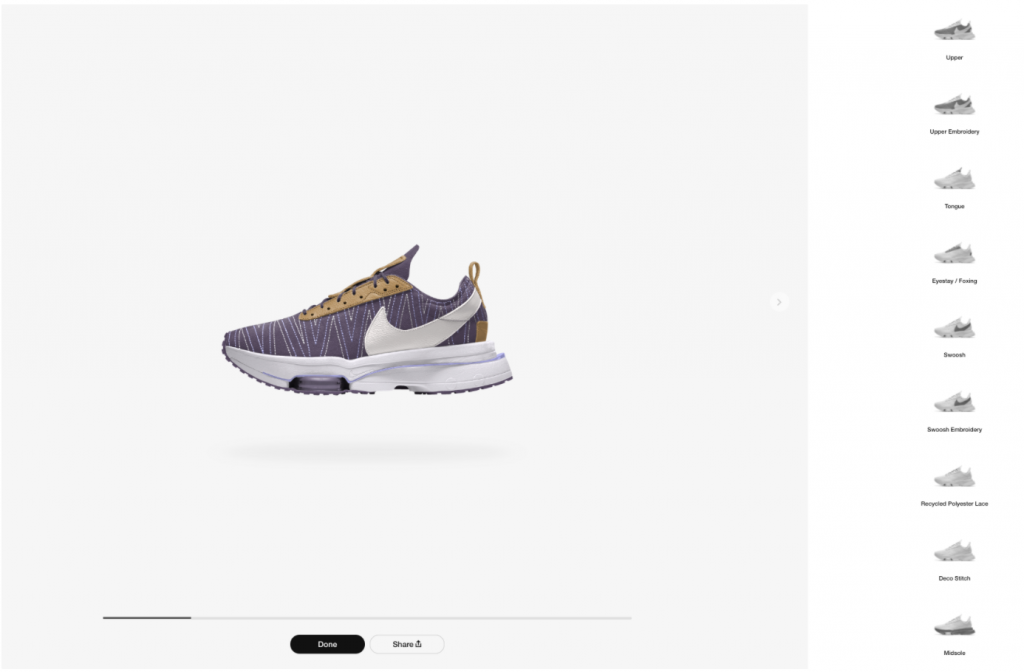
Nike’s by-you builder lets shoppers recolor almost every detail of a shoe, with a detailed photo tracking each change. The tool itself is excellent. The caution is in the labeling, since some option descriptions make it hard to tell adjacent elements apart. For a merchant, that is the trade-off of deep customization: the more options you expose, the more work the naming and grouping has to do.
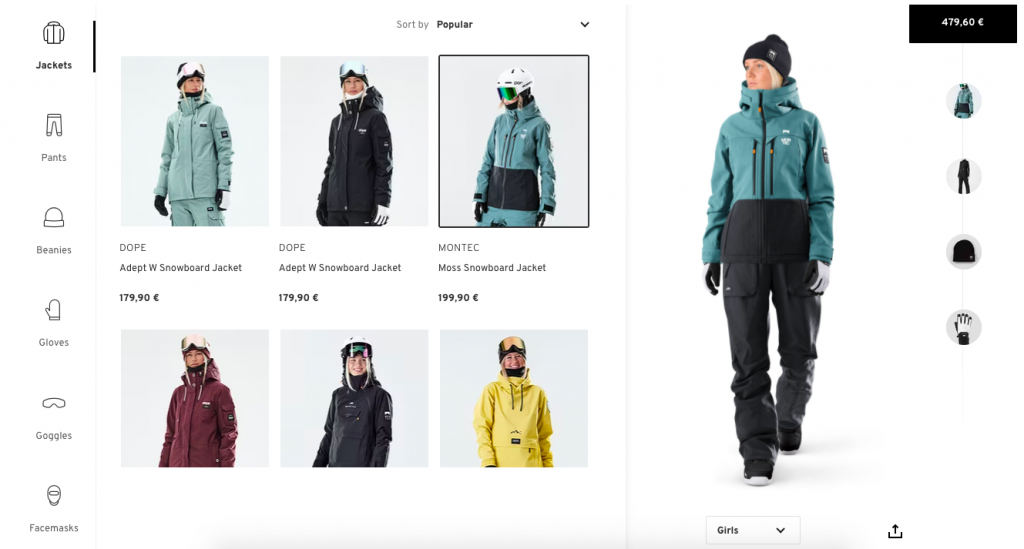
Ridestore’s outfit builder takes a different angle, letting shoppers mix and match ski garments and see a running total on the right as they go. It is configuration as styling, useful when the product is a coordinated set rather than a single item.
Bicycles: step-by-step versus progressive
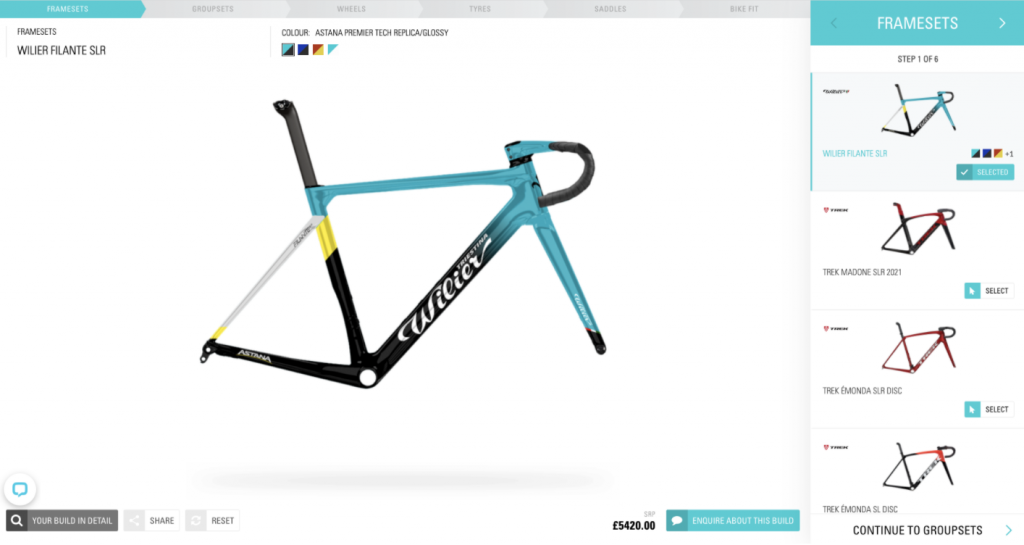
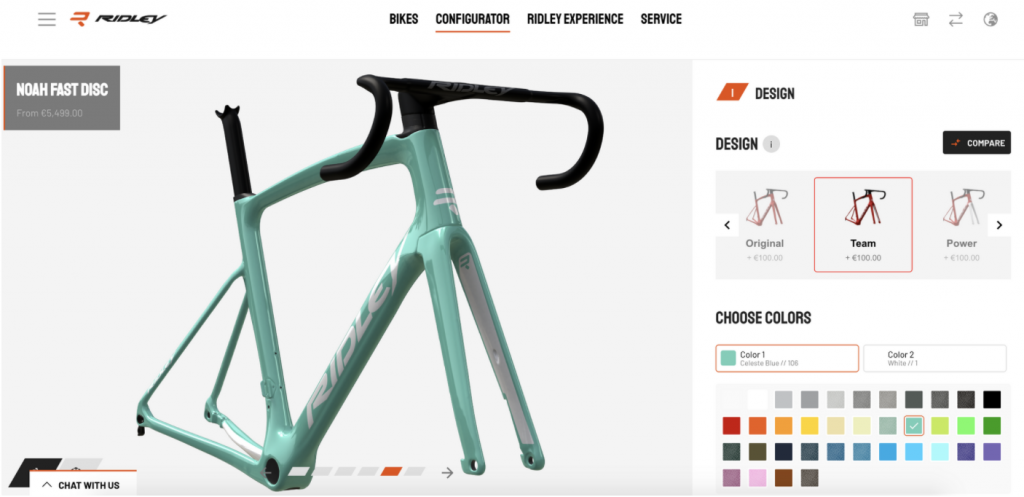
Bespoke Cycling shows each part of the bike as a separate step the shopper clicks through. Ridley Bikes builds a smoother experience where the next step appears as you configure, and at the end you can drop the finished bike onto a background photo to picture it in context. Both work. The difference is pacing, and it matters: a rigid step-by-step flow suits complex builds where order matters, while a progressive flow feels lighter for shoppers who want momentum.
Home and interior: visualizing fit
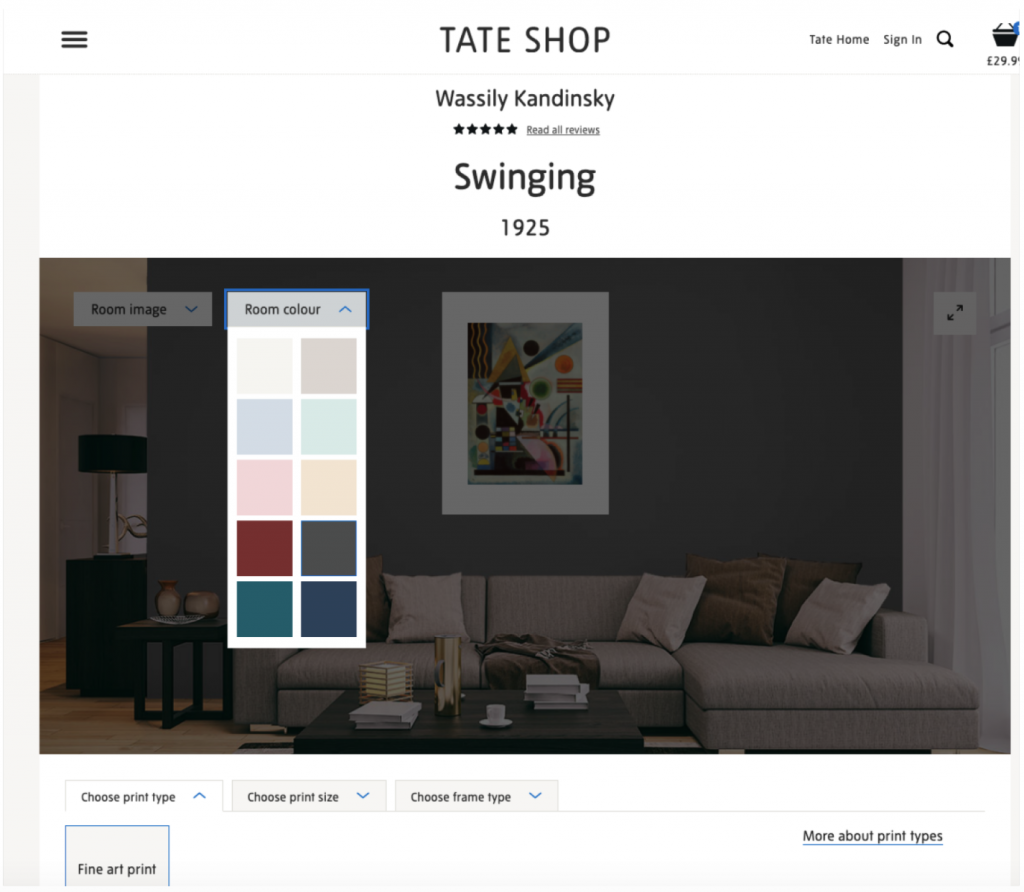
The Tate museum gift shop uses a configurator to help shoppers see how a print would look in their own space, letting them change the wall color behind the artwork. For home goods, the configurator’s job is less about building a product and more about reducing the uncertainty of whether it fits, which is the single biggest reason interior items get returned.
Automotive: the full 3D experience
Ferrari’s car configurator lets shoppers choose between a 2D or 3D experience, with the detail and image changes during configuration doing real work to sell the car. This is the high end of the category, where the configurator is the showroom. Most merchants do not need this level of investment, but it sets the ceiling for what immersive configuration can feel like.

Sporting goods on Magento
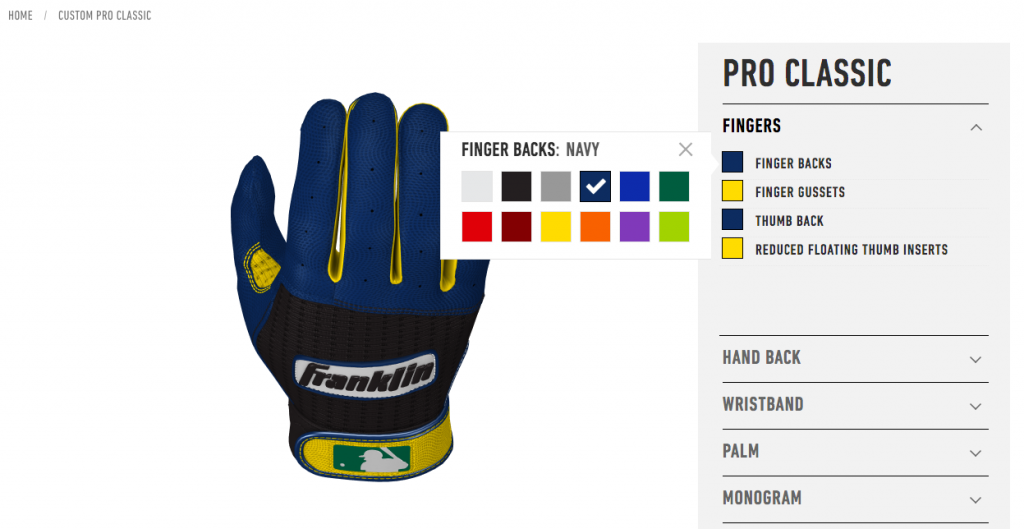
Franklin Sports runs a product configurator built on Magento that lets a shopper design a custom baseball glove, picking colors for every part including the logo and inside detailing, with all changes applied instantly. The product can be viewed in 360 degrees and shared to social media. It is a useful proof point that a serious configurator can live natively on a Magento (Adobe Commerce) store, not only on a bespoke platform.
🚀 Quick takeaway
Across these examples the pattern holds: the best configurators make the choice obvious and the price honest. Visual polish is the finish, not the foundation.
How do I choose a product configurator?
Start with platform fit, then visualization type, then how the tool writes orders back into your store. Pick the configurator that produces a valid, fulfillable order on your existing stack with the least custom glue code, because integration debt is where these projects quietly overrun. A defined category of configurator software exists, with dozens of reviewed tools in directories like Capterra and Software Advice, which is itself a signal that this is now a commercial buying decision.
Work through these questions in order:
- What does the product actually need to show? A photo-swap configurator (Bamford, Tate) is enough for most apparel and home goods. A 3D configurator (Ferrari) is for products where the shopper needs to inspect the object from every angle. Do not pay for 3D you don’t need.
- Does it fit your platform? A tool that integrates cleanly with Magento (Adobe Commerce) or Shopify will cost far less to run than one that needs a custom bridge. Franklin Sports is proof a configurator can live natively on Magento.
- How does it handle the rules? The configurator must enforce valid combinations and write a clean, fulfillable order. If your team has to manually correct configured orders, the tool has failed at its core job.
- What does it do to performance? Heavy 3D assets and live price calculations can slow a page badly. Vendor-neutral guides like Shopify’s walk through the trade-offs, and the examples-and-comparison view in resources like VividWorks’ examples guide is a useful second reference.
- Can you measure the lift? You should be able to track whether configured orders convert better, carry higher AOV, and return less. If you can’t, you can’t justify the next iteration.
🚀 Quick takeaway
The right configurator is the one that produces a valid order on your current platform with the least custom code. Integration debt, not licensing, is where the budget goes.
Implementing a configurator on Magento (Adobe Commerce) or Shopify
The build is rarely the hard part. The constraints are. When we scoped a custom configurator for a bathroom-remodeling retailer, the configurator research and discovery work is where the real constraints surfaced, from image handling to which view options the plugin could actually support. Decisions that looked trivial on paper, like how many product images the configurator had to load and which combinations were even valid, shaped the entire technical approach.
On Magento (Adobe Commerce), a configurator can run natively, as Franklin Sports demonstrates, which keeps the configured product inside the same catalog, pricing, and checkout logic as the rest of the store. That native fit also matters because the platform’s standing is a fair question for any merchant weighing a multi-year build, and the data on whether Magento is dying shows it remains the practical choice for stores with complex product logic. On Shopify, configurators usually arrive as apps or custom storefront components, which is faster to start but can mean more careful work to keep the configured order valid through checkout. If you are still deciding between the two, our Magento vs Shopify comparison covers where each platform fits best.
Whichever platform you are on, the implementation checklist is the same: use high-quality images so the shopper can see exactly how the product changes, keep load times low, be explicit about the steps required to finish a configuration, and give every screen a clear call to action so the shopper always knows what to do next.
🚀 Quick takeaway
On Magento (Adobe Commerce), the configurator can be inside your existing catalog and checkout. On Shopify, it usually stays on an app, which trades setup speed for integration care.
Frequently asked questions
What is an eCommerce product configurator?
It is an interactive tool that lets a shopper build a product from a set of options, with a rules engine validating each choice before the next one becomes available. The output is a buildable, orderable product, and the price updates in real time as the shopper makes selections.
Do product configurators increase sales?
They tend to raise average order value and reduce returns on customized or high-consideration products. Shoppers who build a product add upgrades they would skip on a fixed SKU, and having already seen the exact configuration, they return it less often. The increase is smallest on cheap commodity items where customization adds little.
What is the difference between a 2D and a 3D product configurator?
A 2D or photo-swap configurator changes a flat image as the shopper selects options, which suits most apparel, prints, and home goods. A 3D configurator renders an object the shopper can rotate and inspect from any angle, which fits products like cars or furniture where viewing the form matters. The 3D version costs more to build and can be heavier on page performance.
Can I add a product configurator to Magento or Shopify?
Yes. On Magento (Adobe Commerce), a configurator can run natively inside the existing catalog and checkout, as Franklin Sports shows. On Shopify, it usually arrives as an app or custom storefront component. The key is that the tool writes a valid, fulfillable order back into the store rather than leaving your team to correct configurations by hand.
How much does a product configurator cost?
Cost depends on visualization type and integration depth, not licensing alone. A photo-swap tool that fits your platform cleanly is the low end. A custom 3D configurator with deep rules and a bespoke storefront integration is the high-end. The highest hidden cost is integration glue code, so a tool that fits your existing stack out of the box is usually the cheaper total.
What products are a good fit for a configurator?
Customized and high-consideration goods, where choice carries margin and the shopper benefits from seeing their selection before buying. Watches, bikes, footwear, furniture, sporting goods, and made-to-order items all qualify. Low-cost commodity products with few meaningful options rarely justify the build.
The real decision is how to model your catalog with the right product types so that configured orders stay valid through checkout. If you are weighing that call, structure your products with our team, and we will scope the visualization, rules, and platform fit.