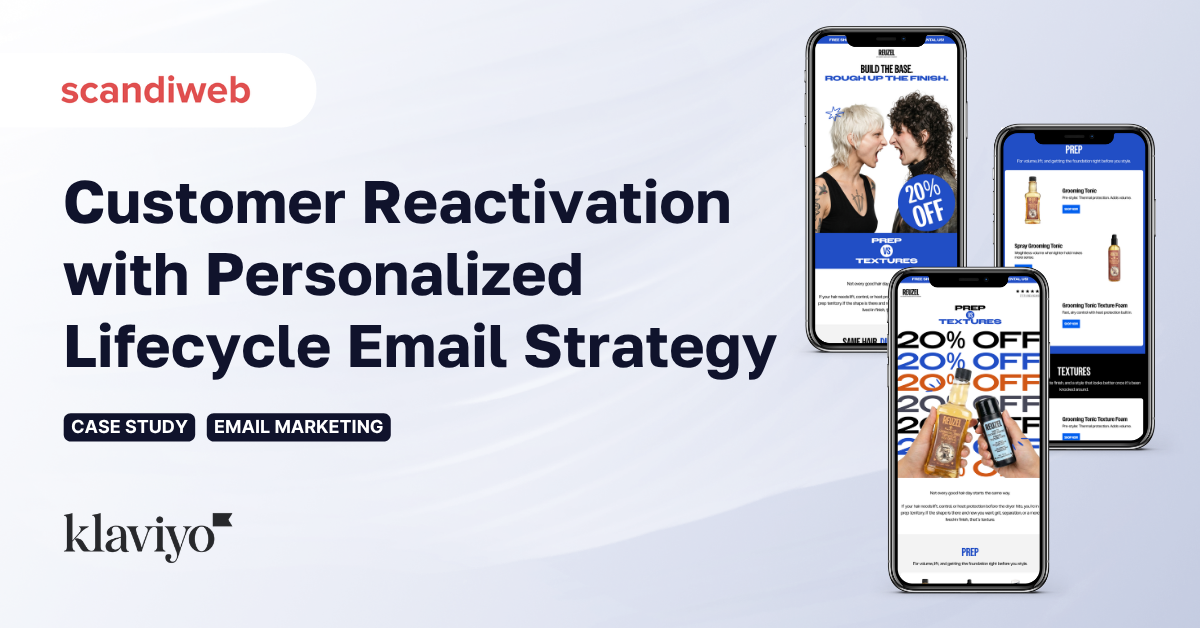
We prepared an email marketing strategy for a prominent men’s grooming brand, used by professional barbers across 95 countries and trusted by customers who shop with them month after month. That kind of loyalty results from a product and brand identity that genuinely resonates. The email program was an opportunity to match that.
In a mature DTC program, email drives 30–40% of total revenue. The key is to recognize that a first-time buyer, a returning customer, and a professional barber have very different relationships with the brand and need to hear from it differently. Here’s what’s possible when addressing customers with targeted messaging and personalization.
Emails for awareness, education, and conversion
Our mission was to develop an email program that is structured to use it at the right moment, for the right customer, in the right way. That starts with a simple framework of three email variants, each built for a different stage of the customer journey.
- Editorial hero
This email should be portrait-driven with an offer in the first fold and minimal copy for moments where attention is the primary job. That could be a new launch or seasonal campaign. It earns the open and sets the narrative for what comes next, sent to the full list with a bias toward new and lapsed customers.
- Product education
This type consists of a comparison structure that lays out the category decision before the CTA appears: welcome email follow-up, browse abandonment email, and cross-sell sends. It reads like a condensed blog post and converts like a product page, moving customers up a tier without leading with a discount.
- Offer close
This email variant is built for the 48-hour conversion window, focuses on a single product, has clear urgency, and uses a structure that does the selling that the first two variants warmed up for. It’s the right format for promo kickoffs and last-chance reminders. For this brand, that could be a reminder email timed to the 60–90 day reorder cycle, a seasonal promo close, or a win-back send that leads with what’s launched since the customer was last active.
Email personalization based on customer types
The three email variants above only work if they’re reaching the right person at the right moment. That requires knowing who’s actually in the list. We identified three distinct customer types, each with a different relationship to the brand and a different reason to open an email.
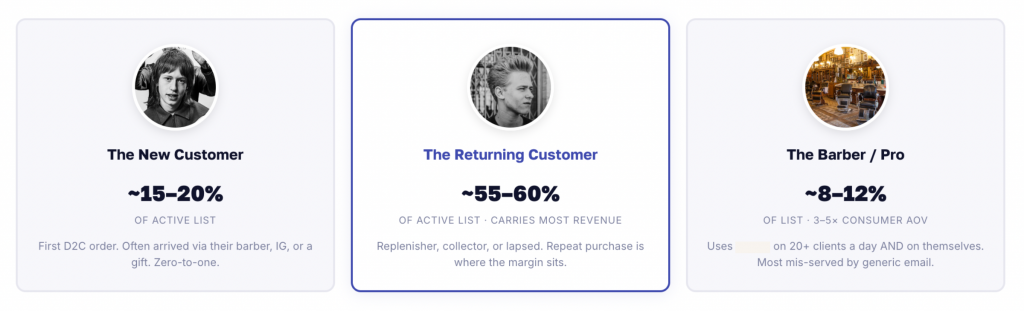
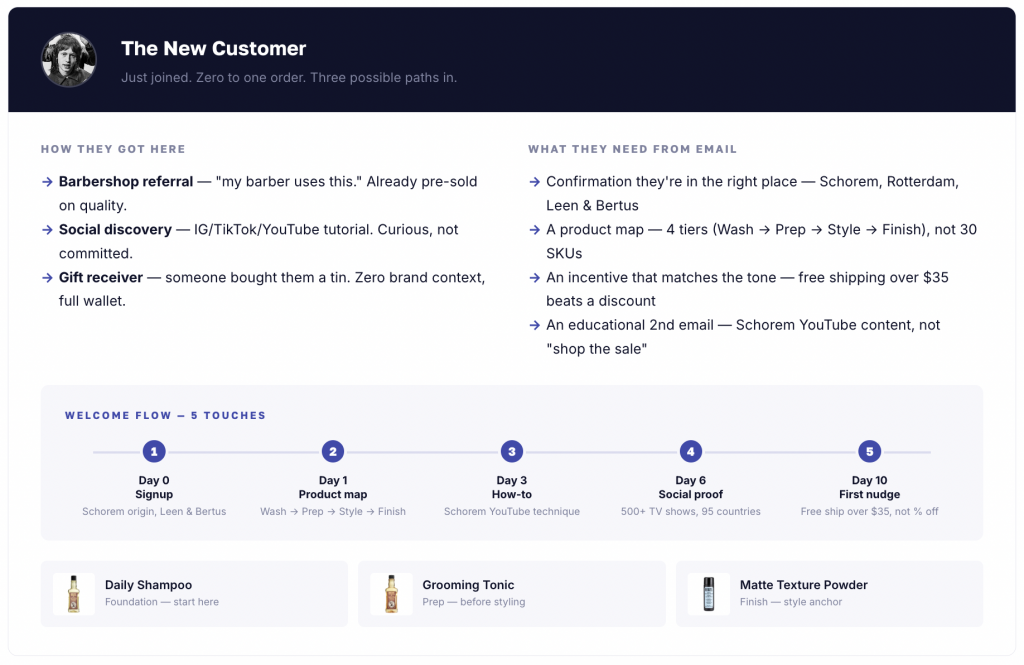
- The New Customer who may already be pre-sold on product quality before their first order, or they may have zero brand context. What happens in the first few emails determines whether they become a loyal reorderer or a one-time buyer. Instead of a discount, they need to understand where the brand comes from, how the catalog is structured, and why the product they just bought is the right starting point.
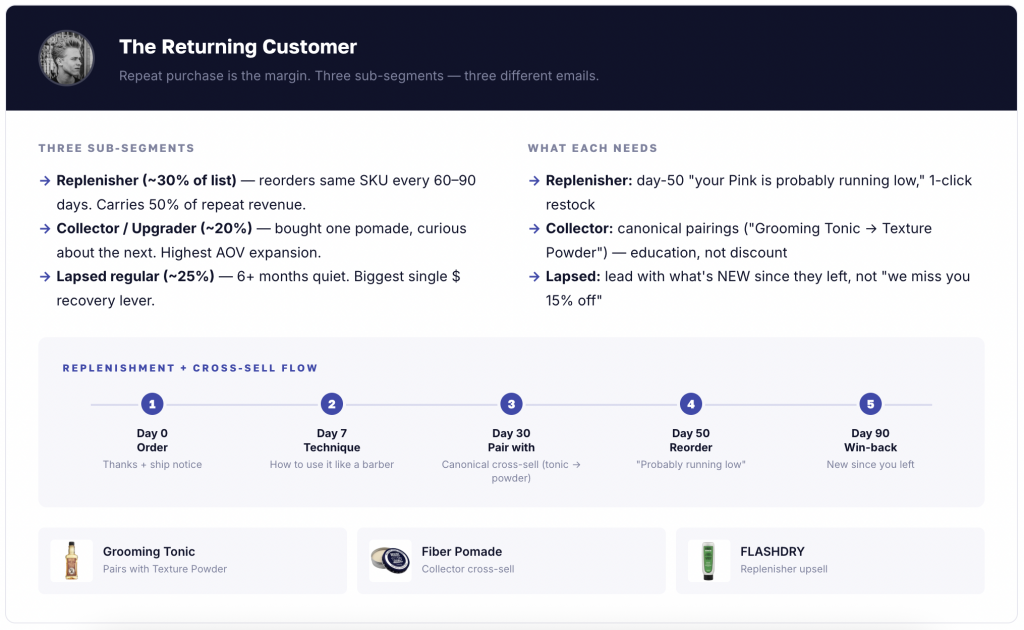
- The Returning Customer has the most revenue potential and requires the most nuance, even at the sub-segment level. Some customers in this segment reorder the same product every 60 to 90 days without much prompting, some bought one product and are curious about what pairs with it, while some haven’t ordered in six months and need a different kind of re-engagement.
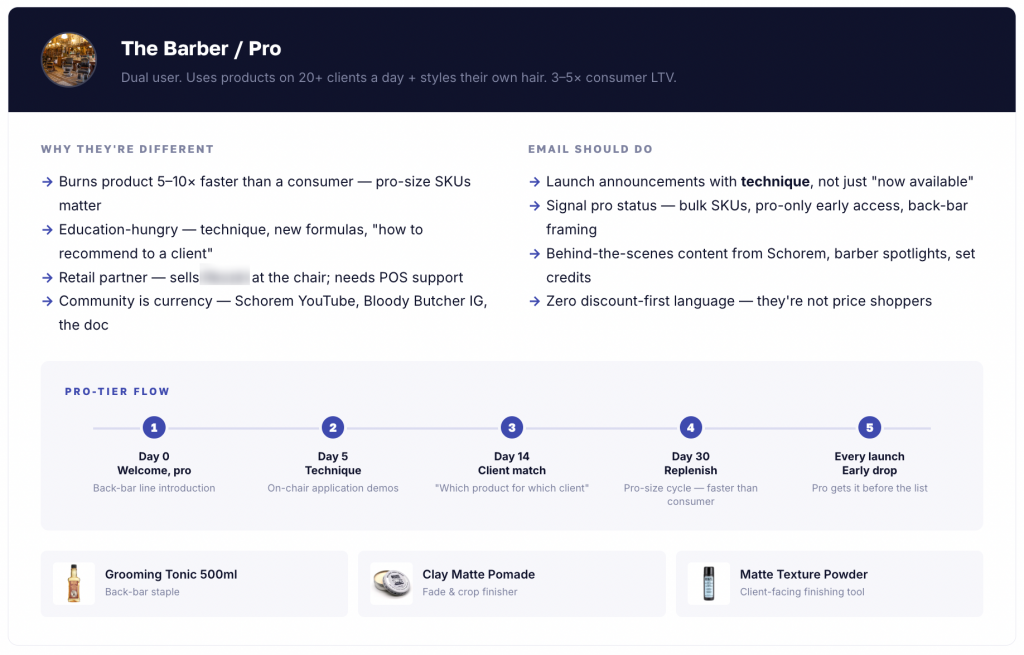
- The Barber/Pro – they want technique content, early access to new formulas, and communication that acknowledges their expertise rather than talking to them like a first-time buyer. With 95 countries of barbershops connected with the brand, this segment is large enough to warrant its own flow.
New customer email flow
The welcome flow should be used for context setting. A new customer may have arrived via their barber, a social tutorial, or a gift, and what they need in the first few emails is enough brand context to understand what they’ve bought into and enough reason to come back.
The flow we developed:
- Day 0: Brand origin. Before any product recommendation, the new customer understands the brand origin and why that matters.
- Day 1: Product map. The catalog is introduced as four tiers, making SKUs feel navigable and not overwhelming.
- Day 3: Technique. Educational content that lets the brand’s credibility do the work.
- Day 6: Social proof. Showcasing scale that confirms a new customer made the right call.
- Day 10: First nudge. Free shipping over a threshold rather than a percentage off better fits the brand tone than a discount-first approach.
Returning customer email flow
The returning customer segment looks like one audience but behaves like several, and each one needs a meaningfully different email to move forward.
- Reorderer buys the same product every 60 to 90 days without much prompting – they need a “probably running low” email at day 50, with a one-click reorder link and no friction between the email and the checkout.
- Collector bought one product and is curious about what pairs with it. The right email is a popular pairing framed as education, less like a sale. The brand’s editorial blog already has this content, so the email just needs to surface it at the right moment.
- Lapsed customer hasn’t bought in six months or more. A generic “we miss you” email with 15% off gets ignored because every brand sends it. In this case, the right hook is what’s new since they were last active – lead with news, close with a frictionless reorder of their last product.
Barber/pro email flow
The pro segment is the most underserved by a generic email program. A professional barber uses the brand’s products on 20 or more clients a day, runs through product five to ten times faster than a consumer, sells it at the chair, and has zero interest in being spoken to like a first-time buyer.
The pro flow could look like:
- Day 0: A back-bar introduction. The professional product line, bulk SKUs, and framing that acknowledge this customer uses their product as a professional tool.
- Day 5: Technique content. On-chair application demos that make barbers better at their jobs and build loyalty.
- Day 14: Client matching. Explaining the products, making the barber a more confident advocate.
- Day 30: A reorder prompt. It’s calibrated to the professional cycle, which runs five to ten times faster than a consumer’s.
Every launch – early access before the general list goes live, giving a signal of status that costs nothing to deliver and builds the kind of loyalty that keeps a professional barber recommending the brand to every client they see. We also recommend zero discount-first language throughout, because this segment is community- not price-driven, and responds to content that treats them as the experts they are.
The full lifecycle email flow
The biggest revenue gains in email marketing come from lifecycle flows that continue working in the background every day, reacting to customer behavior regarding timing and products purchased. Here’s how a grooming brand could leverage those.
Welcome emails to build confidence
A new customer discovering the brand through Instagram, a referral, or a gifted product arrives with very different levels of product knowledge. The welcome sequence should focus on orientation first.
This is also where personalization begins. Well-structured welcome flows in DTC grooming brands commonly achieve 4–8% conversion rates when product education and personalized incentives are introduced early.
Browse abandonment flow to recover high-intent traffic
One of the clearest lifecycle gaps appears when customers repeatedly view products but leave without adding them to the cart. This often signals hesitation rather than a lack of intent. Browse abandonment flows can continue the decision-making process by:
- Re-surfacing the viewed product
- Explaining how it differs from similar products
- Introducing popular pairings
- Reinforcing the quality through educational framing.
Behavior-triggered browse flows in grooming eCommerce regularly recover 1–3% of abandoned sessions without relying heavily on discounts.
Post-purchase emails to foster loyalty
Post-purchase flows are often underutilized despite being one of the highest-value stages in the customer lifecycle. The first order determines much of the future relationship and whether customers reorder. Well-developed post-purchase flows in DTC grooming typically generate between $1.50 and $2.50 revenue per recipient over a 60-day period.
We recommend extending beyond transactional confirmation emails into technique content shortly after delivery, routine pairings several weeks later, and reminders aligned with expected usage cycles. For products with predictable reorder windows, reminder sequences become especially valuable.
Win-back emails to reconnect through relevance
This brand’s customers often lapse because they purchased through a barber instead, they switched routines temporarily, or they simply haven’t been reminded of what’s changed since their last purchase. Instead of positioning reactivation around price, the flow reframes it around discovery and product evolution. That shift preserves brand positioning while still creating urgency to return.
The stronger approach is contextual reactivation:
- New product launches
- New formulations
- Updated routines
- Products connected to previous purchases.
Building a lifecycle email program
This approach starts with the data of who’s in the list, how they buy, and where the program currently isn’t reaching them. From there, we build email variants and lifecycle sequences based on customer behavior. Projected results:
- A mature email program like this drives 30–40% of total DTC revenue
- Personalized welcome flow has a 4–8% CVR, which is up to 4x higher than what a generic version produces
- Post-purchase sequences deliver $1.50–2.50 revenue per recipient over 60 days
- Win-back flows reactivate 3–6% of lapsed customers within 90 days.
Putting all of that together for a list spanning 95 countries and including a pro segment ordering at 3–5x the consumer rate, those benchmarks compound meaningfully.
If your email program isn’t tailored to your customer base, the gap is likely larger than it appears. We build the full program around your brand and customer data – let’s get in touch, and we’ll show you what that looks like in practice.