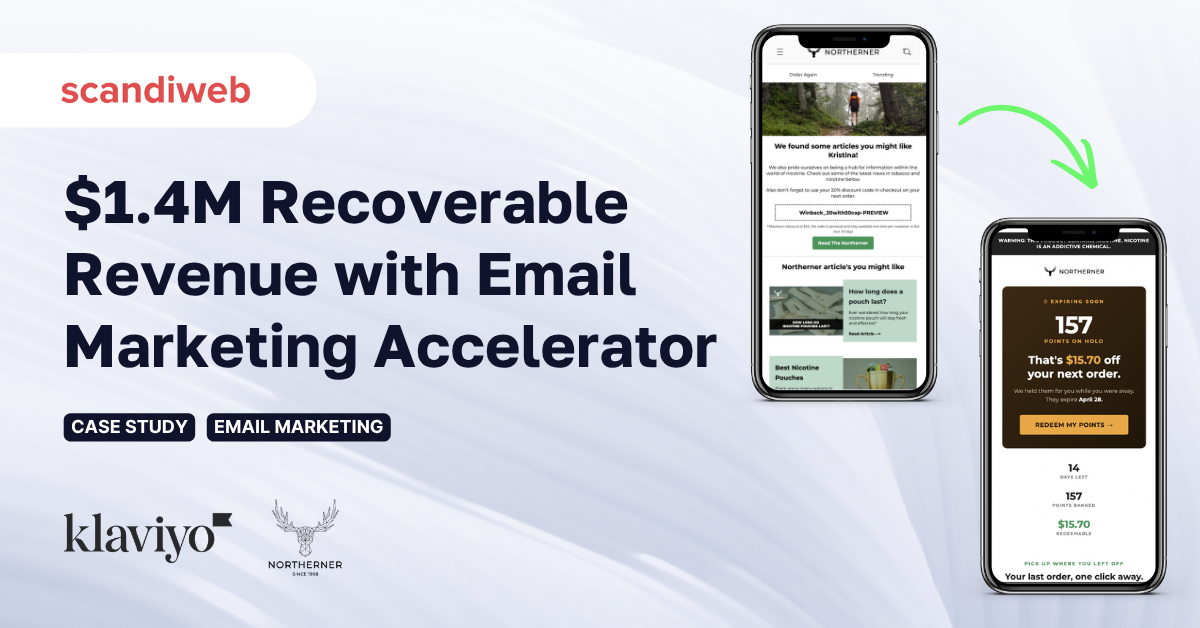
The customers most worth winning back are those who already bought but then quietly stopped. For Northerner, a leading European nicotine pouch retailer, those were almost 34K customers who hadn’t purchased in 30 to 180 days. A generic discount email sent to all of them is not the right approach. Here’s what is!
What the data showed
Our starting point was a lifecycle analysis built on Northerner’s BigQuery order data, split into four segments based on purchase recency:
- Active – bought in the last 30 days
- At risk – 30–90 days inactive
- Need reactivation – 90–180 days inactive
- Lost – 180+ days inactive
We also looked into the average order value for each segment. For Northerner, the highest-value customers were in the “At risk” window, where targeted re-engagement is still efficient.
High-value customer personas
The current Northerner win-back email is sent out with a 20% discount code and a latest article grid. There’s no connection to what the customer actually buys, any reference to their product history, or loyalty points. However, without a personalization infrastructure, it’s the only approach.
To illustrate ways different customers should be re-engaged, we built three personas based on purchase data, each representing a distinct behavior pattern within the segment:
- Marcus orders around 18 cans of a specific product a month. He’s been quiet for 45 days, with the loyalty balance of $15.70, and he doesn’t know it’s about to expire.
- Sarah is a flavor explorer – she’s tried six or more brands in the last 90 days and has a clear lean toward two of them. She’s been quiet for 52 days. What would bring her back is knowing what’s new since she last ordered, curated to her taste profile.
- David is a loyalist to one specific brand, ordering around 12 cans a month. He’s been quiet for 61 days because this product went out of stock – he doesn’t know it’s back.
The 4-touch re-engagement sequence, personalized per customer
The sequence we propose spans 14 days and adapts to each persona at every touchpoint. It has the same structure but completely different content driven by what each customer buys, how long they’ve been quiet, and what’s most likely to bring them back.
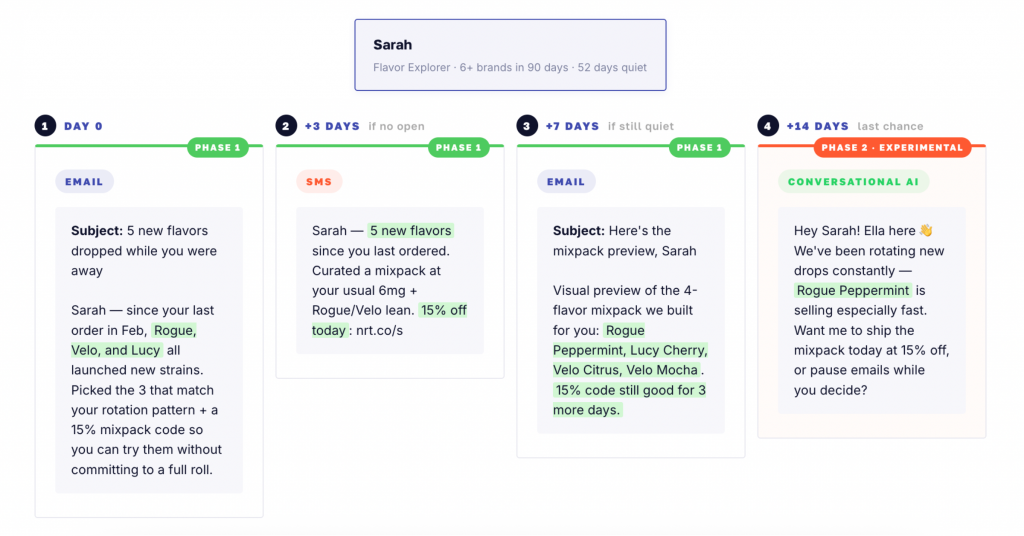
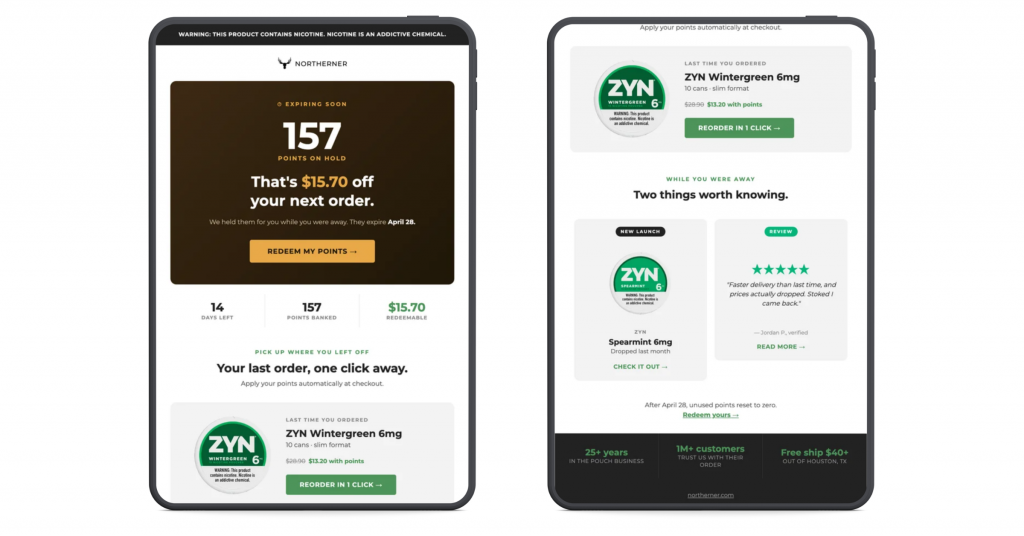
Day 0: Email
The opening touch leads with the most relevant hook for each customer.
- For Marcus, it’s his expiring loyalty credit and a one-click reorder of his usual product.
- For Sarah, it’s a curated mixpack of new flavors that match her rotation pattern with a 15% code to try them without committing.
- For David, it’s a restock alert: his favorite product is back after three weeks out, and 12 cans have been held for him.
This is also where the gap between current and proposed is most visible. The current win-back template would have been a generic discount code and an article grid. We replace it with an email tailored to each customer’s preferences.
Day 3: SMS (if no open)
A short follow-up for customers who didn’t open the day 0 email. It has the same hook and relevant message, compressed for the channel.
- Marcus gets his loyalty credit expiry and a direct reorder link.
- Sarah gets the five new flavors and her 15% code.
- David gets the restock alert with a direct link to his usual product.
Day 7: Email (if still quiet)
The second email shifts the angle slightly for each persona.
- For Marcus, it introduces three new flavors launched since his last order, bundled with his usual product and a stacked loyalty bonus.
- For Sarah, there’s now a preview of the four-flavor mixpack built specifically for her rotation, with the 15% code still live for three more days.
- For David, it adds urgency, stating that only a limited amount of his favorite product remains since the restock, with bulk pricing and 2 extra cans free if he orders today.
Day 14: Conversational AI (experimental)
The fourth touch is a completely different channel. An AI assistant reaches out via a conversational interface. It’s a 1-on-1 thread that references each customer’s exact situation and responds to what they say. For customers who haven’t responded to three touches across email and SMS, this is the last attempt before the sequence closes. Let’s look into this in more detail next.
Recovery mechanism: conversational commerce
This layer is a 1-on-1 conversation, initiated by Ella – an AI assistant that reaches out to customers who have been quiet through three previous touches, with full context of what they buy and how long they’ve been away. The assistant doesn’t push a single scenario but pivots based on replies and can close the sale in the same thread. AI pulls from the purchase history in real time, adapts to what the customer actually says, and resolves a situation that a standard email sequence would have lost entirely.
Also read:
Chat to Buy: The Future of eCommerce Is Conversational
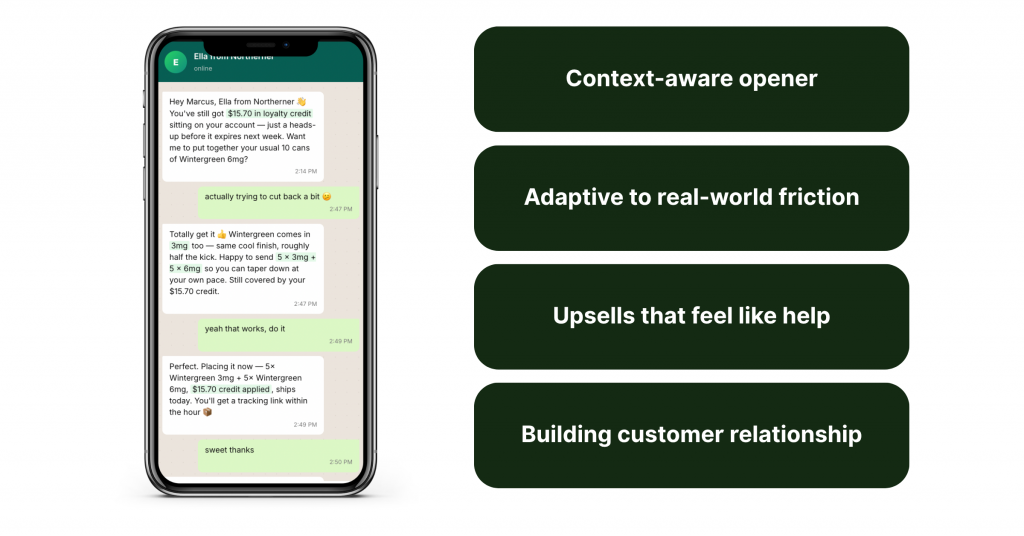
A few things happen in that exchange that are worth noting:
- The opener is specific, not a segment-level assumption – it references the exact product, usual quantity, and exact loyalty balance
- It adapts to real friction and evaluates information to act on
- It closes with continuity, creating an opening for the next conversation.
Additional re-engagement opportunities
The re-engagement sequence targets the highest-priority segment, but it’s rarely the only place with recoverable revenue.
The same personalization logic applied to the re-engagement flow can be extended to three other points in the customer lifecycle: welcome email (especially if it has been converting well below the benchmark), browse abandonment (especially if that flow doesn’t exist yet), and post-purchase flow (especially if it isn’t personalized).
The re-engagement sequence is the starting point because it addresses the most immediate and quantifiable opportunity, while all of these are a natural extension of the same approach, applied to different trigger points in the customer journey.
Starting with a pilot
Rather than applying the full re-engagement program across all customers at once, our approach starts narrow and proves the model before scaling.
The first phase runs on the “At risk” segment, with a 10% hold-out control group to measure reactivation rate and recovered revenue against a clean baseline. If the results hold, the program extends to the full segment, and we apply the personalization layer to the broader flows in parallel.
What makes this approach different is the shift from segment-level messaging to customer-level decision-making. The current Northerner setup already captures enough behavioral and transactional data to support far more relevant communication. The missing layer is connecting purchase history, loyalty data, product availability, and timing into a sequence that responds to the customer rather than treating everyone the same.
If implemented, for their “At risk” segment alone, this represents a recoverable revenue opportunity of approximately $1.4M annually, plus up to $520K in recoverable revenue from existing flows, based on current customer volume and average order value.
If your lifecycle campaigns still rely on broad segments and static templates, you’re likely to see significantly more recoverable revenue than expected. Let’s chat – we can help you identify where those gaps exist and create a personalization strategy based on your current data infrastructure.