
For a long time, building custom software was easy to rule out. Not because the need wasn’t there (it usually was), but because the cost, timelines, and effort were hard to justify. Even when systems didn’t quite fit, it still felt more reasonable to work around them than to build something.
That’s starting to change. We break down why and how the economics of software have shifted in detail in our article Why Custom Software Is Becoming Cheaper than SaaS.
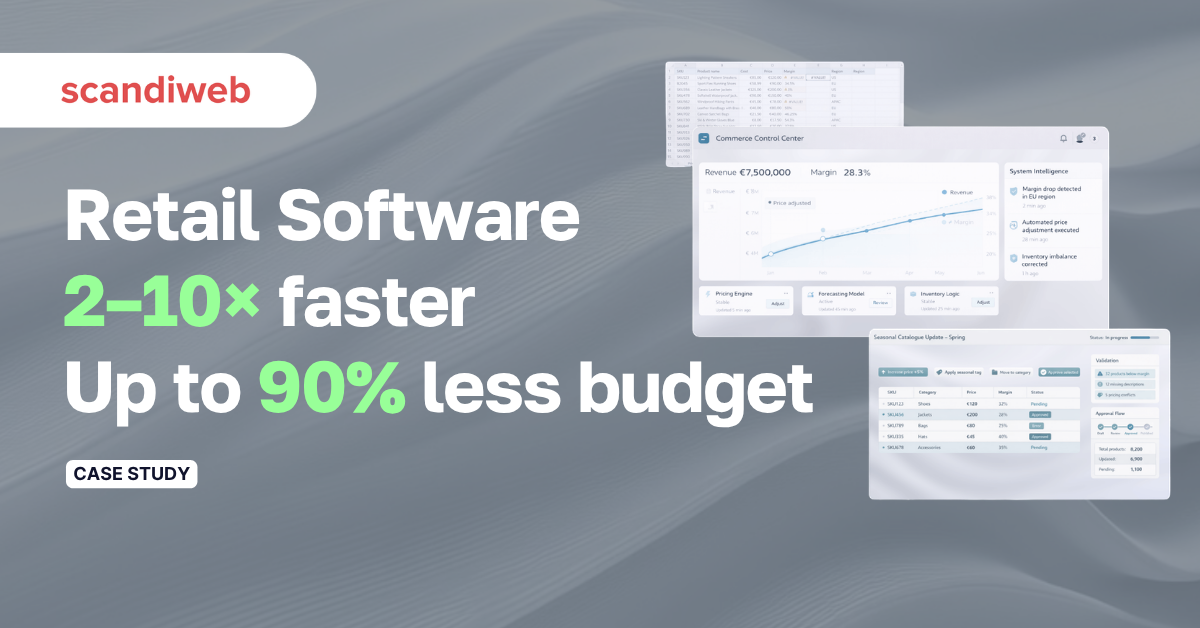
Retail teams are now building internal systems 2–10x faster and with far less overhead than what used to be expected. Work that would have been planned as a long, multi-month project is now being delivered in weeks. Budgets that once pushed decisions off the table are no longer the main blocker and are cut by up to 90%.
Companies can now build the kinds of systems that sit close to how the business actually runs and are usually spread across platforms and manual steps, including pricing, product data, inventory logic, forecasting, and supplier workflows.
The examples below show what that looks like in practice.
The shift in numbers
The easiest way to understand what changed is to look at how these systems used to be delivered and how they are being delivered now.
Instead of large, layered delivery structures, many retailers are moving toward smaller, more focused teams using AI-assisted development. These teams can move from business need to working software much faster, with fewer handoffs and less overhead.
At scandiweb, we’ve introduced AI-agile teams – small, senior engineering teams working with AI-assisted development tools to deliver production-ready systems in weeks instead of months at a fraction of the cost.
| Traditional approach | AI-agile teams |
|---|---|
| built in 6–18 months (often longer) | delivered in 6–10 weeks |
| €500K–€4M+ budget | €80K–€180K one-time cost |
| 10–30+ people across teams | 3–6 person focused team |
| long planning before the build starts | working versions early in the process |
| heavy coordination | direct execution |
The same pattern appears through different systems. Projects that were previously scoped as long, resource-heavy initiatives are now being delivered faster, with fewer people involved, and with significantly lower budgets.
What AI-agile teams have built for retailers
Example 1: Core business system
A 40-year-old UK retailer was running on decades-old legacy systems. Their key workflows, like orders, approvals, reporting, and client data, were spread across multiple tools and processes. Our goal was to consolidate everything into a single system that accurately reflected how the business operated.
Instead of a multi-year transformation program, an AI-agile team delivered the system in a single focused build without the overhead of a large-scale project.
| Typical proposal | AI-agile teams | |
| Project cost | €4M | €0.25M |
| Delivery time | 1.5 years | 14 weeks |
| Team size | 15+ | 5 |
Example 2: Catalog management system
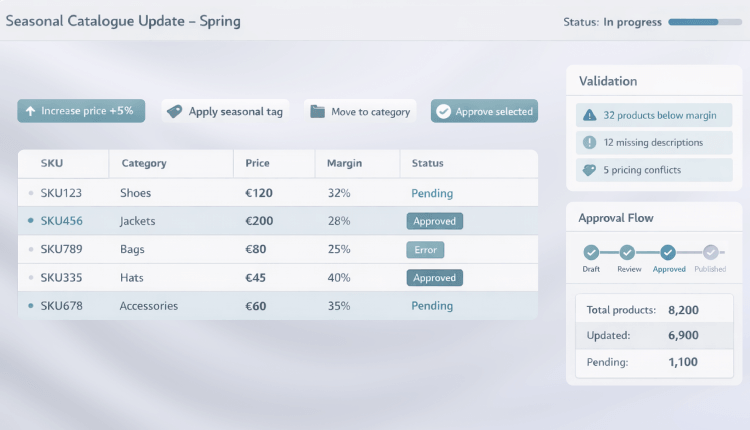
Seasonal catalog updates for this retailer required 12 category managers and a full month of manual work – product data changes, pricing adjustments, and approvals were handled in spreadsheets and disconnected tools.
We built a reliable system that reduced a month of manual work to 3 days. Instead of constant team and file coordination, updates are now managed through a single, structured workflow.
| Typical proposal | AI-agile teams | |
| Project cost | €800K+ | €95K |
| Delivery time | 40 weeks | 8 weeks |
Example 3: Pricing, margin & forecasting system
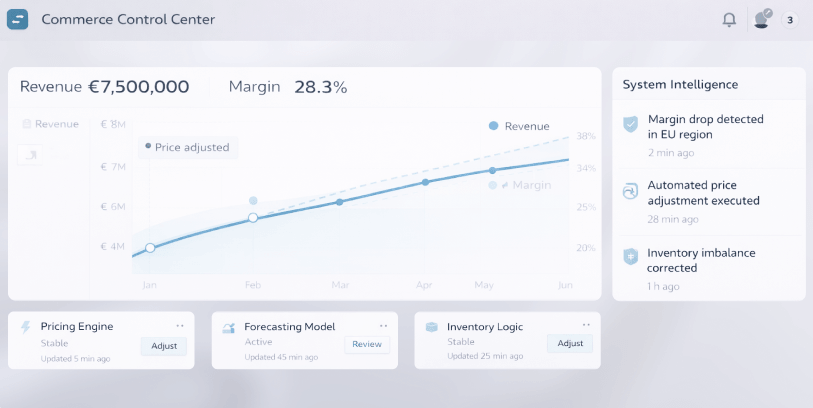
A €200M company was running pricing, margins, and forecasting in Excel, so all the major decisions depended on manually maintained models, with limited visibility and slow iteration. The new system brought that logic into one place – instead of fragmented spreadsheets, decisions are now based on a unified system that reflects real business inputs.
| Typical proposal | AI-agile teams | |
| Project cost | €1.2M | €120K |
| Delivery time | 12 months | 10 weeks |
Example 4: Inventory automation
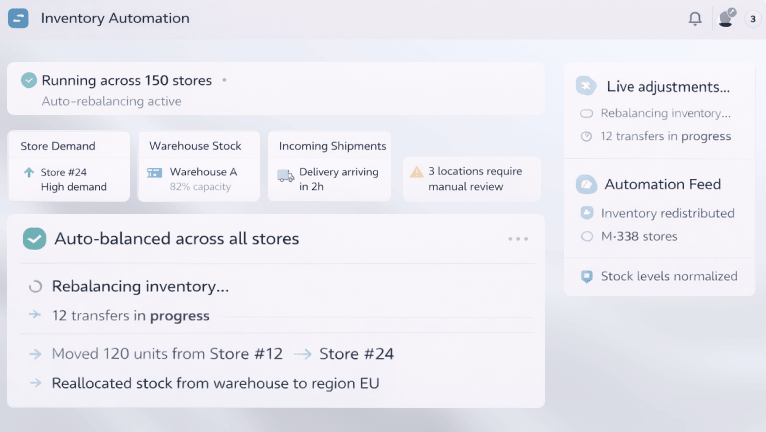
Inventory for 150 stores required constant manual work, with adjustments, rebalancing, and exceptions handled manually in multiple systems. AI-agile teams built a system that automatically handles inventory logic. What previously required continuous manual intervention is now managed through a centralized workflow.
| Typical proposal | AI-agile teams | |
| Project cost | €600K | €80K |
| Delivery time | 30 weeks | 6 weeks |
Example 5: Task & project management
This approach is also great in internal tools where SaaS is heavily used but only partially fits. For companies working around limitations, using only part of the tool, adapting processes, or compensating with manual work, custom systems replace those fragmented workflows with systems that match how the business operates.
For example, an engineering firm replaced Jira where they only used basic task tracking which is about 15% of the product features. Now they run a system built exactly for their workflow. It was done in only 5 weeks and deployed on their server.
- $74,000/year before → now paying $0/year
- $32,000 one-time cost (pays for itself in 6 months)
Example 6: Loyalty & engagement
Outerwear brand relied on Braze for loyalty but couldn’t experiment freely. We built a custom loyalty engine connected directly to their CRM, so they can optimize for repeat revenue.
- $120,000/year before → now paying $0/year
- $90,000 one-time cost
- +27% repeat purchases
What this means
Catalog workflows, pricing logic, inventory management, internal tools, and similar systems are all standard parts of running a business. Most companies already have some version of them in place. And now, they can be built directly for the business, in weeks, with smaller teams and significantly lower budgets.
Look for areas where:
- Spreadsheets carry critical logic
- Teams spend time reconciling data
- Processes depend on manual steps
- Systems do not reflect how the business actually works.
These are often the systems where the impact is highest and the opportunity is most visible. Starting with one focused build is enough to understand how this model works in practice.
Tell us what you need to replace or build! We scope your system in a free 60-minute session. Bring the process you want to digitize and improve, and we will show you what a custom build looks like for your stack.


Share on: