
Last updated: May 2026
For the past decade, most companies building AI systems have relied on the same infrastructure stack: American cloud providers, globally distributed data centers, and proprietary foundation models hosted outside Europe. That architecture is increasingly colliding with a new reality.
🚀 Quick takeaway
Sovereign AI is AI you can run, govern, and prove compliant in Europe. It is becoming a procurement line item for any European organization with an AI footprint, whether the AI runs customer-facing experiences or internal systems. Three deployment models cover most cases: Edge AI on-device, EU-hosted AI infrastructure, and air-gapped sovereign AI. The right choice depends on data sensitivity, regulatory scope, and the systems the AI supports.
Sovereign AI is the practice of running and governing artificial intelligence under European rules, on infrastructure Europe controls, with data that does not leave the jurisdictions that protect it. For any European organization with an AI footprint touching customers, employees, or internal operations, it is moving from a policy conversation to a procurement requirement. Retailers, banks, insurers, manufacturers, public-sector bodies, and enterprises with internal AI tools all face the same question: where does AI run, and who controls it?
This guide explains what sovereign AI means in 2026, how the EU AI Act, GDPR, and the Data Act impact the infrastructure choices behind it, and the three deployment models European organizations use to comply, whether the AI runs customer-facing experiences or internal systems. It closes with a decision framework so you can pick the model that fits your data, your regulatory exposure, and your existing stack, without overbuilding.
Europe is building a sovereign AI ecosystem
Europe is building a sovereign AI ecosystem because the alternative, depending on non-EU providers for the AI that impacts European citizens, customers, and employees, is no longer politically or legally viable. The push covers infrastructure, models, and data, and it is backed by the European Chips Act, the EU AI Act, and the Data Act, plus multi-billion-euro investments in cloud, semiconductors, and compute capacity.
Digital sovereignty has become a central goal of EU technology policy. The concept refers to Europe’s ability to develop and operate digital infrastructure, such as cloud platforms and AI systems, without relying entirely on external providers.
Initiatives include:
- Large-scale investments in European AI infrastructure
- New regulatory frameworks governing data and algorithms
- Policies encouraging the development of European AI ecosystems.
For example, the EU’s broader AI strategy includes significant investment programs designed to expand compute infrastructure and support domestic AI innovation. At the same time, European organizations are placing greater emphasis on control over data and infrastructure, accelerating demand for sovereign AI solutions.
This movement reflects practical concerns about:
- Data protection obligations
- Cross-border data transfers
- Supply chain dependency
- Resilience of critical digital infrastructure.
The European Commission frames this as a single coordinated program on the EU’s strategy on tech sovereignty page, which now reads less like a policy ambition and more as the operating environment European organizations have to plan inside.
AI infrastructure choices under EU regulation
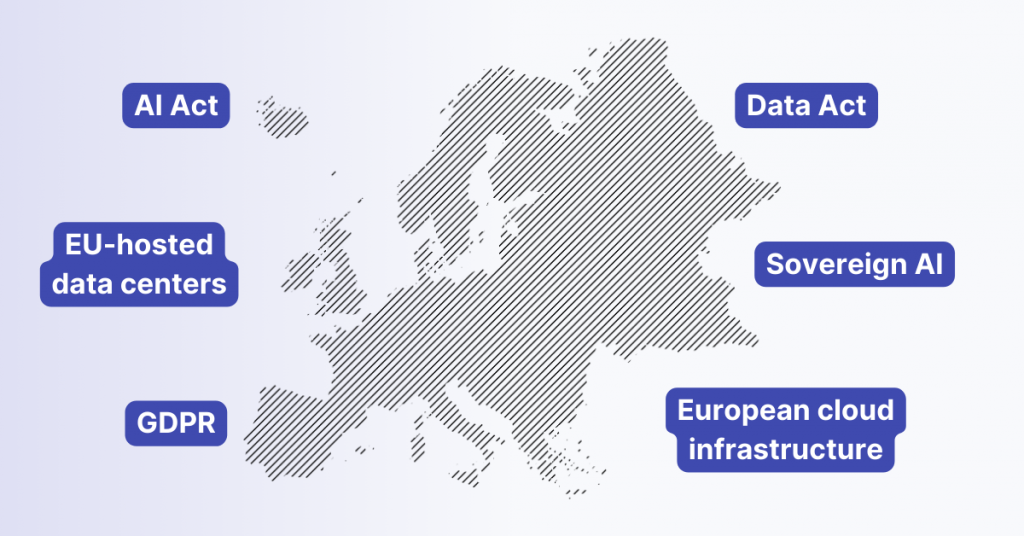
Three EU regulations influence AI infrastructure choices for any organization deploying AI in Europe: GDPR, which governs personal data, the EU AI Act, which governs how AI is built and used, and the Data Act, which governs how data moves between services. Together, they define which AI systems are allowed, where they can run, and who is accountable when something goes wrong.
GDPR – sovereignty over personal data
GDPR (The General Data Protection Regulation) is the baseline rule for AI in Europe because almost every AI use case touches personal data, whether customer profiles in a storefront, employee records in an HR tool, claimant data in an insurance system, or behavioral signals across any application. GDPR requires a lawful basis for processing, real data subject rights, and a defensible answer to where the data lives. Sovereign AI deployments aim to keep that data inside European borders and under European legal control.
For AI systems trained on customer behavior, product interactions, or marketing analytics, this has direct implications for where training and inference workloads can occur.
The EU AI Act – sovereignty over algorithms
The EU AI Act extends sovereignty from data to the AI systems themselves. It classifies AI by risk, prohibits a list of specific practices, and imposes documentation, transparency, and human-oversight obligations on high-risk systems. In practice, that means any AI used in regulated, high-stakes, or customer-facing contexts, recommendation engines, dynamic pricing, hiring tools, fraud scoring, credit decisions, and AI assistants need to be reviewed against the risk tiers before going live in Europe.
Also read:
EU AI Act for eCommerce: 10 Questions Every Business Is Asking Right Now
The Data Act – sovereignty over data flows
The Data Act governs how data moves between cloud services, IoT devices, and business partners. It introduces switching rights between cloud providers, places limits on international data transfers, and creates fairness obligations for data-driven services. For organizations across sectors, it changes the calculus on cloud lock-in and adds data portability to procurement conversations alongside legal review.
Together, these policies reflect a broader strategy of ensuring that European data and algorithms operate under European legal control.
What this means for eCommerce
For European eCommerce brands, sovereign AI changes both how AI is deployed and how it is sold to the business. Procurement teams at large customers increasingly ask suppliers to demonstrate sovereign deployment, and the AI used in customer-facing flows, recommendations, search, dynamic pricing, and chatbots needs to map cleanly to the EU AI Act’s risk tiers, with documentation auditors can read. The brands that prepare for both inquiries quietly outperform those who wait for an audit to force the conversation.
If you are responsible for technology in an eCommerce business, AI has likely already become part of your platform architecture.
You may be using AI for:
- Product recommendations and personalization
- Pricing optimization
- Demand forecasting
- Fraud detection
- Customer support automation
- Marketing segmentation and targeting.
All of these systems process large volumes of customer and behavioral data, often continuously.
If your AI stack relies on external providers, you may need to consider several risks:
- Customer data leaving EU jurisdiction
- Dependency on external cloud providers
- Unclear regulatory exposure when models are trained or hosted outside Europe
- Additional scrutiny when working with enterprise or public-sector clients.
These concerns are becoming particularly relevant if your company sells to regulated industries or works with government organizations. In those environments, AI infrastructure decisions are increasingly evaluated through the lens of data residency, security, and regulatory compliance. More companies are beginning to assess where those AI systems run and who controls the underlying infrastructure.
The shift behind that procurement pressure is well captured in the Atlantic Council’s 2026 report, which calls EU digital sovereignty Europe’s declaration of independence and argues the trajectory is structural rather than cyclical.
Sovereign AI is becoming a procurement requirement
If you are selling to enterprise clients, regulated industries, or the public sector, AI infrastructure is starting to appear in procurement reviews. In addition to performance and features, buyers increasingly ask vendors to demonstrate:
- EU data residency
- Transparent AI governance
- Infrastructure independence from foreign jurisdictions
- Secure and controlled deployment environments.
This means AI architecture decisions can affect whether your company is eligible for certain contracts in the first place. Organizations that cannot clearly demonstrate where their AI runs, how customer data is handled, and which jurisdiction governs the infrastructure may face additional scrutiny during vendor evaluation or be excluded from procurement processes altogether. As a result, more companies are beginning to explore sovereign AI architectures that keep data, models, and infrastructure within European control.
Three deployment models for sovereign AI
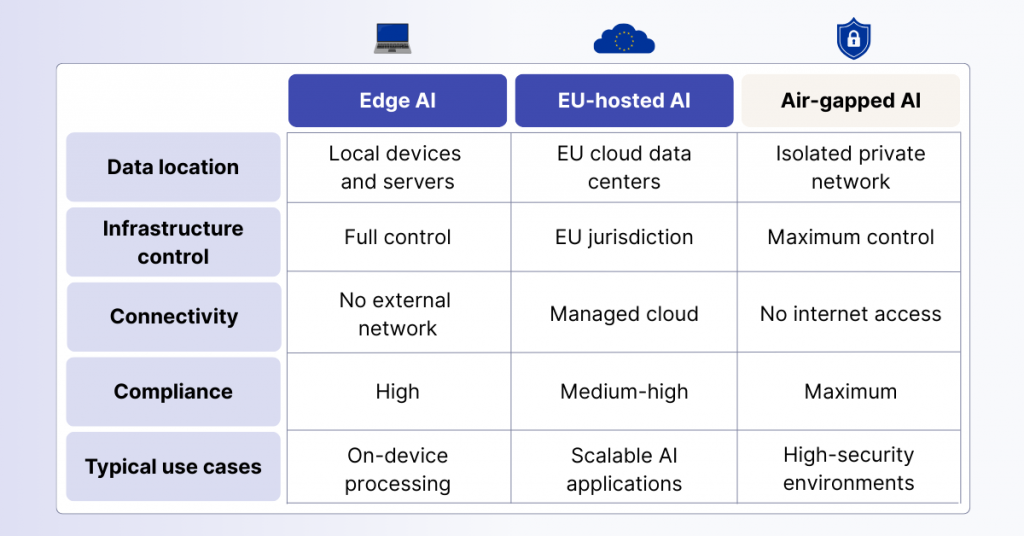
European organizations choose between three deployment models for sovereign AI: Edge AI that runs on the user’s device, EU-hosted AI infrastructure on cloud providers operating inside Europe under EU law, and air-gapped sovereign AI on infrastructure isolated from non-EU networks. The right choice depends on data sensitivity, latency needs, and which systems, customer-facing or internal, the AI supports.
1. Edge AI: processing on-device
Edge AI runs the model directly on the user’s device, so personal data does not leave the device at all. For internal and customer-facing applications, it works well for on-device personalization, offline search, real-time UI assistance, and any feature that requires data to never leave the device. Cost is low, and latency is excellent, but model size and compute are limited, making it best suited to narrower tasks rather than general-purpose assistants.
In edge deployments, AI models run directly on devices or local systems. Examples include:
- Recommendation models in commerce platforms
- Fraud detection systems in payments or financial systems
- AI assistants embedded into internal business tools.
The data never leaves the local environment, there are minimal external dependencies, and strong privacy guarantees. However, edge deployments often require smaller models and limited compute resources.
2. EU-hosted AI infrastructure
EU-hosted AI infrastructure runs models on cloud providers that operate inside the EU under EU law, with data residency, processing controls, and audit trails. For most European organizations, this is the common middle path: it supports larger models and richer use cases than edge, while keeping data and compute under European jurisdiction. The trade-off is supplier lock-in and the need to verify the provider’s sovereignty claims against the spec.
In this model:
- Data processing occurs within EU-hosted cloud environments
- Infrastructure providers comply with European data protection frameworks
- Cross-border data transfers can be minimized or eliminated.
3. Air-gapped sovereign AI
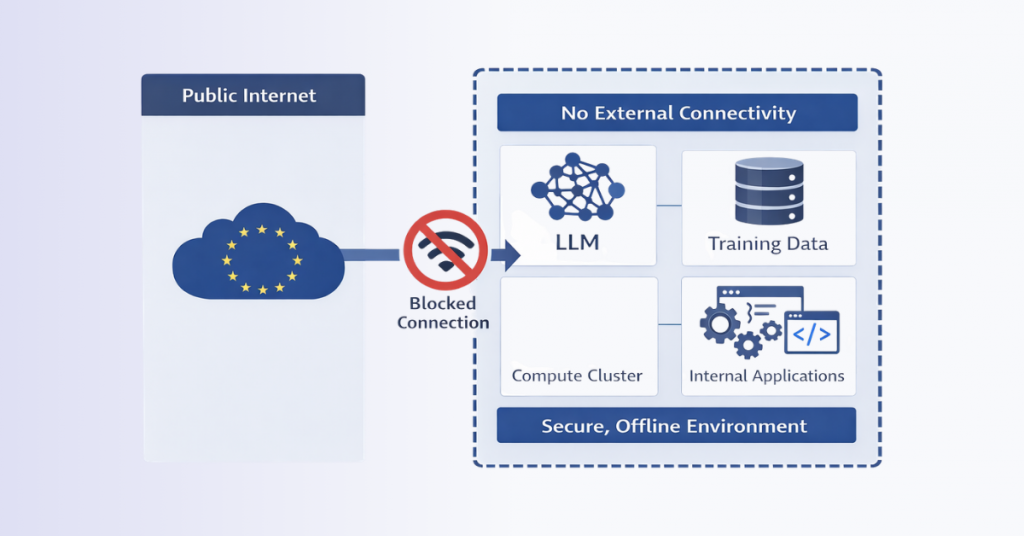
Air-gapped sovereign AI runs on infrastructure physically and legally isolated from non-EU networks, with no shared dependencies on US or Asian providers. It is the strongest sovereignty posture available and the most expensive to operate. It works for regulated categories, defense, healthcare, financial services, public sector workloads, internal fraud and risk systems, and any environment where audit and data-residency requirements are absolute.
While more complex to implement, this architecture provides the highest level of control over data residency and system integrity:
- Infrastructure operates in a completely isolated network
- Systems are disconnected from public internet access
- Models and data remain fully contained within the organization’s environment.
Build, partner, or wait: a decision framework for sovereign AI
The realistic answer for most European organizations in 2026 is partner, not build, and not wait. Building your own sovereign AI infrastructure makes sense at real scale, in a regulated category, with an in-house data team. Partnering with a sovereign-ready provider makes sense for almost everyone else. Waiting is rarely the right call because procurement requirements are tightening month by month.
Build your own sovereign AI infrastructure if:
- Your category is regulated (finance, healthcare, public sector, critical infrastructure), and audit requirements are absolute
- You have an in-house ML and platform team and the budget to maintain it
- You sell to public-sector buyers who require evidence of physical and legal isolation
- Sovereignty is a competitive moat for your organization, rather than only a compliance gate.
Partner with a sovereign-ready provider if:
- You need an EU-hosted AI capability without operating the infrastructure yourself
- Your AI use cases are common ones (search, recommendations, assistants, document processing, internal knowledge tools)
- You can pick a provider whose sovereignty claims match the spec you actually need
- Time-to-compliance matters more than full operational control.
Wait if:
- You have no material exposure to the EEA, Switzerland, or the UK
- Your AI footprint is limited to non-personal data, low-risk uses
- You have a credible plan to act within a defined window once a customer requires it.
Implementing sovereign AI in practice
Implementing sovereign AI is an integration project consisting of four parts: classify the AI use cases against the EU AI Act’s risk tiers, map each one to a deployment model, choose providers and infrastructure that meet the sovereignty bar, and build the documentation auditors will ask to see. Most organizations sequence this over two to three quarters rather than attempting it in one sprint.
Building sovereign AI systems requires a combination of infrastructure design, compliance expertise, and model engineering.
Typical implementation components include:
- EU-hosted compute infrastructure
- Open-source or locally deployed LLMs
- Secure data pipelines and storage
- Audit and monitoring frameworks
- Integration with existing digital systems, including eCommerce platforms, analytics environments, and internal business tools.
The open-source side of the implementation work, sovereign-ready stacks, vendor-neutral tooling, and shared compliance frameworks, is gathered on Linux Foundation Europe’s digital-sovereignty hub, which is worth bookmarking for the implementation team.
Sovereign AI in practice: a European enterprise with mixed AI use cases
A European industrial manufacturer with operations across Germany, France, and the Nordics maps its AI use cases as follows:
The customer-facing knowledge assistant on its product portal runs on EU-hosted AI infrastructure with data residency in Frankfurt and Dublin.
Document processing for technical documentation runs at the edge, in the user’s browser, so customer-shared files do not leave the device.
The internal HR tool that processes job applications uses an EU-hosted language model with documented prompt and output logging.
Sensitive operational AI, fraud scoring on supplier payments, and risk classification for new orders run in an air-gapped environment with no cross-border egress.
The same organization documents each system against the EU AI Act risk tiers so its procurement, audit, and customer-trust teams all work from one record.
How scandiweb supports sovereign AI deployments
As AI becomes a core layer of digital commerce infrastructure, you need a partner who understands AI architecture and regulatory constraints, allowing you to adopt AI capabilities while maintaining full control over customer data, infrastructure, and compliance obligations.
scandiweb works with organizations to design and deploy sovereign AI environments tailored to their requirements, including:
- EU-hosted AI infrastructure for data-residency compliance
- Private LLM deployments integrated with eCommerce platforms
- Air-gapped AI systems for highly regulated environments
- AI-powered commerce tools running within controlled infrastructure.
If you are scoping a sovereign AI deployment, our team can map your AI use cases to the EU AI Act risk tiers and the three deployment models in a short readiness assessment.
The future of AI infrastructure in Europe
The direction of travel in 2026 is unambiguous: European AI infrastructure is being built and procured under European law, with explicit governance, residency, and auditability. The organizations that wait will catch up under audit pressure, but those that treat sovereign AI as a competitive advantage position themselves for the public-sector and enterprise tenders that increasingly require it.
That direction was formalized at the Nov 2025 Summit on European Digital Sovereignty, where France, Germany, and other member states made multi-billion-euro commitments to sovereign cloud, semiconductor, and AI hardware capacity.
Europe is defining an AI model built around transparency and governance. AI infrastructure decisions are becoming strategic, encompassing sovereignty, compliance, and long-term market access. Adapting architecture early means a better position to work with enterprise clients and regulated industries as the sovereign AI processes continue to grow.
If you are deciding what your sovereign AI strategy should be, talk to our team, and we will map your AI use cases to the EU AI Act, the right deployment model, and your existing systems before you commit to a build.