
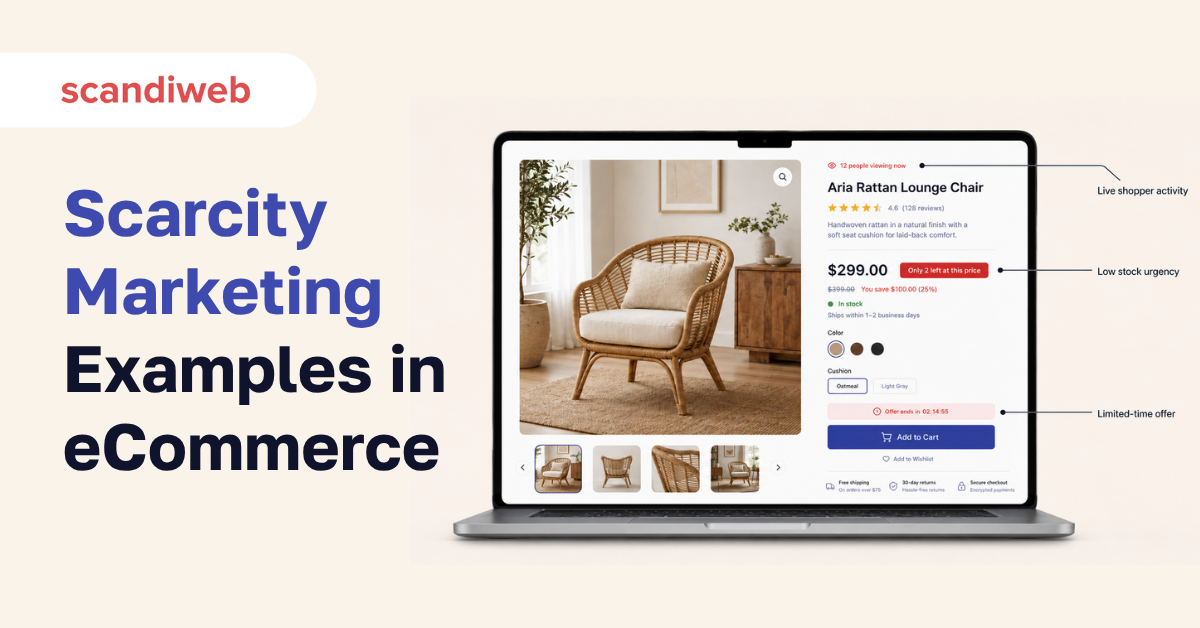
A shopper hovers over a small red badge on a product page. “Only 2 left at this price.” The cursor circles the buy button, drifts away, comes back. They start typing the product name into a new tab to check whether the badge is real. Three seconds later, the tab is closed and the cart is empty, not because the price was wrong, but because the scarcity signal felt like a sales tactic, not a fact.
That single hesitation is the whole job of scarcity marketing in 2026: build a cue strong enough to move a decision, honest enough that a careful shopper does not bounce. The merchants who win at scarcity treat it as inventory honesty wired into UX, not a pressure switch glued onto a checkout. With the documented average cart-abandonment rate sitting at 70.19% across Baymard’s 49-study dataset (Baymard Institute, 2025), the lever matters, but only when the lever is real.
Overview
- Scarcity marketing works because perceived limits shift perceived value, and a 2022 meta-analysis in the Journal of Retailing confirms the effect is strongest when shoppers do not detect marketer intent.
- Quantity-based cues (low-stock counts, exclusive drops, waitlists) outperform time-based cues (countdowns, flash sales) in head-to-head testing, and back-in-stock email flows are the single highest-converting flow type in eCommerce.
- The FTC and Nielsen Norman Group draw a hard line between honest scarcity and dark patterns, and getting that line right is the difference between an 8-figure year and a regulatory letter.
🚀 Quick takeaway
Scarcity is a value cue, not a pressure tactic. If the cue is true, it lifts conversion. If it is fabricated, it lifts complaints, returns, and FTC scrutiny.
What is scarcity marketing?
Scarcity marketing is the practice of communicating a genuine limit on supply, time, or access so that shoppers move from “considering” to “deciding” inside the same session. The limit can be a real low-stock count on a PDP, a real deadline on a price, a real cap on a drop, or a real access tier reserved for members. The keyword is real: the cue must reflect inventory or business reality the merchant can defend if a customer asks.
Done well, scarcity marketing compresses decision time, lifts conversion rate on hesitant shoppers, and recovers demand that would otherwise leak to a competitor tab. Done poorly, with fake countdowns, manufactured stock counts, or “only 1 left” labels that show up on every variant of every product, it earns chargebacks, refund requests, regulatory exposure, and a long-term hit to repeat purchase rate.
🚀 Quick takeaway
The same tactic that lifts a true-scarcity product page can sink a fake-scarcity product page. The cue is not the strategy. The truth behind the cue is.
The psychology behind scarcity marketing
The mechanic is older than eCommerce. Robert Cialdini’s Influence named scarcity as one of six universal persuasion principles: when a resource becomes harder to get, the brain treats it as worth more, often subconsciously. The behavior is consistent across cultures, ages, and product categories, which is why scarcity cues live everywhere from airline seat maps to limited-edition sneakers to grocery-aisle “while supplies last” stickers.
A 2022 meta-analysis published in the Journal of Retailing found that scarcity cues consistently lift purchase likelihood, with quantity-based scarcity producing larger effects than time-based scarcity and effects weakening when shoppers suspect the message is a marketing tactic (Barton et al., 2022). That last finding is the one most merchants underweight: a shopper who senses the badge is a tactic loses trust faster than a shopper who never saw a badge at all.
The three pressures scarcity triggers
- Loss aversion. Missing out on a product feels heavier than the satisfaction of buying it. The pain of the gap drives the decision.
- Competitive arousal. “12 other people are looking at this room” frames the purchase as a small race, which speeds up the close.
- Social validation. “Selling fast” implies other people have already vetted the choice, and the buyer borrows their confidence.
When all three fire at once on the same page, conversion rate moves. When the cues contradict each other (a “selling fast” badge next to 50 units in stock), the page reads as theater and conversion drops.
🚀 Quick takeaway
Quantity beats time. If you only have budget for one scarcity surface, make it a real low-stock signal on the PDP, not a countdown timer on the cart.
Types of scarcity: quantity, time, access, demand
Most eCommerce scarcity falls into one of four categories. Knowing which category a tactic belongs to makes it easier to pick the right surface for the right product.
| Type | What the limit is | Best for | Risk if faked |
|---|---|---|---|
| Quantity scarcity | Number of units left | PDPs, cart pages, drops | Lost trust, regulatory action |
| Time scarcity | A deadline (sale ends, price reverts) | Flash sales, BFCM, seasonal | Reader detection, banner blindness |
| Access scarcity | Who is allowed to buy | Loyalty tiers, presales, early drops | Backlash, “exclusivity” fatigue |
| Demand scarcity | How many other people want it | High-traffic PDPs, hotel/travel | Looks fake on low-traffic pages |
The honest application of each type maps to something the merchant already controls: warehouse counts, promo calendars, member tiers, or live traffic data. The dishonest application is when one of those numbers is invented because the real number is not interesting enough.
Scarcity marketing examples and tactics that work
Below are 11 specific tactics ordered roughly by implementation difficulty, with the type of scarcity each one uses and the trap most merchants fall into.
1. Real-time activity and low-stock signals
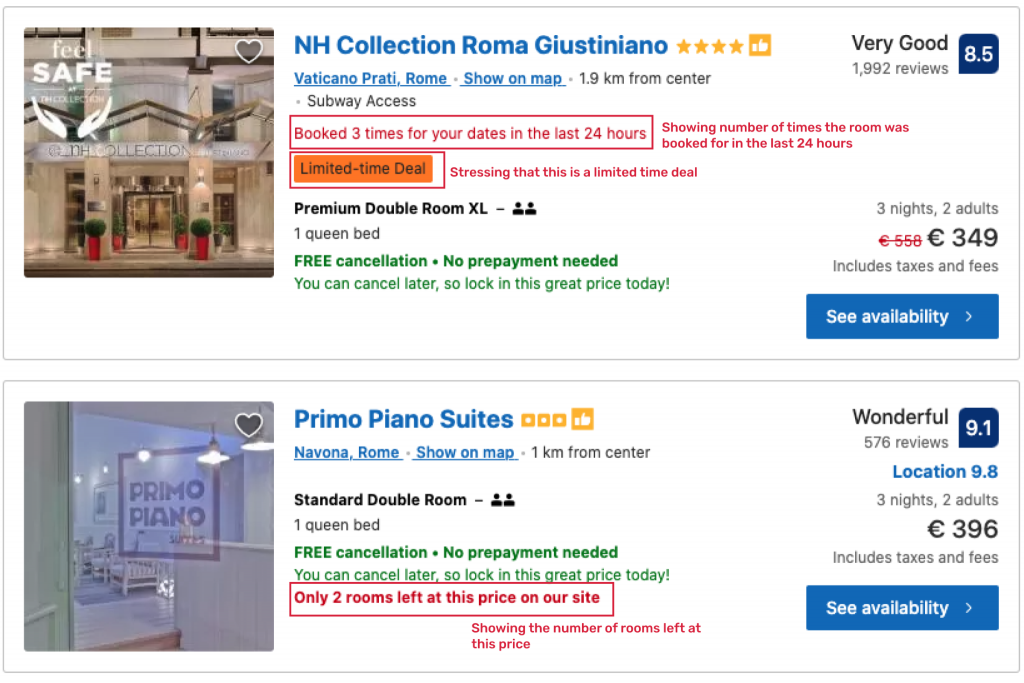
Booking.com sets the modern bar for quantity scarcity on a product page. “Only 2 rooms left at this price” is calibrated to actual inventory, refreshed by the booking system, and visible on every step from search results to confirmation. The cue works because shoppers know hotel rooms genuinely sell out, and the medium itself makes the message believable.
For physical-product eCommerce, the equivalent is a low-stock badge that shows when inventory falls below a category-specific threshold. Baymard’s PDP research consistently flags low-stock messages among the highest-impact additions to a product page when the count is real and the threshold is reasonable.
Stock badges work hardest when the add-to-cart itself is friction-free. Review the add-to-cart best practices before layering urgency on top.
2. Countdown timers for time-bound offers
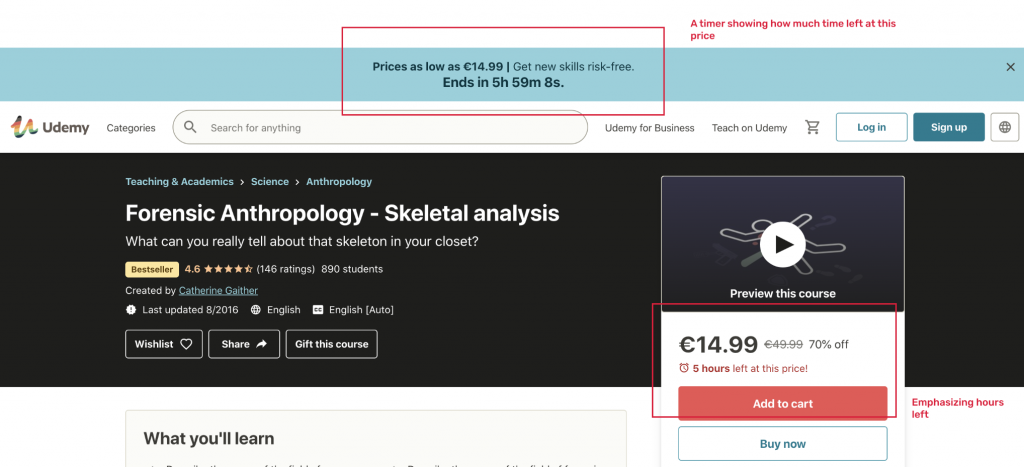
Countdown timers are the most over-used scarcity tactic in eCommerce, and the one most likely to read as fake. A timer that resets every time the page reloads is the canonical example of a dark pattern. A timer tied to a real sale window, where the price genuinely reverts when the clock hits zero, earns the same lift quantity scarcity does, without the trust cost.
Place timers on the same screen as price and stock, not floating across the header. Tie the countdown to the cart so shoppers see the urgency at the decision point, not on a landing page they will leave.
Timers belong on the same screen as price and stock. Our product detail page best practices cover where each urgency element should sit.
🚀 Quick takeaway
A countdown timer is only as honest as the price behind it. If the discount stays after the clock hits zero, the timer is a dark pattern and the FTC has named it as such.
3. Scarcity copy that converts without manipulation
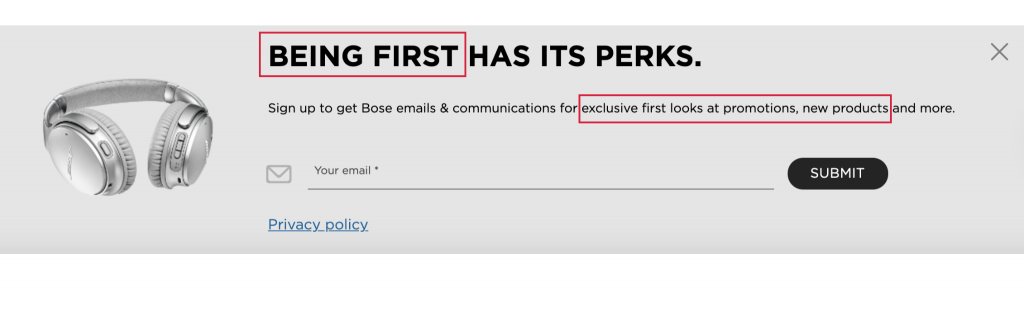
Bose runs a quieter form of scarcity through copy alone. “Sign up before this offer ends” sits inside a newsletter prompt, not on a PDP, and the offer behind it is a real time-bound bundle. The copy borrows the urgency framing without staging a fake limit.
The pattern works on landing pages, exit popups, and email subject lines. Two rules: name what the limit is (a price, a bundle, a window), and make the limit verifiable. “Last chance for the spring bundle, ends Sunday” is honest scarcity copy. “Hurry, supplies won’t last” is filler.
4. Push and email reminders for cart and back-in-stock
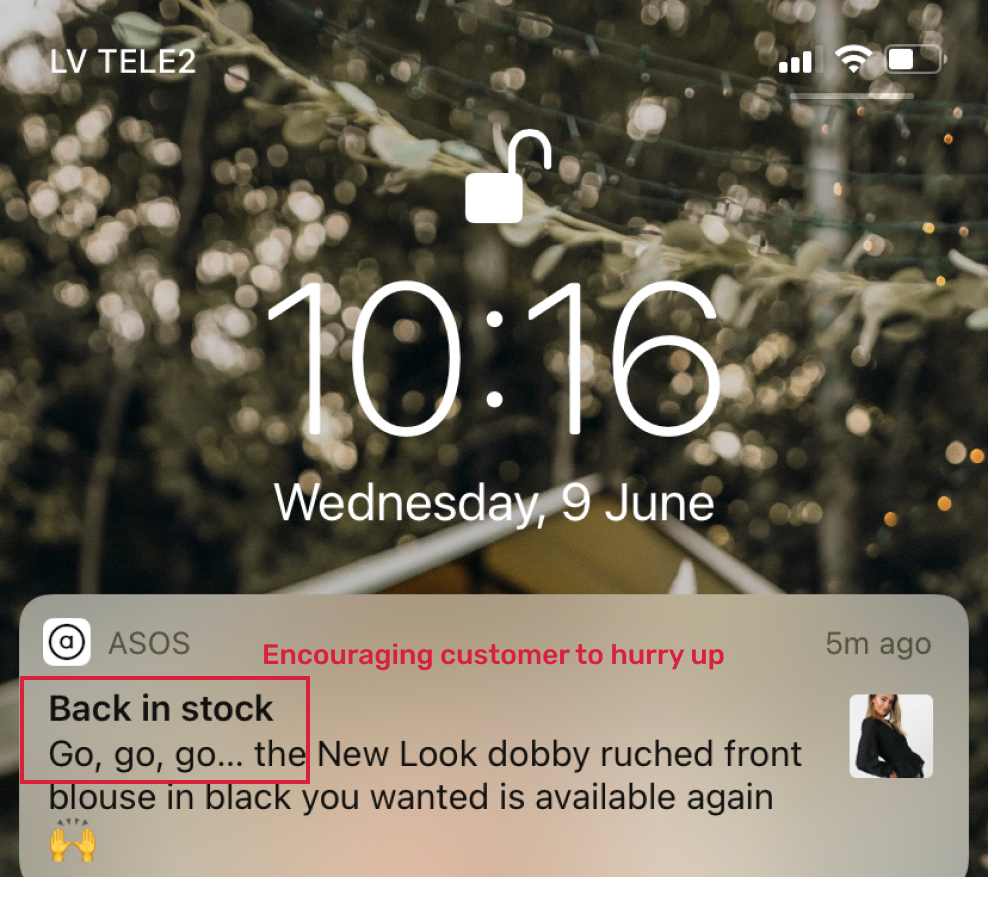
Asos uses push notifications and email to bring scarcity into the moment after a shopper leaves the site. The push reads like a friendly reminder, but the payload is scarcity-framed: the item the shopper viewed is still available, the size they wanted is now down to one, the price has dropped for the next 24 hours.
Back-in-stock email flows turn the same mechanic into the highest-converting message in the eCommerce inbox. Klaviyo’s 2025 eCommerce benchmarks show back-in-stock email flows are the single highest-converting flow type, with open rates near 65% and conversion rates of 12 to 15 percent (Klaviyo, 2025). The mechanic works because the scarcity is real, the product was actually gone and is actually back, and the shopper opted in to be told the moment it returned.
The same urgency mechanics also power high-converting recovery messages. See our breakdown of abandoned cart best practices for the copy patterns that recover the most carts.
5. Limited-edition drops and exclusivity
Nike SNKRS, Supreme, and the modern streetwear playbook are built on a single scarcity mechanic: the drop. A small, fixed inventory of a hyped product, released at a single time, sold to whoever is fastest. The scarcity is the product. Resale value props the demand up. The next drop refills the audience’s anticipation.
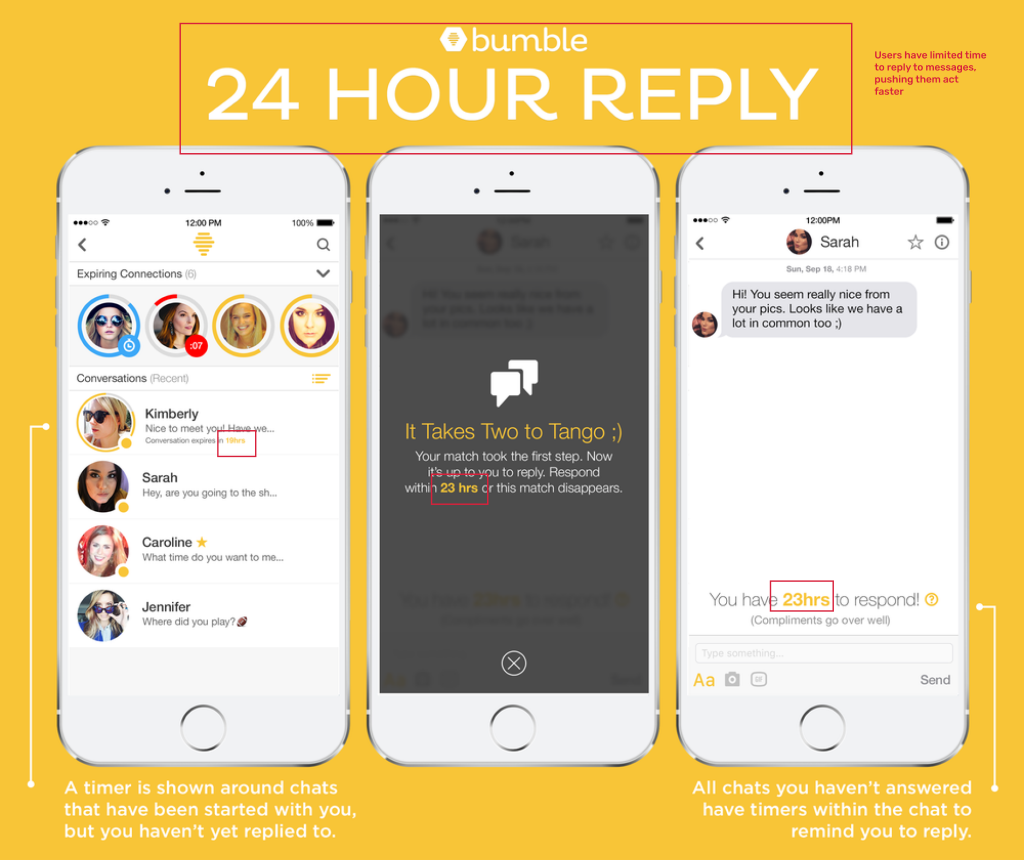
Bumble runs a softer version of the same idea, where the dating app uses time-limited match windows to push interaction inside the app. Outside fashion and dating, drops work for any merchant that can credibly produce a limited run: collabs, seasonal SKUs, anniversary editions, regional exclusives.
6. Flash sales and seasonal scarcity
A flash sale is a planned, time-boxed scarcity event, typically 24 to 72 hours, sometimes tied to a holiday calendar, sometimes triggered by inventory clearance. The scarcity is the price window, and the visible deadline is what moves shoppers from window-shopping to buying.
The biggest scarcity moment of the year is the BFCM window, where almost every merchant runs a layered scarcity event. For the year’s biggest scarcity moment, see our Black Friday preparation guide on staging multi-day urgency without breaking site performance.
7. Exclusive member access and early drops
Access scarcity gates a product behind membership rather than supply. Sephora Beauty Insider, Nike’s SNKRS Pass, and any modern loyalty program use early access, 24 hours before the public, sometimes a week, as a reward worth signing up for. The shopper feels the access as exclusivity. The merchant feels it as a higher-converting cohort with first-mover purchase data.
Members-only drops convert harder when they sit inside a wider rewards system. Our loyalty program setup guide walks through how to structure tiers and access perks.
8. Waitlists and back-in-stock signups
When a product is genuinely sold out, the worst response is a static “out of stock” label. The best response is a waitlist with a real notification trigger. The shopper opts in, the inventory replenishes, and the back-in-stock email lands in their inbox the moment the SKU is buyable again. Klaviyo’s benchmark of 12 to 15 percent conversion on those flows is the proof.
Waitlists also collect demand intelligence that informs reorder quantity, manufacturing schedule, and which SKUs to drop next. The scarcity cue becomes a forecasting tool, not just a conversion tactic.
9. Social proof scarcity (“12 people are viewing this”)
Demand scarcity works best on pages with enough traffic to make the count credible. “1,247 people bought this in the last 24 hours” reads as proof on a hero SKU and as theater on a long-tail SKU with 12 visits a month. Use the tactic only where the underlying number is genuinely high. Switch to a different scarcity cue on low-traffic pages.
The counts must be real. Most modern social-proof widgets pull from actual store data. The temptation to inflate the number with a “smoothing factor” is exactly what the FTC and class-action lawyers look for.
10. Bundle and gift-with-purchase windows
Scarcity wrapped around a bundle frames the deal as the limit. “Free travel kit with orders over $75, this week only” is a time-bound, conditional scarcity offer that lifts AOV instead of unit conversion. The shopper adds an extra item not because they need it, but because the gift will not be there next week.
Bundle scarcity works when the gift has perceived value (a real product, not a sample), when the deadline is real (the kit really does disappear), and when the threshold is set just above the average cart value (so the deal stretches the cart by one item, not three).
11. Pre-order windows with fixed allocations
Pre-orders are scarcity at the supply-chain layer. A product is announced before it manufactures. A fixed number of units is allocated to the pre-order window. The merchant signals that the first batch is the only batch shipping by a certain date. Late buyers either wait for restock or miss out.
Tesla, Apple, and most game launches use this pattern. For smaller merchants, pre-order scarcity works for any product with a real production lead time, where the scarcity is honest because the supply genuinely is constrained by manufacturing reality.
🚀 Quick takeaway
Eleven tactics, four scarcity types. The wrong question is “which one should I use?” The right question is “which one matches a real limit in my business?”
How to implement scarcity marketing on your store (5-step playbook)
A scarcity program is a sequence of small, testable changes, not a single feature rollout. The five steps below are the order most CRO teams run them in.
- Audit existing inventory and promo data. Map which SKUs have genuine low-stock moments, which sales have real deadlines, and which products have member-tier exclusivity. The list of where you can deploy honest scarcity is shorter than the list of places competitors deploy fake scarcity, so start with the honest list.
- Pick one scarcity surface per page type. PDP gets a low-stock badge. Cart gets a price-window timer if there is a real sale. Member tiers get an early-access banner. Do not stack three cues on one page. That is when readers smell theater.
- Pair the cue with frictionless add-to-cart. Scarcity drives intent. Conversion needs the next step to be clean. Pair scarcity cues with relevant suggestions at the cart. Our guide on upselling techniques covers the placements that lift average order value without breaking trust.
- A/B test against a no-scarcity control. The lift from real scarcity is usually 5 to 20 percent on the affected page. If your test shows 80%, the control is broken. If your test shows zero, the cue is invisible or the audience already trusts the brand enough to not need it. A disciplined conversion rate optimization program is what keeps these tests honest.
- Watch for downstream effects. Track return rate, refund rate, and 30-day repeat purchase. A scarcity tactic that lifts conversion but tanks returns is moving cost from one bucket to another. The net is what matters.
Scarcity marketing metrics: what to measure
Scarcity is measured on more than the conversion rate of the page it sits on. The full instrument panel includes:
- Conversion rate on the affected surface, the headline metric, measured against a no-scarcity control.
- Click-to-cart and cart-to-checkout, where scarcity that lifts add-to-cart but not checkout means the cue is doing the wrong job.
- Return rate and refund rate, the trust signal, since fake scarcity inflates both.
- Back-in-stock email open and conversion rate, with Klaviyo’s 65% open and 12 to 15 percent conversion benchmark as the bar.
- Repeat purchase rate at 30, 60, 90 days, the long-term trust signal.
- Net promoter score and review sentiment, where fake scarcity gets noticed first.
A scarcity program that lifts the first metric while degrading the bottom three is a CRO failure dressed up as a CRO win. Run the full panel from day one.
Ethical scarcity vs dark patterns: where the FTC draws the line
The line between honest scarcity and a dark pattern is sharper in 2026 than it was five years ago. Nielsen Norman Group draws a clean line between honest scarcity, where the deadline or stock count reflects reality, and deceptive scarcity, which erodes trust and can trigger regulatory action (Nielsen Norman Group, 2024).
The Federal Trade Commission’s Bringing Dark Patterns to Light report explicitly names “false urgency claims” and “fake low-stock messages” as deceptive practices that can trigger enforcement under the FTC Act (FTC, 2022). The report has been the basis for repeated enforcement actions, and the agency’s most recent guidance has expanded the scope to include reset-on-reload countdowns, manufactured social-proof counters, and “Only X left” badges that show identical values across unrelated products.
The five dark patterns to avoid
- Reset-on-reload countdown timers. A timer that restarts when the page reloads is a fabricated deadline.
- Stock counts that do not move. A “Only 3 left” badge that has read “3” for three weeks is theater, not scarcity.
- Identical counts across the catalog. When every product page shows “Only 2 left”, shoppers notice.
- Social-proof counters with no source. “1,247 people are viewing this” with no underlying analytics is fabrication.
- Hidden conditions on scarcity claims. “Last chance” pricing that returns the next day, with a different label, is the exact behavior the FTC has cited.
If a tactic on the list above is currently running on your store, the right move is to disable it before A/B testing a real-scarcity replacement. The replacement will usually convert better and never carry the regulatory risk.
🚀 Quick takeaway
The cheapest way to lose a trust battle is to fake a number a curious shopper can verify. Honest scarcity is rare enough to be a differentiator on its own.
Scarcity marketing examples from leading brands
A short tour of merchants running scarcity well today:
- Apple runs pre-order scarcity on every major launch. The allocation is real, the delivery date moves on every minute of delay, and the urgency is the shipping window, not a fake timer.
- Nike SNKRS runs drop scarcity with member-tier access. The combination of access and quantity scarcity is the strongest two-cue stack in modern eCommerce.
- Booking.com runs honest demand and quantity scarcity tied to real inventory. The cues are visible at every step from search to checkout.
- Amazon runs low-stock scarcity on PDPs alongside “delivered by” date pressure on the same page. The dual cue compresses the consideration window without crossing into manipulation.
- Supreme runs limited-edition scarcity as the product. The drop sells out in seconds because the scarcity is the value proposition, not a layer added to it.
The common thread: in every example, the scarcity cue reflects a real business constraint. None of these merchants are inventing limits. They are surfacing the ones they already have.
How does scarcity marketing actually work in practice?
Scarcity marketing works by closing the gap between intent and action. A shopper who is 80% sure they want a product needs a small reason to decide now rather than later. A real low-stock badge, a real deadline, a real access window, any of these supplies that small reason. The mechanic is psychological, but the signal must be operational.
The 20% of shoppers who never convert under scarcity are usually the careful researchers who verify the badge before clicking. If the badge survives their verification, conversion lift extends to that cohort too. If the badge does not survive, the cohort leaves and tells other people. Long-run, the honest version of scarcity outperforms the fake version on every metric except the first conversion test, which is exactly why most merchants who shortcut the playbook regret it within 90 days.
Is scarcity marketing ethical?
Scarcity marketing is ethical when the cue reflects a real limit and unethical when the cue is fabricated. The dividing line is whether a shopper who pauses to verify the claim would find the merchant telling the truth. A countdown timer tied to a real sale window is ethical. A countdown timer that resets when the page reloads is a dark pattern named by the FTC.
The ethical test is also the practical test: fake scarcity erodes the trust that makes honest scarcity work. Merchants who use both end up with worse conversion than merchants who use neither.
When does scarcity marketing backfire?
Scarcity marketing backfires when the cue is visibly fake, when multiple cues stack on the same page until the page reads as theater, or when the underlying product does not deserve the urgency the cue implies. A low-stock badge on a slow-moving SKU draws attention to the slow movement. A timer on a price that never changes draws attention to the false claim. A “limited edition” label on a perpetual catalog item reads as a marketing decision, not a product decision.
The other common backfire mode is over-deployment: scarcity on every PDP, every cart, every email, every push. When everything is urgent, nothing is. Reserve scarcity for the surfaces where it earns its place.
FAQ
What is scarcity marketing in eCommerce?
Scarcity marketing in eCommerce is the practice of communicating a real limit on supply, time, or access to compress decision time and lift conversion on hesitant shoppers. The limit can be a low-stock count, a sale deadline, an access tier, or a pre-order allocation, and in every case the requirement is that the limit is true.
Does scarcity marketing actually work?
Yes. A 2022 meta-analysis in the Journal of Retailing found that scarcity cues consistently lift purchase likelihood, with quantity-based scarcity producing larger effects than time-based scarcity. The effect weakens sharply when shoppers detect the cue is a marketing tactic rather than a reflection of reality.
What is an example of scarcity in marketing?
Booking.com’s “Only 2 rooms left at this price” badge is the canonical example. The badge is tied to real inventory, refreshed by the booking system, and visible on every step from search to confirmation. The cue moves shoppers because the medium itself, hotel rooms that genuinely sell out, makes the message believable.
How do you use scarcity in marketing without being manipulative?
Tie every scarcity cue to a real business constraint, audit your store for reset-on-reload timers and static stock counts, never stack more than one scarcity surface per page, and A/B test against a no-scarcity control to measure the real lift. If a tactic only works when the underlying claim is fake, drop it.
Is fake scarcity marketing illegal?
In the United States, the FTC’s Bringing Dark Patterns to Light report explicitly names false urgency claims and fake low-stock messages as deceptive practices that can trigger enforcement under the FTC Act. Multiple merchants have faced enforcement actions for fabricated countdown timers and manufactured stock counts. The regulatory exposure is real, even before the trust and reputation cost.
Which scarcity tactic converts best for eCommerce?
Back-in-stock email flows are the single highest-converting flow type in eCommerce, with open rates near 65% and conversion rates of 12 to 15 percent according to Klaviyo’s 2025 benchmarks. On product pages, real low-stock badges are the most consistent quantity-scarcity lift. For seasonal moments, a real flash-sale countdown tied to a true price window outperforms an evergreen “limited time” banner.
How does scarcity marketing compare to urgency marketing?
Scarcity is about supply (how much is left, how many can buy, who has access). Urgency is about time (when the offer ends, when the price changes, when the deadline hits). Most modern eCommerce campaigns blend the two, since a flash sale uses urgency framing on a scarcity-shaped deal, but the underlying psychology is different. Quantity scarcity tends to produce larger lifts than time urgency alone.
How scandiweb helps merchants run scarcity-driven CRO
The decision in front of most merchants is not whether to add scarcity. It is which surfaces to deploy it on, how to ground each cue in real business data, and where to draw the line that keeps the FTC out of the inbox. That mapping is what a serious eCommerce strategy program does in the first 30 days.
If you are auditing your funnel end-to-end, our eCommerce uplift hacks catalog the highest-ROI changes we see most stores miss. The scarcity layer is one of them, but only when it sits on top of a clean PDP, a fast checkout, and an honest stock feed. scandiweb has shipped 2,100+ eCommerce projects across Adobe Commerce, Shopify Plus, and headless builds, including CRO programs for named clients like PUMA, OM System, and Jaidah Group, and the same pattern shows up every time: the merchants who scale scarcity responsibly are the ones who treat it as a product decision, not a marketing decoration.
If your team is weighing which scarcity tactic to run next, the answer almost always starts with what real limits already exist in the business, not what you can add to the UI. Talk to our CRO team about mapping the honest scarcity moments in your funnel, A/B testing them against the right controls, and pulling the dark-pattern tactics out before they become the regulatory problem.