If your team keeps forwarding you headlines about shopping inside ChatGPT and asking whether the brand needs to do something about it, this guide gives you the answer and the reasoning behind it.
ChatGPT apps for eCommerce are third-party services that run inside ChatGPT, so a shopper can find products and act on them without leaving the conversation. They are built with OpenAI’s Apps SDK, launched in October 2025, and they are a different thing from the ChatGPT chatbot, from custom GPTs, and from the older plugins.
The reason this matters now, rather than next year, is timing. ChatGPT reached around 800 million weekly active users by late 2025, and OpenAI has spent the months since turning it into a place where people find and buy things, not only a place where they write. Most of the content ranking for this topic is either a product page from OpenAI or a vendor pitch telling you to build a custom app today. Our guide explains what a ChatGPT app is, how it works, what changed through 2026, and how to decide whether your store should build one, prepare for it, or wait.
We write this from a specific vantage point. scandiweb has put apps built on the same underlying standard into production, including a content agent and a PPC audit agent, so the guidance here comes from systems we build and maintain ourselves.
🚀 Quick takeaway
The real question behind “what is a ChatGPT app” is whether your store will be discovered, or skipped, inside the assistant 800 million people open every week.
What a ChatGPT app is
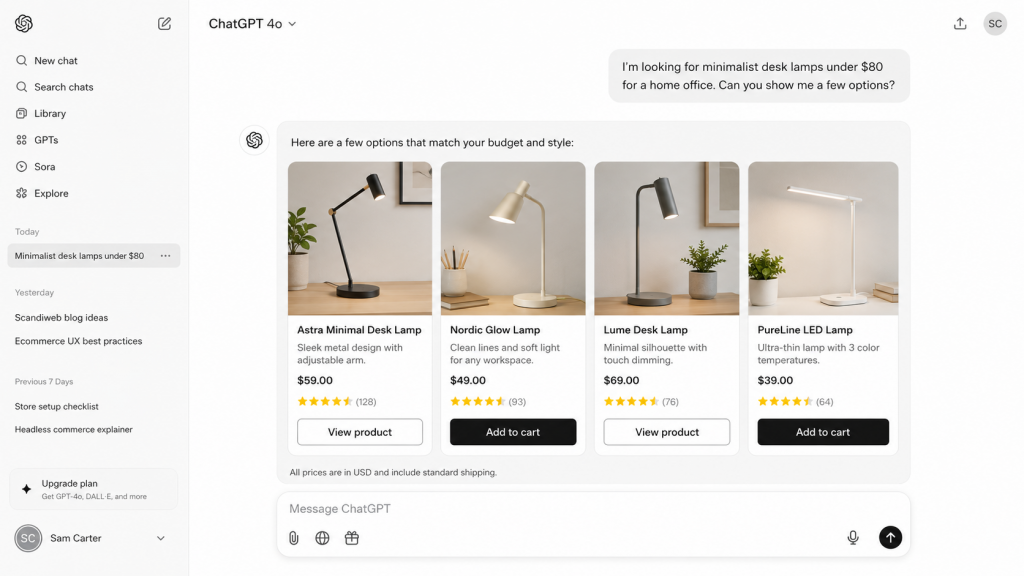
ChatGPT apps are third-party services that run inside ChatGPT, so people can use them in a normal conversation instead of leaving for a separate site. In eCommerce, that means a shopper can browse your catalog, get a recommendation, and in some cases complete a purchase without opening a browser tab. Apps are built with OpenAI’s Apps SDK, launched in October 2025, and they differ from the ChatGPT chatbot, custom GPTs, and older plugins.
The distinction matters because the word “app” is doing a lot of work here. This is not your mobile app reskinned for ChatGPT, and it is not a marketing chatbot bolted onto your storefront. A ChatGPT app is a connected service that ChatGPT can call mid-conversation, render inside the chat with its own interface, and use to take real actions against your live systems. When a shopper asks ChatGPT to find a winter coat under a set budget, an app can return your actual products, in stock, with a way to act on them right there.
Three properties make a ChatGPT app different from anything merchants have plugged into before:
- It runs inside the conversation, so the shopper never context-switches to a new tab or site.
- It reads live data from your systems, so prices, stock, and variants are current rather than scraped or stale.
- It can take actions, from adding to a cart to starting an order, depending on how far you build it.
For a merchant, the practical model is straightforward. ChatGPT is the place the customer already is. The app is how your store shows up there with real data and real functionality, rather than as a static link the model might happen to mention.
🚀 Quick takeaway
A ChatGPT app is a live connection to your commerce systems, not a chatbot. That difference is the whole reason it can sell, and the whole reason it takes engineering.
ChatGPT apps vs GPTs, plugins, and Instant Checkout
A ChatGPT app is built on the Apps SDK and connects ChatGPT to your live systems through an MCP server, with an interactive interface inside the chat. A custom GPT is a configured version of ChatGPT with instructions and files, not a connected service. Plugins and connectors were the earlier integration model. Instant Checkout is a separate payment feature that lets shoppers buy from supported merchants in chat without a full app.
This is the single most common point of confusion, so it is worth a clear comparison. Merchants are being sold “ChatGPT apps” by some vendors and “custom GPTs” by others, and the two solve different problems at very different cost.
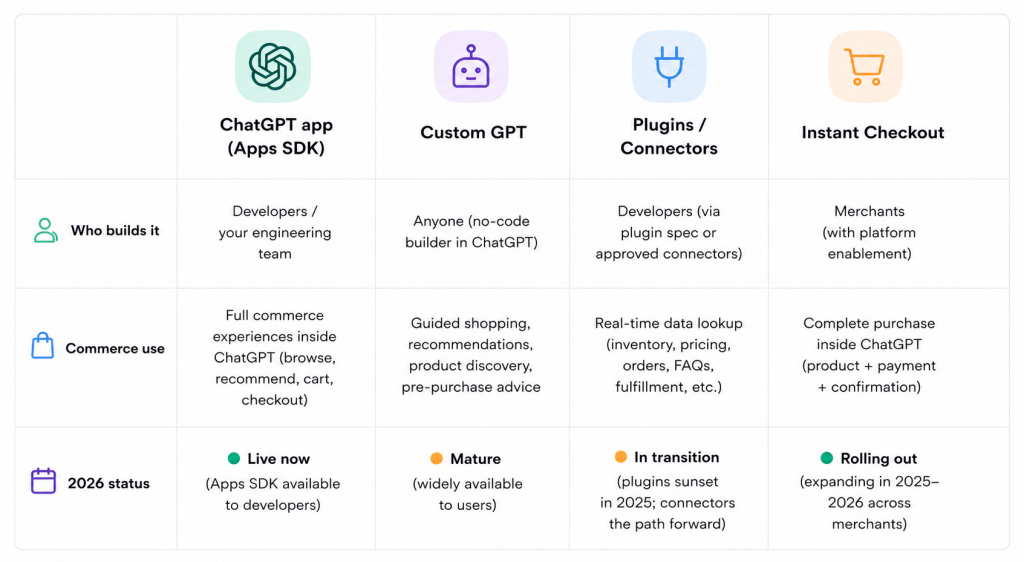
A custom GPT is a quick experiment a marketing team can stand up in an afternoon. It can hold your tone of voice and a few documents, but it does not see your live catalog or take orders. A ChatGPT app is a connected channel that does. Instant Checkout works alongside both as a payment path you can switch on through a supported platform, even before you commit to building an app of your own.
The reason this confusion is expensive: a vendor who pitches “a custom ChatGPT app” for the price of an app build, but delivers a custom GPT, has sold you a brochure when you needed a storefront. Knowing which of the four you actually need is the first real decision.
How ChatGPT apps work, the Apps SDK, and MCP
A ChatGPT app has three parts: tools that let ChatGPT take actions, structured data the model can read, and widgets that render an interface inside the chat. Underneath, the Apps SDK runs on the Model Context Protocol, the open standard that lets ChatGPT connect to external tools and data. For a store, that means your catalog, inventory, and order systems can be reached through one MCP server that the app talks to.
If that last part sounds familiar, it should. The Model Context Protocol is the same standard we covered in depth in our guide to MCP. The Apps SDK builds directly on it, which is why a ChatGPT app is, underneath, an MCP server with an app layer on top. MCP is the plumbing that lets an assistant reach external tools and data in a consistent way. The Apps SDK is what OpenAI layered on top so those connections can run, and render, inside ChatGPT.
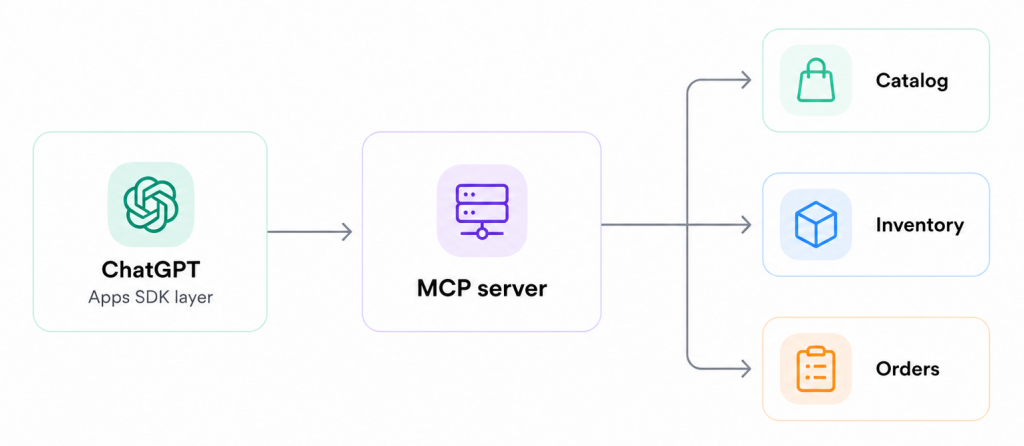
Walk it through in the order a request travels:
- A shopper asks ChatGPT something your app can answer, such as a product search or an availability check.
- ChatGPT calls one of your tools, the named actions you have exposed, like
search_productsorcheck_stock. - Your MCP server receives that call, queries your live commerce systems, and returns structured data the model can read.
- A widget renders the result inside the chat, a product grid or a configuration panel, so the shopper can act without leaving.
The engineering reality comes down to one component you have to own and maintain: an MCP server that exposes your commerce systems in a way ChatGPT can use safely. The widgets and conversation flow are on top of that server. This is why the build question is really an infrastructure question, and why stores with clean, well-structured catalog and inventory data have a real head start. A store whose product data is scattered across spreadsheets and a tired PIM will spend most of the project getting that data fit to expose, before a single widget is drawn.
Why ChatGPT apps matter for eCommerce
ChatGPT reached around 800 million weekly active users by late 2025, which makes it a discovery surface, not only a writing tool. As shopping shifts toward agentic commerce, where an assistant helps choose and buy, brands that are reachable inside ChatGPT can be recommended at the moment of intent. For eCommerce, the value is presence in the conversation where a purchase decision is forming, rather than waiting for a separate site visit.
This is a meaningful change in where discovery happens. For two decades, the contest was for position in a list of blue links. In an assistant-led model, the contest is for being the answer the assistant reaches for when a customer describes what they want. That is the heart of agentic commerce – the assistant does more of the searching and comparing, and sometimes the buying, on the customer’s behalf.
There are two implications worth considering. A customer who completes a purchase inside ChatGPT may never touch your site, which changes how you think about owned traffic, analytics, and the first-party data you have relied on. And the brands that are structured to be reachable, with clean feeds and a working app, are the ones in the consideration set at all. The brands that are not structured for it simply will not appear, the same way a store with no SEO never showed up in organic search.
That second point is the one to take to leadership. This is less about a new marketing channel and more about whether your products are legible to the systems that are starting to mediate demand. A brand can have the better product and still lose the recommendation to a competitor whose data an assistant can actually read and act on.
🚀 Quick takeaway
In assistant-led shopping, you are competing to be the single option the assistant surfaces, which is a narrower and less forgiving race than competing for a higher ranking.
Shopping and Instant Checkout inside ChatGPT
Customers can already buy inside ChatGPT in some cases. OpenAI’s Instant Checkout, announced in September 2025 and built with Stripe, lets US shoppers purchase from supported merchants in the chat, starting with Etsy sellers and expanding toward Shopify merchants. It runs on the Agentic Commerce Protocol, an open standard that handles how a merchant’s products, promotions, and orders move through the conversation.
Instant Checkout is the lower-effort entry point. You do not have to build a full app to be purchasable, provided your platform supports the integration. The difference is between being buyable inside ChatGPT and owning a richer, branded experience there. Many stores will start by being buyable through Instant Checkout while they weigh the decision about a full app.
How to get your products discovered in ChatGPT
Being buildable is not the same as being found. Before a ChatGPT app or Instant Checkout can sell anything, your products have to be legible to the assistant, which comes down to the quality and structure of your product data. This is the work that almost every store can start now, regardless of whether they ever build an app.
A few things carry most of the weight:
- Clean, structured product feeds. Titles, attributes, variants, availability, and pricing that are accurate and machine-readable. If you sell through Shopify, the Shopify Catalog route is one way merchant products reach ChatGPT users.
- Rich attributes. Material, fit, compatibility, use case. An assistant matching “a waterproof jacket for commuting” needs the attributes that let it match, not only a product title.
- Consistent identifiers. GTINs, SKUs, and category mappings that line up across your systems, so the same product is not described three different ways.
This is familiar territory for any team that has done serious product information management, and it is why a clean PIM and a disciplined feed strategy pay off twice. Once for traditional channels, and again for assistant-led discovery.
🚀 Quick takeaway
You can prepare for ChatGPT commerce without writing a line of app code. Clean, richly attributed product data is the entry ticket, and most stores do not have it yet.
What changed in 2026, the shift to brand-owned apps
Through early 2026, OpenAI shifted its commerce focus away from checkout inside the chat and toward brand-owned ChatGPT apps, giving merchants more control over the buying experience. Around 100 companies had apps by then, Instacart integrated in December 2025, and Walmart launched a standalone app. The signal is that owning your own app, rather than relying only on in-chat checkout, is becoming the more durable path.
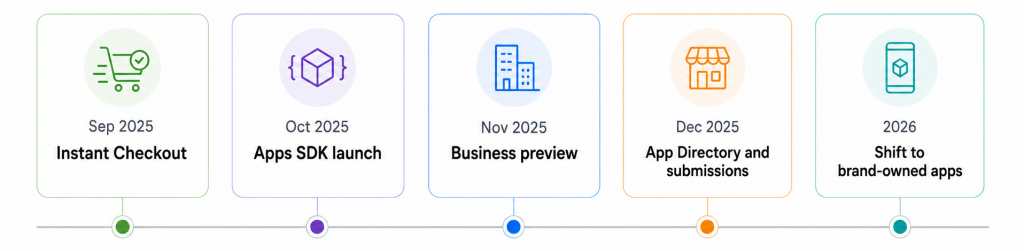
This is the part that most ranking content has not caught up with. The early story, in late 2025, was “buy directly in ChatGPT.” The 2026 story is more layered: OpenAI appears to be steering high-intent commerce toward apps the brand controls, where the merchant owns more of the experience, the data, and the customer relationship. The App Directory, which opened to third-party submissions in December 2025, is the front door for that model, and the early movers are large retailers who can see where this is heading.
If you are setting a strategy, treat the direction of travel as the planning input, rather than any single week’s announcement. The platform is moving toward brand-owned apps as the serious commerce surface, with feed-based discovery and Instant Checkout as the lighter-weight ways to participate in the meantime. A merchant who plans only around in-chat checkout is planning around the version OpenAI is already moving past.
How to build a ChatGPT app for your store
Building a ChatGPT app requires a paid OpenAI plan with developer mode enabled, then an app made of tools, structured output, widgets, and an MCP server. Apps are submitted through OpenAI’s developer platform for the App Directory, which opened in December 2025. At launch, apps were unavailable to logged-in users in the EEA, Switzerland, and the UK, which matters for European brands planning rollout.
In practice, a build moves through a handful of stages:
- Connect your systems through an MCP server. This is the foundational piece and usually the largest share of the work. The server exposes your catalog, inventory, and order operations as tools ChatGPT can call.
- Define the tools. Decide what ChatGPT is allowed to do, such as search the catalog, check availability, or start an order, and set the guardrails on each.
- Build the widgets. The interface that renders inside the chat, the product grid, the configurator, the order summary.
- Submit to the App Directory. Package the required metadata, testing, and country availability, then submit through the developer platform for review.
The work resembles other production agent builds more than it resembles front-end web work. When scandiweb built the Claude Blog Factory and a PPC audit agent, the hard and valuable parts were the same: connecting the model to real systems through MCP, defining safe actions, and maintaining the connection as the platform changed underneath. A store-specific ChatGPT app follows that shape, with your commerce stack in place of the marketing systems.
On cost, there is no single number, and any vendor quoting one without seeing your data is guessing. The real drivers are the state of your product data, the number and complexity of the actions you want to support, and whether you build in-house or with a partner. The ongoing cost is maintenance: an app that talks to your live systems needs care as both your stack and OpenAI’s platform evolve.
🚀 Quick takeaway
Roughly speaking, the MCP server is the project. The tools and widgets layer onto it, which is why stores with clean catalog and inventory data build faster and at lower cost.
One caution for European merchants! Regional availability has lagged, and at launch, apps were not available to logged-in users in the European Economic Area, Switzerland, and the UK. If those are your primary markets, confirm current support before committing to a build timeline, and use the wait to get your product feeds in order so you are ready when availability widens.
Should your store build a ChatGPT app now?
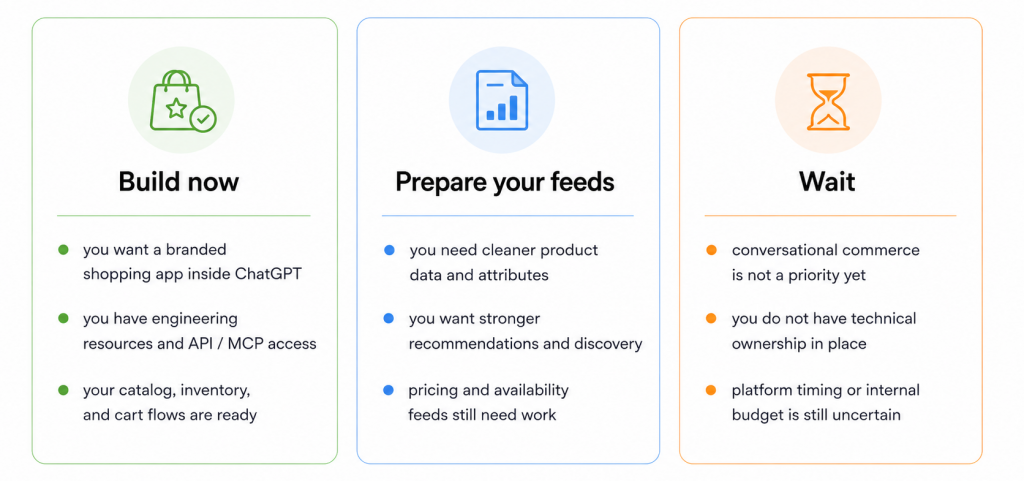
For most stores, the honest answer in 2026 is to prepare, not rush. Building a full ChatGPT app makes sense when you have the engineering capacity and a clear in-chat use case. Preparing your product feeds and data makes sense for almost everyone because it is the low-cost way to be discoverable. Waiting is reasonable if you sell mainly in the EEA or UK, where availability still lags.
Build a ChatGPT app now if:
- You have in-house or partner engineering capacity to maintain an MCP server and app
- You have a clear, repeatable in-chat use case such as reorder, configure, or check availability
- Your buyers are US-based, where the commerce features are live
- You can commit to maintaining the app as OpenAI’s platform changes
- You want a defensible early position before competitors fill the directory.
Prepare your feeds and data instead if:
- You want ChatGPT discoverability without owning an app yet
- Your catalog and inventory data are not yet clean or well-structured
- You sell through Shopify and can use the Shopify Catalog route
- You want to test demand before committing to an engineering budget.
Wait if:
- Your primary market is the EEA, Switzerland, or the UK
- You have no engineering capacity and no development partner
- Your category sees little assistant-driven discovery today.
If you are weighing where your store falls, our team can run a readiness assessment using the same MCP stack we have already put into production, so the decision rests on your catalog, your markets, and your capacity rather than on a vendor’s timeline.
Frequently asked questions about ChatGPT apps for eCommerce
What are ChatGPT apps for eCommerce?
ChatGPT apps for eCommerce are third-party services that run inside ChatGPT, letting shoppers discover products, ask questions, and sometimes buy without leaving the conversation. They are built with OpenAI’s Apps SDK, which connects ChatGPT to a store’s catalog and systems through an MCP server. They differ from the ChatGPT chatbot, from custom GPTs, and from the separate Instant Checkout payment feature.
What apps are available in ChatGPT?
Early ChatGPT apps include Booking.com, Canva, Coursera, Expedia, Figma, Spotify, and Zillow, with Uber, DoorDash, Instacart, OpenTable, Target, and Tripadvisor following. After the App Directory opened in December 2025, third-party developers began submitting their own. The mix is growing quickly, and a notable share are shopping-oriented, including major retailers.
How do I use apps in ChatGPT?
In a supported ChatGPT plan, you can call an app by name in a conversation, or ChatGPT may suggest one when it fits your request. The app then runs inside the chat, showing an interface where you can browse, configure, or act without opening a separate site. Availability depends on your plan and your region.
Is the Apps SDK the same as MCP?
No, but they are closely linked. MCP, the Model Context Protocol, is the open standard that lets ChatGPT connect to external tools and data. The Apps SDK builds on MCP and adds the parts needed to run an app inside ChatGPT, such as interactive widgets. In practice, building a ChatGPT app means running an MCP server plus the app layer on top.
Can customers buy products directly in ChatGPT?
In some cases, yes. OpenAI’s Instant Checkout, announced in September 2025 and built with Stripe, lets US shoppers buy from supported merchants inside the chat, starting with Etsy sellers and expanding to Shopify merchants. Through 2026, OpenAI also shifted toward brand-owned apps, where the merchant has more control over the purchase experience.
How much does it cost to build a ChatGPT app?
There is no fixed price. Cost depends on the complexity of your use case, the state of your catalog and inventory data, and whether you build in-house or with a partner. The main ongoing investment is engineering time to build and maintain an MCP server connected to your commerce systems, plus a paid OpenAI plan with developer mode enabled.
Are ChatGPT apps available in the EU and UK?
At launch, ChatGPT apps were unavailable to logged-in users in the European Economic Area, Switzerland, and the UK, with availability rolling out over time. European brands should confirm current regional support before planning a launch, and may prioritize preparing product feeds while waiting for fuller availability.
Should an eCommerce brand build a ChatGPT app or use Instant Checkout?
For most brands in 2026, the practical path is to prepare product feeds and data first, then decide between a full app and Instant Checkout based on use case and market. Build an app when you have engineering capacity and a clear in-chat use case. Rely on Instant Checkout or feed-based discovery when you want presence without maintaining an app.
Where ChatGPT apps fit in your commerce roadmap
ChatGPT apps for eCommerce have moved from a developer demo to a discovery and buying surface that 800 million weekly users already touch. The sensible first move for most merchants is getting your catalog and data clean enough to be discoverable, then choosing between a brand-owned app and Instant Checkout based on your markets and your engineering capacity. The brands that prepare now will be in the consideration set when assistant-led shopping becomes routine. The brands that wait for full certainty will be wondering why a competitor got there first.
If you are trying to work out whether a ChatGPT app belongs on your roadmap this year or next, talk to our team and we will map it to your catalog, your markets, and the MCP stack we already run in production.