If you are the developer, lead architect, or product manager evaluating whether to put a Progressive Web App in front of your Magento (Adobe Commerce) backend, the question you actually need answered is not “what is a PWA”. You already know. The question is whether the engineering investment pays back, which framework (PWA Studio, Vue Storefront, or ScandiPWA) fits your team, and what the real 2026 deployment looks like once the marketing copy is stripped out.
scandiweb has shipped Magento PWA storefronts at meaningful scale: PUMA across multiple markets, OM System on a 70-store-view multilingual estate, Macron on a 10,000+ catalog B2B operation. Here is what we have learned, written for the people who will actually maintain the codebase.
Key takeaways
- Magento PWA is not a single product. It is a category. PWA Studio is Adobe’s official framework. Vue Storefront and ScandiPWA are the two production-grade alternatives with real adoption.
- The 2026 case for PWA on Magento is strongest for B2C with heavy mobile traffic and a Lighthouse score below 70. The lift in mobile Core Web Vitals translates directly into ranking and conversion.
- Real-world cost: $30K to $70K for a templated PWA rollout. $80K to $200K+ for a custom storefront. Timeline: 3 to 4 months templated, 6 to 9 months custom.
🚀 Quick takeaway
If your Magento mobile Lighthouse score is below 60 and mobile is more than 60% of your traffic, the PWA business case writes itself. If you are above 75 on mobile already, the engineering investment usually does not pay back within 18 months.
What is a Magento PWA?
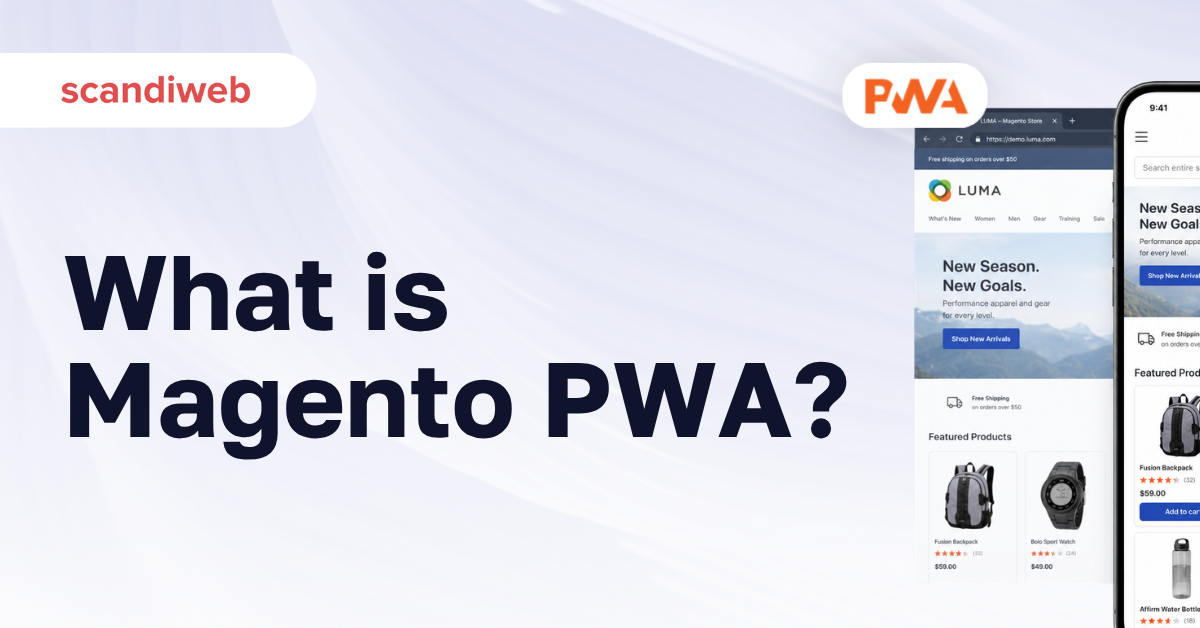
A Magento PWA is a Progressive Web App front-end that consumes the Magento (Adobe Commerce) backend via GraphQL or REST, replacing the default Luma or Hyvä storefront with an app-like experience built on React, Vue, or a similar JavaScript framework. The customer-facing surface behaves like a native app: instant page transitions, offline browsing, push notifications, add-to-home-screen, while the merchant runs the same Magento admin they already know.
Features of Magento PWA technology
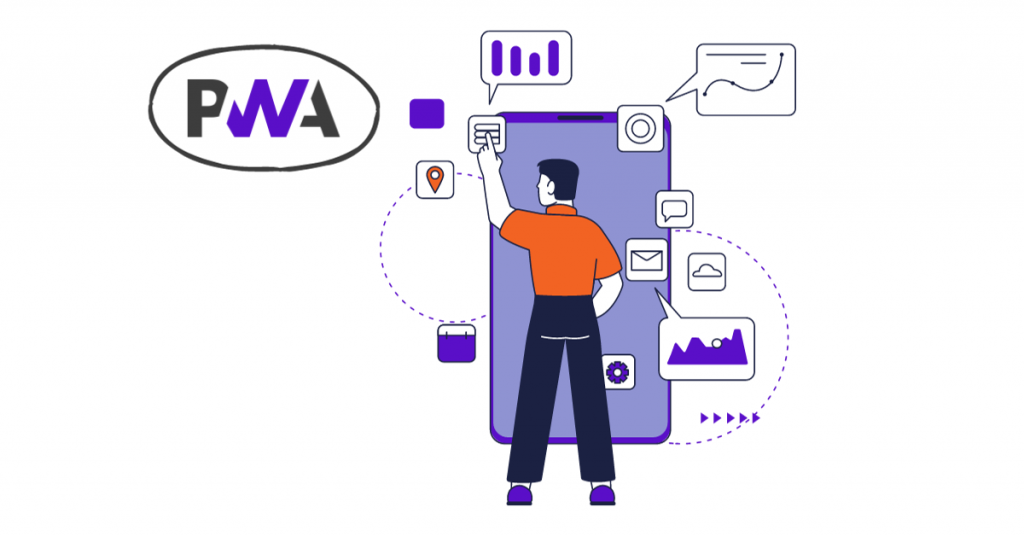
The Magento PWA technical surface centers on four capabilities that move the needle in production:
- Service workers for caching, offline browsing, and push notifications. The most under-used asset in the PWA toolkit. Teams typically ship 10% of the perf wins available because they treat the service worker as a cache rather than as an application layer.
- GraphQL-first data layer that replaces the round-trip-heavy default Magento REST patterns and is the single biggest contributor to mobile time-to-interactive improvements.
- Component-based UI in React (PWA Studio, ScandiPWA) or Vue (Vue Storefront) that decouples the merchandising surface from the backend, letting front-end teams ship without coordinating with Magento devs.
- App-shell architecture that serves the chrome instantly and hydrates the dynamic content asynchronously, which is where the “app-like” perception actually comes from.
🚀 Quick takeaway
The biggest mistake we see post-PWA-launch is teams not auditing the service worker caching strategy. Default PWA Studio and ScandiPWA configurations are conservative. Tuning the cache for your catalog cuts repeat-visit time-to-interactive by another 30 to 50%.
Progressive Web Apps versus native mobile apps
The PWA-vs-native decision is no longer close for most eCommerce brands. Native apps cost 3 to 5× more to build and maintain (two codebases, two store-review processes, two update cycles), and the install funnel is harder than it used to be. Apple’s App Tracking Transparency rules and Google Play’s increasing review scrutiny have raised the install cost. PWA installs are a single tap from the browser with no store gatekeeper.
The cases where native still wins: heavy offline-first workflows (field-service apps, in-store associate tools), deep native-device integration (camera, NFC, AR), and brands where the install is itself the marketing asset.
The benefits of adopting Magento PWA

Mobile UX wins that show up in revenue

The single most reliable revenue lift from a PWA migration is mobile bounce-rate improvement. On client projects we have seen mobile bounce rate drop 15 to 25 percentage points post-PWA, with the largest gains on stores with heavy product imagery and slow legacy Luma themes. Across scandiweb’s PWA work on Magento, the mobile conversion rate lift typically lands between +20% and +40% in the first 90 days post-launch.
SEO and Core Web Vitals lift
A correctly-built PWA improves all three Core Web Vitals: LCP, INP, CLS. The app-shell pattern eliminates the largest contentful paint waterfall the default Magento storefront tends to create. The ranking impact is real but not immediate. Google’s recrawl cycle on a large catalog takes 4 to 8 weeks to fully reflect the new mobile performance scores.
🚀 Quick takeaway
Mobile conversion lift from a PWA shows up within 60 days. SEO ranking lift takes 8 to 12 weeks as Google’s mobile-first crawl catches up with the new Core Web Vitals. Plan reporting cadence accordingly.
Streamlined frontend development
The team velocity story is the under-discussed PWA benefit. Once the front-end is React or Vue, the front-end team can hire from a much larger talent pool than Magento-PHP-frontend developers, ship feature changes without coordinating Magento deploys, and adopt modern testing/CI patterns that the Luma theme makes difficult.
Magento PWA implementation

Selecting the right PWA framework
The three production-grade Magento PWA frameworks each fit different shapes of project. The honest comparison:
PWA Studio is Adobe’s official framework, React-based, built on top of the Magento Storefront API. The strongest case for PWA Studio is teams already deep in the Adobe ecosystem who want vendor-backed support. The weakest case is mid-market teams who find the bootstrap complexity does not match the team’s size.
Vue Storefront is an open-source Vue.js storefront that connects to Magento (and to most other commerce backends, which is increasingly the point). The strongest case is teams that already have Vue capability or want platform-agnostic front-end portability.
ScandiPWA is the framework scandiweb built and open-sourced. React-based, with support for 95% of Magento native features and a much smaller team-onboarding curve than PWA Studio. The strongest case is teams that want a production-ready Magento PWA without the Adobe-ecosystem lock-in. Our ScandiPWA implementation service covers the standard rollout.
The deployment process at a glance
- Audit the existing Magento installation: version (2.4.4+ is the practical floor for current PWA frameworks), extensions, custom code surface, and integration points.
- Pick the framework, set up the development environment, scaffold the storefront project, and connect to the Magento GraphQL endpoint.
- Port custom UI components and theming, integrate the search and merchandising tools, and configure the service worker caching strategy.
- Run staged rollout, typically one market or one storefront first, with the legacy storefront still live for the rest, then promote market-by-market.
Magento PWA development cost in 2026
How much does Magento PWA cost?
Honest 2026 ranges, based on scandiweb’s project portfolio:
- Templated rollout on ScandiPWA or Vue Storefront with light theming customization: $30K to $70K, 3 to 4 month timeline.
- Custom storefront on PWA Studio or ScandiPWA with brand-specific UX and bespoke component library: $80K to $200K+, 6 to 9 month timeline.
- Enterprise multi-storefront rollout across markets/brands: $200K to $500K+, 9 to 12 month timeline.
Timeline for PWA development
The single biggest determinant of timeline is the complexity of the existing Magento installation: number of custom extensions, level of custom code in the Luma theme, and how many storefronts/markets need to migrate. Teams underestimate the extension-compatibility work. That is where the slip happens in 80% of projects.
🚀 Quick takeaway
The PWA cost-per-storefront drops sharply after the first market. Most enterprise PWA projects we ship at scandiweb pay back faster on the second and third storefront rollouts than on the first. Plan multi-market commitment upfront.
Challenges of Magento PWA adoption
Extension compatibility
The most common production blocker. Many Magento extensions ship with PHP-rendered UI components that do not work in a PWA architecture, and the GraphQL coverage of older extensions is patchy. Plan for an extension audit before any PWA project. Typically 30 to 40% of installed extensions need replacement, custom integration, or a maintained PWA-compatible fork.
SEO migration risk
A PWA migration done without an SEO migration plan loses rankings, meaningfully. The risks are URL changes (PWAs sometimes change category and product URL patterns), schema markup gaps (the default PWA Studio templates ship without rich-snippet schema), and the prerendering decision (server-side rendering versus client-side hydration affects what Googlebot indexes). scandiweb’s published PWA migration SEO case study documented a +24% click lift on a fully prerendered ScandiPWA implementation. Teams that skipped prerendering saw the opposite.
Hosting and infrastructure
PWA storefronts need different hosting than legacy Magento. Node.js for server-side rendering, edge caching, and CDN tuning specific to GraphQL responses. ReadyMage and similar managed PWA hosts have emerged specifically to absorb this complexity. If you are also looking at the broader headless decision, our headless eCommerce solutions walk-through covers the architectural choices.
🚀 Quick takeaway
The number-one PWA failure mode is treating it as a frontend project. PWA on Magento is an infrastructure project, a backend GraphQL project, and an SEO project. The frontend is just the visible 20%.
Magento PWA framework comparison
Magento PWA Studio
Adobe’s official React-based PWA framework. The official path, with the longest Adobe-supported roadmap, but the steepest bootstrap learning curve. Best fit for teams already deep in the Adobe ecosystem and able to dedicate frontend engineers full-time to the project.
Vue Storefront
Open-source Vue.js storefront with Magento integration. The strongest case is teams with existing Vue capability or those who want a frontend that can later be re-pointed to a different commerce backend without re-platforming the storefront.
ScandiPWA
ScandiPWA is the React-based PWA theme scandiweb built and maintains. 95% feature parity with Magento native, simpler onboarding than PWA Studio, GraphQL-first, and used in production on PUMA, OM System, Macron, and 80+ other eCommerce projects. Adoption is straightforward for teams that have shipped any React work before.
Should you use a Magento PWA in 2026?
Use a Magento PWA if mobile is more than 60% of your traffic, your current mobile Lighthouse score is below 70, and you have the engineering budget to run a 3 to 9 month project with a 6 to 12 month payback window. Skip the PWA if your mobile traffic is light, your Lighthouse score is already above 80, your team is small, or you are mid-replatforming to a non-Magento backend (in which case the PWA decision is downstream of the platform decision).
Summary
Magento PWA is mature in 2026 and produces real, measurable mobile lift when the project is scoped honestly. The choice of framework, PWA Studio, Vue Storefront, or ScandiPWA, is the second decision. The first is whether the business case is real. For most mid-market Magento estates with mobile-heavy traffic, the answer is yes. For everyone else, the engineering investment is better spent on Hyvä or on tuning the existing Luma theme.
About this guide
Maintained by the scandiweb PWA engineering team. We built and open-sourced ScandiPWA, ship Magento PWA projects across PWA Studio, Vue Storefront, and ScandiPWA, and host managed PWA infrastructure via ReadyMage.
Frequently Asked Questions
Does Magento support PWA in 2026?
Yes. Adobe’s official PWA Studio supports Magento 2.4.4 and above. Vue Storefront and ScandiPWA are the two production-grade open-source alternatives, both compatible with current Magento (Adobe Commerce) versions through 2.4.8.
What is the most popular Magento PWA framework?
Adoption splits roughly: PWA Studio holds the largest share among Adobe Solution Partner-led enterprise projects. ScandiPWA leads mid-market open-source deployments. Vue Storefront is most common in teams with prior Vue.js investment or platform-agnostic ambitions.
How much does a Magento PWA cost in 2026?
Templated rollouts run $30K to $70K (3 to 4 months). Custom PWA storefronts run $80K to $200K+ (6 to 9 months). Enterprise multi-storefront PWA rollouts run $200K to $500K+ (9 to 12 months). The biggest cost variable is extension compatibility work, not the front-end build itself.
Does a Magento PWA improve SEO?
Yes when implemented with server-side rendering or prerendering. Lighthouse score and Core Web Vitals improve, which feeds into Google’s mobile-first ranking. Without prerendering, the SEO outcome is typically negative. The default PWA Studio configuration ships with client-side rendering that Googlebot under-indexes.
Can I keep my existing Magento extensions when migrating to PWA?
Some yes, most no. The realistic number is 30 to 40% of installed extensions need replacement or custom integration when moving to PWA. An extension audit is the first deliverable on any PWA project. Skipping it is the most common cause of mid-project budget blow-ups.
What payment methods work with Magento PWA?
All native Magento payment methods work via the GraphQL API. Braintree, Stripe, PayPal, Adyen, Klarna are all supported across PWA Studio, ScandiPWA, and Vue Storefront. Some legacy payment extensions need GraphQL wrappers built. Budget for that upfront.
Is Hyvä better than a PWA?
For teams looking purely at mobile Lighthouse score and conversion lift without the engineering investment of a full headless rebuild, Hyvä is often the better answer in 2026. Hyvä’s TailwindCSS-based theme delivers most of the perf wins with a much smaller code surface than a PWA. The choice between PWA and Hyvä is the most common architecture conversation we have with mid-market Magento merchants right now.
If your mobile Magento traffic is heavy and your Lighthouse score is below 70, the PWA business case probably writes itself. The framework choice and the migration plan should not. Talk to our PWA engineering team and we will walk you through the trade-offs in 30 minutes.