Magento redesign is often treated as a visual update, but in practice, it usually begins when teams struggle to implement changes as the business grows.
Conversion rates stall, so marketing asks for frontend changes and gets told it’s “complicated.” Developers keep patching around legacy decisions made five years ago. Over time, this limits the team’s ability to make changes, test improvements, and support growth.
In many Magento redesign projects, I’ve noticed that the first conversations tend to focus on the storefront interface. However, frontend performance is directly tied to architectural decisions that affect how quickly the business can implement changes.
A Magento redesign, therefore, evaluates how customer experience, SEO structure, integrations, performance, and upgrade strategy interact within the same platform. When redesign decisions ignore system architecture, new operational issues often appear after launch.
The results depend entirely on the agency you choose.
When a redesign is necessary
Not every store needs it.
Sometimes leadership asks for a redesign when optimization would have solved the problem. I have seen businesses initially consider a rebuild, only to discover the real bottleneck was checkout flow or specific UX friction points.
Redesign usually becomes necessary when limitations are structural rather than cosmetic. You will recognize it through patterns like these:
- Traffic grows, but conversion does not improve
- Users drop off even after incremental fixes
- User journeys frustrate buyers
- New feature development slows because it affects fragile custom code.
When several of these patterns appear together, redesign becomes the logical next step.
What enterprise redesign involves
Enterprise Magento redesign changes multiple layers of the commerce stack.
UX, performance, integrations, SEO, analytics, accessibility, and upgrade strategy all need to align under one roadmap. Changes in one layer affect others, especially in complex Adobe Commerce setups with custom extensions and third-party integrations.
A common mistake is treating UX as only a visual upgrade. Yes, navigation improves, and product pages look better, but if structural changes are not planned, ERP sync can slow, checkout logic can break under traffic, and SEO visibility can drop.
Redesign affects every layer of the system. If you adjust the frontend without checking integrations, friction appears. If you modernize the UI but ignore release workflows, deployment slows. Without architectural planning, surface improvements can introduce new technical problems.
That’s why redesign must start with diagnosis. It requires user journey analysis, conversion research, performance auditing, integration mapping, and technical debt review. Once those foundations are clear, UI becomes strategic.
A well-executed redesign should strengthen:
- Conversion rates
- Mobile performance
- Release and deployment speed
- Integration durability
- Upgrade stability
- Content and merchandising flexibility
When the redesign focuses primarily on interface changes, it doesn’t solve the real problem. And that misalignment only increases long-term cost and reduces ROI.
How to evaluate a Magento redesign agency
It is natural to look at design portfolios when choosing a redesign agency. Visual quality is easy to compare and shapes first impressions. But in Magento projects, success depends more on engineering and data analysis behind the interface.
When assessing a redesign partner, focus on how they approach platform architecture and conversion optimization. Agencies with Magento engineers, CRO specialists, and UX researchers are more likely to improve conversion and performance.
1. What happens before design begins
The first signal is how the agency approaches discovery.
If the process starts with moodboards and homepage inspiration, that’s a creative agency approach. If it starts with customer journey mapping, analytics review, performance diagnostics, and integration analysis, it shows structural discipline.
Ask them what they audit before the redesign. A comprehensive discovery phase typically includes:
- Core Web Vitals and frontend performance
- Conversion funnel analysis
- SEO architecture review
- Custom module risk assessment
- Integration dependency mapping
2. Data-driven UX
The second signal is how they talk about UX.
Strong Magento UX removes friction. I would suggest paying attention to whether they mention usability testing, heuristic evaluation, and measurable A/B validation, or if they focus only on ‘modern feel’ and ‘clean aesthetics.’
The way an agency discusses UX methodology indicates whether design decisions are guided by measurement and experimentation, or primarily by visual direction.
3. Architecture behind the interface
Engineering depth determines whether a Magento redesign remains stable over time.
Frontend changes affect deployment workflows, cache behavior, indexing, extension compatibility, and upgrade paths. Decisions at the template or rendering layer influence how easily the platform can evolve in future versions.
A capable partner understands themes like Hyvä, headless architecture, deployment pipelines, and upgrade compatibility. They should also explain how interface decisions affect release speed and long-term stability.
4. Decision discipline
Experience shows in how an agency manages trade-offs.
Magento redesign involves decisions that affect performance, upgrade compatibility, integrations, and long-term maintenance, so pay attention to whether a team is willing to thoughtfully push back. If a change introduces risk, the agency should explain it clearly and be comfortable saying no.
In several redesigns I’ve seen, a layout change that looked harmless in a design mockup later affected caching behavior, indexing, extension compatibility, or release processes.
The best redesign partners consider second- and third-order effects before implementation, because once a redesign goes live, consequences add up.
Magento redesign agencies to know
Magento redesign projects require a mix of design expertise, technical depth, and platform experience. The agencies listed below are known for delivering Magento store redesigns across different industries and project sizes, each with different strengths.
scandiweb

Best fit for: large, enterprise brands on Magento running commerce in multiple markets.
At scandiweb, Magento redesign projects bring together Magento engineers, UX researchers, and CRO specialists to analyze how the platform performs under real business conditions. Many projects begin when platform complexity slows development or limits conversion improvements.
With more than 20 years of Adobe Commerce experience, they help enterprise merchants run complex Magento stores with multiple integrations, multi-store setups, and high traffic. This hands-on experience shapes how redesigns are planned, ensuring the platform architecture supports stability and future growth.
scandiweb has completed over 2,100 Magento projects and works with more than 700 Magento clients worldwide. The team includes over 600+ commerce specialists with 900+ Adobe Commerce certifications.
Headquarters: Riga, Latvia
Client locations: Global
Focus: Magento performance optimization and business growth
Notable clients: PUMA, Läderach, Jaguar, Levi’s
Vaimo

Best fit for: Adobe Commerce environments with established enterprise processes.
Vaimo typically works with large Adobe Commerce environments that require coordination between multiple teams and integrated business systems. Their projects run within existing processes without interrupting day-to-day operations.
Headquarters: Stockholm, Sweden
Client locations: Global
Focus: Enterprise Adobe Commerce environments
Notable clients: Helly Hansen, Bauhaus, Xiaomi
Bounteous

Best fit for: companies that use analytics and customer data to guide design decisions.
Bounteous is often involved in Magento projects where personalization and analytics guide design decisions. They typically work with organizations that closely track and analyze customer behavior and use those insights to refine the storefront experience.
Headquarters: Frisco, USA
Client locations: Global
Focus: Data-driven commerce environments
Typical work: Personalization initiatives and analytics-led redesign programs
Notable clients: Coca-Cola, Caesars Entertainment, Mars
Atwix

Best fit for: Magento installations with heavy customization that need careful modernization.
Atwix approaches Magento from an engineering perspective. They often work on stores that have been heavily customized and need to be updated without breaking existing functionality. Their work includes resolving extension conflicts and stabilizing complex checkout implementations.
Headquarters: Bratislava, Slovakia
Client locations: Global
Focus: Magento engineering and platform maintenance
Typical work: Upgrades, extension troubleshooting, complex checkout systems
Notable clients: Coyuchi, Cabinets.com, Wyze
Brainvire

Best fit for: Magento environments closely connected to ERP or CRM systems.
Brainvire is commonly selected for Magento projects that involve complex ERP and CRM integrations. In these setups, storefront updates must remain consistent with business logic handled by those systems.
Headquarters: Irving, USA
Client locations: Global
Focus: ERP and CRM integrations
Typical work: Integration-heavy commerce platforms and B2B Magento systems
Notable clients: Walt Disney, Krispy Kreme, FOX Sports
Valtech

Best fit for: global companies running Magento in multiple markets.
Valtech usually participates in large digital programs that combine commerce platforms with brand and customer experience initiatives. These programs often span multiple regions and business units.
Headquarters: London, UK
Client locations: Global
Focus: Enterprise commerce programs
Typical work: Multi-market commerce platforms and global digital initiatives
Notable clients: Audi, Carrefour
How we approach Magento redesign at scandiweb
Our Magento redesigns begin with understanding how the current experience performs. We start with a structured CX audit that combines expert UX review, real customer testing, performance data, and benchmarking against modern eCommerce standards. This helps identify where the actual customer journey diverges from the brand’s intended experience.
Findings are then organized into three layers:
- Quick wins – small UX improvements that can be implemented quickly
- Experience misalignments – design patterns that create friction or confusion
- Structural gaps – deeper issues related to architecture, integrations, or platform logic
This process produces a prioritized roadmap that guides redesign decisions. From there, our team moves into updated wireframes, UI design, and frontend development, followed by ongoing experimentation and conversion optimization once the new experience goes live.
Award-winning Magento redesign projects by scandiweb
Läderach Magento storefront redesign
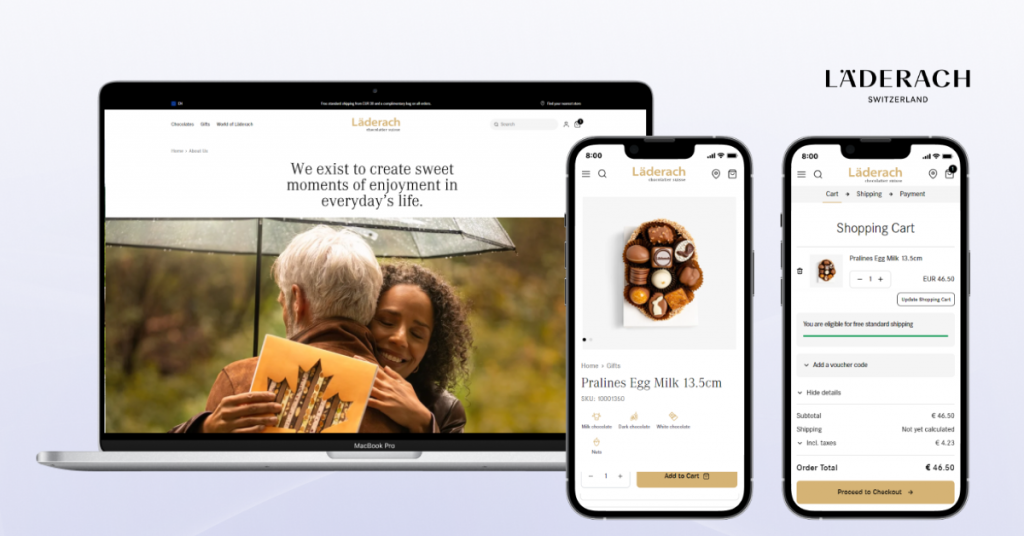
scandiweb redesigned the Läderach Adobe Commerce storefront to better reflect the brand’s premium retail experience while improving performance and conversion.
The project began with a CRO and UX audit to identify drop-off points and usability friction across key pages. Based on these insights, we redesigned transactional flows, restructured homepage and product page layouts, and introduced clearer content hierarchy to guide users toward purchase.
Alongside the design changes, the platform was upgraded to the latest Magento 2 version and the frontend was rebuilt using Hyvä, significantly improving site performance and responsiveness.
The redesign delivered measurable improvements:
- +47.8% conversion rate
- +39% revenue
- +25.5% engagement time
- 93–99 PageSpeed scores across key pages
- The project received the Design Curve Award at Meet Magento New York 2023 for its performance-driven design approach.
Airthings Magento redesign and Hyvä migration
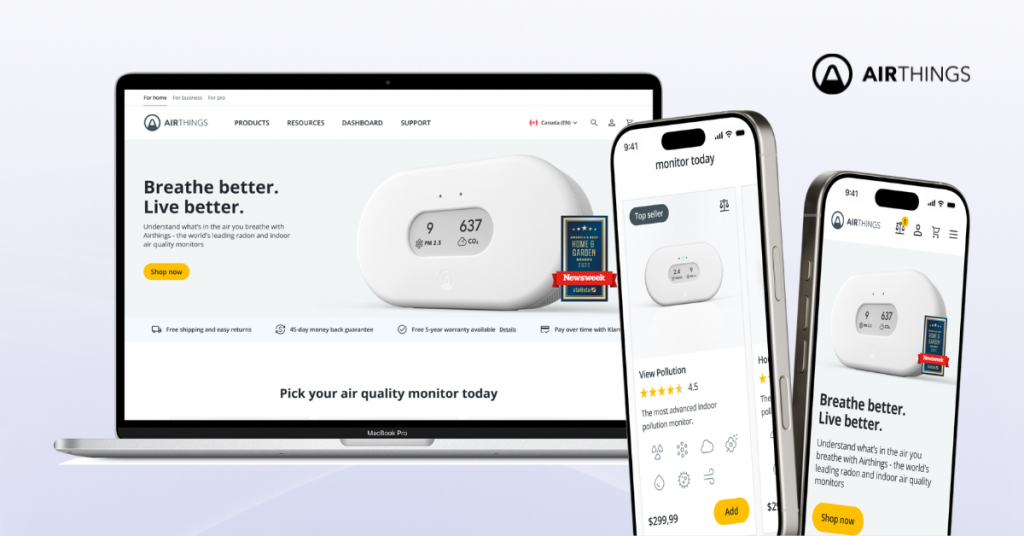
scandiweb redesigned the Airthings Magento storefront to unify the brand’s digital experience and shift the site from a product-centric catalog to a customer-focused educational platform.
The project merged multiple subdomains into a single experience and restructured navigation around use-case journeys, helping customers understand how Airthings products solve real indoor air quality problems. Key pages were redesigned to improve product discovery, integrate educational content, and guide users from learning about air quality to selecting the right device.
The frontend was rebuilt using Hyvä, and the platform integrated with HubSpot to combine Magento’s eCommerce functionality with content-driven customer journeys. This enabled a unified domain experience with faster performance and more flexible content management.
The redesign resulted in strong improvements in engagement and revenue:
- +56% engagement rate
- +17.1% views per user
- +103.4% transactions
- +105.5% revenue
- The project received the Design Pioneer Award at Meet Magento New York 2024 for its customer-centric design and innovative user journey.
Umniah’s Magento storefront modernization
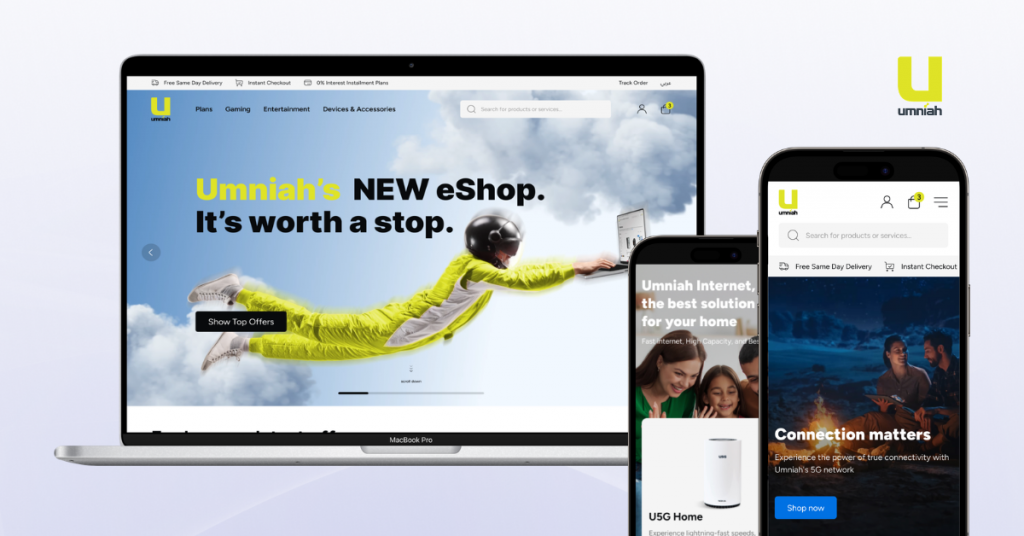
scandiweb redesigned the Umniah eCommerce store to modernize the telecom provider’s digital experience and support a growing portfolio of services and devices. The project rebuilt the storefront on Magento 2 with Hyvä, introducing a faster, mobile-optimized interface aligned with modern UX standards.
The redesign began with a UX audit and benchmarking against leading telecom and eCommerce sites. Major updates included redesigned product listing and product detail pages for devices and service plans, clearer pricing structures, improved bundle configuration, and a mobile-first homepage highlighting key offers and categories. The Hyvä frontend enabled faster performance and flexible content blocks while supporting integrations with systems such as Oracle ERP, Hyperpay, Insider personalization, and other internal services.
Outcomes of the redesign included:
- +86.0% cart-to-view rate
- +71.2% purchase-to-view rate
- +41.1% items purchased
- +72.1% increase in site sessions
- The project received the Design Pioneer Award at Meet Magento New York 2025 for its user-centered telecom eCommerce design.
What ultimately determines redesign success
Magento redesign projects rarely fail because of visual design, but when architecture, integrations, and performance are not considered early enough in the process.
The agencies listed above each bring different strengths – some specialize in UX and design systems, others in enterprise Adobe Commerce builds or platform modernization. The key is choosing a partner that understands how the platform needs to function long after the redesign is launched, including integrations, performance under load, and the flexibility to support future growth.
If you’re evaluating a Magento storefront redesign, the first step is understanding where the current experience creates friction for users and limitations for the business. scandiweb helps enterprise brands redesign and modernize Adobe Commerce storefronts and implement a new UX strategy. Talk to our team to explore your Magento redesign options.