
A Magento certification is a formal credential, issued by Adobe, that confirms a person has passed a proctored exam proving a defined level of skill on Magento (Adobe Commerce). It is a tested measure of whether someone can actually build, extend, configure, or architect a store on the platform.
For a merchant choosing a build partner, that distinction matters more than it first appears. Magento is a deep, opinionated platform, and the gap between a developer who has read the documentation and one who has passed an Adobe exam on it is the gap between a project that holds up under Black Friday traffic and one that does not. In this guide, we’ll explain the current certification tracks, what each one proves, who on a team should hold them, and how to read a vendor’s credentials when you are evaluating who to trust with your store.
🚀 Quick takeaway
Adobe runs Magento (Adobe Commerce) certifications at three levels: Professional, Expert, and Master. They map to developer, frontend, business practitioner, and architect roles. A partner with these credentials in the team is a concrete, verifiable signal of platform competence.
What a Magento certification actually proves
Each Adobe Commerce certification is tied to a specific job role and a specific depth of knowledge. Passing an exam confirms the holder can work fluently with the parts of the platform connected to that role, under exam conditions, without reference material in front of them.
The exams are quite practical. A developer exam tests how Magento’s module system, data models, and extension points behave in real implementations. A business practitioner exam tests catalog, promotion, and store configuration decisions. None of them rewards someone who has only watched tutorials. That is precisely why the credential carries weight when you are deciding who builds your store.
It is worth being clear about what certification does not prove. It does not measure how someone communicates, how they handle a deadline, or whether they have created a store at your scale. Treat it as a strong floor on technical competence, then verify the rest through references and case studies.
The current Adobe Commerce certification tracks
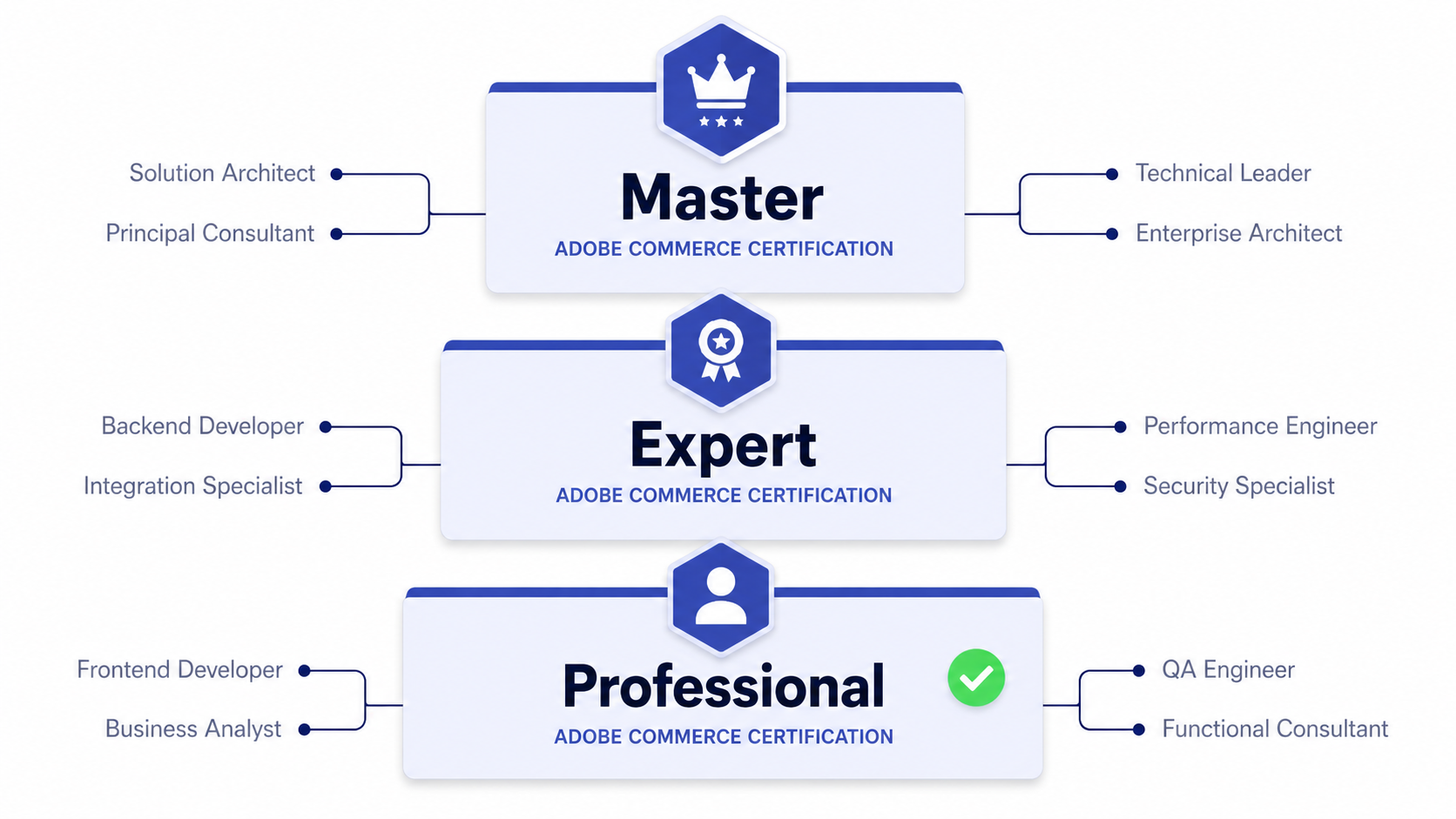
Adobe organizes Magento certifications into three levels that rise with experience, and within those levels into role-based tracks. The structure below reflects the current program as published on Adobe Experience League.
Professional level
The entry tier, aimed at people with up to a year of focused Adobe Commerce experience. It confirms someone can work productively on the platform within their role.
- Adobe Commerce Developer Professional (AD0-E717): backend development, modules, and core platform behavior.
- Adobe Commerce Front-End Developer Professional (AD0-E721): theming, layout, and the storefront layer.
- Adobe Commerce Business Practitioner Professional (AD0-E712): catalog, pricing, promotions, and store configuration for non-developers.
Expert level
The mid-to-senior tier, aimed at people with several years on the platform. It confirms a deeper command of how Magento behaves in complex, customized stores.
- Adobe Commerce Developer Expert (AD0-E716): advanced backend work, performance, and extension design.
- Adobe Commerce Front-End Developer Expert (AD0-E720): advanced storefront engineering.
- Adobe Commerce Business Practitioner Expert (AD0-E708): advanced merchandising and platform configuration.
Master level
The top tier, for senior technical leaders who design whole solutions rather than build single features.
- Adobe Commerce Architect Master (AD0-E722): full-solution architecture, integrations, scalability, and the decisions that hold a large build together.
Older “Magento Certified Developer” and “Solution Specialist” titles still appear on resumes and across the industry. The Solution Specialist credential, in particular, has long been a useful signal of platform-wide configuration knowledge for non-developer roles. We cover what that exam involves and how to prepare for it in our breakdown of the Solution Specialist exam.
| Level | Tracks available | Best read as | Exam fee (USD) |
|---|---|---|---|
| Professional | Developer, Front-End Developer, Business Practitioner | Can work confidently within a role | $125 |
| Expert | Developer, Front-End Developer, Business Practitioner | Deep command of complex stores | $225 |
| Master | Architect | Designs the whole solution | $225 |
What the Business Practitioner track covers for non-technical buyers
If you are a head of eCommerce or a merchandising lead, the Business Practitioner track maps to your world. It tests whether someone can configure catalogs, price rules, promotions, store views, tax and shipping settings, and customer segments correctly inside the Adobe Commerce admin.
That matters because a surprising share of store problems are not bugs at all. They are misconfigurations: a cart price rule that stacks when it should not, a tax class applied to the wrong product set, a store view that breaks for one region. A certified Business Practitioner, on the agency side or in-house, is the person who prevents those quiet revenue leaks. It is also a credential worth funding for your own internal staff, so routine changes do not depend on a partner.
Does the certification matter for Magento Open Source too?
Adobe’s exams are branded Adobe Commerce, but most of what they test applies directly to Magento Open Source as well: the module system, theming, catalog logic, and admin configuration. If you run Open Source, weight the core developer and front-end tracks most heavily, and read a Master-level architect credential as a sign the partner can scale you onto Adobe Commerce later if you grow into it.
How much does Magento certification cost, and how do the exams work?
Professional exams cost $125 USD, while Expert and Master exams cost $225 USD, with reduced rates for candidates based in India ($95 and $150). Each exam runs 100 minutes with around 50 questions, and a passing score is typically set near 64%.
One change worth knowing as a buyer: since 2025, Adobe lets certified professionals renew for free through two short renewal modules of about 15 minutes each, rather than retaking the full exam. Certifications are valid for two years. So a partner with current credentials is not just qualified, they are demonstrably keeping pace with platform changes.
How the free renewal modules work in practice
The renewal change is more useful to merchants than it sounds. Before 2025, a lapsed certification meant booking and paying for a full proctored exam again, which discouraged teams from keeping credentials current. Now, Adobe pushes two short modules through Experience League that walk a certified professional through what has changed in recent releases, each capped at roughly 15 minutes, with a short knowledge check at the end.
In practice, that means a partner’s certifications should never quietly expire. When you ask a vendor for credential dates, a current renewal is a small but telling sign the team treats certification as a standard. A badge renewed within the last two years confirms familiarity with the platform as it stands today, not as it worked three releases ago.
Why Magento certifications matter when you choose a build partner
This is the part that affects your budget and your timeline. Magento is one of the most capable eCommerce platforms available, and it stays widely deployed: industry trackers such as BuiltWith and MGT-Commerce put it at roughly 8% of the global platform market in 2026, powering somewhere in the range of 113,000 to 163,000 live stores depending on the source.
Certification is one of the few signals that cuts through that range objectively. Here is what a credentialed team actually buys you.
It de-risks the technical decisions you cannot see
Most of the choices that decide whether a Magento store is fast, stable, and upgradeable are invisible to a non-technical buyer. Whether a developer extends the platform the supported way or hacks around it does not show up in a demo. It shows up two years later as an upgrade that breaks. Certified developers are tested precisely on doing this the supported way.
It signals investment in the platform
An agency that funds exams, study time, and renewals for its team is telling you it intends to stay current on Magento rather than coast on old knowledge. With the platform’s debated future a recurring question, that commitment is meaningful. We unpack where the platform actually stands in our look at whether Magento is dying, and the short version is that serious, certified partners are still investing heavily.
It supports your own due diligence
Adobe certifications are verifiable. A credible partner can point you to named, certified individuals on the team that will actually do your work, not a logo on a homepage. That verifiability is the practical core of the trust you are buying.
Who on a team should hold which certification?
A healthy Magento partner does not need every person certified at every level. It needs the right credentials in the right seats. Use this as a rough map when you review a team.
- Hands-on developers: Developer Professional at minimum, with senior developers at Expert level.
- Frontend and theming specialists: Frontend Developer Professional or Expert.
- Solution leads and technical architects: Architect Master, the person who owns how the whole build fits together.
- Project managers, merchandisers, and store admins: Business Practitioner, so the non-developer side speaks the platform fluently too.
A team with developer, frontend, and architect credentials covers the full surface of a build. A team where only one person holds everything is a single point of failure. If you are weighing partners on this basis, our comparison of top Magento development companies shows how established agencies distribute these credentials across their teams.
How to verify a vendor’s Magento credentials
You can confirm certifications quickly, which is exactly why they are useful. Ask the partner for the names and roles of the certified people who will work on your project, then request their Adobe credential profiles or Credly badges, which Adobe issues for its certifications and which carry a verifiable link.
Be specific in the ask. “Is your team certified?” invites a vague yes. “Which named developers on my project hold a current Adobe Commerce Developer Expert certification, and can I see the badge?” invites a real answer. A partner that cannot answer the second question is telling you something.
scandiweb has the world’s largest certified Adobe Commerce team and has built on the platform since 2003, with credentials spanning developer, frontend, and architect tracks. We mention it here as a concrete example of what a credentialed bench looks like in practice. The point holds for any vendor: insist on the verifiable version.
What certifications do not tell you
Credentials are a floor, not a finish line. They confirm platform competence, but they do not confirm that a team has delivered at your order volume, integrated with your ERP, or handled a peak-season cutover without downtime. They also do not measure communication, project governance, or how a partner behaves when something goes wrong at 2 am.
So pair the credential check with the things certification cannot prove: case studies at your scale, client references you can call, and a clear answer on who supports the store after launch. Ongoing eCommerce support is where a certified team earns its keep over the life of the store, long after the build is signed off.
Frequently asked questions
What is a Magento certification?
It is an official credential from Adobe confirming a person passed a proctored exam proving a defined level of skill on Magento (Adobe Commerce). It validates real, tested ability rather than course attendance.
What are the levels of Adobe Commerce certification?
There are three: Professional (entry), Expert (senior), and Master (architect). Within Professional and Expert, separate tracks exist for developers, frontend developers, and business practitioners. Master covers solution architecture.
How much does a Magento certification cost?
Professional exams are $125 USD, and Expert and Master exams are $225 USD. Candidates based in India pay reduced rates of $95 and $150, respectively.
How long is a Magento certification valid?
Adobe Commerce certifications are valid for two years. Since 2025, holders can renew for free through two short renewal modules of roughly 15 minutes each, rather than retaking the full exam.
Are Magento-certified developers worth more than uncertified ones?
For a merchant, the value is in risk reduction. Certified developers are tested on building the supported way, which is what keeps a store upgradeable and stable over time. The credential is a strong floor on competence, best paired with proven delivery experience.
Does Magento certification guarantee a good build?
No. It proves platform competence, not delivery track record, communication, or experience at your scale. Verify credentials, then verify case studies, references, and post-launch support separately.
How do I verify that a developer or agency is Magento certified?
Ask for the named individuals on your project and their Adobe credential profiles or Credly badges, which carry verifiable links. A credible partner can show certifications for the specific people who will do your work.
Want credentials that take the doubts out of a Magento build? Meet our certified team and see how a certified Adobe Commerce team de-risks your project from day one.