
Test your website for WCAG compliance
Test your website right now with WAVE: http://wave.webaim.org/ WAVE is a tool to help make web content more accessible. WAVE cannot tell you if your web content is accessible. Only a human can determine true accessibility. Nevertheless, WAVE can help you evaluate the accessibility of your web content.What are the Web accessibility requirements?
WCAG 2.0 was published on 11 December 2008 and WCAG 2.1 was published on 5 June 2018 being backwards compatible. WCAG 2.1 consist of an extended checklist of web accessibility testable success criteria, which are categorized in 13 guidelines, which are further grouped under four principles:- Perceivability – Information and user interface components must be presentable to users in ways they can perceive;
- Operability – User interface components and navigation must be operable;
- Understandability – Information and the operation of user interface must be understandable;
- Robustness – Content must be robust enough that it can be interpreted reliably by a wide variety of user agents, including assistive technologies.
Grounds for a lawsuit?
There are two types of WCAG case causes:- Section 508 article – This is federal law mandating government held websites to be compliant with WCAG 2.0 AA. Your business does not have to worry about this.
- Americans with Disabilities Act (specifically “Title III”) – This is an act signed into law by the US president that obligates all public services to prevent discrimination by disability. Inside the ADA act there is no legally defined WCAG level, given how ADA is not itself about the internet or how it should look. WCAG 2.0 AA started to be used in lawsuits since it was mentioned in the “Section 508 article” and since there is simply no other standard to use for good/bad website accessibility judgement.
It’s not just a legal requirement, it’s a business opportunity
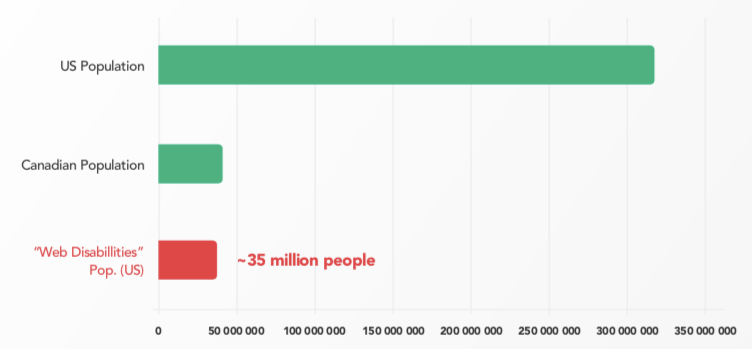
Avoiding law-suits can and should be powerful motivation to make sure you’re WCAG compliant. But that doesn’t tell the whole story. There are strong business reasons for making your website more accessible. You’d be entering a market of ~35 million people. It’s like unlocking access to a market the size of Canada. From a business point of view, your site should be accessible because driving away visitors who have disabilities means lost conversions and revenue. The consumer won’t spend his hard-earned money on a site because it’s impossible for them to do so. Even in cases when it’s possible, it’s still likely to cause friction which can mean a high abandonment rate for your business. In other words, approaching WCAG from the perspective of conversion rate optimization will bring deeper appreciation for its necessity for driving sales.
- 71% of disabled customers with access needs will click away from a website that they find difficult to use.
- Those customers who click away have an estimated spending power of £11.75 billion in the UK alone, around 10% of the total UK online spend in 2016.
- 82% of customers with access needs would spend more if websites were more accessible.
Costs
The costs of making your website WCAG compliant can vary greatly. In terms of what it’ll cost you, a lot of factors need to be taken into consideration from your website’s current status and size, to urgency and scope of optimization.Become WCAG compliant as soon as possible with Scandiweb
Scandiweb has extensive experience in proactively dealing with WCAG for our clients. Most notably, Scandiweb made Lamborghini’s Magento store WCAG 2.0 AA compliant. Implementing a unique keyboard flow and seamless cross-device user experience, along with fixing any WCAG shortcomings, Scandiweb made supercars accessible for everyone. You can take a look at the full case study here. Get in touch with Scandiweb’s WCAG experts and we’ll provide you a free estimated cost range for making your website WCAG compliant. The next step is to figure out the scope and zone in on a more definite estimate and then – let’s get started on making your website a more welcoming place that will drive more revenue! Click here to request a free estimate, or just chat with us directly right now by clicking the orange bubble to your right!Share on: