About
Corbeil Appliances is one of Quebec’s largest home appliance retailers, with over 30 stores across Quebec and Ontario. Founded in 1949, the company serves customers through a mix of in-store consultations, assisted sales, and online transactions. Since joining Groupe Amiel in 2017, Corbeil has become part of a broader retail and distribution network.
Customer journeys at Corbeil can begin in-store, continue online, and involve follow-ups such as deposits or delivery scheduling. It creates a strong dependency among eCommerce, ERP systems, logistics, and store operations, where system reliability and data accuracy directly affect daily work.
Corbeil is part of Groupe Amiel, which operates multiple retail and distribution businesses. As the group moved toward a more centralized model, the need to align systems, reduce complexity, and support expansion across channels and markets became more pressing.
Project goals
Corbeil needed a new platform to reduce day-to-day friction while supporting a more connected retail model. Store teams needed better ways to serve customers, checking inventory across locations and completing purchases on the spot, without delays caused by system limitations. Corbeil’s vision was to rethink how retail operations work throughout channels, from in-store sales to online orders and customer service.
The platform needed to support:
- A modern in-store clienteling application that helps store staff better sell and demonstrate products
- A true omnichannel experience where customers can start their journey in one channel and complete it in another
- A setup where retail POS, ERP, eCommerce, and the in-store application are connected within the same system.
At the same time, the solution needed to enable long-term growth:
- Scalability to support expansion into new markets
- Freedom to introduce new features without restructuring the platform
- The ability to use the in-store application in different retail formats.
Customer and employee experience were both key – consistent and intuitive customer experience across eCommerce and physical stores & a practical and efficient user experience for store employees using the in-store application.
Main objectives
- Lower platform costs without losing flexibility
- A shift toward automated order flow instead of manual handling
- A connected experience where customers can start the journey in any channel and complete the purchase in any other convenient channel
- A modern in-store application to replace terminal-based tools
- Reliable data capture across all touchpoints
- A properly structured analytics layer to support data-driven insights and decisions
- A scalable architecture that allows expansion into new markets and future features
- Readiness for ERP migration to Microsoft Business Central.
Problem
Manual workflows slowing down order handling
Corbeil’s eCommerce setup was tightly integrated with internal operations, but key steps in order processing still relied on manual input. Orders placed online or in-store had to be re-entered into the ERP system, increasing workload and creating room for errors.
Address validation and delivery coordination added further friction – delivery dates were confirmed through follow-up communication rather than selected at checkout, which slowed processing and made scaling more difficult as order volume increased.
Disconnected online and in-store sales tools
Store employees relied on an outdated ERP interface with limited capabilities; tasks like checking inventory across locations or completing a sale often required switching between tools or relying on workarounds. Handling deposits and final payments also had different steps spread across separate tools, creating inconsistencies for staff and customers. Meanwhile, customer journeys could not move smoothly between channels.
Corbeil needed a setup that enabled online and in-store sales to work together, giving store teams better visibility and allowing customers to switch channels without friction. The existing structure made this difficult to achieve and slowed progress toward a more unified retail experience.
Solution
Before implementation, we ran discovery to assess Corbeil’s existing setup and target architecture and evaluate platform options, ERP dependencies, and the role of in-store tools within the broader retail model. In parallel, our CRO and design teams worked on wireframes for the eCommerce storefront and the in-store application, defining how customer journeys and assisted selling should function across channels.
Given the scope of the transformation, the work was split into phases to reduce risk, allow faster delivery of critical improvements, and make it easier for internal teams to adapt. The first phase focused on stabilizing the platform and removing immediate inefficiencies, and in later phases, we introduced new capabilities and prepared the system for ERP migration and further expansion.
Reduced platform overhead
The first step was to lower the platform cost and simplify maintenance. Corbeil moved away from Adobe Commerce Cloud to Magento Open Source, replacing Commerce-specific features with a mix of extensions and targeted custom modules. At the same time, the platform was upgraded to the latest Magento version and migrated to ReadyMage hosting, reducing licensing costs and eliminating unnecessary complexity while maintaining flexibility.
Both the storefront and the in-store application were rebuilt using Hyvä, and the design system was reworked into reusable components, making it easier to maintain and extend the platform as requirements evolve.
Automated order flow between eCommerce and ERP
We reworked order handling to remove manual input and improve data consistency. The platform was integrated with Corbeil’s ERP (C4), allowing orders, customer data, and delivery information to flow automatically between systems. Orders placed online or in-store are now transferred directly to the ERP, without re-entry:
- Address validation during checkout using Google API
- Delivery method and date selection built into the purchase flow
- Inventory synchronization across warehouses and stores.
Assisted selling & unifying payments
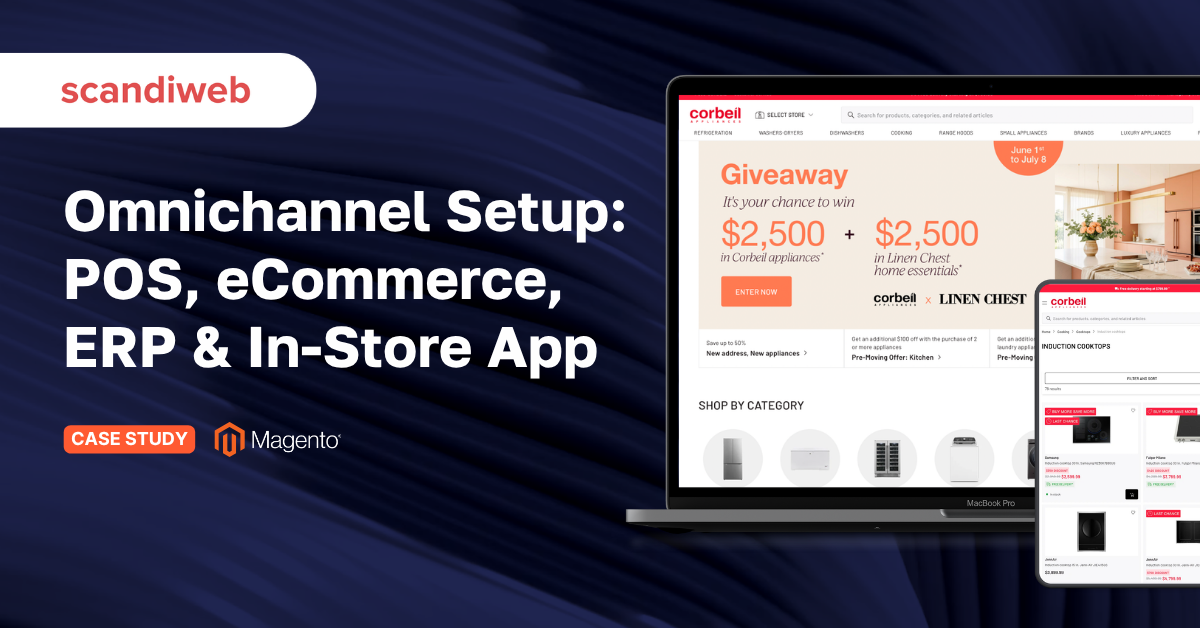
To support store teams, we introduced a dedicated in-store application on the same Magento instance as the eCommerce platform.
The initial version provides a controlled environment for employees, secured through Microsoft SSO, with functionality tailored to in-store use, including access to customer profiles, store-specific context, and pricing logic. Store employees can now assist customers more directly, without relying on separate tools or limited ERP interfaces. What’s more, the same foundation can be extended to other retail formats and temporary sales locations.
Omnichannel order and payment flows
Payment handling for in-store orders previously relied on separate systems, especially for deposit-based purchases.
The solution connected eCommerce, ERP, POS, and the in-store application into a single system, creating a true omnichannel experience. Customers can now start their journey in one channel and complete it in another without losing context.
Payment handling was also unified – the existing PayMyBill solution was integrated into the main eCommerce platform, allowing customers to complete payments for in-store orders online for an aligned shopping experience.
Scalability and future development
The new architecture allows for extension into new markets, introduction of new features without major restructuring, consistent data capture across all customer touchpoints. We laid the groundwork for more structured analytics, enabling better visibility into customer behavior and supporting data-driven decisions.
The system also supports ongoing development across channels, with a multi-year roadmap that includes expanding the in-store application, enhancing customer-facing features, and exploring AI-driven capabilities such as content generation, chatbots for price negotiations, and internal knowledge database.
Results
Corbeil’s transformation reduced friction in order handling, in-store operations, and system coordination, while establishing a foundation for long-term changes:
- Connected shopping experience & unified payment handling – customers can complete balances for in-store purchases online or through customer service at their convenience
- In-store teams equipped for assisted selling – store employees now use a dedicated application instead of terminal-based ERP tools, allowing them to access inventory, assist customers, and complete transactions within a single interface
- Orders placed online or in-store are now transferred directly into the ERP, removing manual input and reducing processing errors
- Address validation and delivery scheduling are completed during checkout, eliminating follow-up coordination and speeding up order processing
- Lower platform cost with improved stability and simpler maintenance
- Simplified day-to-day work for store and back-office staff, eliminating disconnected tools or repeat the same steps
- New retail formats, system changes, AI capabilities exploration, and future initiatives supported without adding complexity.
The foundation for further transformation is already in place. With ERP integration and the in-store application established, the platform is ready for migration to Microsoft Business Central. This setup also creates a base for expanding the in-store tool into a more complete retail system, where employees can manage transactions, access inventory from multiple locations, and support customers within a single environment.
Is your eCommerce platform still relying on manual processes or disconnected systems? scandiweb helps retailers simplify their platforms, automate workflows, and connect online and in-store systems into a single, reliable foundation. Let’s review your setup and identify where complexity is holding your business back.