Automated flows now generate 39% of Sportland’s email revenue from just 3% of sends. 12 months after the CDP launch, email orders are up 20.6% and paid media has returned 9.5% more revenue on 21.3% less spend, lifting ROAS 39.1%.
Behind those numbers is a rebuild of how they collect and use customer data, with scandiweb’s team owning the personalization strategy from initial integration through the AI-driven experiences running today.
About
Sportland is the leading sportswear retailer in the Baltics, known for its award-winning in-store experience and broad omnichannel presence. Their business operates across multiple countries, with distinct store views and marketing teams in each market.
While they had already made strides in building a strong data foundation, marketing activation was still tied to costly tools, which were limited in terms of the email marketing automations Sportland wanted to implement.
They required a solution capable of supporting multiple markets, distinct store views with different languages and product assortments, and siloed customer data. Even before the project began, this complexity presented a significant challenge, as any prospective platform needed robust configuration options to manage user consent data, customer accounts, and product catalogs effectively for campaign execution.
Rather than move to another standalone email service provider, scandiweb helped Sportland rethink the foundation.
Project goals
To fix fragmented customer data and disconnected marketing touchpoints, we implemented a customer data platform (CDP). The decision to move away from a standalone email marketing platform opened the door to a broader transformation in how Sportland manages and uses customer data in multiple markets with distinct store views and separate customer data handling.
A properly implemented CDP enables:
- Centralized collection of data from eCommerce, ERP, POS, email, SMS, support, and more
- A 360-degree customer view built on resolved identities and real-time data updates
- Advanced audience segmentation using predictive metrics and behavioral insights
- Multi-channel campaign delivery with unified messaging across email, ads, and website content.
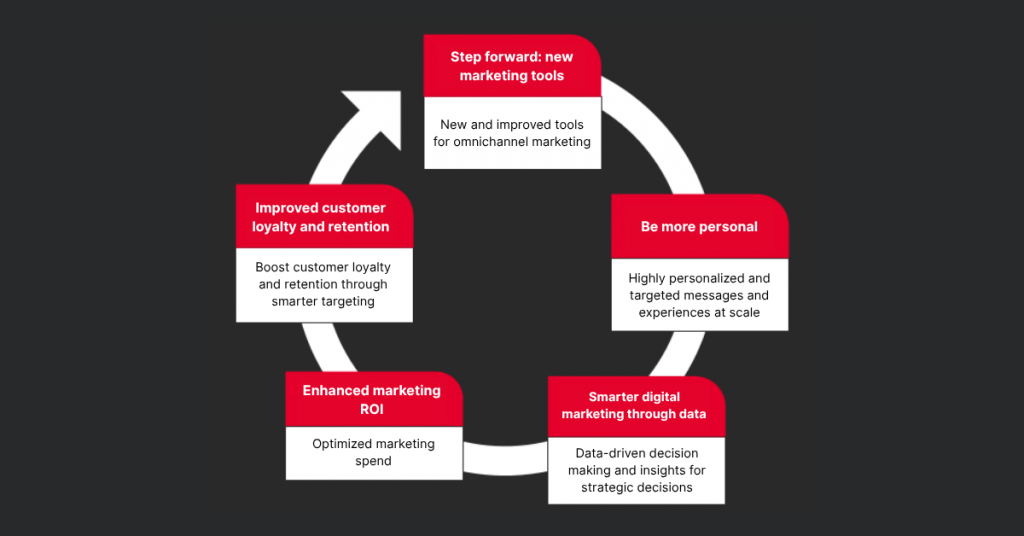
Project goals for Sportland’s CDP integration included:
- Migrate the whole email marketing setup from Klaviyo to Bloomreach
- Consolidate fragmented customer data across markets into a unified CDP framework
- Implement tracking for user behavior across the whole customer journey using the Bloomreach SDK
- Integrate backend purchase and refund data via Google BigQuery
- Build robust email automation flows, improving upon and expanding what was possible in Klaviyo
- Enable A/B testing, predictive segmentation, and automated product recommendations
- Sync audiences with Meta and Google Ads for personalized paid marketing
- Establish privacy-compliant consent management
- Ensure performance is measurable through reporting dashboards in Bloomreach and Looker Studio.
For more insight into CDPs, watch a recording of our webinar, or read more for all the essentials on how CDPs can help eCommerce retailers grow their revenue:
How to Increase Your eCommerce Revenue 2-3x with CDPs
Approach
Sportland knew they had outgrown Klaviyo, but the alternative needed to support more than just email. We assisted in the selection process by comparing capabilities and costs across several CDP solutions. After a series of discovery sessions and technical deep-dives, Bloomreach was chosen for its ability to unify data across channels and support scalable marketing automation.
Email marketing platform selection
An often-overlooked factor in marketing platform comparisons is the management and execution perspective – how intuitive it is for teams to build templates, manage dynamic content, and launch campaigns on a day-to-day basis.
We chose to migrate to Bloomreach because of its smooth content creation experience, which made assembling emails faster and more efficient. More importantly, it integrated email, CDP, product recommendations, and on-site personalization into a single system, enabling a unified, 360-degree view of the customer and a stronger omnichannel strategy.
Initially focused on site search and recommendations, Bloomreach has expanded its capabilities into marketing automation and CDP solutions. Bloomreach’s Composable Personalization Cloud combines data ingestion, AI-driven segmentation, identity resolution features, and delivery through native integrations in one place, enabling the collection and unification of customer data while delivering personalized experiences and messaging to brand customers.
Klaviyo remains a strong option for smaller Shopify merchants, but Sportland’s growth and channel complexity called for a more advanced, unified solution.
CDP setup for a multi-market business
Sportland operates across multiple countries, each with its own store view and customer database. A central question was whether to consolidate all markets into one project or split them by country. While a unified project promised simplicity, overlapping data and conflicting user IDs made that approach impractical. Based on our recommendation, we implemented a market-specific structure to preserve data integrity and avoid downstream issues.
In the architecture we built, data flows into Bloomreach from Sportland’s core business systems on one side, and marketing activation flows out to every customer touchpoint on the other.
What feeds Bloomreach
- Magento (eCommerce)
- ERP system
- GA4 and BigQuery (behavior and backend data)
- Google and Meta ads data
- Additional sources like POS data are already scoped for the next phase, extending the customer view into physical stores and explicit customer signals.
What Bloomreach powers
- Email automated flows and campaigns
- Email content personalization
- Google and Meta audience syncing
- Weblayers
- On-site content blocks and personalization
- Personalized search
- Looker Studio performance reporting.
Every data source enriches a single customer profile, and every activation channel draws from that same profile.
Configuring the foundation
We then began tailoring the Bloomreach setup to Sportland’s data ecosystem:
- Defined tracking requirements across the entire user journey
- Implemented the Bloomreach Web SDK to capture on-site behavior
- Structured product catalog attributes and configured the data pipelines
- Integrated backend customer, order, and refund data from Google BigQuery with regular syncs into Bloomreach.
Because Bloomreach pricing is tied to the volume of events processed and stored, it was essential to estimate yearly traffic and optimize tracking from the start. We disabled non-essential auto-tracked events and fine-tuned the implementation to retain key data points without overspending.
To ensure user privacy, we implemented proper consent logic for event tracking. This was integrated with existing frontend controls so that marketing data collection respects user preferences in all markets.
Campaign setup and automation
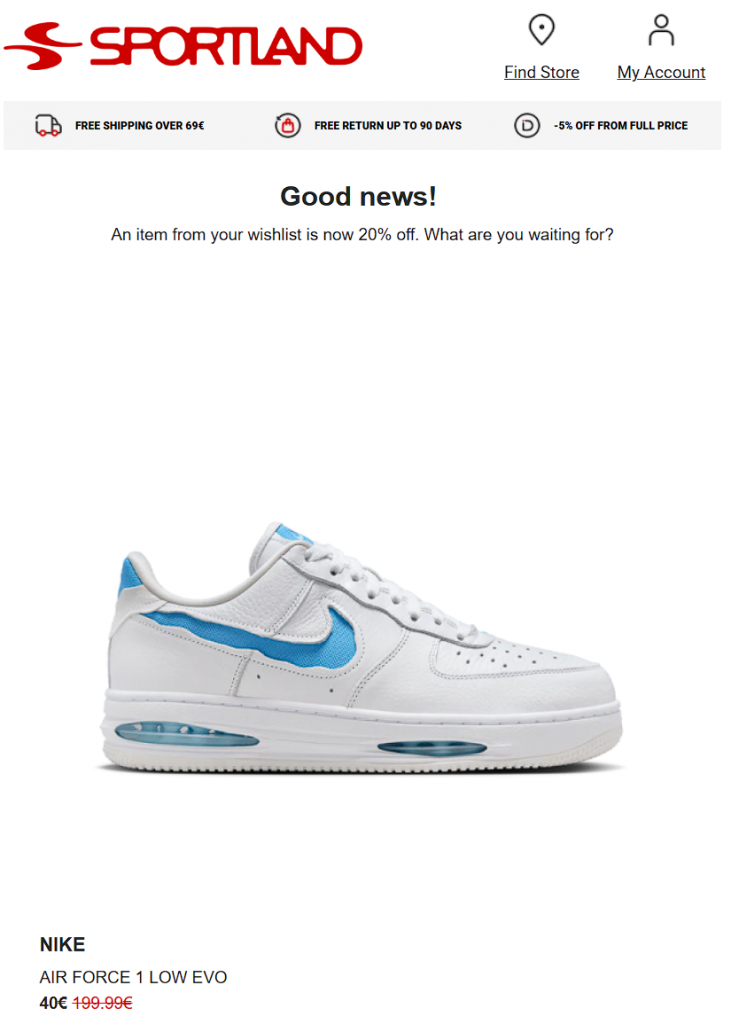
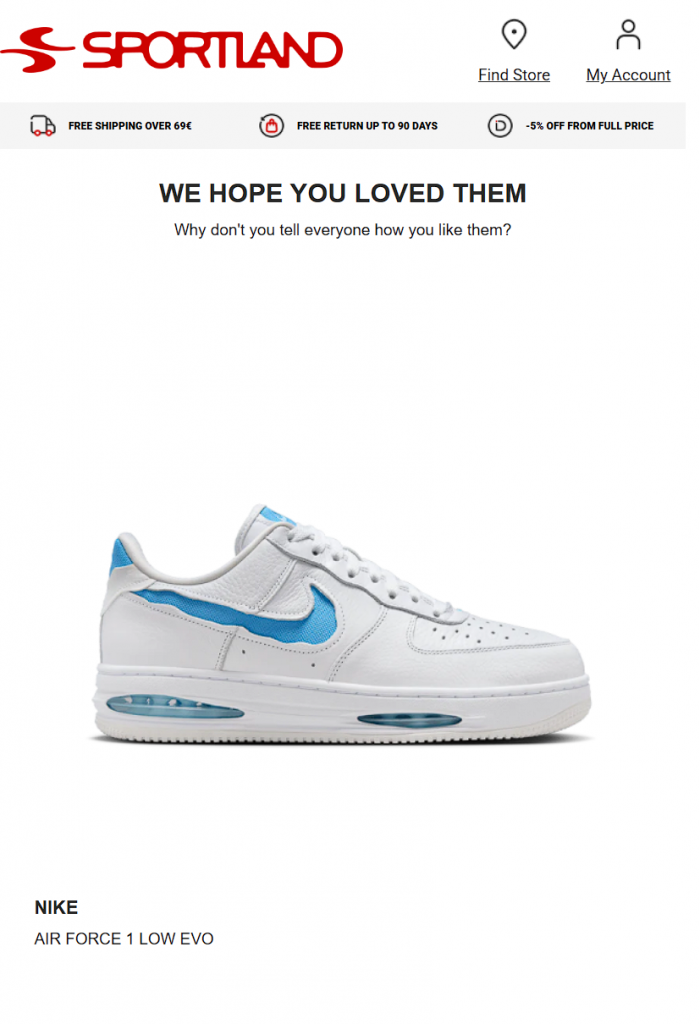
We redefined and significantly expanded email automation flows compared to their Klaviyo setup. These flows were tailored per market, taking into account local behavior and store-specific logic:
- Browse abandonment flows
- Post-purchase product recommendations
- Multi-step cart abandonment
- Welcome series variations
- Targeted outlet campaigns.
Automated flows now generate 39% of Sportland’s email revenue while accounting for just 3% of sends. With a properly tuned lifecycle program, the right message gets to the right person at the right moment, at scale, without a marketer overseeing every send-out.
We also moved Sportland from generic “active subscribers” targeting to intelligent segmentation using RFM and predictive models. Segmented flows now generate +18% revenue per recipient compared to generic sends.
PPC strategy
We connected Bloomreach to Google and Meta Ads, enabling audience syncing, including predictive segments based on AI-driven purchase likelihood and RFM models.
Product recommendations were also migrated from Clerk.io to Bloomreach, requiring extensive QA and catalog mapping to ensure consistent logic across web and backend data layers. Our internal feed management tool played a key role in syncing enriched product data with Bloomreach.
To support decision-making outside marketing teams and provide more accessible performance insights, we built reporting views in Bloomreach and Looker Studio. It enables internal stakeholders to monitor and optimize campaigns without needing to navigate the CDP backend.
From rule-based to AI-driven personalization
On-site recommendations started rule-based, where someone had to decide in advance what to show whom. Our site personalization & optimization team migrated Sportland to Loomi AI-powered recommendations that learn from behavior and adapt in real time.
Early data from the newly launched blocks shows a 2.4x conversion increase versus the older rule-based version. An even bigger win is that this personalization engine is repeatable across markets, and every new market Sportland launches inherits it.
Results
Within months of launching the new CDP, Sportland saw improvements in email marketing and paid media. The ability to unify backend data with behavioral signals enabled more relevant, better-timed communications, while automation and audience targeting became significantly more advanced compared to the previous setup.
Email marketing
- +20.6% orders
- +11.3% placed order rate
- +10.4% revenue in the first few months after launch
- +48% revenue YoY due to automated flows and predictive segmentation.
Paid media performance
- +39.1% ROAS
- +9.5% revenue
- +25.1% average order value
– all while marketing spend was reduced by 21.3%.
Google Ads
- +29.6% conversions
- +72.2% ROAS
- +18.5% revenue
- -31.2% cost
Project outcomes
- Market-specific CDP setup in place to reflect Sportland’s multi-store structure
- Sync between frontend and backend customer data
- Fully redesigned email automation flows
- Consolidated campaign performance reporting in Bloomreach and Looker Studio
- Seamless transition from Clerk.io to Bloomreach for product recommendations
- Rule-based recommendations replaced with AI-driven Loomi personalization, repeatable in all markets
- Sportland’s team now can manage content blocks and launch campaigns independently
- Dedicated CX strategist tying email, paid, and on-site together into a real lifecycle strategy, turning the CDP from a data platform into a business growth engine.
The setup is built to keep growing – new markets inherit the personalization engine, new channels plug into the same customer view, and Sportland’s team owns it, running and expanding the system independently.
A CDP is a way to align your data, teams, and channels around your customer needs. Request a free consultation with our Analytics team, and let’s build a system that works seamlessly, leading to more effective marketing, much stronger customer loyalty, and overall better business results.