
Review content is the only thing on your product page that you did not write, cannot fully control, and will lose if you change providers carelessly.
eCommerce reviews integration connects your store to the system that collects, moderates, and displays customer reviews, photos, and questions, so that content appears on product pages, reaches Google as structured data, and stays yours if the relationship with the vendor ends. Most of the work is not display. It is ownership, performance, and what happens at the edges.
What is eCommerce reviews integration?
eCommerce reviews integration is the connection between a storefront and a review platform, covering how review requests go out after an order, how submitted content comes back, how it renders on product and category pages, and how star ratings are exposed to search engines through structured data. It runs on a native platform feature, a vendor app, or a custom build against the provider’s API, and the right choice depends far more on catalog size and page-speed budget than on review volume.
Most stores already have something. The platform’s built-in reviews, a widget somebody added years ago, or a spreadsheet of testimonials. The question is usually whether the current setup can survive being seen by Google and by a Core Web Vitals audit at the same time.
Our wider guide to Magento integrations covers the other systems a store connects to. Every review and UGC tool named here has a page of its own in our integration directory, documented separately for each platform.
🚀 Quick takeaway
Reviews are the one content type on your site that a third party stores, your customers write, and Google reads. Each of those three facts creates a different risk.
Where review content actually lives
This is the question that decides everything else, and it is rarely asked before a contract is signed.
On the vendor’s servers, rendered by a widget. The most common setup and the fastest to launch. The review text is never in your database. Your page loads a script, the script fetches the content, and the content appears. If the vendor is slow, your product page is slow. If you leave, the content goes with them unless you have a documented export.
On the vendor’s servers, pushed into yours. Better. The vendor remains the system of record for collection and moderation, but reviews are synced into your platform so they render server side and exist in your database. More integration work, considerably less risk.
In your platform natively. Magento, Shopify, and the rest all ship review functionality. Free, fully owned, and usually missing the parts that matter commercially, such as review request automation, photo and video capture, and syndication.
The middle option is right for most stores with serious catalog size, and it is the one vendors are least likely to lead with, because it reduces switching costs.
Replatforming is where the choice gets tested. A store moving from one platform to another has to carry its reviews across, and reviews are tied to products by whatever identifier the review system recorded at collection time. If that was an internal product ID rather than a SKU or GTIN, and the new platform assigns new internal IDs, the mapping breaks silently. Reviews survive the migration but attach to nothing, or worse, attach to the wrong products. Checking which identifier your review data keys on costs an afternoon and prevents a problem that is close to unfixable afterward.
🚀 Quick takeaway
Ask one question before anything else. If we leave you in two years, what exactly do we take with us, and in what format?
Native, app, or platform — choosing a review stack
Three shapes, and the right one follows from how much the content is worth to you commercially.
Use the platform’s native reviews when reviews are a tick-box. Low volume, no photo capture, no automation needed. It costs nothing and nothing breaks.
Use a dedicated review app when collection rate is the problem. Judge.me, Trustpilot, and similar products exist because asking well, at the right moment, with the right incentive, roughly doubles the number of reviews most stores collect. If your constraint is volume of reviews rather than display of reviews, this is the layer that fixes it.
Use a full UGC platform when reviews are part of a wider content and retention strategy. Yotpo and comparable platforms bundle reviews with loyalty, referrals, and visual UGC. The argument for them is not better reviews. It is one customer record across reviews, points, and referrals, which is genuinely hard to assemble from separate tools.
Cost shape differs too. Native is free and costs flexibility. An app is a modest monthly fee that scales with order volume. A full platform is a commitment that usually comes with a minimum term, and the exit from one is the slowest of the three.
🚀 Quick takeaway
Pick the layer that fixes your actual constraint. More reviews, better display, or one customer record across reviews and loyalty are three different problems with three different answers.
Which review tools connect to which platform
| Tool | Best for | Integration notes |
|---|---|---|
| Yotpo Reviews | Stores wanting reviews, loyalty, and UGC under one record | The broadest footprint of the set. See the Magento Yotpo Reviews integration |
| Judge.me | High collection rates at a low price point, strong on Shopify | Popular with DTC brands. Covered on the Magento Judge.me integration and the Shopify Judge.me integration pages |
| Trustpilot | Company-level trust alongside product reviews | Two review types with different schema handling. See the Magento Trustpilot integration |
| Tolstoy | Shoppable video and visual UGC | A different content type with its own performance considerations. See the Magento Tolstoy integration |
| Yotpo Loyalty | Points and tiers tied to review activity | Rewarding reviews is where loyalty and UGC meet. See the Magento Yotpo Loyalty integration |
| LoyaltyLion | Loyalty programs that incentivize reviews | Covered on the Magento LoyaltyLion integration page |
| Smile.io | Lightweight points and referrals | See the Magento Smile.io integration |
| Friendbuy | Referral mechanics | Referral and review flows share the post-purchase moment. See the Salesforce Friendbuy integration |
What changes between platforms is less the tool and more how the content renders. A Shopify theme and an Adobe Commerce frontend handle third-party scripts differently, which is why the same vendor can feel fast on one build and slow on another.
That is also why the same tool is documented separately per platform. Yotpo on a headless Adobe Commerce build and Yotpo on a standard Shopify theme are different pieces of work, so the Shopify Yotpo Reviews integration and the BigCommerce Yotpo Reviews integration cover their own specifics, as does the Shopify Trustpilot integration for merchants on that stack. If you run more than one storefront, assume the integration effort is per storefront rather than per vendor.
🚀 Quick takeaway
The vendor is rarely the reason a review widget is slow. The way it was embedded usually is.
The problems nobody scopes
Rich snippets and structured data
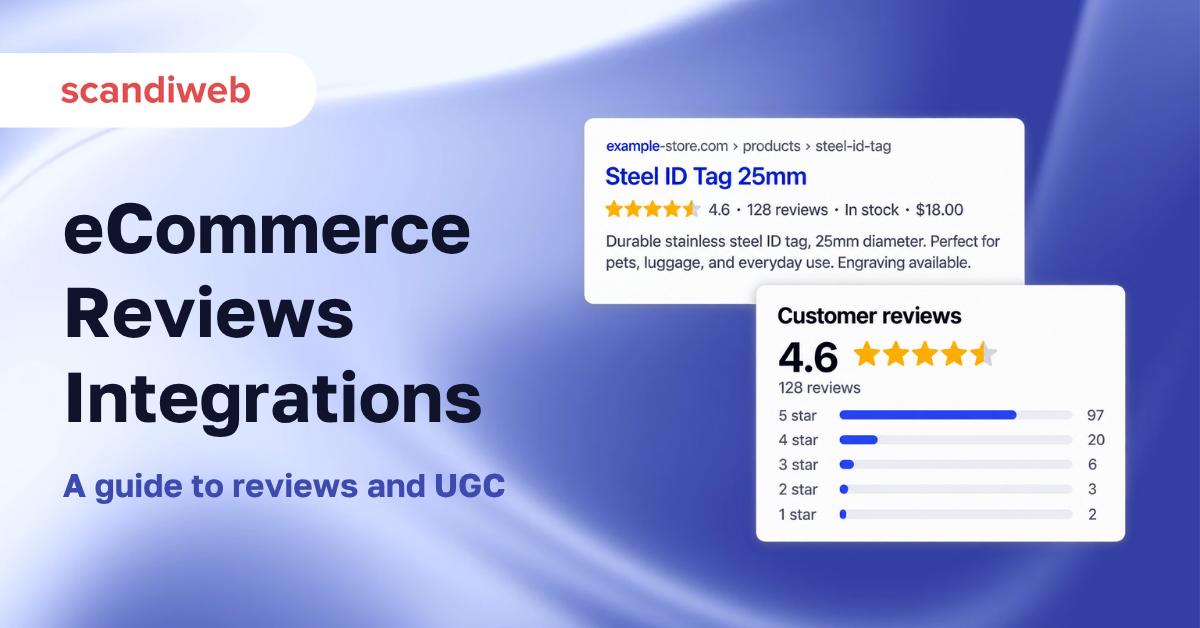
Star ratings in search results come from Product and AggregateRating schema on your page. If the reviews load from a third-party script after the page renders, the markup may not be in the HTML Google parses, and the stars never appear. This is the single most common disappointment after a review project, because the reviews are visibly there and the search result is visibly plain. Server-side rendering of the review data, or injecting valid schema independently of the widget, is what fixes it.
Page speed and third-party widgets
A review widget is third-party JavaScript on your highest-value template. It competes with everything else for the main thread, and on product pages it frequently lands in the critical path. Lazy loading below the fold, deferring non-critical scripts, and rendering the summary rating server side while deferring the full list are the usual mitigations. None of them happen by default.
Moderation, fakes, and compliance
Publishing reviews means publishing content you did not write, which carries obligations. European consumer rules require that merchants state whether reviews are verified and how, and that incentivized reviews are disclosed. A moderation workflow that nobody owns becomes a backlog, and a backlog becomes either stale content or unchecked content.
Review portability when you switch
Years of reviews represent real commercial value and real SEO value. Before signing, establish what an export contains, whether it includes photos, whether customer identifiers come with it, and whether product associations survive the move. Reviews that arrive as a CSV with no SKU mapping are not portable in any meaningful sense.
Syndication to marketplaces and Google
Reviews can be pushed to Google Shopping and to some marketplaces, which compounds their value well beyond your own product pages. That syndication has its own requirements, usually identifier-based, which is the same constraint that governs selling through marketplaces generally. If your catalog lacks GTINs, syndication will not work regardless of how many reviews you hold.
Photos, video, and questions are different content types
Most teams scope “reviews” and then discover they bought four things. Written reviews, customer photos, shoppable video, and a questions-and-answers block all behave differently. Photos need moderation and a CDN strategy, because a product page carrying twenty user images has a weight problem written into it. Video needs a player and a poster frame, and shoppable formats such as those covered on the Magento Tolstoy integration page add a commerce layer on top of playback. Questions and answers need somebody to answer them, which is a staffing commitment rather than a technical one, and an unanswered question block is worse than none at all.
Decide which of the four you actually want before evaluating vendors, because pricing and capability differ sharply across them and the demo will show you all four regardless.
🚀 Quick takeaway
If the stars are not showing in Google, the problem is almost always that the markup is not in the server-rendered HTML.
Reviews, loyalty, and referrals overlap more than vendors admit
All three belong to the same moment, which is just after a customer receives an order. A post-purchase email can ask for a review, award points, and offer a referral link, and whether that is one message or three is an integration decision rather than a marketing one.
Timing is the part that gets least attention and moves the number most. A review request sent on dispatch arrives before the product does. Sent too late, the purchase has stopped being interesting. The right delay depends on the category, which means the request has to be triggered by delivery status rather than order status, and that requires the review platform to know something only your carrier integration knows. This is the most common reason a review tool underperforms its benchmark.
Running separate tools for each is perfectly workable, and many stores do it well. The cost is that no single system knows the customer reviewed, earned points, and referred a friend, so segmentation has to be assembled afterward in a data layer or an analytics tool. Running one platform for all three solves that and reduces your options in every individual category.
There is no universally right answer. There is a wrong one, which is choosing three separate tools and then expecting unified reporting without building it.
🚀 Quick takeaway
If you run reviews, loyalty, and referrals separately, decide early where the unified customer view is assembled. It will not assemble itself.
How to scope a reviews integration
- Count what you already hold. Number of reviews, where they are, and whether they are tied to SKUs that still exist
- Decide the storage model. Vendor-hosted widget, synced into your platform, or native. Everything downstream follows
- Write the schema requirement into the brief explicitly. Not “reviews should show in Google”, but which markup, rendered where, validated how
- Set a performance budget for the widget. And test the product template with it before launch rather than after
- Get the export format in writing. Before signing, not when leaving
What to gather before scoping
- A current review count and export sample, if one exists
- Which identifier your existing reviews key on, SKU, GTIN, or an internal product ID
- Your product template’s current Core Web Vitals figures
- The post-purchase email flow as it works today, including when it fires relative to delivery
- Whether any reviews are already syndicated anywhere
None of these need a developer, and together they answer most of what an agency would otherwise spend the first week discovering. The identifier question in particular is the one that decides whether a future migration is routine or painful, and almost nobody is asked it before signing.
🚀 Quick takeaway
Testing the widget on your real product template, with your real catalog, before signing is the cheapest insurance available in this category.
Frequently asked questions about eCommerce reviews integration
Do I own the reviews my customers leave?
It depends on the contract and the storage model. If the content is on the vendor’s servers and rendered by a widget, you have a licence to display it rather than possession of it. If reviews are synced into your platform, you hold a copy regardless of what happens to the relationship. Check the export clause before signing rather than at renewal.
Why are my star ratings not showing in Google?
Almost always because the structured data is not in the HTML that Google parses. Widgets that inject reviews client side after the page loads often leave no valid Product or AggregateRating markup in the server response. Validate the rendered page with a structured data testing tool rather than assuming the widget handles it.
Will a review widget slow my site down?
It can, and on product pages it often does, because it is third-party JavaScript on your most important template. The fix is architectural rather than vendor-specific. Render the summary rating server side, defer the full review list, and keep the widget out of the critical rendering path.
Can I move my reviews to a different provider?
Usually, with caveats. Review text generally exports cleanly. Photos, videos, customer identifiers, and product associations frequently do not. Ask for a sample export file during evaluation, not a description of one.
Should reviews and loyalty be the same platform?
Only if you need one customer record across both. A combined platform gives you that at the cost of flexibility in each category. Separate best-in-class tools give you better individual features and leave you to assemble the unified view yourself.
How many reviews does a product need?
Enough that a buyer stops looking for more, which is far fewer than most merchants assume and far more than zero. The practical priority is coverage across the catalog rather than depth on bestsellers, because the products with no reviews at all are the ones losing conversions.
Can I incentivize reviews?
Yes, within rules that differ by market. Offering loyalty points or a discount for a review is common and legal in most places, provided the incentive is disclosed and is not conditional on the review being positive. Incentivized reviews usually have to be labelled as such, and some syndication destinations treat them differently from organic ones. Build the disclosure into the flow rather than adding it later.
What happens to reviews for products we discontinue?
They usually remain in the review platform and disappear from the site along with the product page, which quietly removes content that still carried search value. If discontinued products are replaced by near-identical successors, moving the reviews across is often legitimate and occasionally not, depending on how different the products are. Decide the policy before the first catalog cleanup rather than during it.
Getting eCommerce reviews integration right
Reviews integration is an ownership and performance project more than a display project. Decide where the content is stored, write the schema requirement into the brief, and set a performance budget before anyone installs anything.
If reviews are a tick-box, the native feature is genuinely fine and costs nothing. If collection rate is your constraint, a dedicated app will fix it. If you want one customer record across reviews, points, and referrals, a combined platform earns its cost, provided you have read the exit terms.
Ask what the export contains before you sign. That one question separates a reversible decision from a permanent one.
The stores that get the most out of this category treat reviews as inventory rather than as a widget. They know how many they hold, which products are uncovered, which identifier the content keys on, and what the content would be worth to a competitor if it walked out of the door with a vendor. That framing changes the questions asked at evaluation, and it is the difference between buying a tool and building an asset.
Planning a reviews or UGC integration and want a scope you can defend? Talk to our integration team.