
If you picked Volusion years ago because it was simple, it probably did the job. Now, most likely, every roadmap conversation hits similar walls – the feature you need is not on the platform, or the theme cannot do what your brand needs. So, the platform that once felt safe now feels like a ceiling, and you might be wondering whether staying put is the bigger risk.
The following comparison puts Magento (Adobe Commerce) next to Volusion on cost, scalability, customization, support and longevity, and SEO.
🚀 Quick takeaway
Volusion is a low-cost hosted builder that suits very small catalogs, but active stores decreased by ~17% YoY in late 2024, and its market share is well below 1%. Magento (Adobe Commerce) is the scale-up path, with no catalog or sales caps and full control over checkout, integrations, and SEO. If you are outgrowing Volusion or worried about its longevity, Magento is the move, and the migration is very doable with the right partner.
Magento vs. Volusion: the key differences
Volusion is a hosted SaaS builder for small merchants who want to launch fast without touching code. Magento (Adobe Commerce) is an enterprise-grade platform built for growing stores. In other words, Volusion trades control for simplicity, and Magento trades simplicity for control.
For a small catalog with simple needs, Volusion can feel easier. The moment you need custom checkout logic, B2B pricing, deep integrations, or a catalog past a few thousand SKUs, the gap opens fast.
| Category | Magento (Adobe Commerce) | Volusion |
|---|---|---|
| Platform type | Open-source and licensed (Adobe Commerce), self-hosted or cloud | Closed hosted SaaS builder |
| Cost model | Free Open Source plus hosting and build, or Adobe Commerce license | Monthly subscription, $35 to $299, plus custom Prime tier |
| Catalog and sales caps | None | Product and annual revenue caps per plan |
| Customization | Full control over code, checkout, and data model | Limited to platform features and a small theme set |
| B2B features | Built-in quoting, company accounts, customer-specific pricing | Not designed for B2B |
| Scalability | Proven at enterprise volume | Suited to small catalogs and traffic |
| Longevity | 130,000-plus active stores, ongoing Adobe investment | Declining stores and market share since 2020 |
Cost and total cost of ownership
Volusion looks cheaper on the sticker. Its plans run from $35 per month (Personal) to $79 (Professional) and $299 (Business), with a custom Prime tier above that, per Volusion’s published pricing. The catch is in the fine print: lower plans cap your product count and your annual sales, so the price rises as you grow, and you can hit a wall mid-season.
Magento Open Source has no license fee at all. Your investment goes into hosting, build, and maintenance instead of a subscription. Adobe Commerce adds a license priced on your revenue, in exchange for full support, B2B modules, and cloud infrastructure. The honest read is that Magento usually costs more up front and over time, but it removes the caps and the ceiling, so the spend tracks your growth rather than throttling it.
When you compare total cost of ownership, weigh the hidden costs of staying small: lost sales from caps, workarounds for missing features, and the eventual re-platforming bill when Volusion can no longer keep up.
Is Magento more expensive than Volusion?
Usually yes, at least up front, because Magento needs hosting and a build rather than a flat subscription. The difference is that Magento has no catalog or sales caps, so it scales with revenue instead of charging you more to stay small.
Scalability and performance
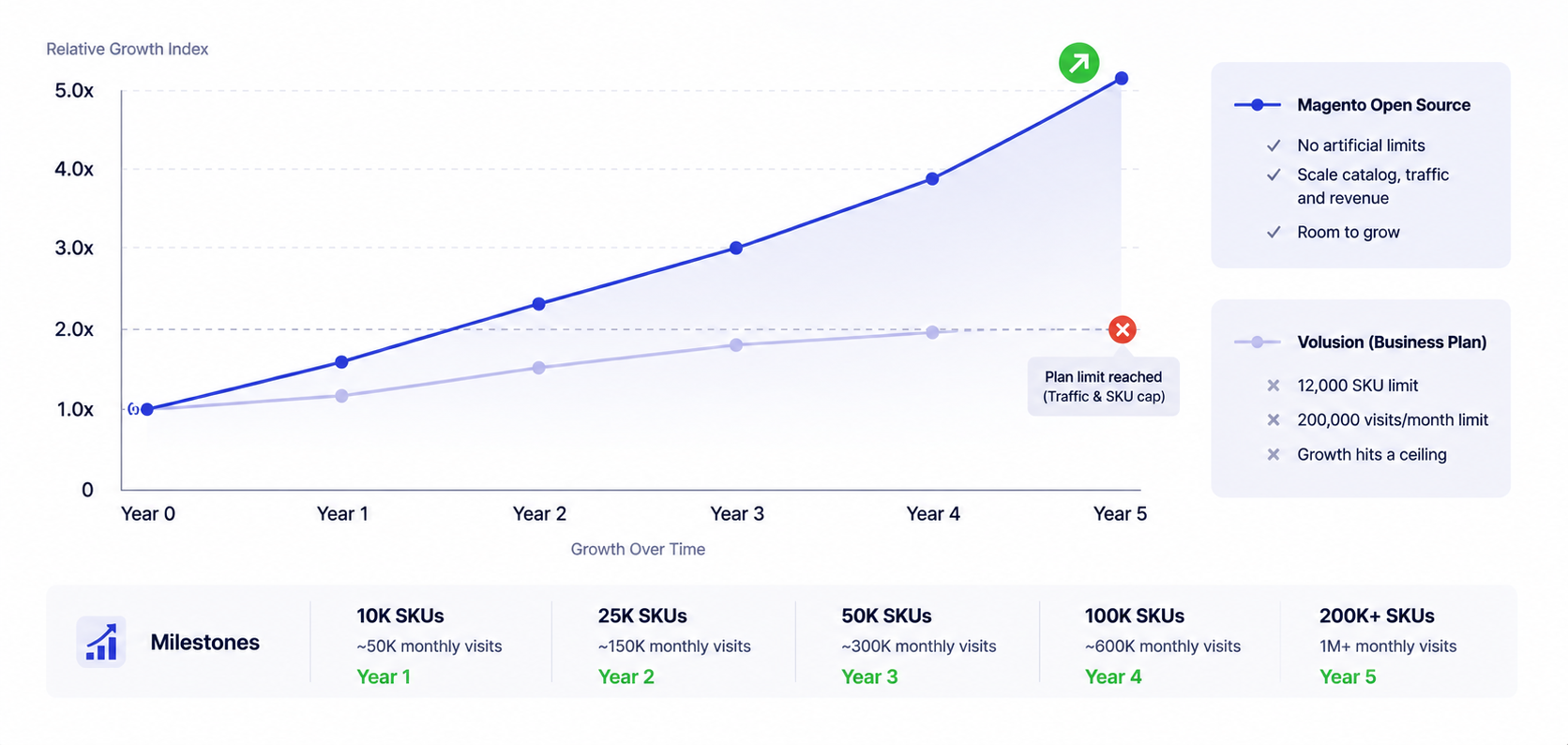
This is where the two platforms separate most clearly. Volusion is built for small stores, and its plan caps make that explicit. Once your catalog or order volume grows, you are managing around the platform rather than with it.
Magento (Adobe Commerce) is the opposite. It powers more than 130,000 active storefronts worldwide in 2025 and handles an estimated $173 billion in annual gross merchandise value, according to industry figures compiled from Adobe and analyst data. Brands such as Nike and HP run on it precisely because it does not buckle under large catalogs, traffic spikes, or complex promotions.
If you expect growth, want to add markets, or run flash sales and seasonal peaks, Magento gives you headroom Volusion was never designed to provide.
Customization and flexibility
Volusion gives you a fixed set of features and a small library of themes. You can configure within those boundaries, but you cannot rebuild the checkout, change the underlying data model, or add a feature the platform does not offer. For a simple store that is fine. For a brand with specific workflows it becomes a constant negotiation with the platform’s limits.
Magento is open. You have full control over the storefront, the checkout flow, the catalog structure, and the admin. Thousands of extensions exist, and anything not available off the shelf can be built. This is why Magento suits B2B and hybrid models: native company accounts, quoting, and customer-specific pricing are first-class features rather than bolt-ons.
Those B2B capabilities matter in practice. A distributor selling to both trade and retail can show net pricing to logged-in wholesale accounts, gate certain catalogs behind approval, and let buyers request a formal quote that a sales rep converts to an order, all without leaving the storefront. Volusion has no native equivalent, so the same workflow means manual quoting outside the platform or a third-party tool bolted on. On Magento those flows are configuration and extension work.
That flexibility is the main reason merchants leave Volusion. The platform is not bad at what it does, it simply does not let you do enough. With Magento development, the constraint becomes your strategy and budget.
Support, security, and longevity
Longevity is the uncomfortable part of this comparison. Volusion’s trajectory has been downward: it filed for Chapter 11 bankruptcy reorganization in 2020, active stores dropped roughly 17% year over year as of late 2024 (PCMag), and its market share now rests well below 1%. None of that means the platform vanishes tomorrow, but it does mean you are building on a foundation that is shrinking, with limited new investment and a thinning ecosystem of developers and apps.
Magento rests on a healthier footing. Backed by Adobe, it has a large global community, a deep partner network, and steady platform updates.
On support, the models differ. Volusion bundles support into its subscription. Magento Open Source relies on your team or an agency, while Adobe Commerce includes Adobe support. Many merchants pair either edition with an ongoing eCommerce support partner for monitoring, security patches, and continuous improvement.
Is Volusion being discontinued?
Volusion is still operating, so it is not officially shut down. But with a 2020 bankruptcy filing, falling store counts, and shrinking market share, its long-term outlook is uncertain enough that growth-minded merchants are actively planning their exit.
SEO and marketing
Volusion covers SEO basics: editable titles, meta data, and URLs. The constraint is control. You work within what the platform exposes, which limits how far you can optimize site structure, schema, and page speed.
Magento gives you full command of technical SEO. You control URL structure, canonical tags, structured data, hreflang for multiple regions, and performance work like caching and image optimization. For brands that treat organic traffic as a core channel, that headroom matters, and it pairs well with dedicated Search Engine Optimization work to compound results over time.
The migration angle matters here too. Moving off Volusion is mostly an exercise in protecting what already ranks: exporting products, customers, and orders, then mapping every old URL to its Magento equivalent with 301 redirects so search equity carries over. A mid-size catalog of a few thousand SKUs is typically a matter of weeks rather than months, with the bulk of the effort going into data mapping, redirect rules, and template work rather than rebuilding from scratch. Plan that redirect map before launch and you keep your rankings intact, which is exactly where most rushed re-platforms lose traffic.
On the marketing side, Magento exposes far more of the funnel. Native customer segmentation, cart price rules, related-product logic, and abandoned-cart flows are configurable in the admin, and the platform integrates cleanly with analytics, email, and the wider Adobe marketing stack. Volusion offers a narrower set of built-in promotions, so growth teams quickly run into what the platform will and will not let them test.
Which platform should you choose?
The decision comes down to where your business is heading, not just where it is today.
Choose Volusion if you run a very small store with a limited catalog, simple needs, and no plans to scale or customize. You want the lowest possible monthly cost and minimal involvement, and you accept the platform’s caps and its uncertain future as acceptable trade-offs.
Choose Magento (Adobe Commerce) if you are growing or expect to, sell B2B or hybrid, need custom workflows or integrations, run a large catalog, or simply want a platform that will not cap you or stagnate beneath you. Magento costs more to build and run, and in return it removes the ceiling Volusion puts on your business.
For most merchants reading a comparison like this, the very fact that you are evaluating alternatives is the answer. If Volusion’s limits are already shaping your roadmap, Magento is the platform built to absorb the growth Volusion cannot.
Also read: Magento vs BigCommerce.
Frequently asked questions
What is the main difference between Magento and Volusion?
Magento (Adobe Commerce) is an open, enterprise-grade platform with full customization and no catalog caps. Volusion is a closed hosted SaaS builder aimed at small stores, with feature limits and plan-based caps on products and sales.
Is Magento better than Volusion for a growing store?
Yes. Magento is built to scale, with proven enterprise performance and no caps on catalog size or revenue. Volusion’s plans throttle growth and the platform itself is declining, which makes it a poor fit for ambitious stores.
How hard is it to migrate from Volusion to Magento?
It is very manageable with the right partner. The core work is moving products, customers, orders, and SEO redirects cleanly so you keep your rankings and history. A structured migration protects traffic and revenue during the switch.
Will I lose my SEO rankings if I leave Volusion?
Not if the migration is planned properly. Mapping old URLs to new ones with 301 redirects and preserving metadata keeps your existing rankings intact. Most ranking loss after a re-platform comes from skipping these steps.
Is Volusion still a safe platform to build on?
For a tiny store it still functions, but its 2020 bankruptcy filing, falling store counts, and sub-1% market share make it a risky long-term foundation. Growth-minded merchants are increasingly migrating away before the limits become urgent.
What does Magento cost compared to Volusion?
Magento Open Source has no license fee, with costs going to hosting and build, while Adobe Commerce adds a revenue-based license. Volusion charges $35 to $299 per month with caps. Magento usually costs more overall but removes the growth ceiling.
If Volusion’s limits are already shaping your roadmap, the smartest next step is to plan a safe migration to Magento that protects your traffic, your data, and your revenue along the way.