
You are weighing two open-source platforms that look similar on a feature checklist and feel completely different the moment your team starts building. Shopware and Magento (Adobe Commerce) both let you own the code, host where you like, and customize without asking a SaaS vendor for permission. The tension is that they pull from very different ecosystems, demand different talent, and carry different cost curves over three to five years.
In this comparison, we’ll cover architecture, licensing and total cost of ownership, customization, B2B depth, ecosystem and talent availability, and performance.
🚀 Quick takeaway
Shopware is the modern, Symfony-based, API-first choice with strong roots in Europe and the DACH region, lighter infrastructure, and B2B features in the core. Magento (Adobe Commerce) is the heavier enterprise option with the largest global talent pool, the deepest extension marketplace, and the most mature native B2B suite.
Shopware vs Magento: the key differences
Both are open-source PHP platforms, both can be self-hosted, and both target serious merchants.
- Framework: Shopware runs on Symfony, a mainstream PHP framework with a large developer base. Magento uses its own framework, which is powerful but specialized.
- Origin and reach: Shopware was built in Germany and is strongest across Europe and DACH. Magento has a larger global footprint and talent pool.
- Licensing: Both offer a free open-source edition. Shopware’s paid tiers are published and predictable, while Adobe Commerce pricing is quote-based and tied to revenue.
- B2B: Shopware offers B2B components in its commercial tiers. Magento’s native B2B suite, available with Adobe Commerce, is one of the most complete on the market.
| Category | Magento (Adobe Commerce) | Shopware |
|---|---|---|
| Underlying framework | Proprietary Magento framework, PHP 8.3+ | Symfony 7, PHP 8.2+ |
| Editions | Magento Open Source (free), Adobe Commerce (paid) | Community (free), Rise, Evolve, Beyond (paid) |
| Licensing model | Quote-based, revenue-tiered | Published monthly tiers plus custom enterprise |
| Strongest region | Global, with deep North America and UK presence | Europe and the DACH region |
| Native B2B | Mature suite with Adobe Commerce | B2B components in commercial tiers |
| Ecosystem size | Largest extension marketplace and partner network | Smaller but modern and fast-growing |
| Admin experience | Deep and powerful, steeper learning curve | Modern, closer to a SaaS feel |
| Infrastructure weight | Heavier: search, cache, queue services | Lighter baseline requirements |
Architecture and developer experience
Shopware 6 is built on Symfony, one of the most widely used PHP frameworks, with an API-first core that makes headless builds and external integrations natural rather than bolt-on. Its app system runs customizations in a sandboxed layer, which keeps most extensions clear of the core and reduces the risk of an update breaking your store. For teams that already know modern PHP, the ramp is short.
Magento takes a different path. Its framework is proprietary and module-based, layering plugins and observers over a service stack that typically includes a database, OpenSearch or Elasticsearch, Redis, and a message queue such as RabbitMQ. That depth is exactly what lets large merchants model almost any business rule, but it also means more moving parts to host, tune, and maintain.
Which platform is easier for developers to work with?
Shopware is generally easier to onboard because Symfony skills are common, and the codebase is newer with less accumulated technical debt. Magento offers more depth and far more specialists, so complex requirements have more precedent to draw on.
If you are hiring from a broad talent market and want faster onboarding, Shopware’s Symfony foundation helps. If your roadmap includes deep, unusual customization and you want a partner who has solved similar problems many times, Magento’s maturity and the size of its specialist community work in your favor.
Licensing and total cost of ownership
This is where the two platforms diverge most clearly for a budget owner. Both have a free open-source edition, so the headline “free” is true on each side. The real cost lives in licensing, hosting, development, and ongoing maintenance.
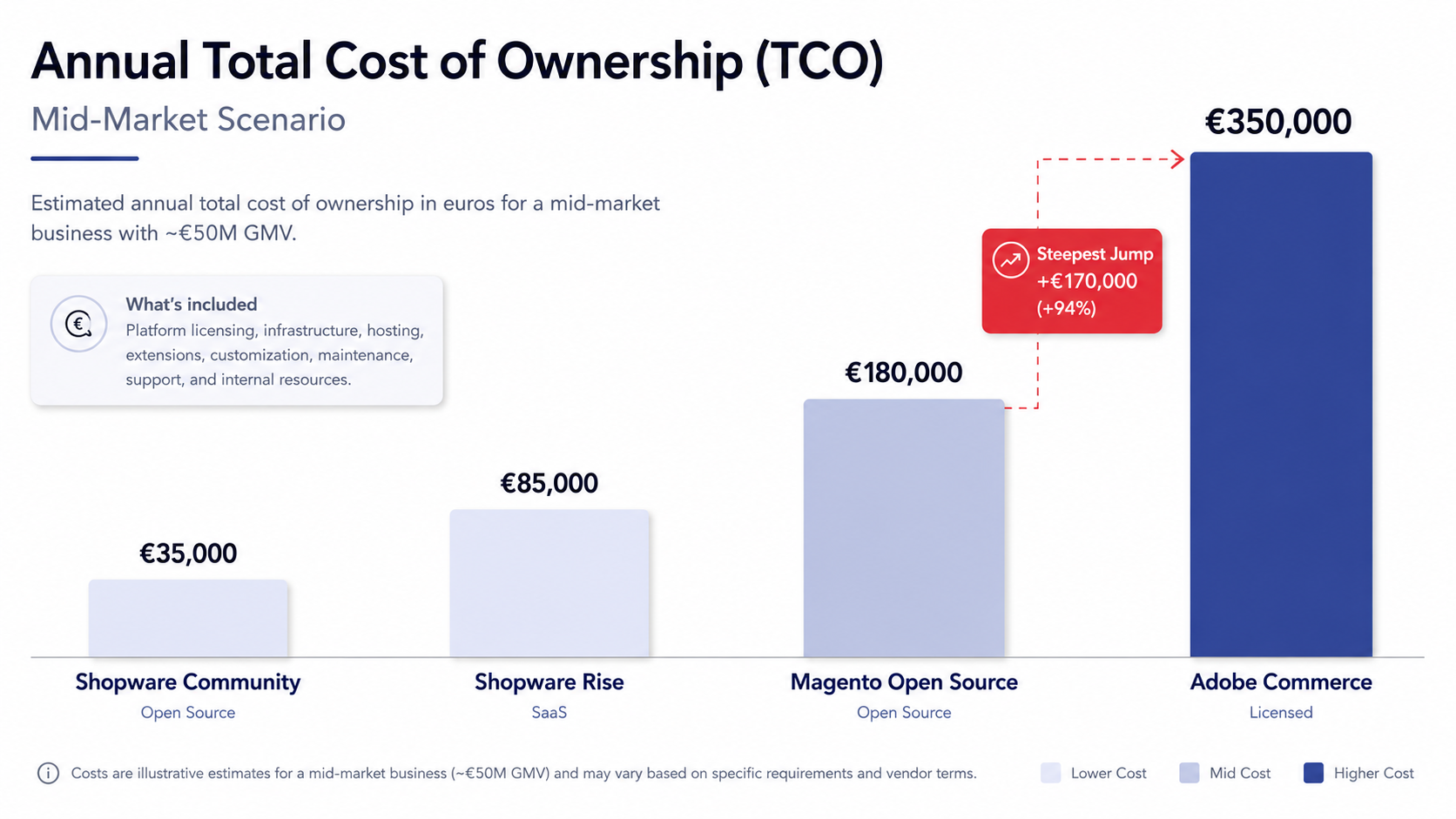
Shopware publishes its commercial tiers, which makes forecasting straightforward. Industry pricing breakdowns from MGT-Commerce (April 2026) put Shopware’s Rise tier from roughly €600 per month, with mid-market annual TCO in the €22,000 to €55,000 range. Adobe Commerce, by contrast, is quote-based and scales with revenue, landing those same estimates at roughly €48,000 to €150,000 or more per year once licensing is included. Magento Open Source removes the license fee entirely, so its cost is dominated by hosting and development.
Which platform has the lower total cost of ownership?
For most mid-market merchants, Shopware Rise or Magento Open Source carry a lower total cost of ownership than Adobe Commerce, because they avoid revenue-based licensing. Adobe Commerce earns its premium when you genuinely use its enterprise features such as native B2B, advanced merchandising, and Adobe’s wider marketing stack.
The trap is comparing license fees alone. Hosting profile, extension licensing, and the day rate of the talent you can actually hire often move the three-to-five-year number more than the platform license does. We break the editions apart in detail in our Adobe Commerce vs Magento Open Source comparison, which is worth reading before you size a budget.
Customization and extensibility
Both platforms are built to be molded, and neither will box you in the way a closed SaaS tool does. The difference is in how customization is delivered and how safe it stays through upgrades.
Shopware’s app and plugin system keeps a clean line between your custom logic and the core, which makes updates less risky and the codebase easier to reason about over time. Magento’s plugin and module architecture reaches deeper into the platform, giving you near-total control of behavior at the cost of more careful upgrade planning. Both support headless and composable approaches if you want to decouple the storefront from the backend.
Magento’s extension marketplace is the larger of the two by a wide margin, so for many common needs there is already a vetted module rather than a custom build. Shopware’s store is smaller but modern, and because Symfony talent is plentiful, custom work is often quick to commission. If you are weighing a fully decoupled build on either platform, our commercetools vs Adobe Commerce article frames the composable trade-offs well.
B2B capabilities
B2B is one of the clearest dividing lines. If selling to other businesses is core to your model, the depth of native features will shape your build more than almost anything else.
Magento offers one of the most complete native B2B suites in the market through Adobe Commerce, including company accounts, shared catalogs, negotiated pricing, quote workflows, requisition lists, and granular role permissions. These are built in rather than assembled from third-party extensions. We cover the most useful ones in our roundup of Adobe Commerce B2B features.
Shopware addresses B2B through components available in its commercial tiers, with capabilities such as employee management, role-based access, and quick order. These cover a strong share of mid-market B2B needs, and the platform has invested heavily here. For the most complex enterprise B2B scenarios, with deep account hierarchies and intricate pricing logic, Magento still tends to need less custom work out of the box.
Is Shopware or Magento better for B2B commerce?
Magento (Adobe Commerce) is the stronger choice for complex, enterprise-grade B2B thanks to its mature native suite. Shopware is well-suited to mid-market B2B where modern admin usability and lower licensing cost matter more than the deepest possible feature set.
Ecosystem, partners, and talent availability
A platform is only as strong as the people and tools around it, and this is where Magento’s scale shows. According to Q1 2026 estimates compiled by trackers including BuiltWith, StoreLeads, 6sense, and W3Techs, Magento and Adobe Commerce together power roughly 150,000 to 260,000 active stores worldwide, holding an estimated 5 to 7 percent of the global eCommerce platform market. Shopware holds an estimated 1 to 2 percent with roughly 30,000 to 60,000 active stores, and it is growing fastest in the DACH region.
The same data shows movement in both directions. StoreLeads tracking of the Magento install base reported a year-over-year decline of around 15 percent into early 2026, which reflects consolidation toward both SaaS and newer platforms rather than the platform disappearing. We unpack what that trend really means for merchants in our analysis of whether Magento is dying, and the short answer is no, but the market is maturing.
For talent, Magento’s larger footprint translates into a deeper bench of agencies, freelancers, and certified developers globally, which matters for hiring leverage and continuity. Shopware’s talent pool is smaller and concentrated in Europe, though the Symfony foundation means a broad base of general PHP developers can contribute without deep platform-specific training.
Performance and scalability
Both platforms can run fast, and both can run slowly if the infrastructure and code are not handled well. The starting points differ.
Shopware’s baseline infrastructure requirements are lighter, which can make smaller and mid-sized stores cheaper to host and quicker to tune. Magento carries a heavier service stack by default, but that stack is purpose-built for large catalogs and high concurrency, and it scales to very large enterprise traffic when properly architected. For catalogs in the hundreds of thousands of SKUs with complex pricing and faceted search, Magento’s design has more proven precedent at the top end.
The reliable lesson across both is that performance is an outcome of architecture and hosting discipline, not a property of the logo. A well-tuned Magento store outperforms a neglected Shopware one and the reverse is equally true. Either way, plan for proper caching, search, and a hosting setup matched to your real traffic.
Which platform should you choose?
There is no universal winner between Shopware and Magento, only the better fit for your catalog, your team, and your region. Use these profiles as a starting point.
Choose Shopware if you want a modern Symfony-based codebase with a clean developer experience, you operate primarily in Europe or the DACH region, you value transparent published pricing, your B2B needs are mid-market rather than the most complex enterprise scenarios, and you prefer lighter infrastructure with a SaaS-like admin.
Choose Magento (Adobe Commerce) if you run a large or complex catalog, you need the deepest native B2B suite, you want the largest global ecosystem of extensions and certified talent, you operate across multiple regions and brands, or you intend to use Adobe’s wider marketing and analytics stack. Magento Open Source is the right starting point when you want that flexibility without the Adobe Commerce license.
If your shortlist also includes a SaaS option, our Magento vs Shopify comparison is a useful companion read before you commit either way.
Frequently asked questions
What is the main difference between Magento 2 and Shopware 6?
Shopware 6 is built on the Symfony framework with an API-first core and published pricing tiers, while Magento 2 uses its own framework with a larger global ecosystem, a deeper extension marketplace, and a more mature native B2B suite available through Adobe Commerce.
Is Shopware cheaper than Magento?
Often, yes, for mid-market merchants. Shopware’s published tiers and lighter infrastructure typically produce a lower total cost of ownership than revenue-based Adobe Commerce licensing. Magento Open Source can also be very cost-effective because it carries no license fee, leaving hosting and development as the main costs.
Is Shopware similar to Shopify?
Only at the surface. Shopware’s admin has a modern, SaaS-like feel, but it is open-source software you can self-host and fully customize, with optional hosted plans. Shopify is a fully managed SaaS platform with fixed hosting and a more closed core. Shopware is closer to Magento in flexibility and control.
Does anyone still use Magento in 2026?
Yes. Magento and Adobe Commerce still power an estimated 150,000 to 260,000 active stores worldwide according to Q1 2026 tracker estimates. The install base is consolidating rather than collapsing, and the platform remains a leading choice for complex catalogs and enterprise B2B.
Can I migrate from Magento to Shopware or the other way around?
Yes, but treat it as a re-platforming project, not a simple export and import. Data structures, custom logic, extensions, and integrations all differ, so a structured migration plan with thorough testing protects your catalog, SEO, and order history. A specialist partner reduces the risk considerably.
Which platform is better for large catalogs?
Magento (Adobe Commerce) has the stronger track record for very large catalogs in the hundreds of thousands of SKUs, thanks to its search, indexing, and caching stack. Shopware handles substantial catalogs well, but Magento has more proven precedent at the highest end of catalog size and concurrency.
Which platform is better for B2B?
For complex enterprise B2B, Magento leads with its native company accounts, shared catalogs, negotiated pricing, and quote workflows. For mid-market B2B where usability and licensing cost weigh heavily, Shopware’s B2B components are a strong and more economical fit.
Still unsure? Compare with our architects and get a clear recommendation grounded in your catalog, B2B needs, region, and team.