Adobe Commerce is the most-deployed enterprise commerce platform with the deepest native feature set. commercetools is the most-composable, API-first MACH platform with the highest ceiling on customization. Both were named Leaders in the 2025 Gartner Magic Quadrant for Digital Commerce. Adobe for the ninth consecutive year, commercetools for the sixth. So when teams ask scandiweb which platform is “better,” the honest answer is neither. They are different shapes of solution for different shapes of problem.
This guide walks through where each platform earns its keep, the migration realities both directions, and a four-question decision framework we use with named-client deployments on both. If you are mid-evaluation and need a yes/no answer fast, jump to the “Choosing the right platform” section.
Overview
- Adobe Commerce is an integrated, feature-complete platform, strongest for B2B-heavy operations, mid-market through enterprise teams that want one vendor accountable across catalog, checkout, and merchandising.
- commercetools is a headless, microservices-first MACH platform, strongest for teams with engineering capacity that need to compose the commerce stack from best-of-breed components.
- The decision rarely comes down to features. It comes down to team composition, integration surface, and 18-month total cost of ownership.
🚀 Quick takeaway
If you have a strong in-house engineering team and want maximum composability, commercetools wins. If you want one vendor responsible end-to-end and need deep B2B out of the box, Adobe Commerce wins. The wrong fit is almost always more expensive than the wrong feature comparison would suggest.
Core differences between commercetools and Adobe Commerce
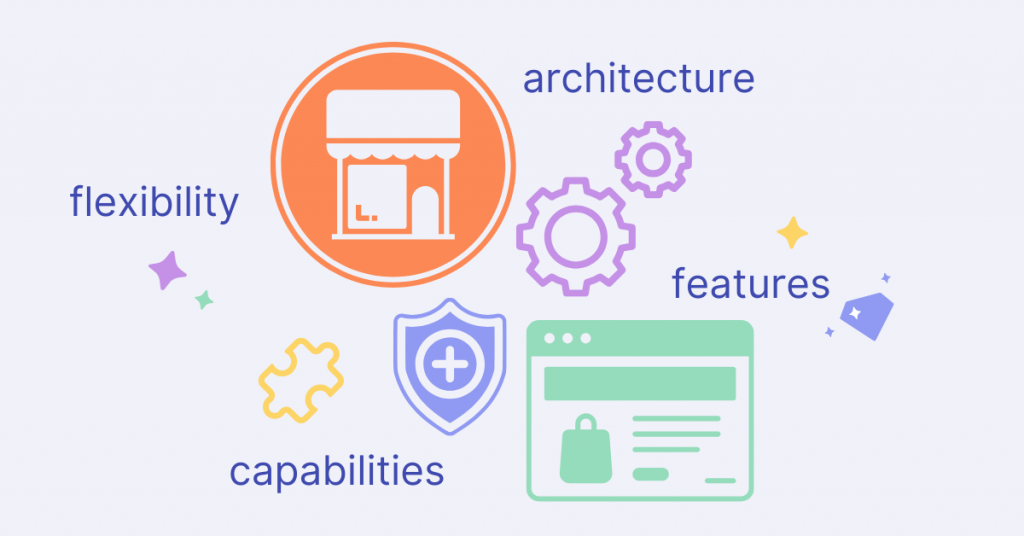
Adobe Commerce and commercetools sit at opposite ends of the commerce architecture spectrum. Adobe Commerce ships as an integrated platform with catalog, checkout, merchandising, search, and B2B baked in. commercetools ships as a set of APIs and microservices designed to be composed with best-of-breed front-end, search, payments, and CMS pieces.
That architectural difference cascades into everything else: implementation time, team shape, integration cost, total cost of ownership.
Architecture and flexibility
Adobe Commerce is monolithic by default, with headless capabilities available through the PWA Studio and the Storefront API. Most Adobe Commerce projects we ship at scandiweb stay on the monolithic frontend because it eliminates a class of integration complexity teams underestimate.
commercetools is headless from day one, built on MACH principles: Microservices, API-first, Cloud-native, Headless. The trade-off is that teams must bring (or build) the front-end, the CMS, the search experience, and the orchestration layer themselves. Our commercetools development work typically pairs the platform with Next.js, contentful or Sanity for content, and Algolia for search.
Features and capabilities
Adobe Commerce ships with deep native B2B (company accounts, shared catalogs, requisition lists, negotiated pricing), built-in B2C merchandising, page builder, and tight Adobe Analytics + Adobe Target integration. For B2B-heavy operations, Adobe Commerce is often the faster path to working software.
commercetools focuses on the commerce engine (cart, checkout, order management, pricing, promotions) and leaves everything above the engine (presentation, content, search, personalization) as a composable choice. For brands building a custom commerce experience that does not map to standard patterns, this is a meaningful advantage.
🚀 Quick takeaway
Adobe Commerce shortens time-to-launch and reduces integration risk. commercetools extends customization ceiling and team velocity at maturity. Most teams over-index on day-one capabilities and under-index on month-eighteen flexibility.
In-depth look at commercetools

commercetools is the reference platform for MACH-aligned commerce. The API surface covers cart, checkout, orders, payments, pricing, promotions, customers, products, and product types. Anything customer-facing is your team’s responsibility to build or assemble.
Key strengths of commercetools
The microservices architecture lets engineering teams deploy parts of the commerce stack independently. A checkout change does not require redeploying the catalog. For brands shipping changes weekly across a multi-brand, multi-market estate, this is the strongest argument for commercetools.
The platform scales horizontally without architectural surprises. Teams that have outgrown a monolithic platform typically cite peak-traffic stability and the ability to ship new market launches independently as the commercetools wins that justified the move.
API-first design means commercetools fits cleanly into a wider business stack: ERP, PIM, OMS, CRM, CDP. The integration cost is real but the integration surface is predictable.
Challenges and considerations
commercetools requires engineering. Teams without strong in-house frontend, integration, and DevOps capacity run into trouble. The platform does not ship with a default storefront, a default checkout UX, or a default merchandising surface, so every team builds those.
The learning curve is steep for organizations new to MACH. Adopting commercetools without prior headless experience typically extends the project by 4–6 months versus an Adobe Commerce equivalent of similar scope.
Exploring Adobe Commerce
Adobe Commerce (formerly Magento Commerce) is the most-deployed enterprise commerce platform globally and the platform scandiweb has worked on for more than 20 years. The 2.4.x line has matured into a stable, feature-complete platform with strong B2B and tight Adobe Experience Cloud integration.
Advantages of Adobe Commerce
Native B2B is the strongest single argument for Adobe Commerce. Company accounts, requisition lists, negotiated pricing, shared catalogs, and quote management ship as platform features. The equivalent commercetools implementation costs months of engineering.
The Adobe Experience Cloud integration (Analytics, Target, Sensei AI, Real-Time CDP) is the deepest in the market for teams already running Adobe marketing tooling. Cross-platform data flow that requires custom integration on commercetools is wired up by default.
Implementation time is shorter. Adobe estimates 30% faster than equivalent composable builds, which matches our experience across the 100+ Magento and Adobe Commerce projects scandiweb has shipped.
Potential limitations
Adobe Commerce is a monolithic platform. Front-end changes typically require a full deploy, and the LTS support cycle (current 2.4.x LTS support ends in 2027 per Adobe’s roadmap) means version-upgrade discipline matters.
Customization beyond the platform’s native models can be expensive. The pattern we see most often is teams trying to fit non-standard business logic into the catalog model. When business logic diverges enough, commercetools’ composability becomes the safer long-term bet.
Pricing is increasingly opaque. Adobe stopped publishing tiered Commerce pricing publicly after 2022. Typical Adobe Commerce Cloud deployments start around $22K/year and scale with GMV.
🚀 Quick takeaway
If your business model is B2B with company accounts, requisition lists, and negotiated pricing, Adobe Commerce will ship faster and cheaper. If your business model has non-standard catalog logic or composable front-end ambitions, commercetools will scale better long-term.
Choosing the right platform for your business
The framework we use with named-client deployments on both platforms reduces the decision to four questions.
When to choose commercetools
Choose commercetools when at least three of the following are true: your engineering team has shipped headless commerce before. You need to compose the front-end, CMS, and search from best-of-breed pieces. Your business logic diverges meaningfully from standard B2C catalog patterns. You operate across multiple brands or markets that need independent release cadence. You have 9+ months of runway for the initial build.
When to choose Adobe Commerce
Choose Adobe Commerce when at least three of the following are true: B2B features (company accounts, shared catalogs, requisition lists) are core to the model. You want one vendor accountable across the full stack. The team is small or stretched and prefers integrated tooling. You already run Adobe Experience Cloud for marketing. You need to launch in 4–6 months rather than 9–12.
🚀 Quick takeaway
The four-question decision framework outweighs the feature spreadsheet every time. A team that picks commercetools without prior headless experience usually spends the cost difference on the learning curve in months 1 to 6.
Migration strategies
Both directions are non-trivial. Catalog migration, customer migration, order history, and SEO continuity are the four work-streams that consume the most engineering time regardless of direction.
Migrating to commercetools
Phased migration outperforms big-bang every time. The pattern that works is to move one part of the commerce surface to commercetools first (typically the storefront for a single market), keep the existing platform as the order/data system of record, then migrate categories or markets one at a time. This approach typically cuts replatforming cost by 30–40% versus a single-cutover migration.
Migrating to Adobe Commerce
Adobe Commerce migrations from legacy platforms (Magento 1, custom builds, Shopify Plus, Salesforce Commerce Cloud) follow a more standard path because the platform’s data model is well-documented. If you are weighing that specific move, our Salesforce Commerce Cloud vs Magento comparison breaks down the trade-offs. scandiweb’s Magento 2 migration guide covers the four standard work-streams and the typical 4–6 month timeline. Adobe Solution Partner-led migrations are typically faster than in-house attempts. For mid-flight stabilization on either side, our eCommerce support services bridge the team during migration cutover.
How much does each platform cost in 2026?
Neither vendor publishes tiered pricing. Honest 2026 ranges based on published partner data and scandiweb’s deployment experience: Adobe Commerce Cloud typically starts at $22K/year and scales to $125K+ for enterprise. commercetools starts higher (typically $50K+/year) and scales similarly, but the platform cost is a smaller share of total project cost because most of the build investment goes to front-end and integration. Total 18-month TCO for a comparable mid-market deployment runs $400K–$800K on Adobe Commerce versus $600K–$1.2M on commercetools, mostly driven by the front-end work composable architectures require.
The future of eCommerce: a composable approach
The composable commerce shift is real, but the framing is wrong in most press coverage. Composable does not mean abandoning integrated platforms. It means treating the commerce stack as a portfolio of services rather than a single bundled product. Adobe Commerce has added headless and composable capabilities (PWA Studio, Storefront API, the Adobe Composable Commerce announcement). commercetools has matured its tooling for less-engineering-heavy teams.
Leading platforms in composable commerce
- commercetools, the canonical MACH platform. Highest customization ceiling, highest engineering investment.
- Adobe Commerce, integrated by default, composable by extension. Easier first step into composability for teams without prior headless experience.
- BigCommerce, enterprise composable storefront with simpler integration than commercetools.
Benefits of composable commerce
Faster time-to-market for individual stack changes: front-end, search, payments can each be deployed independently. Ability to swap individual pieces without replatforming. Cleaner integration with the wider business stack (ERP, OMS, CDP). Independent release cadence for multi-brand or multi-market operations.
Wrapping up
commercetools and Adobe Commerce both deserved their 2025 Gartner Leader status. They solve different shapes of the same problem. The choice should fall out of your team composition, business model, and 18-month plan, not the vendor’s marketing materials. scandiweb has shipped projects on both platforms (Macron, OM System, Skinnydip, Hairy Baby, and 100+ Adobe Commerce projects more broadly), and the most common cost mistake we see is teams picking the platform that wins the feature comparison rather than the platform that fits the team building it.

About this guide
Maintained by the scandiweb commerce engineering team. We are an Adobe Solution Partner and ship projects on both Adobe Commerce and commercetools. Reviewed against current 2025/2026 Gartner research and Adobe Commerce 2.4.x release notes.
Frequently Asked Questions
What is the main difference between Adobe Commerce and commercetools?
Adobe Commerce is an integrated platform with catalog, checkout, B2B, merchandising, and search baked in. commercetools is a MACH-aligned API-first platform that ships the commerce engine and leaves the front-end, content, search, and presentation as composable choices. Adobe ships faster, commercetools customizes deeper.
Which platform is better for B2B in 2026?
Adobe Commerce ships native B2B (company accounts, requisition lists, negotiated pricing, shared catalogs) as platform features. commercetools can do all of this but requires custom build. For B2B-heavy operations, Adobe Commerce is typically the faster and cheaper path.
How much does Adobe Commerce versus commercetools cost?
Adobe Commerce Cloud typically starts at $22K/year and scales with GMV. commercetools typically starts at $50K+/year. Total 18-month TCO including build sits at $400K–$800K for Adobe Commerce and $600K–$1.2M for commercetools at comparable mid-market scope. The gap is mostly front-end engineering, not licensing.
Is commercetools a good fit for a small team?
Usually no. commercetools requires in-house frontend, integration, and DevOps capacity. Small teams without prior headless experience typically run a 4–6 month longer project than the Adobe Commerce equivalent. If the team is small, Adobe Commerce or BigCommerce is usually the lower-risk choice.
Can you migrate from Adobe Commerce to commercetools (or vice versa)?
Yes, both directions. The pattern that works is phased migration. Move one storefront or market first, keep the original platform as the system of record, then migrate categories incrementally. Big-bang migrations carry the highest risk and typically cost 30–40% more than a phased equivalent.
Are both platforms still Leaders in the Gartner Magic Quadrant?
Yes. The 2025 Gartner Magic Quadrant for Digital Commerce named Adobe Commerce a Leader for the ninth consecutive year and commercetools a Leader for the sixth consecutive year. Both are evaluated against completeness of vision and ability to execute.
Should I wait for the next Adobe announcement before deciding?
No. Both platforms are mature, both are Leaders, and both have AI roadmap announcements scheduled for 2026 that will not change the architectural fit decision. The platform that fits your team and business model now will still fit in 18 months.
If you are mid-evaluation between commercetools and Adobe Commerce and want a 30-minute call with engineers who have shipped both, get in touch. We will help you turn the vendor-feature spreadsheet into a decision matched to your team and 18-month plan.