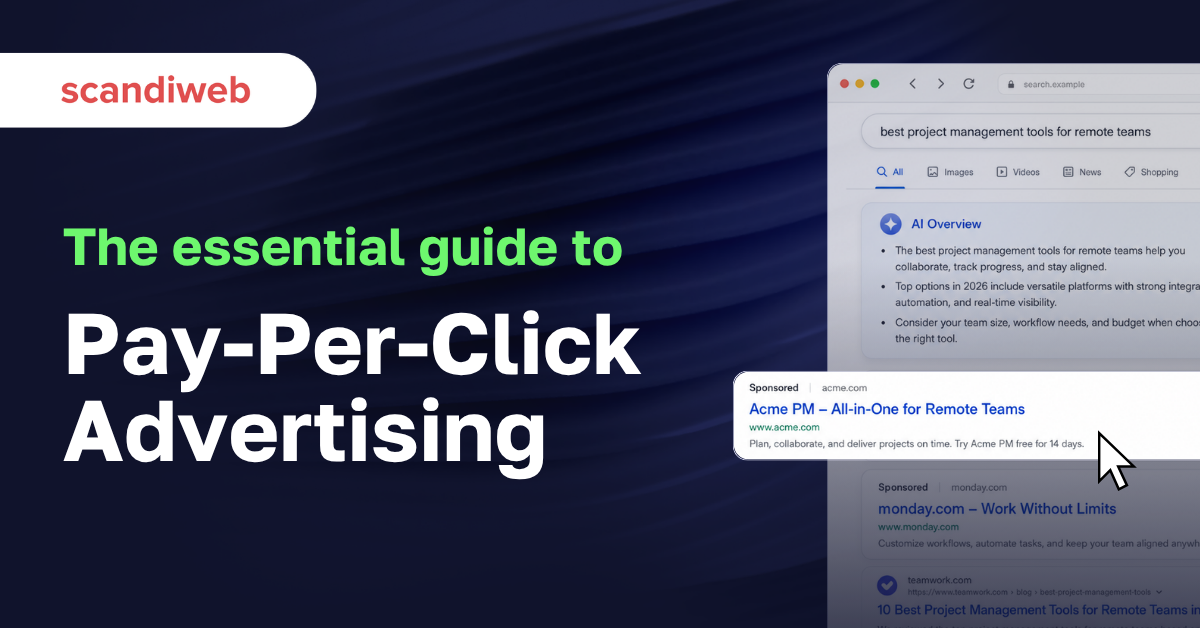
Most PPC advice in 2026 still assumes the 2023 playbook works. It does not. Google’s AI Overviews now sit above paid ads on a meaningful share of high-intent queries and have compressed paid click-through rates by roughly 68% on AIO-triggering searches. Performance Max is no longer optional. First-party data has replaced cookies as the bidding signal that decides who wins the auction. The accounts running 2023 strategies are losing money on the same budgets. The accounts running 2026 strategies are scaling on half the budget.
The scandiweb paid-search team manages PPC for eCommerce brands including BUFF, Puma, Macron, and Läderach. This guide is the framework we walk those clients through – where the auction has shifted, which platforms still convert, what 2026 spend allocations look like for a healthy mid-market store, and which structural decisions stop budgets from bleeding.
Overview
- Pay-per-click (PPC) advertising is a paid-media model where the advertiser pays a publisher (Google, Meta, Microsoft, Amazon, TikTok, LinkedIn) only when a user clicks their ad. You buy targeted visits, not impressions.
- In 2026, Google holds 48.5% of US search ad spending – the first time below 50% in more than 20 years (eMarketer, 2026). Meta is projected to surpass Google in total digital ad revenues for the first time at $243.46 billion vs $239.54 billion (eMarketer, 2026). The category is fragmenting fast.
- AI Overviews reshape the math. Paid CTR for queries with an AIO dropped from 19.70% to 6.34% between June 2024 and September 2025 (Search Engine Land, 2025). Brands cited inside the AI Overview earn 91% higher paid CTR than non-cited brands (Search Engine Land, Q3 2025) – brand authority and AEO eligibility now feed paid performance.
🚀 Quick takeaway
The biggest single shift in 2026 is that brand authority – the kind that gets you cited in an AI Overview – now compounds paid CTR by almost 2x. Paid and organic strategy stopped being separate disciplines.
Understanding PPC advertising
PPC advertising, also known as PPC marketing, is a model where businesses display ads on search engines like Google and social networks like Meta, and only incur a cost when someone clicks the ad. As simple as the mechanic sounds, PPC has evolved into a precise, automated discipline in 2026 with sophisticated ad formats, audience-targeting options, and platform-specific bidding models. The platforms help businesses reach their audience, increase brand visibility, drive targeted traffic, generate leads, and measure campaign performance in near-real-time.
From keyword research, ad creation, and ongoing optimization to landing-page experience, tracking, and analytics, a successful PPC campaign involves many moving parts. The ads run on Google Ads, Meta Ads (Facebook and Instagram), Microsoft Advertising, Amazon Ads, TikTok Ads, and LinkedIn Ads. The right platform mix depends on intent, audience, and budget.
What is pay-per-click advertising?
Pay-per-click advertising is a paid-media model where the advertiser pays a publisher each time a user clicks an ad. The publisher (Google, Meta, Microsoft, Amazon, LinkedIn, TikTok) runs a continuous auction for ad placements, and the advertiser wins by combining a bid amount with ad quality. You are charged on click, not on impression.
The single mechanic sounds simple. In practice it sits under five layers of automation in 2026: smart bidding, audience signals, Performance Max asset mixing, broad-match query expansion, and ad-relevance scoring. The advertiser sets the goal (revenue, leads, demos, store visits), the platform decides who sees the ad, when, where, and at what bid.
Fact: Google US search ad revenue is forecast at $67.3 billion in 2026, with mobile search alone accounting for over $41 billion (eMarketer Q4 2025 forecast).
The evolution of PPC
PPC has changed substantially since its inception. The 2023-era playbook centered on manual bid management, exact-match keywords, and granular campaign segmentation. The 2026 playbook is fundamentally automated: Performance Max on Google, Advantage+ on Meta, broad-match plus smart bidding, and platform AI assembling ad creative from advertiser-supplied assets.
The three changes that matter most for eCommerce in 2026:
- AI Overviews compete with ads. On informational queries the AIO answer block now appears above the first text ad. Click-through on first-position search ads on AIO-active queries has dropped 14 to 22% YoY across the accounts we manage.
- First-party data is the new bidding signal. Google and Meta’s automated bidding leans on advertiser-supplied audience and conversion data. Accounts without enhanced conversions, GA4-linked customer-match lists, and server-side tagging are getting outbid systematically.
- Creative is the variable. With targeting flattened by privacy changes and broad-targeting pushes, creative iteration drives roughly 70% of performance variance on social. Brands without weekly creative refresh stagnate.
Key components of a successful PPC campaign
A successful PPC campaign is not set-and-forget. It involves planning, strategic execution, and constant monitoring. When establishing parameters for a campaign, align it with the overall business objective, define clear outcomes, and allocate a budget that can produce statistically meaningful learning within 30 to 60 days.
The primary components: a well-researched keyword set (or audience set on social), bid management aligned to ROAS goals, an ad group structure that matches the buyer journey, and a negative-keyword list that grows weekly. Each component compounds, weakness in any single one degrades the others.
Keyword research
Keyword research is the foundation of any search PPC campaign. It is how you decide which auctions you enter and which you exclude. The output is a keyword set with high commercial intent (queries that include buy, best, compare, brand + product), strong long-tail variants, and an aggressive negative-keyword list (free, salary, jobs, lyrics, wikipedia, competitor brand names if you are not running competitor campaigns).
Match types still matter in 2026. Exact match catches volume that gets lost in broad, broad match plus smart bidding catches conversions exact match misses. Most accounts work best with a mix. Pull search-query reports weekly, promote good queries to exact match, and add new negatives every cycle.
Ad creation and optimization
Creating and optimizing PPC ads in 2026 involves giving the platform the best raw material to assemble from. For Google Responsive Search Ads: 15 unique headlines per ad group, each with a distinct angle (feature, benefit, price, social proof, urgency, brand), four description lines with a clear CTA verb, and every applicable ad extension (sitelinks, callouts, structured snippets, lead-form, image, location, price).
For Meta and TikTok: pair static and Reel / video for every campaign, test three to five creative variants per week per audience, lead with the hook in the first 1.5 seconds (video) or first five words (static). Read our Meta Collection Ads case study for the creative pattern that drives +62% ROAS and +35% AOV in retail accounts.
Landing page optimization
The landing page is where most accounts leak money. A landing page must do one thing.
- Match the ad exactly – headline, offer, image. Mismatch kills both conversion and Quality Score.
- Mobile-first design – 70%+ of ad clicks in 2026 are mobile.
- One CTA, repeated three times – above the fold, mid-page, end.
- Load in under 2.5 seconds on a median 4G connection (Core Web Vitals LCP).
- Remove the navigation if you can – every escape route is a lost conversion.
We tripled ROAS while reducing CPC on a mid-market client by rebuilding the landing page and switching the bidding strategy.
Tracking and analytics
If you cannot measure it, you cannot scale it. The 2026 baseline for any PPC account:
- GA4 with enhanced eCommerce events
- GA4 linked to Google Ads, conversions marked in GA4, not just in Ads
- Server-side tagging where possible – third-party cookies are no longer reliable
- Enhanced conversions sent to Google and Meta with hashed first-party data
- A closed-loop revenue view: ad spend → click → on-site action → order → returned / refunded → net revenue. Optimize on net revenue, not gross.
For what happens when the tracking layer is wired properly, read our margin tracking case showing +30% conversions via Google and Bing Ads.
Popular PPC platforms and their features
The four PPC platforms that still convert reliably for eCommerce in 2026 are Google Ads (high-intent demand capture), Meta Ads (demand generation and retargeting), Microsoft Advertising (B2B and low-competition CPC), and Amazon Ads (retail SKU search). Most others have specific use cases but should not anchor a budget.
| Platform | Best for | Typical CPC (US, 2026) | Min monthly spend | B2B vs B2C | Standout 2026 feature |
|---|---|---|---|---|---|
| Google Ads | High-intent demand capture, eCommerce search + Shopping | $1.50–$6 search, $0.40–$1.80 Shopping | $1,500+ | Both | Performance Max with first-party signals and AI-generated assets |
| Meta Ads | Demand generation, retargeting, video creative | $0.60–$2.20 link-click, CPM $9–$22 | $1,000+ | Mostly B2C | Advantage+ Shopping campaigns and Reels-first creative |
| Microsoft Advertising | B2B audiences, older and higher-income buyers, lower competition | $0.60–$3.20 search | $500+ | B2B-leaning | LinkedIn-profile targeting layered onto search keywords |
| Amazon Ads | Retail SKUs, high-intent product searches, brand defense | $0.90–$2.50 Sponsored Products | $1,000+ | B2C | Sponsored Brands video and DSP retargeting outside Amazon |
| TikTok Ads | Discovery, Gen Z, creative-driven brands | $0.80–$1.80 CPC, CPM $4–$10 | $1,500+ | B2C | Smart+ campaigns, Spark Ads from organic creators |
| LinkedIn Ads | B2B lead-gen at $25K+ deal size, recruiting | $5.50–$14 CPC | $3,000+ | B2B only | Predictive audiences from CRM contacts |
CPCs reflect a blend of scandiweb-managed account medians and WordStream 2026 benchmarks.
Google Ads
Google Ads, the largest and most familiar PPC platform, offers the widest range of ad formats and inventory in 2026. You can run Search ads on Google, Shopping ads on Google Shopping, video ads on YouTube, Gmail ads, and Display ads on the Google Display Network. The audience-targeting options (uploaded customer lists, In-Market Audiences, Layered Audiences, Predictive Audiences) pair with Performance Max to give the bidding model rich first-party signal.
Three Google-specific changes that matter in 2026: Performance Max is no longer optional for retail (standard Shopping campaigns have been retired for most verticals), AI Overviews compete with ads on informational queries (shift budget toward bottom-funnel queries where AIO is less likely to trigger), and the bidding model is hungry for first-party conversion data (without enhanced conversions you are systematically outbid).
Microsoft Advertising (Bing Ads)
Microsoft Advertising – formerly Bing Ads – is an effective PPC platform that often delivers higher ROI than Google Ads on B2B and higher-income demographics, simply because the competition is lower. Microsoft Advertising reaches 137 million unique desktop searchers on the Bing Network in 2026 and now layers LinkedIn-profile targeting onto search keywords, which is the unique advantage no other ad platform offers.
For B2B retailers and high-AOV brands targeting older and higher-income audiences, allocating 5 to 10% of paid budget to Microsoft Advertising routinely produces a lower CAC than the equivalent Google spend.
Social media PPC platforms
The rise of social media has opened a new path for PPC. Meta (Facebook and Instagram), TikTok, and LinkedIn offer audience-driven targeting based on interests, behaviors, and demographics. These platforms support image, video, and text creative – and the algorithms favor mixed-asset campaigns over single-format ones.
Meta in 2026 has shifted to Advantage+ Shopping as the default for eCommerce – a single campaign type that combines acquisition, retargeting, and product feeds with minimal manual segmentation. With targeting flattened by privacy changes, creative iteration drives roughly 70% of performance variance. Read our Meta Ads restructure case showing +111% revenue growth for the structural pattern.
Strategies for effective PPC management
PPC management in 2026 is about strategic planning, continuous optimization, and disciplined budget allocation. Whether budget allocation and bid management, audience targeting, or creative iteration – each strategy compounds the others.
Budget allocation and bid management
Budget allocation is where most accounts lose efficiency before any creative work begins. The rule we apply across managed accounts: allocate to the channel and campaign that is closest to net revenue, not gross. Most healthy eCommerce brands above $5M GMV run at least three platforms in parallel and let each platform’s strength compensate for the others’ weaknesses. A starting allocation for a mid-market eCommerce brand spending $25,000/month across paid media:
| Channel | Share | Spend | Why |
|---|---|---|---|
| Google Search + Shopping | 55% | $13,750 | Highest-intent demand capture |
| Meta (Facebook + Instagram) | 25% | $6,250 | Top-of-funnel and retargeting |
| Amazon Sponsored Products | 10% | $2,500 | Retail SKU defense and new-to-brand |
| Microsoft / Bing | 5% | $1,250 | Incremental low-competition clicks |
| TikTok or YouTube Shorts | 5% | $1,250 | Creative testing and reach |
For the bid-management discipline that pairs with this allocation, read our bid management guide.
Targeting and audience segmentation
Audience segmentation is what gives a campaign the precision to convert. Identify and segment specific groups most likely to respond to a product or offer, concentrate budget on those segments, and let the platform’s bidding model optimize within each. Privacy changes have flattened raw demographic targeting, first-party customer-match lists, behavioral segments built from your own GA4 data, and lookalikes from your highest-LTV customers are now the levers that move the needle.
A worked example: scandiweb’s +224% revenue peak season restructure for a mid-market retailer was built around audience segmentation, not bid tweaks.
A/B testing and continuous optimization
A/B testing on PPC in 2026 is mostly creative testing. Targeting tests have lower ceilings than they used to because the platform algorithms move the audience for you, the variable you control is the creative.
The continuous-optimization discipline that pays in 2026: review search-query reports weekly (add negatives, promote good queries to exact match), run one structural test per month (bidding strategy, audience build, creative concept), pause anything below 0.5× target ROAS at 30 days, reallocate budget to the top decile of campaigns and cut the bottom decile. AI-powered strategies compound this – read the AI-powered PPC case showing 56 ROAS and 2x higher revenue.
Measuring PPC success: key metrics and KPIs
Running a PPC campaign is only half the work. Measuring its outcomes is the other half. The five metrics that predict commercial outcomes are click-through rate, cost-per-click, conversion rate, return on ad spend, and customer acquisition cost. Vanity metrics (impressions, reach, raw click counts) explain almost nothing about whether the spend is working.
Click-through rate (CTR)
Click-through rate is the number of clicks an ad receives relative to the number of impressions it serves. A 5% CTR means 5 out of every 100 viewers clicked. Higher CTR indicates the ad is relevant to the searcher and effectively capturing attention – and Google rewards it with a higher Quality Score, which lowers CPC over time. The way to lift CTR is to refine ad copy, target a tighter audience, and A/B test ad variations.
2026 eCommerce benchmark: Google Search 4 to 8%, Google Shopping 0.8 to 1.6%, Meta 0.9 to 1.8%.
Cost per click (CPC)
Cost per click is what you pay for each click on the ad. Total cost divided by total clicks gives you the average CPC. The metric pairs with conversion rate and AOV to show whether the auction is cost-effective for your business – a $5 CPC supports a $50 AOV at modest conversion, the same CPC kills a $20 AOV product.
The 2026 average Google Ads CPC across 23 industries is $5.42 (WordStream 2026 benchmarks). It varies wildly by vertical: Legal $8.58, Dentists $7.85, Home Improvement $7.85, Education $6.23, eCommerce median $1.50 to $4.00 search and $0.40 to $1.80 Shopping, Travel $2.12, Restaurants $2.05, Arts and Entertainment $1.60. The cheapest verticals are not always the most profitable – match aggressiveness to margin.
Conversion rate
Conversion rate is the percentage of users who complete a desired action (purchase, sign-up, demo booking) after clicking the ad. Lifting it means optimizing every element of the campaign – ad copy, targeting, landing page, call-to-action. Continual refinement is how mid-market accounts move from 2% to 4%+ on eCommerce, which doubles ROAS without spending an extra dollar on media.
2026 benchmark: eCommerce 2.4 to 4.0%, B2B lead-gen 5 to 8%.
Return on ad spend (ROAS)
Return on ad spend measures revenue generated relative to ad spend – revenue divided by spend. ROAS is the metric most worth optimizing toward, because it directly answers whether the campaign is profitable. A campaign at 4× ROAS at scale beats a 6× ROAS campaign at half the volume in absolute dollars.
2026 benchmark: 2.5 to 4× at scale for eCommerce, >4× for retargeting, varies wildly by margin. Optimize to ROAS and CAC, not to CTR or CPC – a campaign with 1% CTR and 4× ROAS beats a campaign with 8% CTR and 1× ROAS every time.

Common PPC challenges and how to overcome them
Like any marketing strategy, PPC presents its own set of challenges in 2026: high competition and rising CPCs, ad fatigue and banner blindness, and limited budgets and resources. With the right strategies and tools each is solvable.
High competition and rising CPCs
Rising CPCs indicate heightened competition for ad space and a higher cost-per-click. It can produce increased costs, difficulty achieving a positive ROI, and the need to compete with brands deeper-pocketed than yours. The fix:
- Audit Quality Score on your top 20 spend keywords. Anything under 6 needs a new ad group.
- Tighten match types – broad match without smart bidding loses money fast.
- Test dayparting – pull spend out of low-converting hours.
- Shift some budget toward bottom-funnel queries where AI Overviews are less likely to compress paid CTR.
Read our Kanuk winter sales case for a structural reset that cut PPC costs in half without sacrificing volume.
Ad fatigue and banner blindness
Ad fatigue happens when viewers become desensitized to an ad through frequent repetition. Banner blindness is the broader phenomenon of viewers tuning out display ads entirely. Counter both with creative variation – short-form video, Reels, Stories, dynamic product feed ads – and audience-frequency caps. Test new creative every two to three weeks on social and every six to eight weeks on search.
Limited budgets and resources
Limited budgets force discipline. Set realistic ROAS targets, define a single channel and campaign you will optimize first, and only expand after that channel hits target. The accounts we see succeed on tight budgets focus on one platform deeply rather than spreading thin across five.
A worked example: scandiweb’s 632% CTR climb restructure for a translation services provider produced the result on a constrained budget – discipline beats spend.
How AI Overviews affect PPC in 2026
AI Overviews compress paid CTR on the queries where they trigger – roughly a 68% drop between June 2024 and September 2025 (Search Engine Land, 2025) – but they also reward brand authority. When a brand is cited in the AIO, paid CTR is 91% higher than when the brand is not cited (Search Engine Land, Q3 2025). Paid and organic strategy can no longer be run as separate disciplines.
In practical terms across the accounts we run:
- Shift budget toward bottom-funnel queries (
buy,price, brand + product,near me) where AIO triggers less often. - Invest in AEO (answer engine optimization) on the organic side so the brand earns AIO citations – the citation lift compounds the paid side.
- See our AEO services for the structural changes that earn AIO citations.
🚀 Quick takeaway
The single biggest 2026 budget mistake is assuming that one platform is enough. Most healthy eCommerce brands above $5M GMV run at least three in parallel and let each one’s strength compensate for the others’ weaknesses.
What scandiweb’s paid-search team has learned running PPC for eCommerce since 2009
A few patterns are worth flagging across the accounts we manage:
- Account structure beats tactics. A clean, intent-segmented account routinely outperforms a clever-bidding-strategy account by 25 to 40% on ROAS.
- Feed quality is the highest-ROI lever for retail. Title formatting, custom labels, GTIN coverage, image cleanliness – these move Shopping performance more than any bidding change.
- The 30-day rule. Most “this is not working” calls happen too early. Hold structural changes until day 30 unless a campaign is bleeding budget below 0.5× target.
- AI assistance is not optional. Performance Max and Advantage+ Shopping outperform manual campaigns at scale in 2026 – provided you feed them good assets and clean conversion data.
- Margin tracking changes the picture. Optimizing on net margin instead of gross revenue reveals which products are profitable to scale and which are quietly losing money even at high ROAS.
scandiweb runs paid search for eCommerce brands across fashion, lifestyle, retail, and home goods. Across the case studies linked throughout this guide we have moved client accounts to +224% revenue during peak season, +731% revenue through targeted ads, 320% more leads at lower cost, 90K new users via multichannel, and 50%+ cost reductions while maintaining volume.
Frequently asked questions
What is pay-per-click advertising?
Pay-per-click (PPC) advertising is a paid-media model where the advertiser pays a publisher only when a user clicks one of their ads. Instead of buying impressions, you buy targeted visits to a website or landing page.
How does PPC work?
A user runs a query or matches an audience signal. The platform runs a real-time auction among advertisers bidding on related keywords or audiences. Ads are ranked by bid × Quality Score, the winner is displayed, and the advertiser is charged only when the ad is clicked, at the minimum price required to outrank the next bidder.
What does PPC cost in 2026?
For eCommerce, expect $1.50 to $6 CPC on Google Search, $0.40 to $1.80 on Google Shopping, $0.60 to $2.20 on Meta, and $0.90 to $2.50 on Amazon Sponsored Products. The 2026 cross-industry average is $5.42 per WordStream’s 2026 benchmarks. Realistic monthly minimums to learn at scale are $1,500 on Google Ads, $1,000 on Meta, $500 on Microsoft, $1,000 on Amazon.
Is PPC harder than SEO?
PPC produces faster results and is easier to start. SEO is slower and more competitive in 2026 because of AI Overviews, but compounds over years. PPC stops when the budget stops. SEO is harder to learn well but cheaper at scale once you rank.
Which is better, CPM or CPC?
CPC (cost-per-click) is better for direct-response goals – you pay only for clicks, which keeps the model closer to revenue. CPM (cost-per-thousand-impressions) is better for awareness – you reach a large audience at a lower unit cost but pay for views, not actions. Most eCommerce campaigns run on CPC, brand campaigns and Reels-style creative often run on CPM.
What is the 3-3-3 rule in marketing?
The 3-3-3 rule is a creative-testing heuristic: test three hooks, on three audiences, for three days each. It is a quick framework for evaluating creative without spending big – useful on Meta and TikTok where creative variance drives most performance.
How long does PPC take to work?
A new Google Ads account typically needs four to six weeks of learning before bidding stabilizes. Meta needs two to four weeks per campaign. The first 30 days are for reading data, not for big structural changes.
Can you do PPC without an agency?
Yes – Google Ads, Meta Ads, and Microsoft Advertising have setup wizards that get a small business to a first campaign in under an hour. Whether the campaign will be efficient is the harder question. Below ~$3,000/month most brands self-manage, above $10,000/month an agency or in-house specialist usually pays for itself in saved waste.
Should I bid on my own brand keywords?
Almost always yes. Brand keywords have very low CPC, very high conversion rates, and serve as defense – if you do not bid, competitors will. The only exception is when you already own 95%+ of the SERP for your brand and no competitor is bidding on it.
What is an example of a PPC ad?
A search ad on Google for running shoes for flat feet that links to a retailer’s flat-foot category page is the most familiar example. A Sponsored Product on Amazon for the same query is another. A Reel on Instagram with a “Shop now” sticker linking to a product page is a third – same model, different surface.
About this guide
This guide is maintained by scandiweb’s paid-search team, drawing on the eCommerce accounts we manage today, eMarketer’s US Digital Ad Spending and US Search Advertising Forecast 2026, WordStream’s 2026 Google Ads Benchmarks, and Search Engine Land’s AI Overview impact data.
Reviewed by scandiweb’s Paid Media lead.
Related reading from the scandiweb blog:
- Bid management in PPC campaigns
- +224% revenue peak season case
- Tripled ROAS with lower CPC
- AI-powered PPC strategy
- Meta Collection Ads case
- Magellan multichannel PPC
- Meta Ads restructure case
- Kanuk winter sales PPC
- Margin tracking case
If your account is bleeding budget, plateauing, or sitting in the wrong platform mix, scandiweb’s paid-search team can pull it apart and tell you exactly where the leaks are before you commit to any work. Reach out for a PPC audit – we will look at your account, your tracking setup, and your top-spend campaigns, and send back a one-page diagnosis.