Two things are true about Salesforce Commerce Cloud at the same time, and both should impact your decision. The first is genuinely appealing: SFCC takes infrastructure off your plate, so you never patch a server, size a database cluster, etc. The second is the part vendors mention more quietly: in exchange, you hand over a slice of every dollar you earn through revenue-share pricing, and you accept tighter limits on how deeply you can change the platform. Magento (Adobe Commerce) inverts both truths. You own the code and the roadmap, and you also own the responsibility for keeping it running and paying to build what you want.
So the real question is which trade-off fits how your business grows. Our comparison breaks down Salesforce Commerce Cloud vs Magento on pricing, control, B2B, ecosystem, time-to-market, and total cost.
🚀 Quick takeaway
Salesforce Commerce Cloud is a fully managed SaaS platform. Magento (Adobe Commerce) is an open, license-plus-build platform.
Salesforce Commerce Cloud vs. Magento: key differences
Both platforms land in the enterprise tier, and both were named Leaders in the 2025 Gartner Magic Quadrant for Digital Commerce, so neither is a wrong answer on capability alone. SFCC is software as a service, meaning Salesforce owns the stack and rents you access. Magento is a platform you license or run open source and then deploy on infrastructure you control, with full access to the underlying code.
That single difference cascades into everything else: how you pay, how far you can customize, how fast you launch, and who is on the hook when something breaks. The table below summarizes where each platform pulls ahead before we go deeper on each angle.
| Category | Magento (Adobe Commerce) | Salesforce Commerce Cloud |
|---|---|---|
| Delivery model | Open platform, self-managed or Adobe-hosted (PaaS) | Fully managed SaaS, Salesforce owns the stack |
| Pricing basis | Annual license tied to GMV/AOV (or free Open Source) plus build and hosting | Base license plus revenue share, roughly 1 to 3 percent of GMV |
| Code access | Full source access, deep customization | Sandboxed, extend within platform limits |
| Roadmap control | You own it, change anything | Salesforce sets the platform roadmap |
| Time to launch | Longer, build-heavy | Faster with managed templates and reference apps |
| B2B | Native B2B in Adobe Commerce, one backend | Separate B2B Commerce product or licensing |
| Maintenance burden | On you or your partner | Handled by Salesforce |
| Best fit | Brands wanting differentiation and ownership | Brands wanting speed, scale, and a Salesforce-centric stack |
How does the pricing model differ between SFCC and Magento?
Salesforce Commerce Cloud charges a base license plus a revenue share, while Magento charges a fixed annual license (or nothing for Open Source) on top of your build and hosting. The first scales with your sales, the second does not.
SFCC does not publish fixed prices. Independent pricing breakdowns from partners such as Swell and Elogic put the model at a base license in the tens to hundreds of thousands of dollars per year, combined with a revenue share of roughly 1 to 3 percent of gross merchandise value, tapering as volume grows. The practical effect is that your platform bill rises every time your store has a great quarter. For a fast-growing brand, that can become the single largest line item, and it is recurring forever.
Adobe Commerce also ties its annual license to GMV and average order value, but the figure is set at contract time and does not take a cut of each transaction. Magento Open Source carries no license fee at all, though you still fund the build, extensions, hosting, and support. The mental model is simple. With SFCC, you rent capacity and pay a percentage to keep renting. With Magento you make a larger up-front, fixed investment and keep the upside as you scale.
Which model is cheaper at scale?
For high-GMV brands, Magento usually wins on marginal cost because your platform fee does not climb with revenue. SFCC tends to win when your sales are modest or unpredictable, since you avoid a heavy fixed build and pay in proportion to what you actually earn.
Control and customization: owning the code vs working within the platform
This is where the two-truths tension is sharpest. Magento gives you full access to the source code, so you can change checkout logic, build bespoke pricing engines, restructure the catalog, and integrate anything your stack requires. If a feature does not exist, you or your partner build it. That freedom is why brands with complex merchandising or unusual business rules gravitate to it.
SFCC deliberately limits that freedom to protect the managed environment. You extend the platform through its supported framework and cartridges rather than rewriting core behavior. For many teams that is a feature, not a bug, because it keeps upgrades clean and shifts security and uptime to Salesforce. The constraint only bites when your differentiation depends on doing something the platform was not designed to allow.
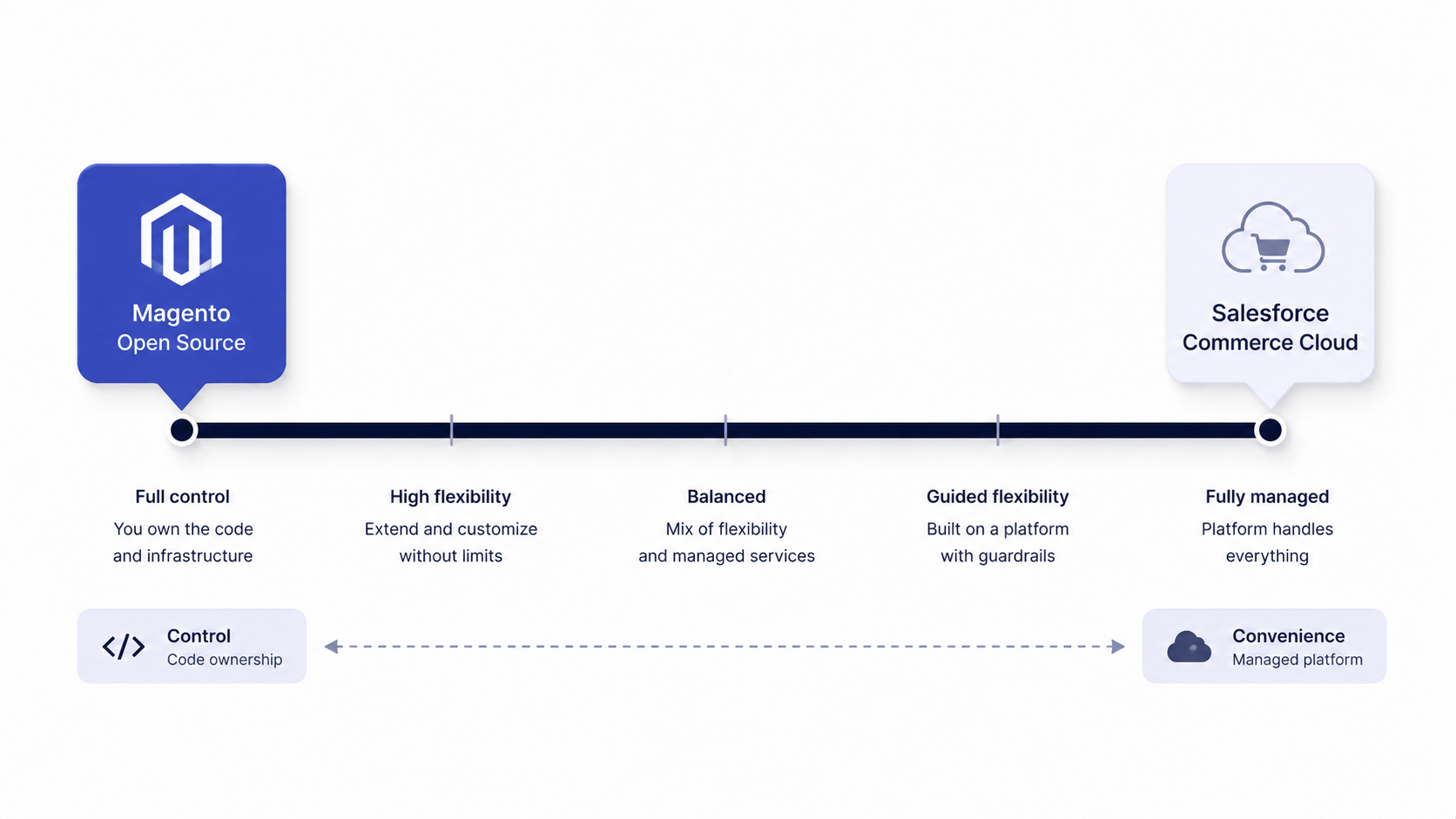
A useful way to frame it: control is a cost as well as a benefit. With Magento, you own the roadmap, which means you also own the upgrades, the regression testing, and the technical debt if you build carelessly. With SFCC, you rent stability, which means you accept the platform’s limits in exchange for never carrying that operational weight yourself.
B2B capabilities: native depth vs separate product
If B2B matters, the platforms diverge meaningfully. Adobe Commerce ships native B2B features inside the same backend that runs your B2C store: company accounts, custom catalogs and price lists, quote workflows, requisition lists, and approval rules. One platform serves both audiences, which keeps data, catalog, and operations unified.
Salesforce addresses B2B largely through a separate product line, so a serious B2B requirement often means additional licensing or a second build alongside the B2C storefront. The upside is tight alignment with Salesforce CRM and sales workflows. The downside is more moving parts, more cost, and more integration work to make the two sides feel like one business.
Ecosystem and integrations
SFCC’s center of gravity is the wider Salesforce ecosystem. If you already run Sales Cloud, Service Cloud, Marketing Cloud, or Data Cloud, Commerce Cloud slots in with native data sharing and a single customer record across the funnel. For organizations standardized on Salesforce, that gravitational pull is the strongest argument in its favor.
Magento’s ecosystem is open and broad rather than vendor-anchored. The Adobe Commerce Marketplace and a large global developer community supply extensions for payments, ERP, PIM, search, and tax, and because you control the code you can integrate any third-party system through APIs without waiting on platform support. Adobe also bundles its own analytics and experience tooling for teams already invested there. The trade-off is familiar: Magento gives you more integration freedom, SFCC gives you a more curated, lower-maintenance set of connections.
Time-to-market and operations: speed vs flexibility
SFCC is generally faster to launch. Managed infrastructure, reference storefronts, and prebuilt capabilities mean less to stand up before go-live, and Salesforce absorbs scaling, security patches, and uptime afterward. For a team under deadline pressure or without deep in-house engineering, that speed and the hands-off operations are real, ongoing value.
Magento launches take longer because you are building, not configuring, and you own operations after launch. That is the cost of flexibility. Many brands offset it by working with a partner who handles hosting, monitoring, performance, and upgrades, which recovers much of the operational convenience while preserving full ownership of the platform.
Total cost of ownership over five years
Sticker price misleads on both platforms, so model the full five-year picture. For SFCC, that means base license plus cumulative revenue share, implementation, and any separate B2B licensing. Because the revenue share compounds with growth, a brand that triples its GMV over five years can see its platform cost climb steeply even though it never touched a server.
For Magento, the five-year math is front-loaded: a larger initial build, an annual license (or none for Open Source), plus hosting and ongoing support. After that, scaling sales does not raise the platform fee, so cost per order tends to fall as you grow. The honest summary is that SFCC trades a lower entry barrier for a recurring percentage, while Magento trades a higher entry cost for a flatter long-run curve and full ownership of the asset.
Market position and platform health
Both platforms are firmly established, which removes a common worry. Adobe Commerce, built on the Magento codebase, powers a very large installed base. BuiltWith trend data and third-party estimates such as Digiteon’s put Magento-based storefronts well above 100,000 worldwide, holding a meaningful share of the global platform market, though that figure mixes paid Adobe Commerce with free Magento Open Source and should be read as the wider ecosystem rather than the enterprise edition alone.
Salesforce, for its part, has been named a Leader in the Gartner Magic Quadrant for Digital Commerce for ten consecutive years through 2025, positioned furthest for completeness of vision, while Adobe earned its ninth consecutive Leader placement. In short, neither platform is a bet on survival; the choice is about fit.
Which should you choose, SFCC or Magento?
The decision comes down to whether you want to own your roadmap or rent your stability. Use these profiles to place your business.
Choose Salesforce Commerce Cloud if your organization already runs on Salesforce CRM and clouds, you want to launch quickly with minimal in-house engineering, you prefer never to manage infrastructure, and you are comfortable paying a revenue share that grows with sales in exchange for that hands-off stability. It fits brands that value speed, managed scale, and a unified Salesforce customer record over deep platform control.
Choose Magento (Adobe Commerce) if your competitive edge depends on customization, you want full ownership of the code and the roadmap, you run complex or blended B2B and B2C operations from one backend, and you would rather make a larger fixed investment than pay a perpetual percentage of revenue. It fits brands that want to build a differentiated experience and keep the upside as they scale. Most teams that go this route work with a Magento development partner to recover the operational ease that SaaS provides by default. If you are mapping the broader Adobe Commerce decision, our guide to Adobe Commerce vs Magento Open Source clarifies which edition matches your needs.
Also read: Magento vs Oracle Commerce Cloud.
Frequently asked questions
Is Magento the same as Adobe Commerce?
Adobe Commerce is the paid, enterprise edition built on the Magento codebase, while Magento Open Source is the free, self-managed version. Both share the same core, so “Magento” usually refers to either depending on context.
Is Salesforce Commerce Cloud like Magento?
They serve the same enterprise tier but work very differently. Magento gives you code-level control and ownership, while Salesforce Commerce Cloud is a managed SaaS platform that trades some control for hands-off operations and faster launch.
What is Salesforce Commerce Cloud called now?
Salesforce markets its commerce offering under the Salesforce Commerce Cloud name, spanning its B2C and B2B commerce products within the broader Salesforce Customer 360 ecosystem.
How much does Salesforce Commerce Cloud cost compared to Magento?
SFCC combines a base license with a revenue share of roughly 1 to 3 percent of GMV, so cost rises with sales. Magento (Adobe Commerce) uses a fixed annual license plus build and hosting, with Open Source carrying no license fee. At high volume Magento is often cheaper per order.
Does Salesforce Commerce Cloud support B2B?
Yes, but typically through a separate B2B Commerce product or additional licensing rather than the same backend as B2C. Adobe Commerce, by contrast, includes native B2B features in a single platform.
Which platform is faster to launch?
Salesforce Commerce Cloud is generally faster because its managed infrastructure and reference storefronts mean less to build before go-live. Magento takes longer since you are building a more customized solution, but you gain full ownership in return.
Can I migrate from Magento to Salesforce Commerce Cloud or the reverse?
Yes, both directions are feasible with proper data mapping for catalog, customers, and orders, plus a rebuild of the storefront and integrations. Because the platforms differ architecturally, treat it as a re-platform rather than a lift-and-shift.
Still weighing whether to own your roadmap or rent it? Talk enterprise architecture with our team, and we will map the right platform to how your business grows.