
The pitch is seductive: pick a template, drag a few blocks, add products, and you are selling by the weekend. Wix sells that promise well, and for a tiny catalog it largely delivers. The problem starts later, when the store you launched in a weekend has to carry a real business. A website builder is built around the assumption that your needs stay simple. Serious commerce assumes the opposite, that complexity arrives the moment you start to win.
That is the real question behind Magento vs Wix. It is not which tool is easier to start with, because Wix wins that on day one. It is which platform still fits when you have thousands of SKUs, B2B buyers asking for negotiated pricing, three markets in two currencies, and a marketing team that needs control over every URL. Magento, now sold by Adobe as Adobe Commerce, was built for exactly that pressure. Wix was not.
This comparison treats both fairly. There are real stores that should stay on Wix and never look back. There are others paying a quiet tax every month because they outgrew it two years ago and have not noticed. Below we put the two platforms side by side on cost, ease of use, scalability, customization, payments, support, B2B, and SEO, so you can place your store on the right side of that line.
🚀 Quick takeaway
Wix is an entry-level website builder that fits very small, simple stores selling a handful of products with little ongoing complexity. Magento (Adobe Commerce) is an open, enterprise-grade platform built for large catalogs, B2B, multi-store, and heavy customization.
Magento vs Wix: the key differences at a glance
The short version: Wix and Magento solve different problems. Wix is a hosted, all-in-one website builder where eCommerce is one feature among many. Magento is a dedicated commerce platform you host and shape yourself, with no ceiling on catalog size, integrations, or custom logic.
Wix optimizes for the person who wants to launch without a developer. Magento optimizes for the business whose requirements will eventually exceed what any closed builder allows. The table below frames the headline contrast before the detailed sections.
| Category | Magento (Adobe Commerce) | Wix |
|---|---|---|
| Best fit | Mid-market to enterprise, large catalogs, B2B, multi-store | Very small, simple stores and content-led sites |
| Hosting model | Self-hosted or cloud, you choose the stack | Fully hosted by Wix, no server control |
| Ease of launch | Needs a developer or agency | Drag-and-drop, launch without code |
| Catalog scale | Hundreds of thousands of SKUs | Comfortable into the low thousands, strained beyond |
| Customization | Full source-code control, open architecture | Limited to platform features and app market |
| Payments | Open gateway choice, custom checkout, your own PCI scope | Wix Payments plus a fixed set of providers, hosted checkout |
| B2B features | Native B2B in Adobe Commerce (company accounts, quotes, price tiers) | Minimal, not built for B2B |
| SEO control | Deep control over URLs, metadata, structured data, performance | Solid basics, less granular control |
| Support model | Agency or partner plus Adobe support on Commerce | Wix managed support across all plans |
| Cost shape | Free open source plus build and hosting, or licensed Adobe Commerce | Predictable monthly fee per plan tier |
What are Magento and Wix?
Magento is a dedicated eCommerce platform you control end to end. Wix is a general-purpose website builder that added a store feature. That distinction shapes everything that follows.
What is Magento (Adobe Commerce)?
Magento is an open-source commerce platform Adobe acquired in 2018 and now sells in two forms. Magento Open Source is free to download and self-host. Adobe Commerce is the licensed enterprise edition with native B2B, advanced merchandising, and Adobe cloud hosting layered on top.
Because the codebase is open, agencies and in-house teams can change almost anything: checkout logic, pricing rules, catalog structure, integrations with an ERP or PIM. That openness is the reason Magento still powers around 130,000 live stores worldwide as of 2026, according to BuiltWith technology-tracking data, and why it remains a common choice among high-volume and B2B sellers. It is also why Magento needs real engineering to run well. The power and the cost come from the same place.
What is Wix?
Wix is a hosted website builder that lets anyone assemble a site by dragging elements onto a canvas. Wix Stores is the eCommerce module bolted onto that builder. You get templates, a visual editor, hosting, and an app market, all managed by Wix with no server to maintain.
Wix reported roughly 290 million registered users across more than 190 countries in its 2025 financial disclosures, a base that makes it one of the most widely used website builders in the world. The active eCommerce subset is far smaller, and Store Leads technology data as of 2026 places the bulk of live Wix stores in the small-catalog range. That scale is real, but it is concentrated at the simple end of the market. Wix is excellent at getting a modest store online fast. It is not designed to be rebuilt from the inside when your requirements grow past its feature set.
Ease of use: who can run the store?
Wix is dramatically easier to start with. A non-technical founder can build and publish a small Wix store in a weekend without writing code. Magento expects a developer or an agency from day one.
That gap is genuine, and it matters most at the smallest scale. If you sell twenty products and run the store yourself, Wix removes the friction Magento would add. The drag-and-drop editor, built-in hosting, and managed updates mean you are never blocked waiting on a technical resource.
The trade-off appears as the store grows. Ease of use in a builder comes from limiting choices. The moment you need a workflow Wix did not anticipate, a custom shipping rule, a bespoke product configurator, an integration with your warehouse, you hit a wall the editor cannot move. Magento inverts this. It is harder to operate but has almost no ceiling, which is why teams running complex catalogs accept the higher operating bar. For a fuller view of what running Magento well involves, our analysis of Magento adoption separates the real maintenance demands from the myths.
Cost and total cost of ownership
On the sticker, Wix wins easily. On total cost of ownership at scale, the comparison is more honest than the monthly fee suggests.
What does Wix cost?
As of 2026, Wix sells eCommerce capability through its Business plan tiers. The entry commerce tier (marketed as Core) runs around the high-$20s per month, the mid Business tier lands near the low-$30s, and the top Business Elite tier reaches roughly the high-$100s to low-$200s per month on annual billing. All tiers include hosting, security, and the Wix Payments option, with pricing varying by region and promotion, so treat these figures as approximate as of 2026 rather than fixed. There is no separate build cost for a basic store because you build it yourself.
The hidden costs are softer. As you add paid apps from the Wix App Market to fill feature gaps, the monthly bill creeps up, and some apps carry their own subscriptions. Because you cannot deeply customize, certain requirements simply cannot be bought at any price, which becomes a cost in lost capability rather than dollars.
What does Magento cost?
Magento Open Source has no license fee, but you pay for hosting, the initial build, and ongoing maintenance. Adobe Commerce adds a license, typically negotiated and priced against your gross merchandise value, in exchange for native B2B, advanced features, and managed cloud infrastructure.
The number that matters is total cost of ownership over several years. Magento costs more to stand up and maintain, and that investment buys headroom: no per-feature paywalls, no platform ceiling, and the ability to optimize the parts of the funnel that move revenue. For stores past a certain size, the cost of staying on a builder shows up as lost sales and operational drag.
Scalability: where the builder runs out of room
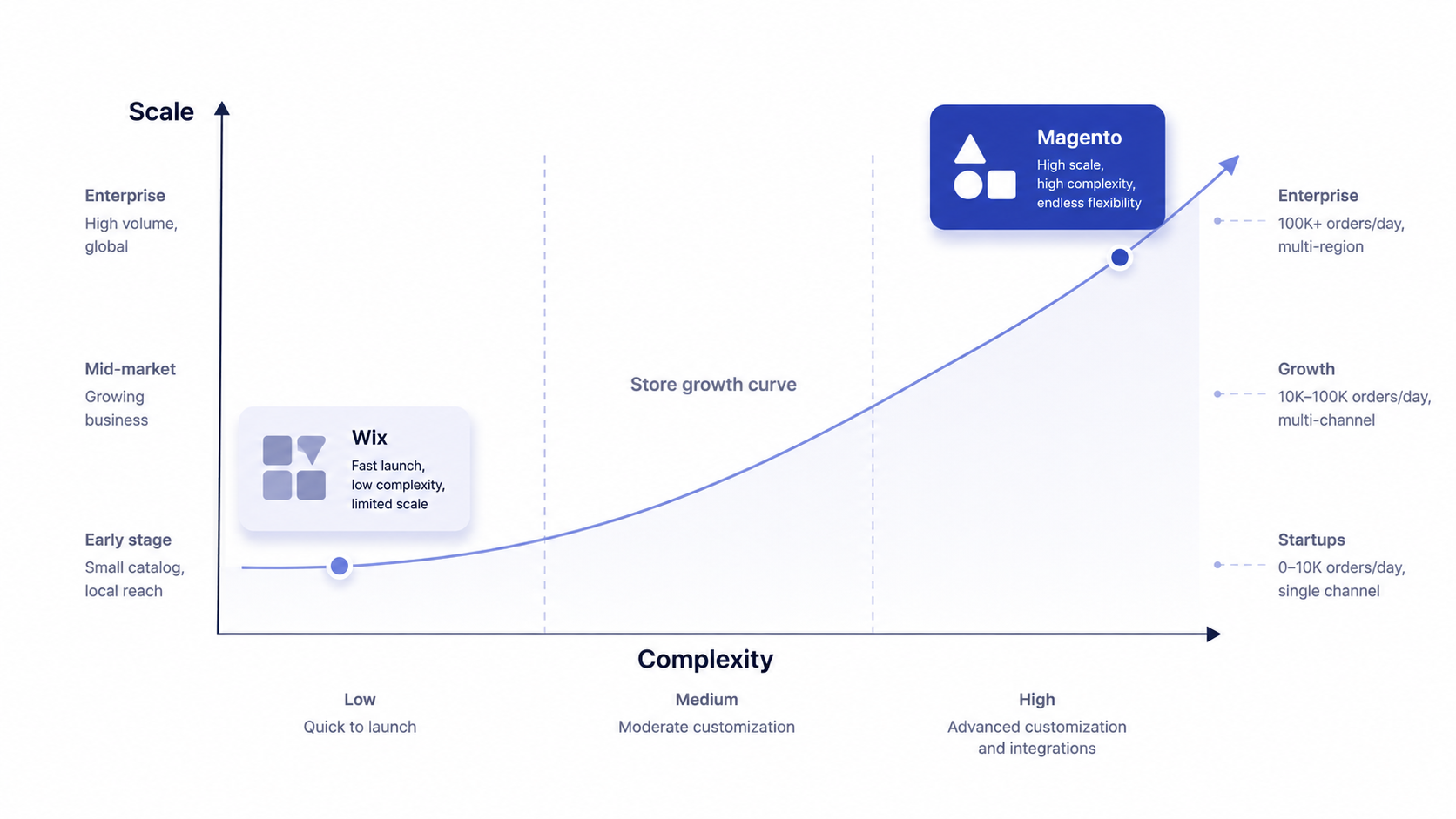
This is the core of the contrarian case. Wix scales fine until it does not, and the wall is hard rather than gradual. Magento is built to absorb growth in catalog, traffic, and complexity without a replatform.
Wix handles small and even mid-sized catalogs acceptably, but several limits surface as you grow. Product counts in the high thousands strain the admin and storefront. Complex catalog structures, large numbers of variants, and high-concurrency traffic spikes are not what the platform was tuned for. Because you do not control the hosting or the code, you cannot engineer your way around those limits when you hit them.
Magento was designed for the opposite scenario. It runs comfortably with hundreds of thousands of SKUs, supports multiple stores and websites from one admin, and gives you control over caching, indexing, and infrastructure so performance scales with investment. When traffic or catalog grows, you add resources and optimize, rather than starting over. That is the practical meaning of a platform with no ceiling, and it is the single biggest reason businesses migrate off builders.
What does moving off Wix involve?
A replatform is more than copying products across. Because Wix is a closed system, there is no full database export of the kind Magento ingests directly, so a migration team extracts the catalog, customers, and order history through exports and APIs, then maps that data into Magento’s structure. The storefront itself is rebuilt rather than ported, since Wix templates do not translate to Magento themes.
The work that protects revenue is the part merchants underestimate: preserving URL structure with redirects so you do not lose rankings, carrying over historical orders for support and accounting, and re-creating any logic that lived inside Wix apps. Planned ahead of a growth spike, this is a controlled project. Done in a panic after hitting a wall during peak season, it is expensive and risky. If you reach that point, our Magento migration work focuses on moving without losing rankings or order history.
Customization and flexibility
Wix lets you customize within its lines. Magento lets you redraw the lines. For most growing brands, that difference decides the platform.
With Wix you choose a template, restyle it in the editor, and extend functionality through the app market. That covers common needs well. What it does not cover is anything the platform did not anticipate, because you never touch the underlying code. Even swapping templates after launch is constrained.
Magento gives you the full source code and an open, modular architecture. You can change checkout flows, build custom product types, automate merchandising, and integrate with an ERP, PIM, or any third-party system through APIs. That flexibility is why complex brands choose it and why a capable build partner matters. The same openness that makes Magento powerful makes a poorly built Magento store fragile, so the implementation quality is decisive. Our breakdown of what Magento is goes deeper on the architecture behind that flexibility.
Payments and checkout: how much control over the money path?
Both platforms can take a card. The difference is who owns the checkout and how many payment options you can offer as you grow.
Wix routes commerce through Wix Payments, its built-in processor, alongside a fixed set of supported gateways such as PayPal, Stripe, and a handful of regional providers. Checkout is hosted and largely standardized, which keeps PCI scope low and setup fast because Wix handles the compliance burden. The constraint is that you accept Wix’s checkout flow and its supported providers. You cannot deeply restyle the steps, insert custom logic mid-checkout, or add a niche local payment method Wix has not integrated.
Magento takes the open approach. You select from a large extension marketplace of payment gateways or integrate any processor directly through its payment API, which matters for merchants who need region-specific methods, B2B options like purchase orders and offline payment, or a one-page checkout tuned for conversion. That freedom comes with responsibility: you own more of the PCI scope and the checkout is yours to build and maintain. For high-volume stores, the ability to add local payment methods per market and to optimize the checkout itself is often worth that overhead, because checkout friction maps directly to abandoned carts.
SEO and performance: how much control do you get?
Both platforms can rank. The difference is how much control you have over the levers that matter at scale, and how far you can push performance.
Wix covers the SEO basics well: editable titles and descriptions, customizable URLs, automatic sitemaps, and mobile-responsive templates. For a small content-led store that is enough. The constraint is depth. You work within Wix’s rendering and structure, with limited control over technical details and page speed beyond what the platform exposes.
Magento gives you granular control over URL structure, metadata, canonical tags, structured data, and the full performance stack. You can implement advanced caching, tune Core Web Vitals, and adopt modern frontends like headless or lightweight Hyva themes to hit speed targets that directly affect rankings and conversion. The payoff is measurable: Google’s own research found that as mobile page load time goes from one second to three seconds, the probability of a bounce rises by 32 percent, and Deloitte’s “Milliseconds Make Millions” study (2020) found that a 0.1-second improvement in mobile site speed lifted retail conversion rates by 8.4 percent. With Google continuing to weight page experience and Core Web Vitals as ranking signals through 2025 and 2026, the ability to engineer those metrics rather than wait on a builder is a real advantage for stores competing on organic traffic. The catch is the same as everywhere else with Magento: the control is only worth what your team or partner does with it.
B2B and multi-store: the requirements Wix cannot meet
If you sell B2B or run multiple storefronts, this section likely ends the comparison. Magento has native B2B and multi-store. Wix has neither in any serious form.
Adobe Commerce ships native B2B functionality: company accounts with buyer hierarchies, negotiated and tiered pricing, quote requests, requisition lists, and credit limits. It is one of the few platforms a Gartner-recognized vendor markets specifically for digital commerce at the enterprise tier, and B2B sellers value it because business buyers expect account-based pricing and self-service ordering that a consumer builder simply does not model.
Magento also runs multiple stores, websites, currencies, and languages from one admin with shared or separate catalogs, which suits brands operating across regions or selling both retail and wholesale. Wix is built for a single, simple storefront. If your roadmap includes B2B, wholesale, or international expansion, the question is not whether you outgrow Wix but when. For teams weighing the hosted-builder route more broadly, our Magento vs Shopify comparison covers the trade-offs of staying on a managed platform.
Also read: Magento vs BigCommerce.
Also read: Magento vs Volusion.
Support and ecosystem: where help comes from
The two platforms answer the support question in opposite ways. Wix centralizes it. Magento distributes it across a partner ecosystem.
With Wix, support is built into the subscription. You get help center articles, ticketed support, and on higher tiers priority and phone channels, all from Wix itself. There is one vendor to call, and the app market gives you a curated set of add-ons vetted to work inside the platform. For a small team without technical staff, that single point of accountability is genuinely valuable, and it is part of what the monthly fee buys.
Magento has no single vendor that runs your store for you. Adobe provides product-level support on Adobe Commerce, but day-to-day development, fixes, and optimization come from an agency, a partner, or an in-house team. The upside is a deep ecosystem: a large extension marketplace, a global pool of certified developers, and specialist agencies that can take full ownership of a build. The downside is that the quality of your store is only as good as the partner you choose, which makes vendor selection one of the most consequential decisions in a Magento project. For stores that want managed coverage without giving up that flexibility, ongoing eCommerce support fills the gap a builder includes by default.
Which should you choose: Magento or Wix?
The decision comes down to where your store is now and where it is heading. Match your situation to the closer profile below.
Choose Wix if you are launching a small, simple store, sell a limited catalog, run the site yourself without developers, want the lowest possible startup cost and effort, and do not foresee B2B, multi-store, or heavy customization needs. For that profile, Wix is the right tool and Magento would be overkill.
Choose Magento (Adobe Commerce) if you have a large or complex catalog, sell B2B or wholesale, operate across multiple stores, regions, or currencies, need deep customization and integrations with systems like an ERP or PIM, or are already feeling the limits of a builder. The higher operating bar buys headroom you will keep using as you grow.
The honest middle ground: if you are a small store today but confident you are heading toward complexity, factor the replatform cost into the Wix decision now. Many brands start on a builder, succeed, and then pay to migrate under pressure. Choosing the platform that matches your three-year plan is usually the cheaper path.
Frequently asked questions
Is Magento better than Wix?
Neither is universally better. Magento is better for large catalogs, B2B, multi-store, and heavy customization. Wix is better for very small, simple stores that need to launch fast without developers. The right answer depends on your catalog size, complexity, and growth plan.
Can I migrate from Wix to Magento later?
Yes. Many brands start on Wix and move to Magento once they outgrow the builder. The migration extracts products, customers, and order history through exports and APIs, rebuilds the storefront, and sets up redirects to protect rankings, so it is best planned deliberately rather than done under pressure when you have already hit a wall.
Is Wix good for a large eCommerce store?
Wix handles small and mid-sized catalogs acceptably but strains with very large product counts, complex catalog structures, high-concurrency traffic, and B2B requirements. Because you do not control the hosting or code, you cannot engineer around those limits, which is where larger stores tend to outgrow it.
How much does Magento cost compared to Wix?
Wix has a low, predictable monthly fee per plan tier with hosting included, ranging roughly from the high-$20s to low-$200s per month as of 2026. Magento Open Source has no license fee but requires paying for hosting, build, and maintenance, while Adobe Commerce adds a license. Magento costs more upfront but removes per-feature paywalls and platform ceilings, so compare total cost of ownership over several years rather than month one.
Does Wix support B2B selling?
Wix offers only minimal B2B capability and is not built for it. Magento (Adobe Commerce) includes native B2B features such as company accounts, tiered and negotiated pricing, quotes, and requisition lists, which is why it is a common choice for B2B and wholesale sellers.
Which platform is better for SEO, Magento or Wix?
Both can rank. Wix covers SEO basics like editable metadata, custom URLs, and sitemaps. Magento gives deeper control over URL structure, structured data, caching, and performance, which is an advantage for stores competing hard on organic traffic at scale.
What payment options does each platform support?
Wix routes payments through Wix Payments plus supported gateways like PayPal and Stripe, with a hosted checkout that keeps PCI scope low but limits customization. Magento lets you integrate almost any payment gateway and fully customize the checkout, including B2B methods like purchase orders, at the cost of owning more of the PCI and maintenance burden.
Is Magento hard to use?
Magento has a steeper operating bar than Wix and typically needs a developer or agency to run well. That is the trade-off for its flexibility and scale. For complex stores, the higher effort is justified by capabilities a builder cannot offer.
When the website builder runs out of room, the smart move is not to patch around the ceiling but to plan the step up with a team that has migrated and scaled hundreds of stores on Magento.