
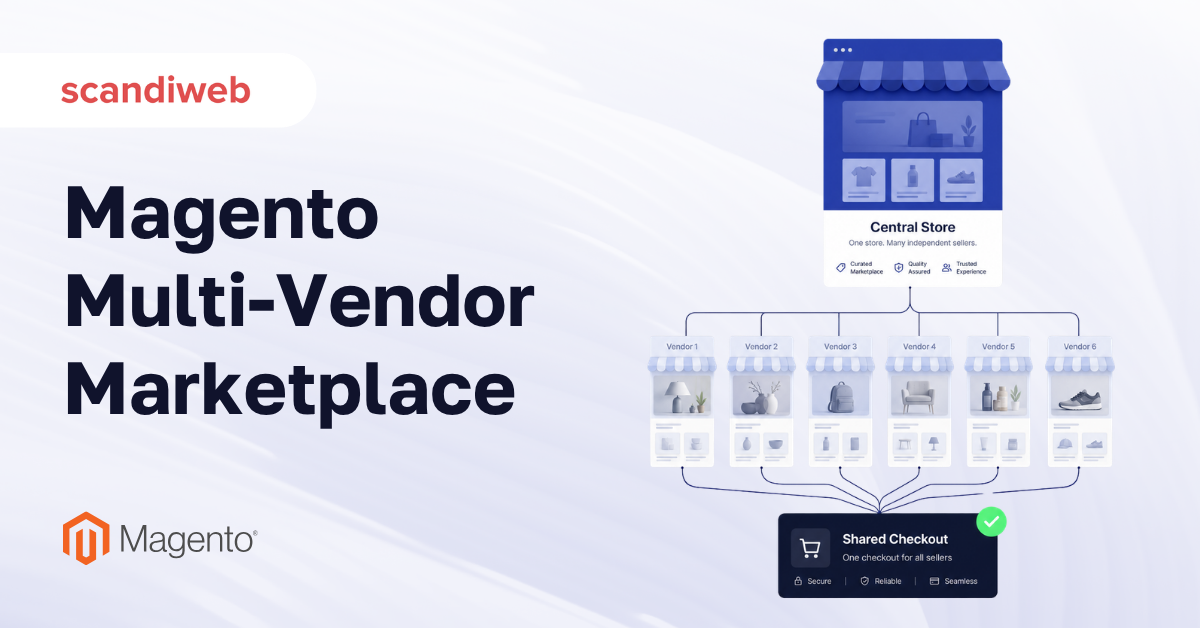
Searching for Magento marketplace, you have probably landed on two very different things. One is the Adobe Commerce Marketplace, the official store where you download extensions and themes for your own site. The other is a multi-vendor marketplace, where you turn your Magento (Adobe Commerce) store into a platform that hosts many independent sellers, like Amazon, Etsy, or a B2B trade hub. In this article, we will clarify the first meaning, then focus on the second and what a multi-vendor build is, what it costs in features and effort, and when it is the right move for your business.
🚀 Quick takeaway
A Magento multi-vendor marketplace is a single Adobe Commerce storefront where many third-party sellers list and sell their own products, while you, the operator, manage onboarding, commissions, payouts, and trust. You build it either with a marketplace extension (faster, lower-cost, less control) or a custom development project (slower, higher-cost, full control). The right choice depends on catalog complexity, payout rules, and how far your model differs from a standard seller-product-commission setup.
Magento Marketplace vs. a multi-vendor marketplace
The term “Magento Marketplace” most often refers to the Adobe Commerce Marketplace, formerly branded Magento Marketplace. It is Adobe’s official catalog of vetted extensions, themes, and modules that merchants and agencies install to extend a single store. You go there to buy a checkout extension or a marketplace module.
A multi-vendor marketplace is the opposite direction of travel. Here, you take your own Magento store and convert it into a platform where outside vendors register, list products, and sell to your shared customer base. You set the rules, take a commission, and own the customer relationship. The Adobe Commerce Marketplace is software you consume, while a multi-vendor marketplace is a business you operate.
If you requested a Magento multi-vendor, you most likely want the second one, and the rest of this guide is about that build.
What is a Magento multi-vendor marketplace?
A Magento multi-vendor marketplace is a single Adobe Commerce storefront that lets many independent sellers list, price, and fulfill their own products under one shared brand and checkout. The platform operator handles onboarding, commission rules, payouts, and customer trust, while each vendor runs their own catalog and orders from a dedicated dashboard.
In practice, this changes three things compared with a normal single-merchant store:
- Ownership of inventory – you no longer own most of the stock, vendors do, and your catalog grows without your buying team
- Money flows – customer pays once at checkout, then revenue is divided between the relevant vendors and your commission
- The operator role replaces the retailer role – you curate sellers, enforce quality, resolve disputes, and run the platform, rather than sourcing and selling goods yourself.
According to ECDB, marketplaces generated 83.4% of global eCommerce gross merchandise value in 2025, up from 81.0% in 2023, while first-party online stores accounted for just 16.6%. Digital Commerce 360 reports that third-party GMV across the world’s top 100 marketplaces was projected to grow 10.1% to $3.2 trillion in 2025. The marketplace structure is where a large share of online demand now rests.
Why merchants build a marketplace on Magento
Merchants move to a multi-vendor model for reasons that go beyond “more products.” The structure changes the economics of the business.
Catalog growth without inventory risk
Vendors fund and hold their own stock. You expand assortment and category depth without tying up working capital or warehouse space.
Commission revenue on top of, or instead of, margin
You earn a percentage of every vendor sale. A healthy marketplace can run leaner than a pure retail operation because the cost of goods rests with the sellers.
A defensible network effect
More vendors attract more buyers, and more buyers attract more vendors. Over time, that flywheel is hard for a single-merchant competitor to match.
Magento (Adobe Commerce) is a common choice for this because it is open-source at the core, deeply customizable, and built to handle large catalogs and complex B2B and B2C rules.
Core features every Magento marketplace needs
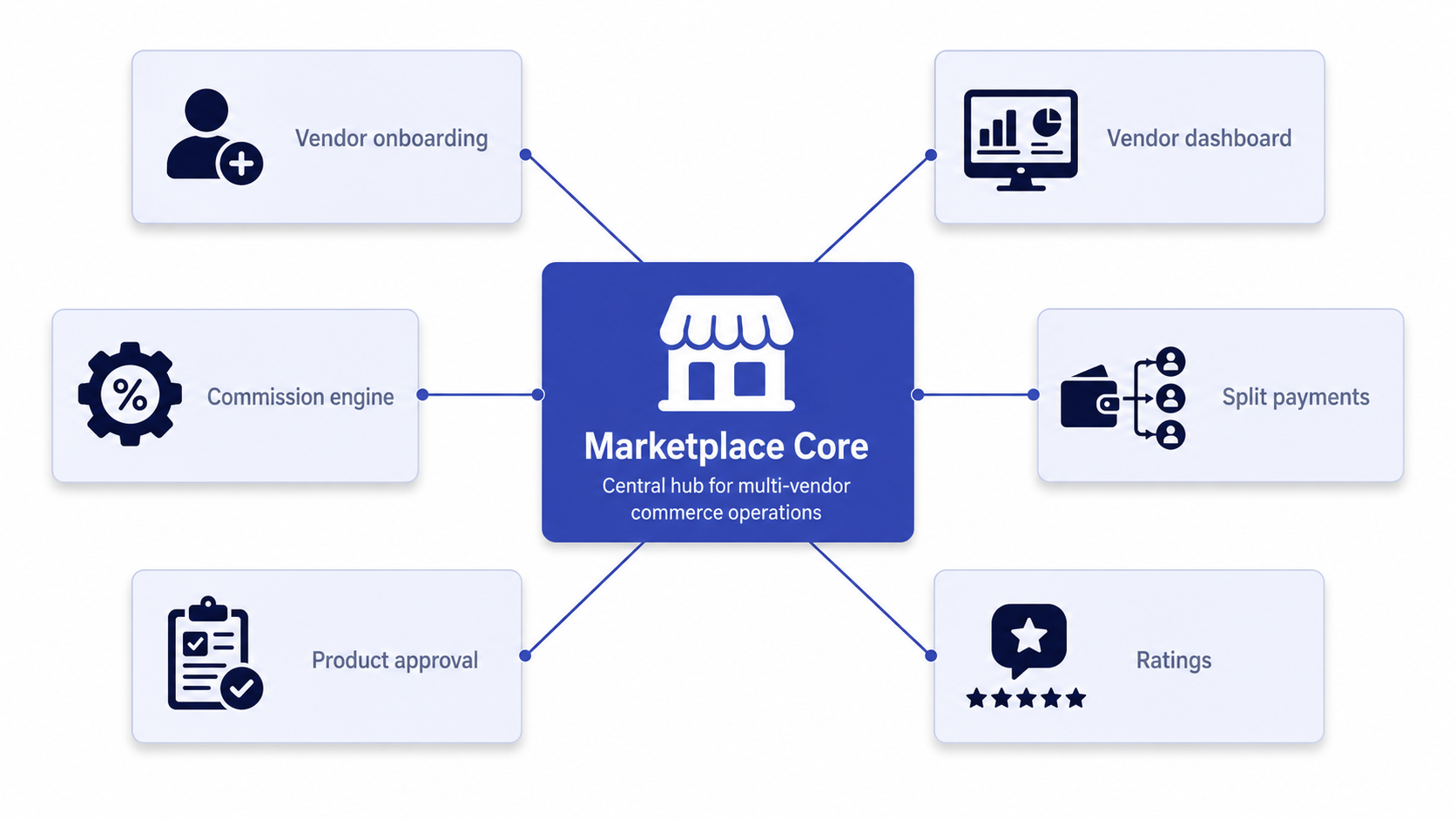
Whether you buy an extension or build custom, a credible multi-vendor marketplace needs the same functional spine. These are the features buyers and sellers expect, and the ones that quietly decide whether the platform earns trust.
Vendor onboarding and approval
Sellers register, submit business details, and either go live automatically or wait for admin approval. Manual approval protects quality early on. Automated approval scales better once your standards are codified. Most serious marketplaces run a hybrid: auto-approve known vendors, review new ones.
Vendor dashboards
Each seller needs a self-service panel to add products, manage stock, view orders, track payouts, and read customer reviews. The richer the dashboard, the less of your team’s time goes into vendor support. This is the single feature that most affects operating cost at scale.
Commission management
You set how much you take per sale. Mature setups support global rates, per-vendor rates, and category- or product-level commissions with price-range rules. Your commission logic is the heart of the business model, so it deserves more scrutiny than any other feature.
Split payments and payouts
When a customer pays once for items from several vendors, the system must split the funds, deduct your commission, and route the rest to each seller on a defined schedule. This is where marketplaces get legally and technically serious, because you may be handling money on behalf of others. Payment providers such as Stripe Connect, PayPal for Marketplaces, and Mangopay exist specifically for this, and integrating one correctly is rarely a drag-and-drop task.
Product approval and catalog control
Operators need to review listings before they go public, enforce category rules, and remove items that break policy. Without this, catalog quality drifts, and the brand suffers.
Ratings, reviews, and trust signals
Vendor ratings, product reviews, and a way for customers to flag bad sellers are what make a marketplace feel safe to buy from. Trust is the product as much as the goods are.
Extension vs custom build: how should you create the marketplace?
You build a Magento multi-vendor marketplace in one of two ways: install a marketplace extension and configure it, or commission a custom development project. An extension is faster and cheaper but constrains your model to its features. A custom build costs more and takes longer, but fits any business logic you need.
Most projects start with an extension and only move to heavy customization, or a custom rebuild, once the model outgrows what off-the-shelf modules allow.
| Consideration | Marketplace extension | Custom build |
|---|---|---|
| Time to launch | Weeks | Months |
| Upfront cost | Low (roughly $99 to $700 for the module) | High (development time and team) |
| Business-logic fit | Limited to module features | Anything you can specify |
| Payout and commission rules | Standard, with add-ons | Fully bespoke |
| Maintenance burden | Vendor-managed updates | Your team or agency |
| Best for | Validating the model, standard rules | Unusual models, large scale, deep integrations |
Which Magento marketplace extensions are worth knowing?
The mature options most teams shortlist are Webkul, Amasty, Purpletree, CedCommerce, and CreativeMinds, a set that also features in wider roundups of the best Magento 2 extensions. They differ mainly in commission flexibility, dashboard depth, and how cleanly they handle split payouts.
For context on real pricing and packaging, Webkul’s Marketplace Multi Vendor module for Magento 2 lists at around $249 for the base, with paid add-ons for advanced commissions and Hyvä theme support. Amasty’s multi-vendor extension lists around $299, and Purpletree and CedCommerce options start near $99. The headline price is rarely the full cost. Installation, Adobe Commerce edition support, theme compatibility, and add-on modules stack on top, and a real marketplace usually needs several of them.
A common warning in the Magento community, visible in r/Magento threads on building marketplaces, is that extensions can conflict with each other and with your theme, and that “the marketplace extension is not working” is a frequent support ticket after Magento or theme upgrades.
Is there a free Magento multi-vendor extension?
Free and open-source marketplace modules exist on GitHub, but they suit proof-of-concept work. They typically lack vetted split-payment integrations, security hardening, and ongoing maintenance, which makes them risky once real money and real vendors are involved.
When does a custom marketplace build make sense?
A custom build is justified when your model breaks the assumptions an extension is built on. Watch for these signals:
- Non-standard payout logic. Tiered commissions, region-specific tax handling, milestone payouts, or escrow that no module supports cleanly.
- Deep integrations. ERP, PIM, marketplace-wide search, or a headless storefront that needs the vendor data model exposed through APIs. Our work on Integrations is often where marketplace projects get genuinely complex.
- B2B trade rules. Negotiated pricing, company accounts, approval workflows, and quote requests across many sellers. If that is your world, the B2B eCommerce layer needs to coexist with vendor logic, which extensions rarely handle well.
- Scale and performance. Tens of thousands of vendors or millions of SKUs, where extension architecture starts to strain and you need control over indexing, caching, and database design.
- Brand and UX control. A vendor and buyer experience that has to match a strong brand.
In most of these cases, the realistic path is a hybrid: a solid extension as the foundation, then targeted custom development on top, handled through proper Magento development. A full ground-up custom marketplace is the right call mainly at the high end of complexity and scale.
What does a Magento marketplace cost, and how long does it take?
An extension-based marketplace can launch in a matter of weeks for the cost of the module plus configuration and testing. A custom or heavily customized build runs into months and a development budget that scales with complexity, because the work is in payout logic, integrations, and vendor experience.
The honest cost driver is the operating model. Mapping commission rules, payout schedules, vendor agreements, tax handling, and dispute processes is where projects expand. Teams that specify these before development, rather than during, spend far less.
Is Magento still a good base for a marketplace in 2026?
Yes. Magento (Adobe Commerce) remains a strong marketplace foundation because of its open architecture, large extension ecosystem, and ability to handle complex catalogs and B2B rules. The platform is actively maintained and widely used at an enterprise scale.
Frequently asked questions
What is the difference between the Magento Marketplace and a multi-vendor marketplace?
The Magento Marketplace, now the Adobe Commerce Marketplace, is Adobe’s official store for buying extensions and themes for your own site. A multi-vendor marketplace is a store you operate that hosts many independent sellers. One is software you consume, the other is a business you run.
Can I turn an existing Magento store into a multi-vendor marketplace?
Yes. You add a marketplace extension or commission custom development that introduces vendor accounts, dashboards, commissions, and split payments on top of your current catalog. Your existing products and customers can remain in place while vendor selling is layered on.
How do split payments work in a Magento marketplace?
The customer pays once at checkout. The platform then divides the funds, deducts your commission, and routes the remainder to each vendor on a set schedule, usually through a marketplace payment provider such as Stripe Connect, PayPal for Marketplaces, or Mangopay. Correct setup matters because you may be handling money on behalf of others.
Is there a free Magento multi-vendor marketplace extension?
Free and open-source modules exist on GitHub, but they suit testing rather than production. They generally lack vetted payment integrations, security hardening, and maintenance, which makes them risky once real vendors and payouts are involved.
How much commission do marketplaces usually charge vendors?
It varies widely by category and model, often in the range of 5 to 20 percent per sale, and mature platforms set different rates by vendor, category, or product. Your commission structure is the core of the business model, so it should be designed deliberately rather than copied from a default.
Extension or custom build, which should I start with?
Most merchants start with an extension to validate the model quickly and cheaply, then move to custom development once payout logic, integrations, or scale outgrow the module. A hybrid of extension plus targeted customization is the most common production setup.
Can a Magento marketplace support B2B selling?
Yes, though it adds complexity. Negotiated pricing, company accounts, approval workflows, and quote requests have to coexist with vendor and commission logic, which usually pushes a B2B marketplace toward custom development rather than off-the-shelf extensions alone.
Thinking about turning your store into a multi-seller marketplace? Talk to scandiweb to plan a marketplace build that fits your commission rules, payout logic, and scale from day one.