
Omnichannel retailers simultaneously have to manage processes, systems, and customer experience across eCommerce, POS, loyalty, CRM, ERP, data, in-store tools, wholesale, and other sales channels.
Making them work as one is the real challenge.
Actually, most retailers we meet are dealing with a connection problem. Each system in the stack does roughly what it’s supposed to do in isolation, but in between, there’s a disconnect. As a result:
- Store associates don’t see accurate online stock
- Online and in-store experiences are not continuous for customers
- Launching in new markets takes more effort than expected
- Finance reconciles three systems manually every month
- Internal teams spend time aligning systems instead of improving them,
and hundreds of other frictions due to a fragmented retail stack.
Fixing it is a retail operating model project, and the partner you choose has to understand the whole picture: how point-of-sale connects to inventory, how loyalty ties into CRM, how wholesale orders flow into the same ERP as DTC, how in-store tools need to behave for associates who have eight seconds to help a customer. Miss any of those, and the omnichannel promise stays a slide in a strategy deck.
Over the years, scandiweb has helped retailers design and implement this kind of end-to-end connected setup, covering the full operating model behind the storefront. In this article, we’ll walk through omnichannel enablement projects we’ve delivered for Byggmax, Läderach, Sportland, JYSK, and Lafayette 148.
What end-to-end omnichannel requires
Omnichannel is best understood as a set of conditions that either hold across your operation or don’t. When they hold, the customer experience feels seamless, and operational costs decrease. Otherwise, every channel becomes a silo that someone has to manually bridge. Four conditions, in our experience, ensure an end-to-end omnichannel experience:
A single view of the customer across every touchpoint. A customer who buys online, returns in store, joins the loyalty program on their phone, and gets a service email the following week should appear as one person across every system that sees them. This sounds obvious and is surprisingly rare in practice. Achieving it requires CRM, eCommerce, POS, and loyalty to share data in real time.
Inventory and product data your teams trust. If a store associate has to call another location to check stock because the system is “usually wrong,” the omnichannel promise has already broken down at the point where it matters most. What this condition requires is near-real-time inventory visibility, consistent product data across channels, and a master source that your ERP, webshop, POS, and marketplaces all defer to.
Loyalty, pricing, and promotions that behave consistently everywhere. A promotion the webshop runs, and the POS can’t apply, becomes a promotion that generates complaints. Points earned in one channel that fail to redeem in another erode trust in the brand over time. The loyalty and pricing engines need to sit above the channels, governing them, rather than living inside one of them.
Systems designed so operations don’t depend on manual workarounds. Every retailer has people who hold the stack together with spreadsheets and other workarounds. A good omnichannel setup steadily reduces the number of those people you need, e.g., integrations can handle edge cases, and in-store tools are built around how staff actually work.
To make omnichannel work, retailers need alignment among:
- Customer experience – consistent journey from discovery to purchase to post-purchase, even if switching between channels
- Operational workflows – how orders are placed, fulfilled, returned, or assisted in-store → how store teams access information → how inventory is used
- Systems and architecture – eCommerce, POS, ERP, CRM, PIM, and other systems working as one setup
- Data and decision-making – product, customer, and performance data usable across teams and markets, translated and accessible in the right context.
When these layers are connected into one working system, it enables consistent brand perception, faster expansion into new markets, scalable operations without increasing complexity, and continuous, data-based improvement.
Let us demonstrate through long-term scandiweb partnerships with global omnichannel retailers.
Byggmax x scandiweb: one platform for 6 stores, 3 markets, and 200+ locations
Byggmax is one of the largest DIY retailers in the Nordics, operating more than 200 physical stores across Sweden, Norway, Finland, and Denmark alongside a fast-growing eCommerce channel. With a catalog of 55,000+ SKUs with country-specific pricing and stock, the business serves DIY customers arriving with project ideas and professional builders managing material logistics.
Seasonality is their defining feature: roughly 70% of revenue is generated in a specific period, during which the workforce grows by x10, with extra seasonal workers hired to support store operations.
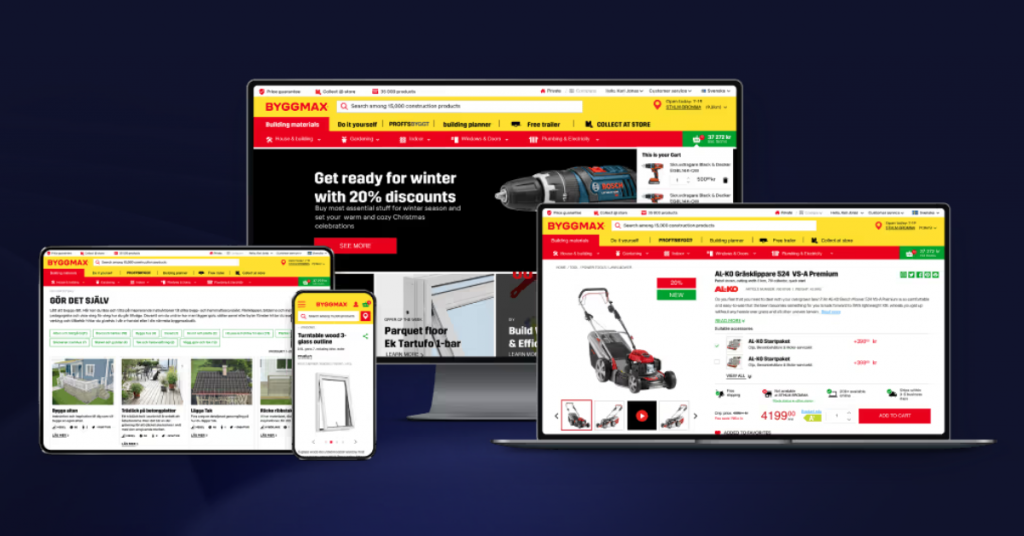
Previous setup
Byggmax’s eCommerce setup had become complex as the business expanded, due to a mix of shared components, country-specific logic, and custom infrastructure that became unpredictable during peak traffic. Performance varied among markets, releases carried high risk, UX and performance improvements kept getting deprioritized by stability work, and the roadmap had shifted toward firefighting rather than growth.
The 200+ physical store network needed to integrate cleanly with the digital Magento ecosystem for BOPIS, local stock and pricing, and customer service.
Omnichannel setup we built
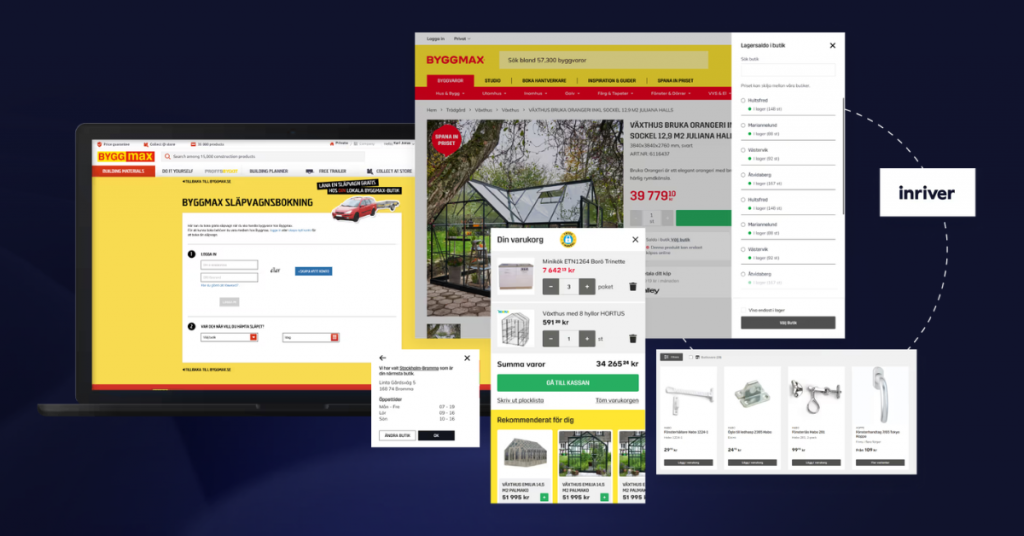
We consolidated Byggmax onto a single Adobe Commerce platform for six store views and built customer-facing flows that connect the online and in-store experiences.
The PIM integration was preserved and stabilized through the migration, so that customers see accurate stock and pricing for their selected store at every point in the journey.
BOPIS is built around real-time inventory checks and automatic store selection: when an online customer taps the store selector, the nearest location is pre-filled based on their geographic position, with operating hours and contact details surfaced in the same view. Customers can verify product availability at their local store and choose in-store pickup at checkout.
The in-store app extends the same connection in the other direction. Customers in a physical store can use the app to navigate the layout via an interactive map, scan items as they shop, see real-time product availability and pricing, add items to a cart for home delivery, and book a trailer to transport materials. The app makes the store itself a touchpoint that feeds into the same commerce base as the website.
A more recent phase of our work introduced an AI-based ShopBot running both on the website and in-store kiosks, trained on common DIY projects and the full Byggmax catalog. Customers describe the project they want to build, and the ShopBot walks them through the steps, recommends specific SKUs, sizes, and quantities, and can process images of the project area to suggest appropriate materials. The same assistant runs 24/7 across both channels.
How it connects
Adobe Commerce serves all six store views from a single platform →
Inriver PIM is the source of truth for real-time product data visibility, feeding accurate information into the website, the in-store app, and the BOPIS flow →
The in-store app and the web storefront are connected – a cart built in the store behaves like a cart built on the website, and goes into the same checkout →
The ShopBot runs across web and in-store kiosks against the same product catalog and project knowledge base, so the experience of asking “what do I need to build a fence?” is consistent whether the customer asks online from home or at a kiosk.
Outcome
- 5x longer engagement time compared to standard project blog pages
- 68% higher conversion rate for customers using the ShopBot
- 95% higher average order value for ShopBot-assisted purchases
- Maintained stock and pricing accuracy
- Stabilized release process, with the platform now supporting the planned roadmap.
Läderach x scandiweb: from fragmented systems to a scalable omnichannel model
Läderach is a family-owned Swiss chocolatier founded in 1962, now operating in its third generation. The brand has distribution in more than 50 countries and 134 branded retail stores across 10+ countries, alongside its direct-to-consumer eCommerce presence, and a growing franchise network, all of which require consistent product data and system coordination.
The business is part of the premium segment, where the experience across every touchpoint, from the boutique in Zurich to a checkout page at 11 pm, has to reflect the same craftsmanship the product does.
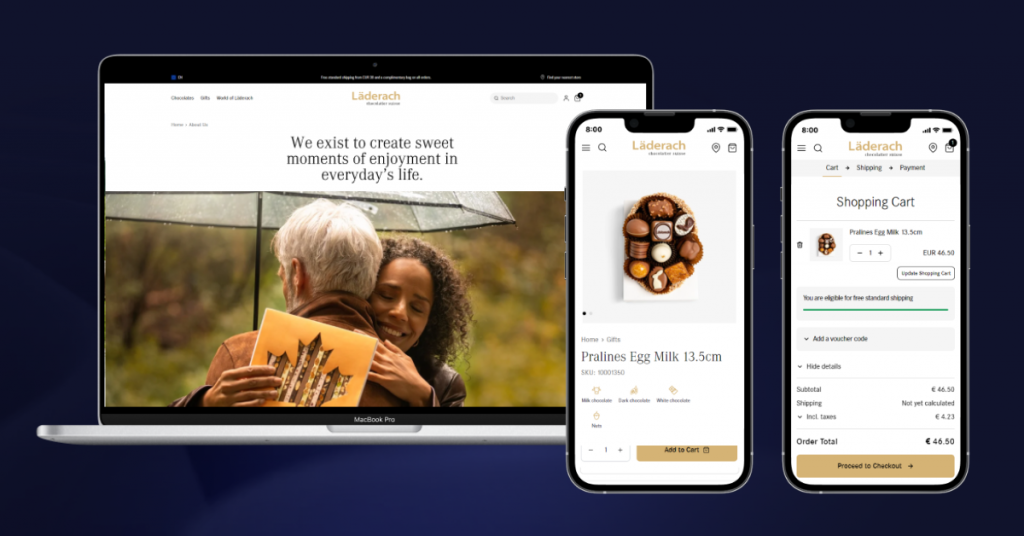
Previous setup
When we started working with Läderach, their ecosystem was highly fragmented. They were running multiple Magento stores alongside several WordPress websites, with content in different places depending on how the relevant page had been built. The underlying infrastructure had been set up and managed by a third party that was being wound down, meaning the foundation the business was running on had a time limit.
The experience did not reflect the brand. Websites and stores were poorly built, and the value of the product was not clearly communicated. For a premium product, this was a critical gap, as customers did not understand the price, and the brand was not strongly positioned as a gifting option.
Additionally, the digital experience did not reflect the in-store reality. While Läderach operates a global network of premium retail stores, this was not clearly communicated online, creating a disconnect in how the brand was perceived. The web presence and the physical retail footprint were running in parallel rather than reinforcing each other.
Data flow between the ERP and Adobe Commerce needed attention. It was structured for manufacturing, not for customer-facing use, which made it difficult to present products consistently in different channels and regions. At the same time, launching new markets or supporting franchise partners required significant manual effort.
Omnichannel setup we built
The first step was system consolidation. We brought all digital experiences under unified Adobe Commerce instance, upgraded to the latest version, simplifying the architecture and making it easier to manage and scale. The infrastructure was rebuilt on AWS with auto-scaling, replacing the third-party setup that was being abandoned.
From there, we focused on experience and positioning. Based on on-site workshops and customer journey analysis, we defined a redesign approach centered on communicating product value, craftsmanship, and gifting use cases. This led to a full UX overhaul and frontend transformation using Hyvä, alongside a broader rebranding initiative. We rebuilt Läderach’s digital experience to reflect the same level of quality and storytelling found in their physical stores, bringing both channels into alignment.
The store finder was rebuilt as a full-featured store locator covering the boutique network, making the 134 physical locations a navigable part of the digital experience.
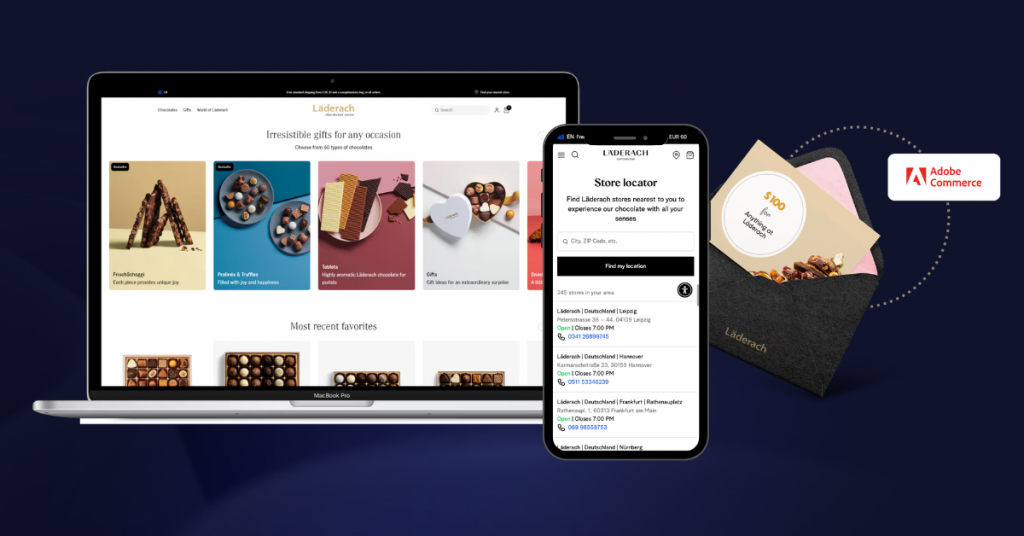
To address product data challenges, we introduced a PIM layer using Pimcore. Product information from the ERP was transformed into structured, consumer-facing content, standardized across markets, and translated where needed.
To support growth, we also worked on enabling:
- Localized eCommerce setups for new markets (localized eCommerce stores launch alongside physical retail locations, supported by consistent product data and brand presentation)
- B2B platform for franchise partners
- Centralized portal for accessing product data and assets
- Template-based eCommerce model for franchisees.
How it connects
Adobe Commerce hosts all content (consolidated from the previous WordPress/Magento split) and serves the storefront across every country Läderach operates in. The store switcher handles market-specific presentation on top of that single instance →
Product information flows from the ERP into Pimcore, where it is structured and adapted for customer-facing use. From there, it is distributed across all digital touchpoints and markets in a consistent format →
Laderach.com is the central layer for the customer experience; it reflects the brand’s premium positioning and communicates the same value that customers encounter in physical stores →
As Läderach expands into new markets, this structure allows localized eCommerce stores and physical retail locations to be introduced on a consistent foundation, with product data, content, and brand presentation remaining aligned →
For franchise markets, partners can access structured product data and assets through a centralized portal and operate on a predefined eCommerce setup.
Outcome
Most notable results after the Hyvä migration and continued optimization:
- +47.8% conversions
- +52.9% total users
- +25.5% average engagement time
- +40.4% eCR
- +95.4% purchase revenue
- +77% transactions
- +55.2% sessions with add to cart
- +61.1% sessions with checkouts
- -20.8% bounce rate
- The Läderach website received the Design Curve Award at the 2023 Meet Magento NYC event.
After launch, Läderach onboarded to scandiweb’s Service Cloud model with a dedicated eCommerce Manager running continuous improvements: user research across session recordings, heatmaps, and voice-of-customer data; seasonal campaign management; and ongoing CX work, including a trigger-based pop-up system for shipping cut-off dates that nudges customers toward purchase at the right moment.
Sportland x scandiweb: unifying data, channels, and stores across 5 markets
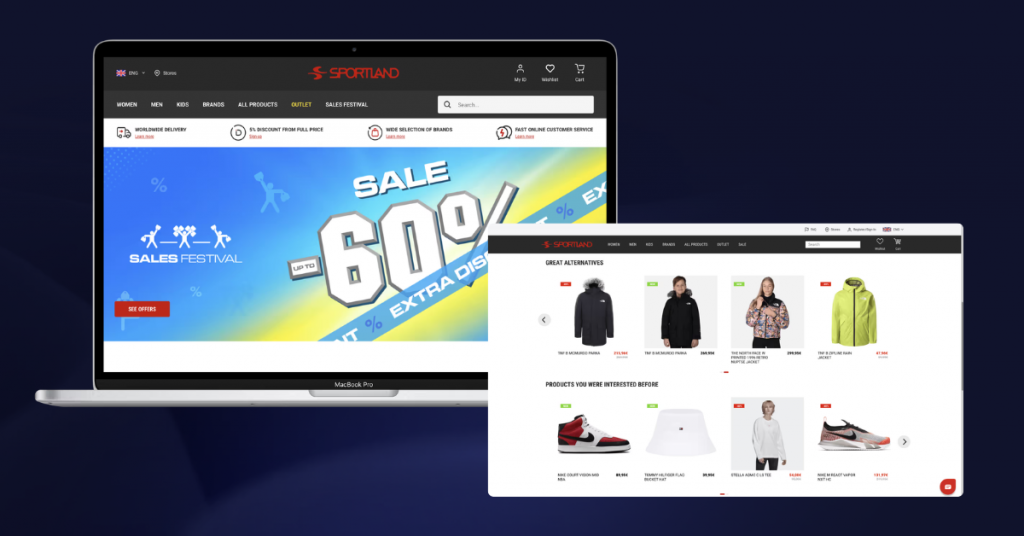
Sportland International Group is the leading sportswear retailer in the Baltics, officially representing 19 of the world’s leading sports brands across the region. They run 120+ physical stores with an award-winning in-store experience and serve five markets with distinct customer databases.
Previous setup
At the beginning of our partnership, Sportland had the retail footprint and the brand position to support a serious eCommerce channel, and a strong foundation of customer data across the physical store network, but what was missing was the platform and the marketing activation layer that could treat 120+ stores and five markets as one operation.
The ERP and POS systems running the physical store network were not connected to the eCommerce platform. Customer data was fragmented across markets, with distinct store views, different languages and product assortments, and siloed databases that made unified segmentation and personalization hard to operate. Reporting on 120+ stores across five markets required a data infrastructure the business didn’t yet have, and marketing activation was running on tools that limited what the team could actually do with the data they were collecting.
Store pickup, real-time inventory, and the kind of multi-channel customer experience a top regional retailer needs were all on the roadmap without the infrastructure to deliver them.
Omnichannel setup we built
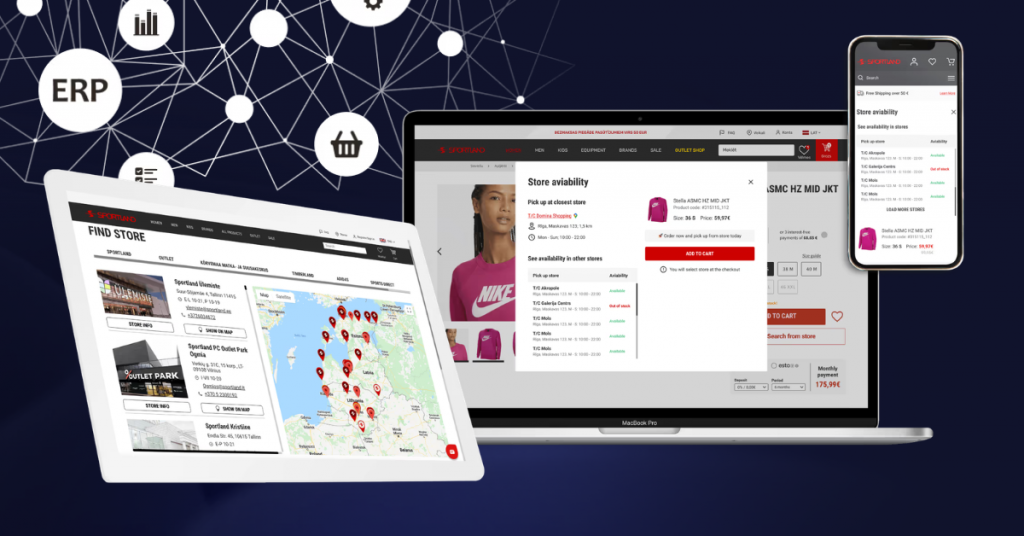
Sportland’s eCommerce platform for 5 markets was launched on Adobe Commerce with a ScandiPWA frontend and ReadyMage hosting. We built a custom ERP integration to synchronize inventory, customer, and order data between the physical store network and the new platform.
A full BOPIS flow was built directly into the product journey: customers select their pickup store from the PDP itself, with stock availability visible per store alongside opening hours and addresses, and orders are ready for collection within 30 minutes at no additional delivery cost.
Data warehouse and reporting
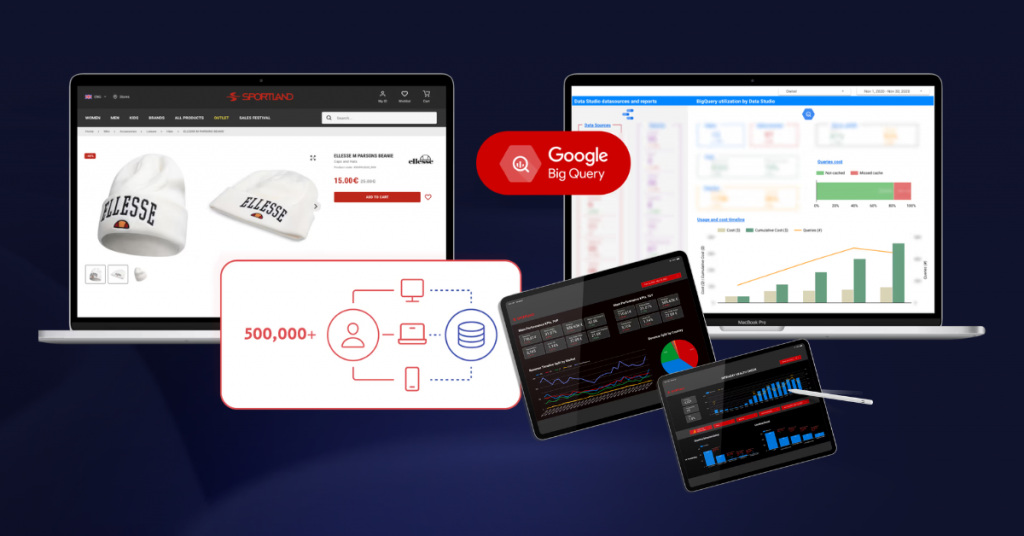
We built the data layer to merge information from 120+ physical stores, the ERP, POS, and the five eCommerce stores. A BigQuery setup consolidates multi-source data with per-market differentiation, feeding reporting views that cover overall performance, store-level comparison, eCommerce-specific KPIs, and error monitoring in one consolidated report. We’ve also executed a successful first-party data strategy, built on 500,000+ loyal customer records that Sportland now owns.
Weekly performance dashboards are displayed in Sportland’s main office, making the business’s status visible to decision-makers.
CDP & marketing unification
The marketing activation layer was then rebuilt on Bloomreach – rather than consolidating five markets into one project, we implemented a market-specific structure, preserving data integrity while keeping the marketing operation unified.
We implemented audience sync into Google Ads and Meta, including predictive segments. Email automation flows, each tailored per market for local behavior and store-specific logic, are expanded well beyond what the previous setup supported:
- Browse abandonment
- Post-purchase product recommendations
- Multi-step cart abandonment
- Welcome series variations
How it connects
Adobe Commerce runs as the platform across all five markets →
ERP and POS are integrated so that inventory, customer, and order data flow between the 120+ physical stores and the eCommerce channel, making real-time stock visibility in the BOPIS flow work →
The BigQuery data warehouse merges data from the physical stores, ERP, POS, and the five eCommerce stores into one structure with per-market differentiation →
Segments built on that unified data activate into email, SMS, Google Ads, and Meta →
Looker Studio and Bloomreach reporting views read from the same data layer, so marketing performance, store performance, and eCommerce KPIs are all drawing from a consistent source.
Outcome
- +30% online sales
- +20% repeat customers
- 120+ physical stores, ERP, POS, and 5 eCommerce stores merged into one data structure.
- 500,000+ first-party customer records consolidated under Sportland’s ownership.
- +20.6% orders after email personalization
- +80% conversions with AI-powered product recommendations.
JYSK x scandiweb: connecting 50+ stores and 5 channels into one system
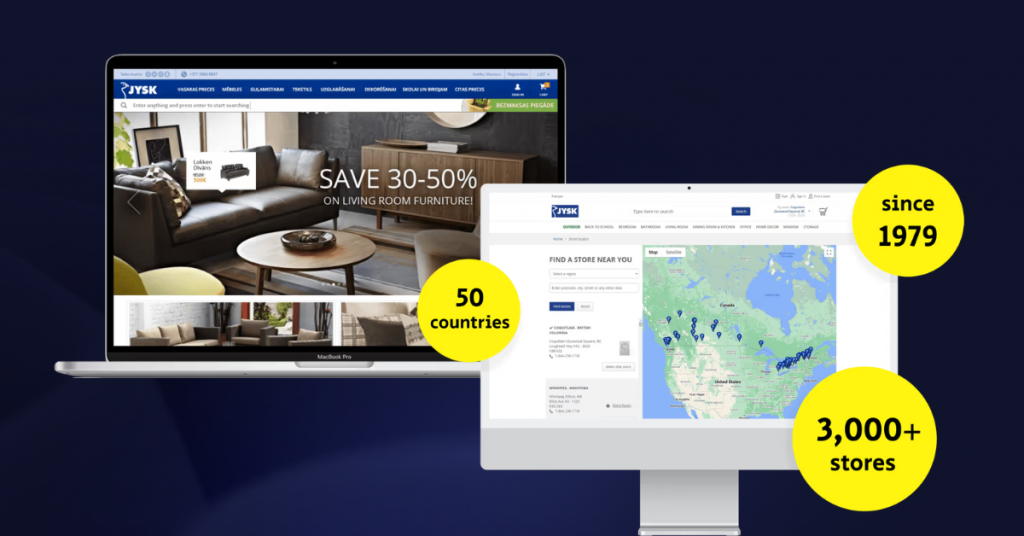
JYSK is an international home furnishings and décor retailer with more than 3,000 stores across over 50 countries. Our client, JYSK Canada, operates 50+ physical stores alongside an eCommerce presence, a call center, print catalogs, and a customer-facing mobile app. Our partnership began back in 2014 and has evolved through multiple phases of the business.
Previous setup
JYSK Canada had the components of a modern retail operation already in place – an online store on Magento, a physical store network serving customers across the country, a call center taking orders, catalogs driving traffic, and Microsoft Dynamics Navision running the back office. The remaining work was to get those components to behave as a single system rather than five parallel ones.
- Customer journeys frequently began in one channel and finished in another
- Inventory visibility across the store network and warehouses was limited on the customer-facing side
- Other device performance lagged well behind desktop, which mattered as traffic increasingly shifted to mobile
- Store assignment for pickup relied on manual selection.
Omnichannel setup we built
Our collaboration at this stage centered on integrating Adobe Commerce (Magento 2) with Navision as the backbone, then extending that integration outward to every customer touchpoint JYSK Canada operated.
Adobe Commerce was connected to Navision for synchronized stock, pricing, and product data, with real-time multi-warehouse stock status available for every product in the 50-store network. That single source of inventory truth became the foundation for everything built on top of it.
On the customer-facing side, we implemented a full BOPIS (buy online, pick up in store) flow, including an automated store locator that assigns the nearest JYSK store to the customer based on their location. The in-store experience was extended through the JYSK app, which lets customers navigate store layouts, locate specific products on the shelf, verify stock in real time, and add items to a cart for home delivery if they’d rather not carry them out.
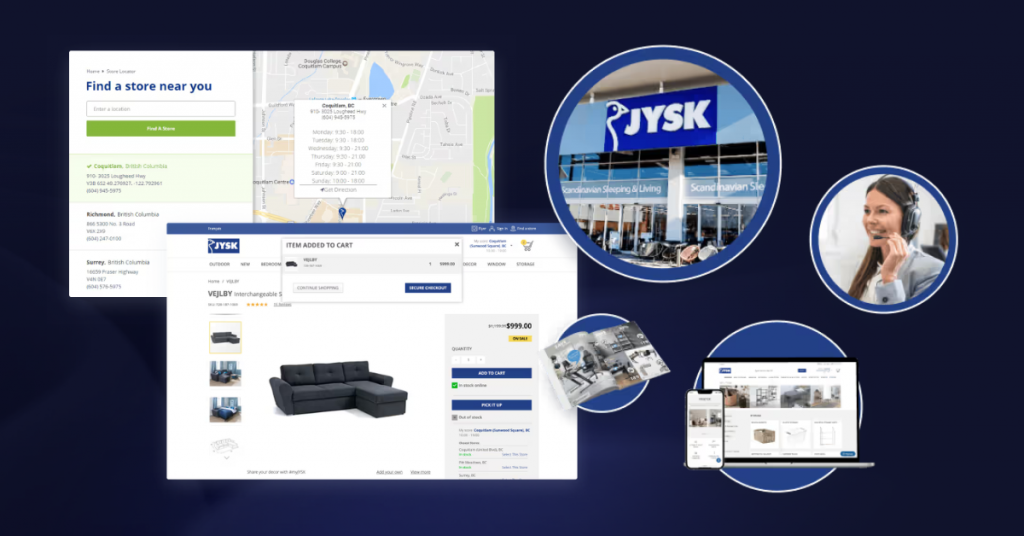
The call center was integrated into the same order and inventory backbone, so an agent-assisted order draws from the same stock data and customer record as a self-service web order.
At a later phase, we introduced the Hyvä frontend on top of the Adobe Commerce platform, rebuilding the storefront for speed and mobile usability while preserving the integrations underneath. Google Analytics and heatmap data informed the redesign, which was structured around conversion-driven patterns. Content was woven into commerce through the #discoverJYSK blog, cross-linked with product pages to connect inspiration with purchasing.
How it connects
Omnichannel solution for 50 stores featuring in-store pickup, catalogs, call center, and desktop/tablet/mobile.
Navision serves as the system of record for inventory, pricing, and product data →
Adobe Commerce integrates with Navision for real-time synchronization, meaning stock levels on the website, in the app, and at the call center reflect the same warehouse and store data →
The store locator and BOPIS flow sit on top of this same inventory layer, so a customer selecting a pickup store sees availability grounded in the same numbers the store associate will see when the order arrives →
The JYSK app reads from the same stock service, letting in-store customers trust what the phone tells them about what’s on the shelf.
Outcome
- 50+ stores connected into a single system spanning inventory, pickup, and customer records
- +600% mobile conversion rate following the mobile-optimized rebuild and the later Hyvä implementation
- +20.1% checkout conversion rate
- +43.8% transactions
- +58% unique purchases
After the main launch, our partnership transitioned into a dedicated eCommerce Growth team model, with ongoing work on loyalty cards, gift cards, and additional payment methods.
Lafayette 148 x scandiweb: unified customer data for stylists in boutiques and digital
Lafayette 148 is a New York-based women’s luxury fashion house, specializing in apparel, footwear, and accessories, sold in flagship boutiques, outlet locations, international stores, a wholesale and retail partner network covering 500+ locations, and a direct eCommerce channel. A central part of the brand experience is a high-touch clienteling model – stylists and store associates work 1:1 with customers, offering personalized recommendations rooted in their shopping history and preferences.
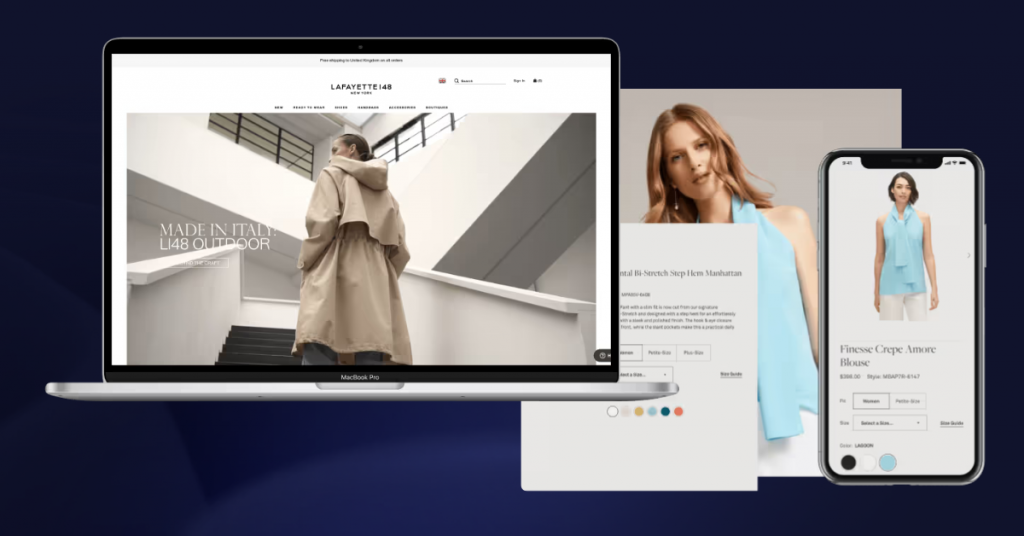
The digital channel needs to carry the same weight as the boutique, and the data underneath both needs to work as one. Our partnership began as a platform rescue and has continued for more than 10 years.
Previous setup
Lafayette 148’s customer data was scattered across many systems – boutique POS, outlet and international stores, clienteling tools used by stylists, an eCommerce store on Magento, loyalty accounts, purchase history – and the same customer could be represented by multiple identifiers.
Forming a unified view was difficult, and the business was working with a prior CDP that the team couldn’t fully control:
- Identity resolution rules couldn’t be modified without vendor support
- Reporting required extensive manual work
- The platform couldn’t link online behavior to individual profiles.
Omnichannel setup we built
At the beginning of this partnership, scandiweb took full ownership of Lafayette 148 replatforming, consolidating responsibility over migration, data, integrations, and frontend delivery into a single point of accountability. We rebuilt the platform on Adobe Commerce Cloud, and a comprehensive data migration moved years of customer and product history to the new platform.
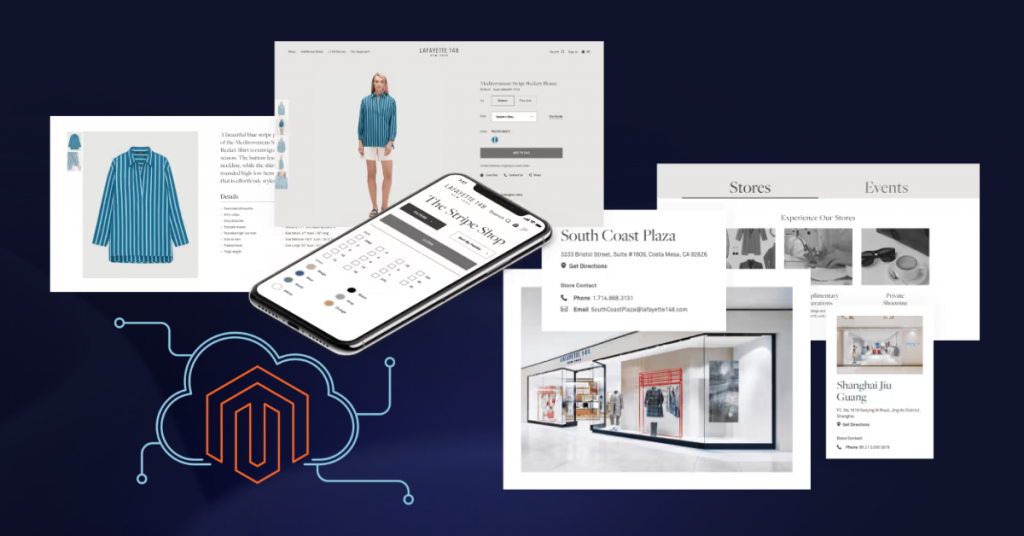
We built the store locator extension to maintain the 500+ retail partner network, making physical retail a navigable part of the digital experience.
A custom Shop the Look module brought something closer to the stylist-assisted boutique experience online, letting customers assemble complete outfits, select colors and sizes, and preview the result instantly. Adobe Page Builder, with advanced content types and animations, supports the brand’s seasonal storytelling.
Unified customer data
With the platform stable and the eCommerce channel growing, scandiweb migrated Lafayette 148 to Salesforce Data Cloud, integrating the new CDP with Magento, the clienteling tools stylists use in the boutiques, and the rest of the technology stack. Identity resolution was configured to match and unify customer records across the boutiques, outlets, international stores, stylists, eCommerce, and loyalty accounts.
They can now capture customer lifetime order count and revenue, purchase frequency, engagement, preferences, and preferred stylist or store, and other data to run segmentation strategies. In-store, the clienteling experience is rebuilt on top of the unified data layer. Stylists access detailed customer profiles ahead of appointments.
How it connects
Customer interactions from the boutiques, outlets, international stores, stylist clienteling tools, Magento storefront, and loyalty program feed into Salesforce Data Cloud →
Identity resolution merges them into single profiles keyed across email, phone, loyalty account, purchase history, and in-store interaction →
Calculated traits run on top of those profiles, feeding segmentation that powers email and SMS marketing, paid media, and the in-store clienteling experience →
The AWS data infrastructure handles ingestion and transformation at a scale that exceeds the CDP’s native capabilities →
Adobe Commerce Cloud continues as the transactional platform, with the data layer built during the replatform feeding customer and behavioral signals back into the unified profile.
Outcome
The replatforming was delivered within the six-month window after years of previous unsuccessful attempts, with a clean transition, no downtime, and no data loss across years of accumulated customer and product history.
- Revenue doubled during the partnership
- 85% of revenue generated from re-engaging existing customers
- Over 40% of online sales come through email and SMS
- Automated hundreds of hours of manual reporting
- ROAS improvements through unified audience activation
- Internal ownership of clienteling dashboards
Our collaboration has continued for more than 10 years, spanning platform, frontend, data infrastructure, customer data, clienteling, BI, and marketing, enabling and refining a deliberate end-to-end omnichannel retail solution.
What this means for omnichannel retailers
The diagnostic questions worth asking inside your own operation are the following and alike:
❓”can a store associate trust the stock number the system shows them?”
❓”can a customer earn loyalty value in any channel and spend it in any other?”
❓”does my ERP, CRM, PIM, and commerce platform agree on who a customer is and what they’ve bought?”
❓”can my marketing team activate a segment built from unified behavior data directly into the channels that reach the customer?”
❓”does my store network appear inside the digital experience, or alongside it?”
The investment sequence matters, cause platform work that precedes data unification often has to be revisited once the data layer catches up. In-store tools built without a unified customer profile cannot deliver the outcomes they promise, and so on. A partner who can see the whole sequence is meaningfully different from a partner who is strong on one layer.
Every project showcased in this article involved decisions in which the tech, data, integrations, marketing, and CX teams needed to agree on a trade-off in real time. Consolidating those decisions into one partner with a single accountable delivery model is what enables omnichannel programs to succeed.
scandiweb has spent more than a decade helping retailers design and implement end-to-end omnichannel experiences. Reach out today, and we’ll walk through your current systems and channels, identify the connection points, and share the next strategic steps.