
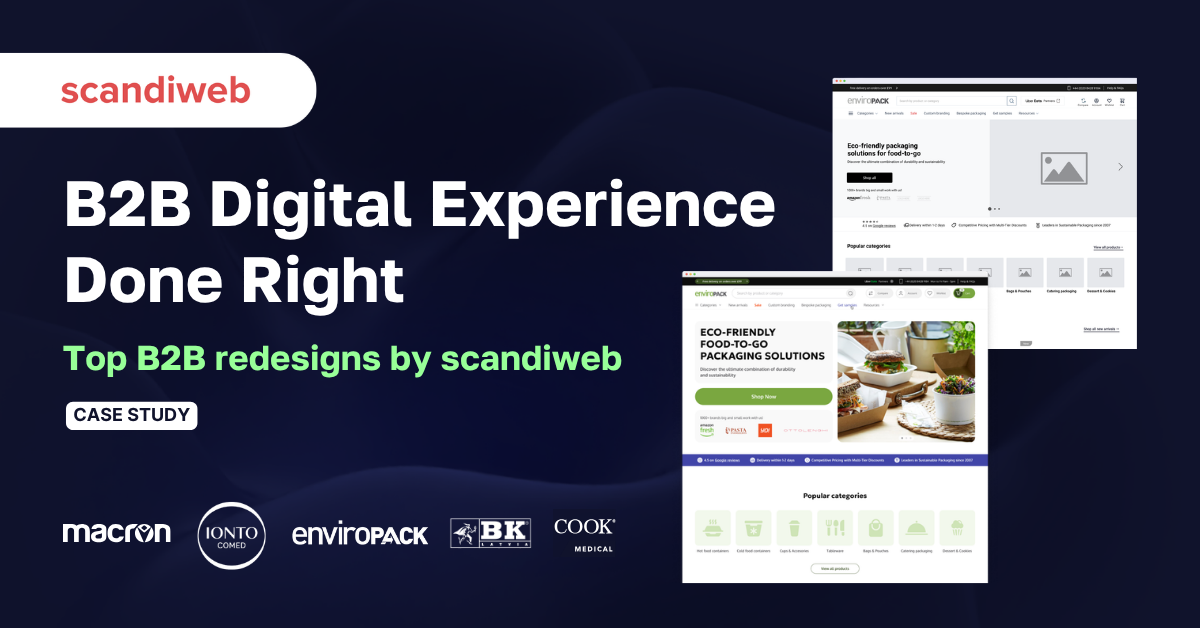
In B2B, the eCommerce platform sits at the center of how companies buy, reorder, and manage suppliers, becoming part of the workflow itself. Research shows that most B2B buyers now prefer to complete tasks independently, without relying on sales teams, and they are willing to switch suppliers when digital channels fall short. As high as 90% of B2B customers will turn to a competitor that offers a smoother, more reliable experience, and 87% would pay more for a supplier with an excellent eCommerce portal.
The difficulty is that B2B purchasing does not follow the same logic as B2C. Orders are tied to specific business needs, often defined in advance, and involve multiple people with different roles in the decision. Buyers spend more time evaluating options and verifying details before placing an order. The process is structured, repeatable, and driven by requirements rather than exploration.
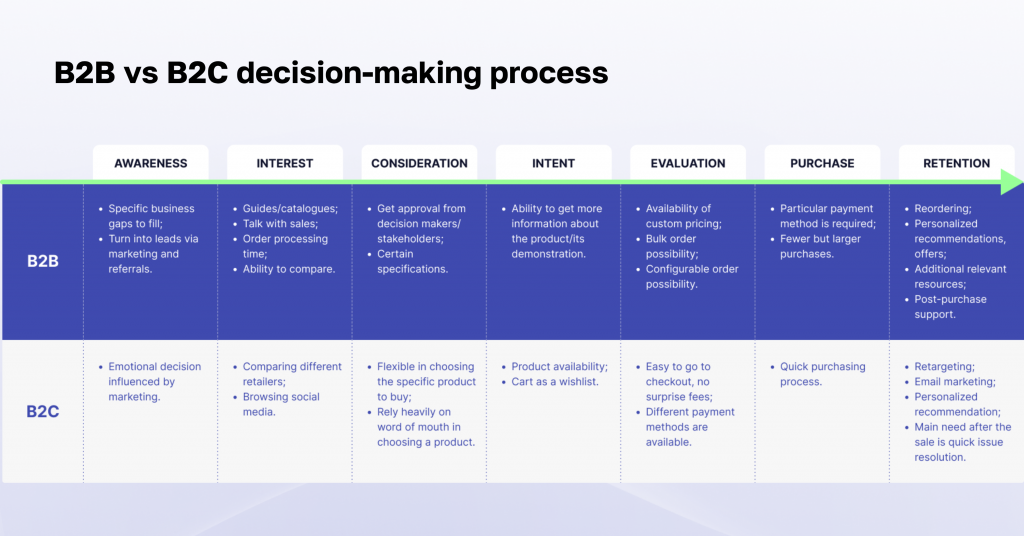
This directly affects what users expect from a platform. They need to:
- Locate exact products quickly
- Access detailed specifications without searching across multiple sources
- See pricing, stock availability, and account-specific terms accurately
- Place large or complex orders without introducing errors
- Easily reorder, and more.
When these conditions are not met, the impact is immediate and creates friction on both sides – for the customer trying to place orders, and for the B2B company trying to scale.
What breaks in most B2B platforms
The same issues appear again and again in B2B eCommerce, even when the industries are completely different. The friction tends to come from disconnected systems, weak self-service, hard-to-navigate product information, and ordering flows that take more effort than they should. These problems usually mean the platform was never shaped around how B2B customers actually buy.
Fragmented experiences
Many B2B companies grow through multiple brands, markets, catalogs, or business units. Over time, that often leads to separate sites and disconnected customer journeys. Users end up dealing with different:
- Navigation patterns
- Content structures
- Levels of product detail
- Rules depending on the brand or market.
That kind of fragmentation creates work for the customer. In our project with Ionto, the challenge was exactly this: three separate websites had to be brought into one unified platform that combined catalog and eCommerce functionality while keeping the experience consistent across brands.
Partial self-service
Not fully delivering self-service means that customers can browse, search, and maybe add products to cart, but the more important parts of the journey still sit outside the platform. Typical gaps include needing sales support for quotes, limited access to account-specific pricing, no efficient way to reorder, or too much manual handling for standard purchasing tasks.
Most B2B customers prefer self-service tools, and many will switch suppliers when the digital channel cannot support their needs.
Incomplete product information
B2B product pages have to help users verify whether something is right for a specific use case, team, order type, or requirement. When that information is too thin, too scattered, or too hard to compare, buyers need to leave the site to check documents, contact support, or confirm details internally before they can move forward.
Here’s how we’ve helped our clients enhance product information:
- Create advanced customization and quote-ready product flows for teamwear and bulk orders for Macron
- Prepare clearer product details, eco-property information, and usage tagging to support confident purchases for Enviropack
- Improved search, product clarity, and list-view detail for users to find exact products efficiently on Cook Medical’s eCommerce portal.
Simplified ordering flows
A standard eCommerce cart is often too limited for B2B needs, as business customers deal with bulk quantities, repeat purchases, configurable items, approval logic, and account-specific conditions. Routine ordering may begin to feel slow.
B2B cart and checkout should have:
- Bulk order tables
- Quote-request options for customizable products
- Quick order functionality
- Dashboards and account tools
- Stock visibility tied to real buying decisions.
What breaks in most B2B platforms is the mismatch between the system and the workflow. When the platform mirrors how customers research, compare, configure, reorder, and manage purchasing, it starts reducing effort on both sides. When it does not, teams fall back on email, spreadsheets, and sales support to complete tasks the platform should already handle. If we look at it from this angle, the digital experience directly affects conversion and revenue.
Top B2B redesigns by scandiweb
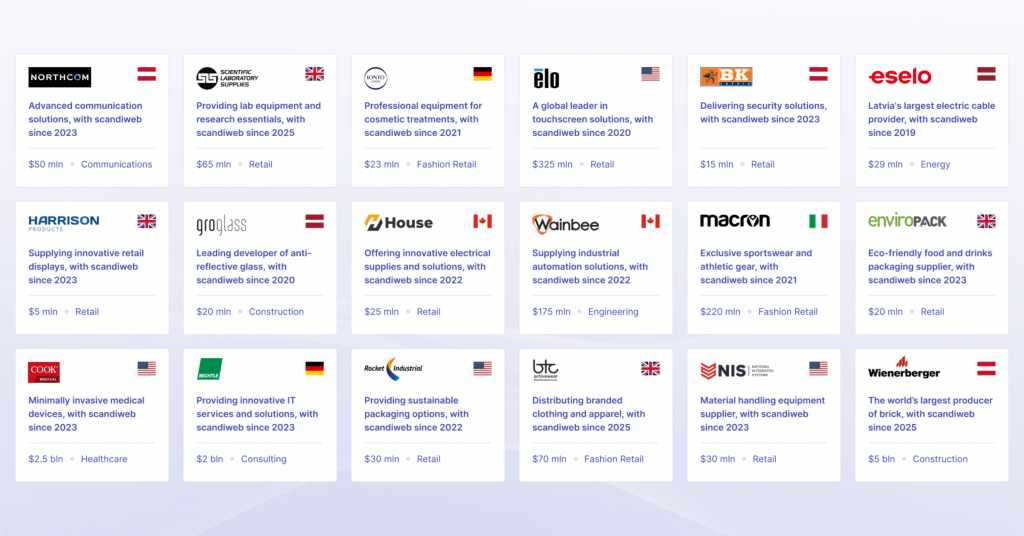
In different industries, similar changes reflecting how B2B customers actually buy lead to measurable improvements.
1) Macron: innovative B2B experience
Macron is a global supplier of athletic apparel and teamwear, known for highly customizable products and large, structured orders.
Our goal was to design a flexible B2B platform that supports advanced product customization, bulk ordering, and personalized user journeys tailored to different business needs.
Our approach followed a user-centered process:
- Requirement gathering with stakeholders to define user journeys and key features
- UX wireframes, mapping complete user journeys for three distinct B2B user types
- Final UI aligned with the existing B2C experience to maintain visual consistency.
Design highlights
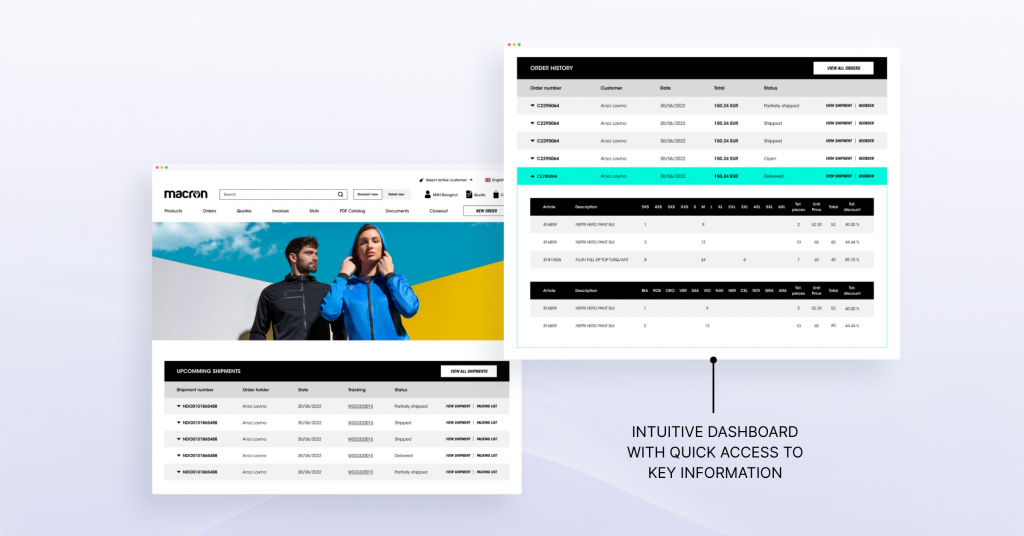
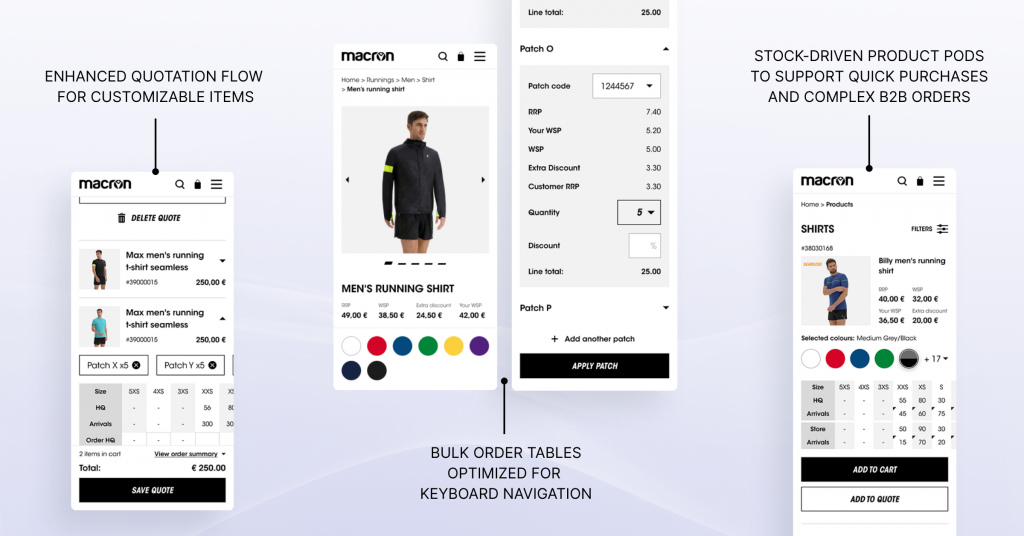
As a result, Macron’s customers can manage bulk purchases with diverse sizes and variations, access real-time stock information, and request a quote or place an order directly within the same flow. An intuitive dashboard gives quick access to key account information, while structured ordering tables reduce friction in high-volume purchasing.
- +132.5% conversion rate from direct traffic
- +14.1% transactions
- +29.8% year-over-year revenue
- +32.8% returning visitors
- Macron became a finalist for the B2B Trailblazer Award at the 2024 Meet Magento New York Ecommerce Excellence Awards.
Also read:
Macron’s B2B Platform Evolution with Adobe Commerce
2) Ionto: consolidated B2B digital experience
IONTO-COMED is a German manufacturer of professional cosmetic equipment, operating across multiple brands with distinct identities.
Our goal was to build a unified platform from three separate websites that combines an informational catalog with full eCommerce functionality while maintaining a consistent, structured user experience.
Our approach was driven by data:
- CRO audit to assess user navigation, identify usability gaps, review the site against best UX practices, and define a new site concept
- UX wireframes outlining clear user journeys for guest and logged-in users to strengthen brand awareness and drive higher conversions
- A unified design system applied to all three brands.
Design highlights
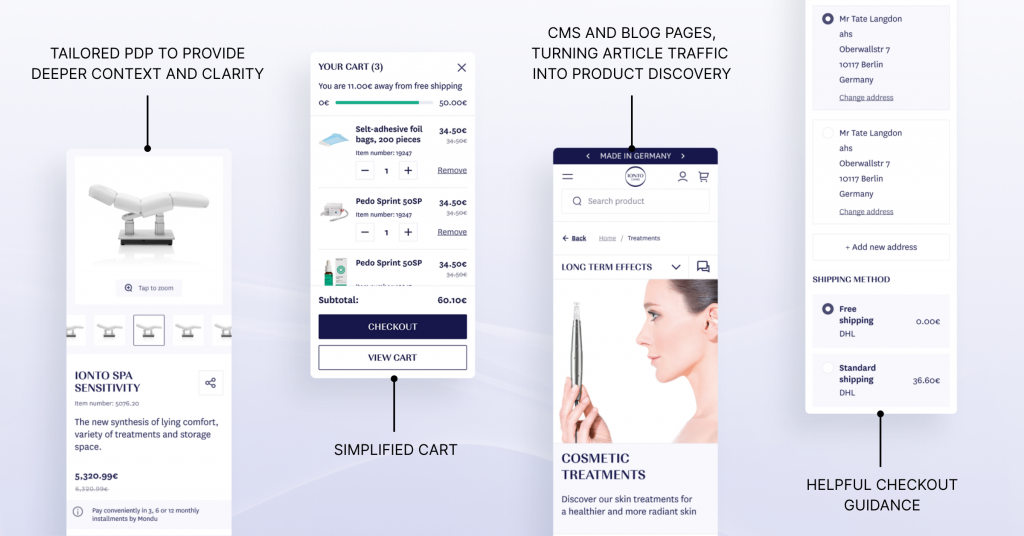
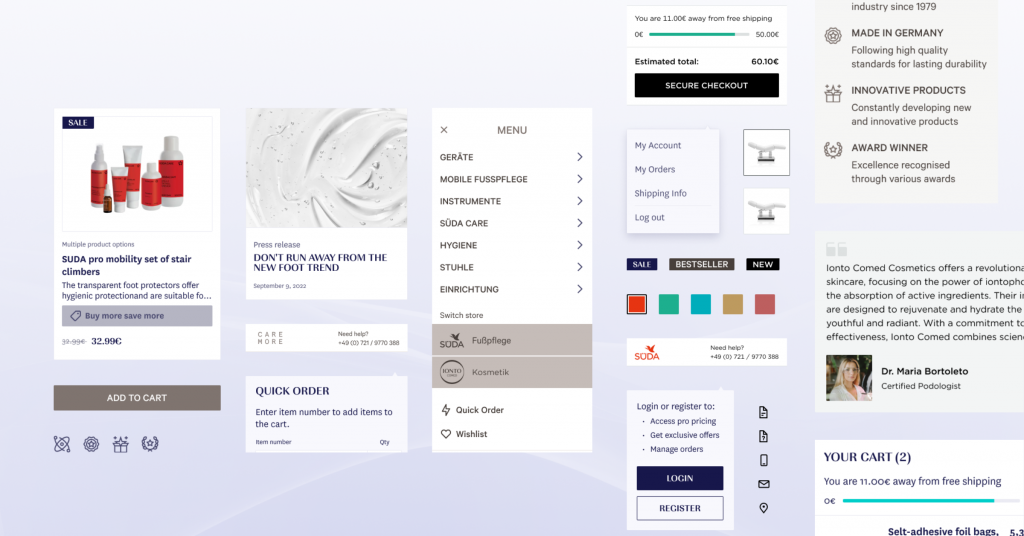
As a result, Ionto has a fully redesigned and strategically unified multi-store platform that supports three distinct brands – IONTO, Süda, and Caremore – within a single, cohesive digital experience with consistent navigation, shared functionality, and a clear structure for product discovery and purchasing. Product pages provide detailed context for specialized items, and CMS and content pages support product discovery through educational content.
- +90.2% online revenue
- +33.4% sessions
- +100.3% add-to-cart rate
- +93.3% transactions
- +44.9% conversion rate
Also read:
Proactive eCommerce Support Secures a 90.2% Revenue Increase for Ionto
3) Enviropack: improved usability for B2B customers
Enviropack supplies eco-friendly food packaging and already had strong traffic driven by its SEO program, but lacked usability and alignment with how customers evaluate and purchase products.
Our goal was to deliver a conversion-focused website redesign to position the company as an industry leader and design new entry points that enable user journeys throughout all services.
Our approach to the user-focused redesign:
- UX audit to identify gaps and benchmark against eCommerce best practices and cross-industry references
- Wireframes defining page structure, messaging, content hierarchy, and key interactions
- Final UI aligned with brand guidelines and conversion-focused design to strengthen brand recognition, build trust, and position the company as an innovative market trendsetter.
Design highlights
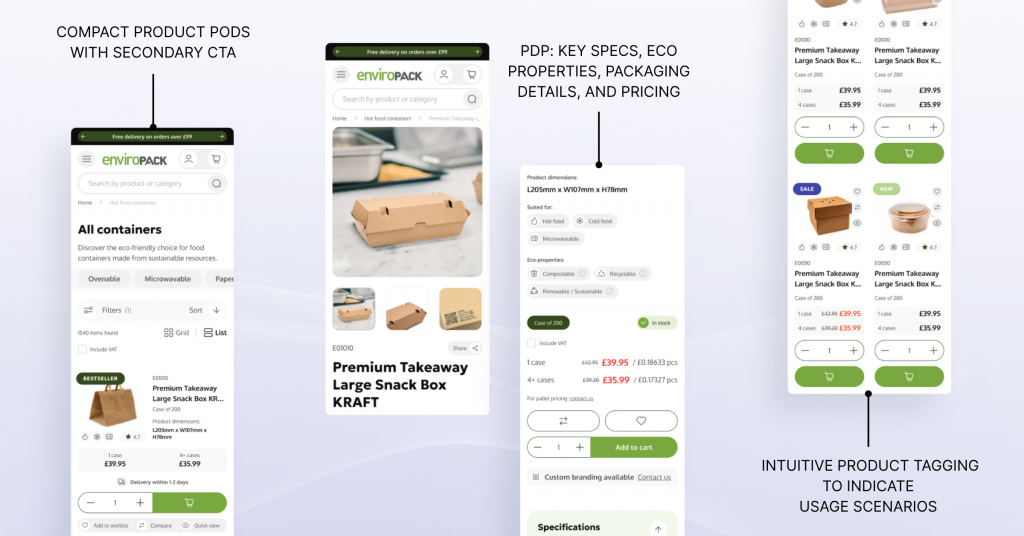
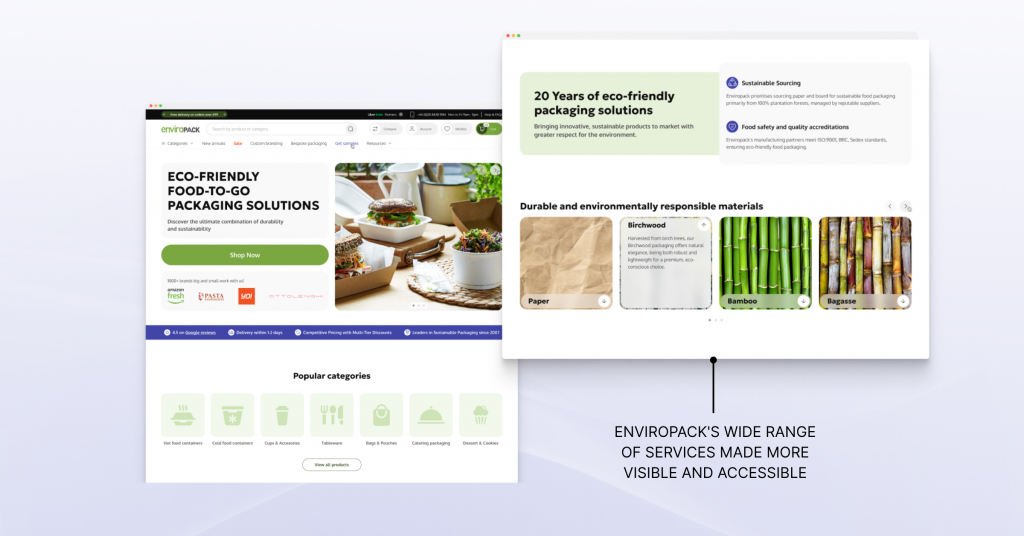
As a result, Enviropack’s updated platform makes product information easier to understand and compare. Product detail pages highlight specifications, usage scenarios, and pricing logic, while visual indicators help users quickly identify relevant products. The overall structure supports smoother navigation and clearer entry points across the site, empowering customers to make confident and informed purchases.
- +22.3% average purchase revenue per user
- +20.1% average session duration
- +10.4% session conversion rate
Also read:
How AEO Helped Enviropack Become a Top AI Pick for Sustainable Packaging
4) BK Group: unified B2B security platform
BK Group distributes security systems and equipment across the Baltics, working with a wide range of products and suppliers.
Our goal was to create a unified eCommerce platform that enables B2B functionality, keeping the experience simple and aligned with the brand. The implementation was built on the Hyvä theme, with a focus on gradual improvements.
Our approach included:
- Requirement gathering to define the scope and technical setup
- UX wireframes focused on introducing B2B-specific functionality through new extensions
- UI aligned with the existing brand identity, but refreshed to reflect a more contemporary and refined look
Design highlights
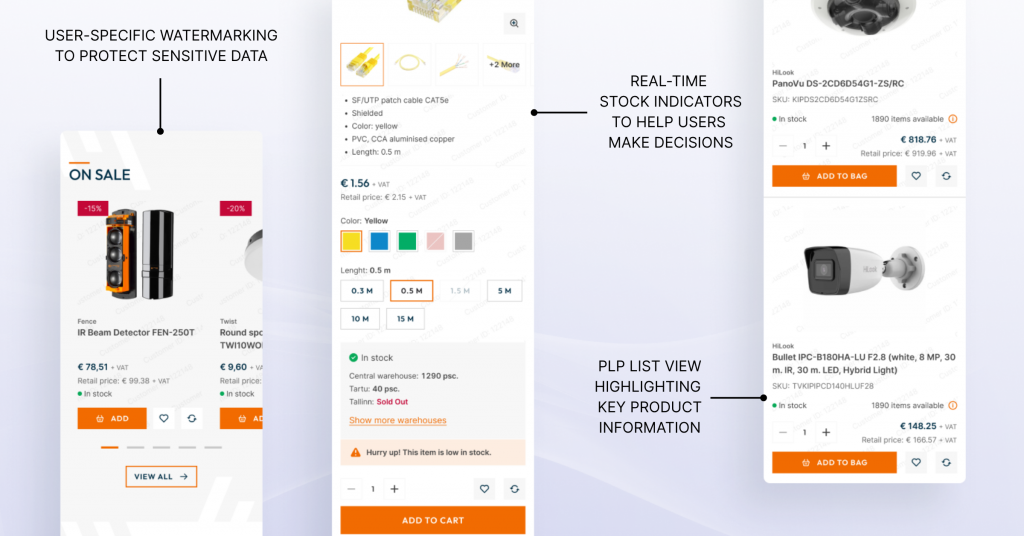
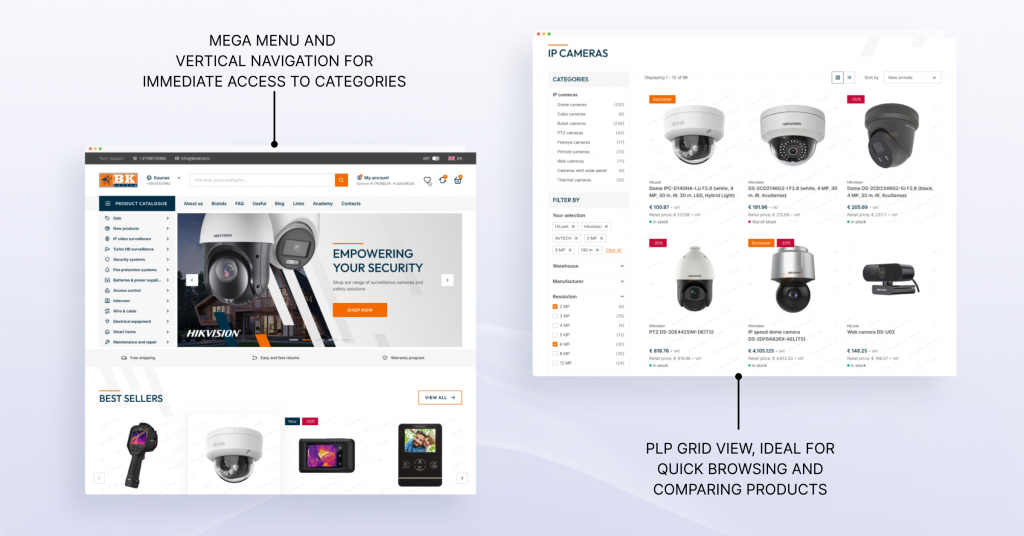
As a result, the platform introduces features designed for business users, including real-time stock visibility, structured product listing views, and navigation systems that support faster access to categories and products. Additional elements, such as user-specific watermarking, help protect sensitive pricing information.
Also read:
Merging Two Markets on Magento+Hyvä for a Multinational B2B Supplier BK Group
5) Cook Medical: B2B customer portal
Cook Medical develops minimally invasive medical devices for healthcare providers and serves customers who rely on accuracy and clarity when accessing product information. Their customer portal differs from traditional eCommerce sites by focusing on providing a catalog experience rather than driving additional purchases. It is designed to help B2B customers browse and search for specific products, catering to their unique needs and priorities.
Our goal was to design a clean, minimalist customer portal with a primary focus on search – the most business-critical and frequently used feature for their users.
Our approach combined expert review and collaborative workshops:
- UX audit to identify usability gaps and improvement opportunities
- Wireframes based on customer workshops and real usage patterns
- Final UI aligned with the brand’s style guide for a clean, minimalistic design that evokes the feeling of a laboratory or hospital environment – tidy, sterile, and highly functional, with a focus on clarity and simplicity in every interaction.
Design highlights
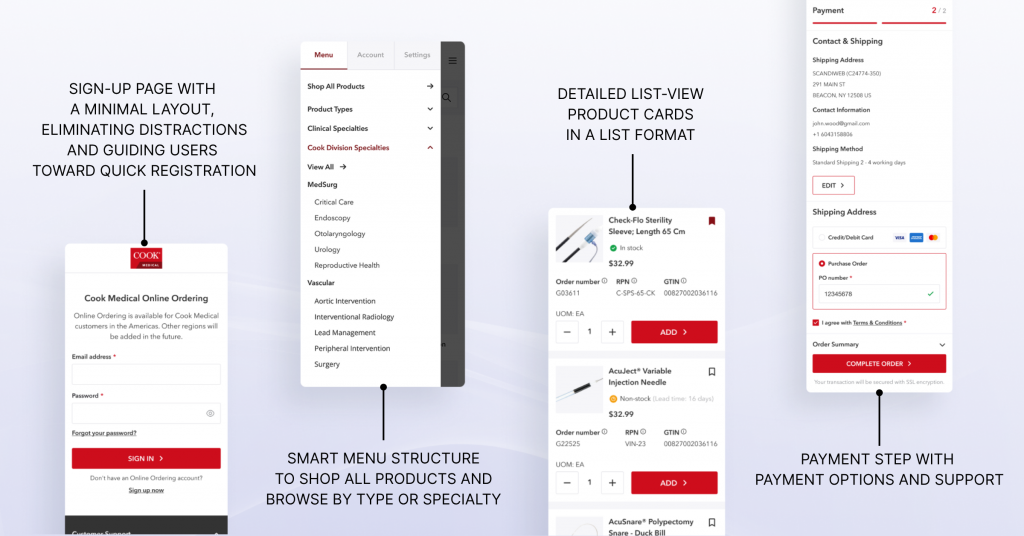
As a result, Cook Medical’s product listings are presented in detailed list views, exposing key information such as availability, specifications, and ordering details at a glance. Navigation supports multiple ways of finding products, whether by category, specialty, or known identifiers, creating a system that supports efficient, task-focused usage, allowing customers to find and order what they need with minimal friction.
Also read:
Dated Magento 1 Migration to a Modern Magento 2 Experience for B2B Buyers
Top 10 B2B eCommerce Websites with Great UX and Smart Features
What this means for your B2B store
B2B eCommerce improvements come from aligning the platform with how your customers search, browse, compare, configure, select, buy, and reorder. When your store supports all those actions, ordering takes less time, decisions require less back-and-forth, and customers rely less on manual support. And over time, you see higher conversions and retention, and more predictable growth.
If you are evaluating where your current platform falls short, or planning the next step in your B2B eCommerce setup or design, we can help you map out what that should look like in practice. Let’s talk about ways your B2B store can improve.