If you’re running on Shopify Plus and wondering whether to stay, or if you’re already evaluating alternatives but unsure whether any of them actually fits your business better, you’re asking the right question. Shopify alternatives split into four serious replacements at the upper-mid-market level: Adobe Commerce, BigCommerce Enterprise, commercetools, and OroCommerce. Four others fit different buyers. The right choice depends on operational depth, B2B requirements, and integration scope, not feature counts. Adobe Commerce wins for ERP-driven catalogs, BigCommerce for SaaS simplicity without transaction fees, commercetools for composable architecture, OroCommerce for B2B distributors with negotiated pricing.
The pressure that pushes most upper-mid-market merchants into this question is structural, not aesthetic. Shopify Plus charges 2 percent on every transaction processed outside Shopify Payments. At $50M annual revenue, with even half of payments running through third-party gateways, that is roughly half a million dollars a year flowing to the platform on top of the license fee, and the math scales with growth instead of decreasing.
This guide compares the eight strongest Shopify alternatives in 2026, each rated against the same six criteria, with a side-by-side table you can take into a stakeholder meeting and a decision framework that maps each platform to a specific business condition.
Why most “Shopify alternatives” lists miss the point
If you’ve already read two or three Shopify alternatives lists and walked away with a longer list of platforms but no clearer answer, that is by design. Most articles in this category compare platforms by feature counts, app-store size, or theme libraries. That serves a creator picking a first cart, not a $50M to $500M business deciding what carries the next ten years of growth. The real question is system fit: when a business outgrows Shopify Plus, the constraint is rarely the cart itself. It is multi-store sprawl, B2B account hierarchies, ERP-driven pricing logic, or composable architecture.
This article uses a different lens, the one scandiweb applies in real replatforming engagements: Control, Foundation, Growth. Control means the system has become risky or unreliable. Foundation means the system cannot scale without a rebuild. Growth means the system is stable but commercial performance is lagging. The right Shopify alternative depends on which of those conditions a business is in. scandiweb works with all four of the main alternatives covered here, so there is no commercial reason to favor one over another.
🚀 Quick takeaway
The best Shopify alternative is the one that fits the system pressure your business is already under, not the one with the longest feature list.
Signs you’ve outgrown Shopify Plus
Most replatforming projects do not start with a feature gap. They start with a structural one. Businesses outgrow Shopify Plus when multi-brand or multi-region operations strain the one-store-per-brand model, when B2B requires deep account hierarchies and ERP-driven pricing, when integrations carry the catalog instead of the storefront, or when 2 percent third-party gateway fees scale into six and seven figures annually.
Multi-brand or multi-region operations strain Shopify Plus
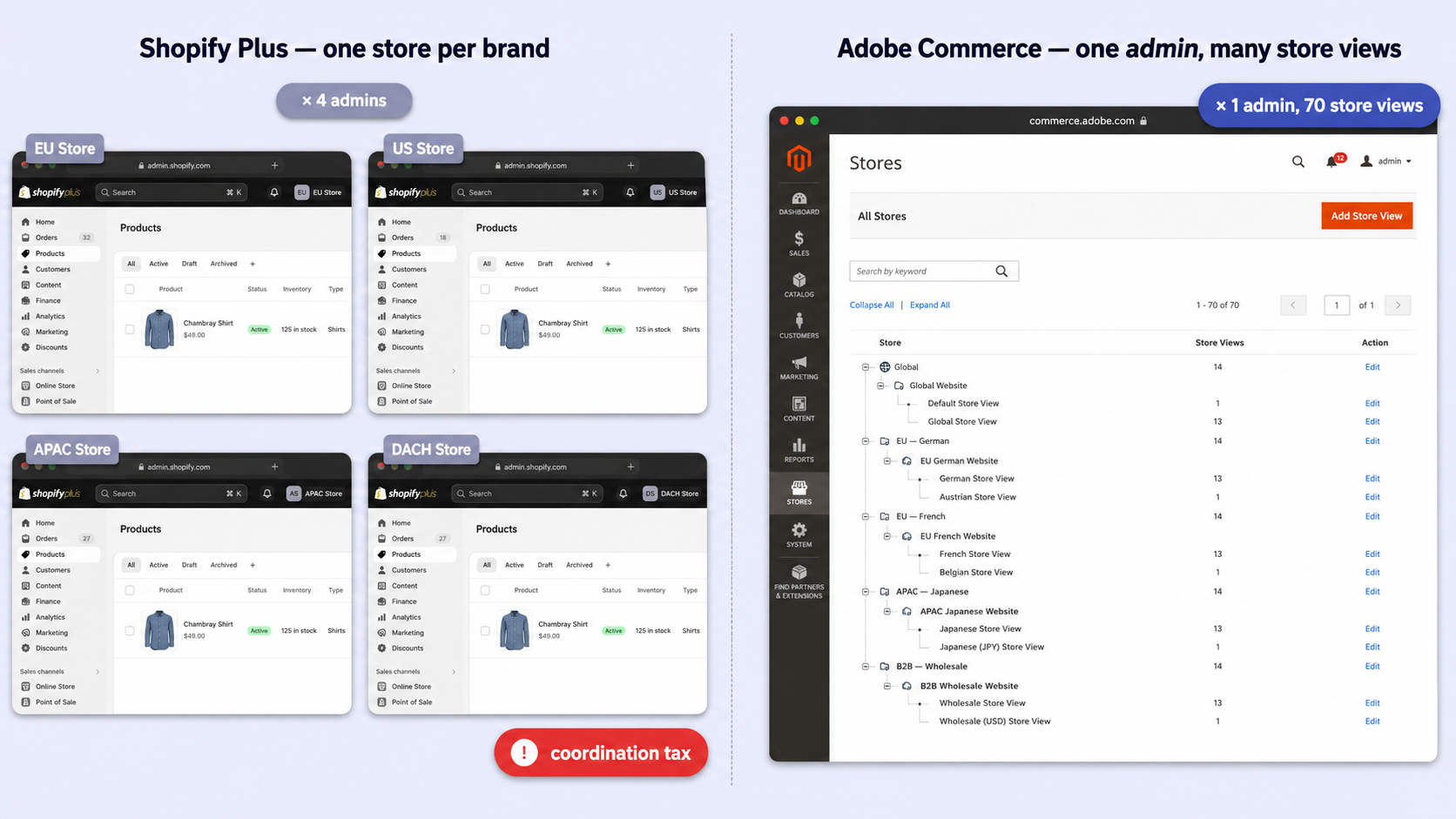
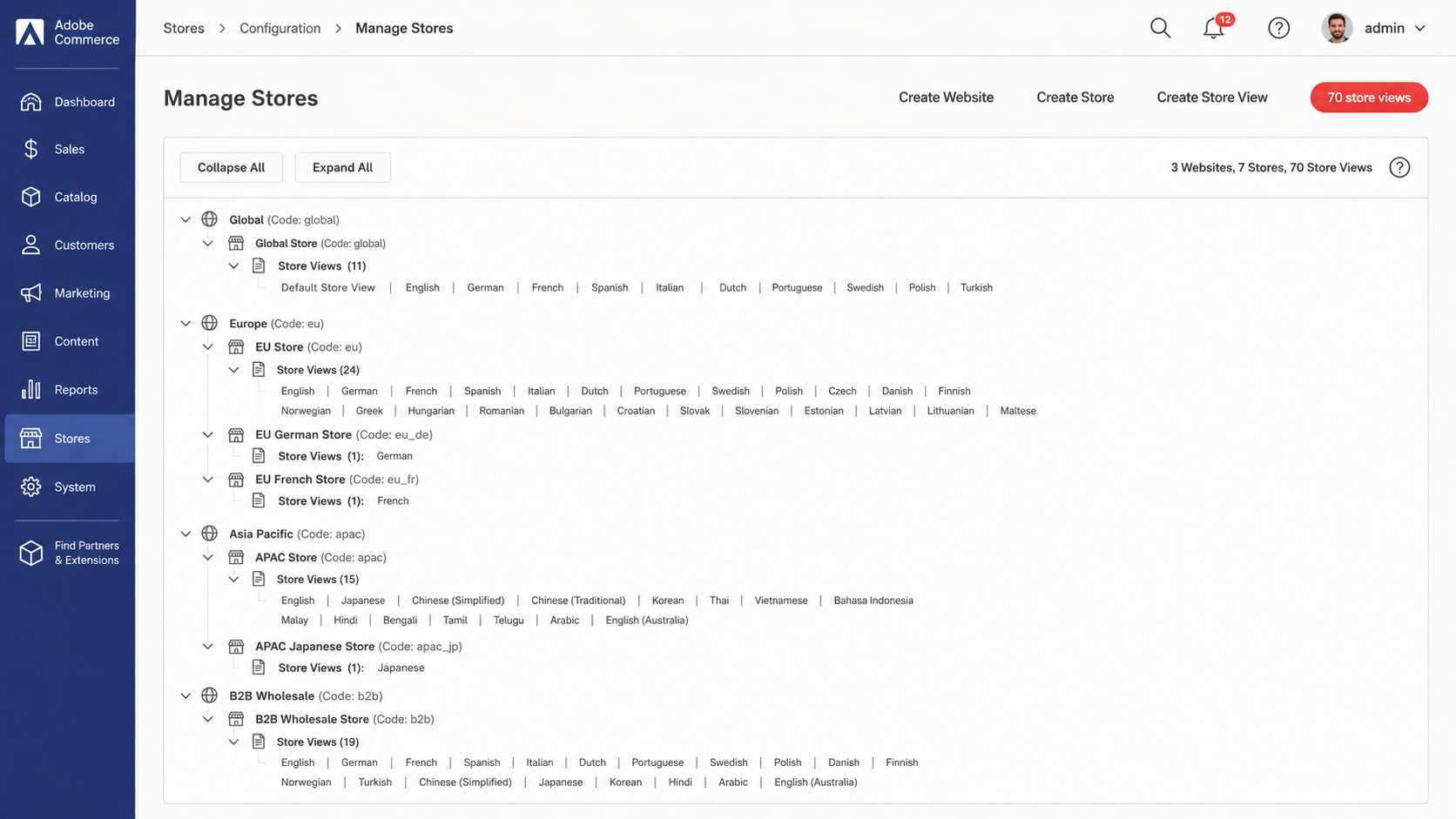
Shopify Plus uses one store per brand or region. Each store has its own admin and its own apps, which means updating the same product copy across four stores is four separate jobs. At ten or twenty storefronts it becomes a coordination tax. Adobe Commerce, by comparison, runs 70 store views across 20 languages on a single instance for clients like OM System, with one admin and one product catalog flowing into every storefront.
B2B with negotiated pricing and account hierarchies
Shopify Plus added B2B price lists and quote tools in 2024, and they work for straightforward wholesale. They do not yet handle deep account hierarchies, multi-step approval workflows, RFQ-driven sales, or pricing logic that lives in an ERP. For a distributor with tiered customers, contract pricing, and an ERP that owns the catalog, OroCommerce or Adobe Commerce B2B is closer to the data model the business already runs on. A specialist B2B eCommerce build is rarely a good fit on a B2C-first platform.
Heavy ERP, PIM, or OMS integration requirements
When the integrations are the real product, the platform’s API depth and data model matter more than the storefront. scandiweb has built systems with 81,000 structured product records flowing through unified data layers (Rocket Industrial), and 10,000 plus product catalogs feeding global B2B operations (Macron, +29.8 percent YoY revenue and +132.5 percent conversion uplift). Those volumes work on Adobe Commerce or commercetools. They do not fit cleanly into a Shopify Plus data model.
Transaction fees that scale with revenue
Shopify charges 0.5 to 2 percent on transactions when you use a payment processor other than Shopify Payments, depending on plan tier. At $5M revenue that is up to $100K a year. At $50M revenue it is up to $1M a year. BigCommerce, Adobe Commerce, commercetools, and OroCommerce do not charge platform transaction fees. For high-volume operations, the math alone justifies a serious comparison.
🚀 Quick takeaway
You have outgrown Shopify Plus when the constraint is structural, not feature-level: multi-store sprawl, B2B depth, ERP-driven catalogs, or transaction-fee drag at scale.
How we evaluated these 8 Shopify alternatives
Every platform is rated against the same six criteria, so the comparison is apples-to-apples rather than vendor-to-vendor.
- Pricing tier: entry, mid-market, or enterprise
- Customization: low, medium, or high
- Best business size: SMB, mid-market, or enterprise
- Native B2B: full, limited, or none
- ERP integration depth: deep, moderate, or basic
- Implementation effort: low, moderate, or high
These are the dimensions that decide replatforming outcomes in actual scandiweb projects. App store size and theme count are not on the list because they almost never decide the outcome.
Shopify alternatives at a glance: comparison table
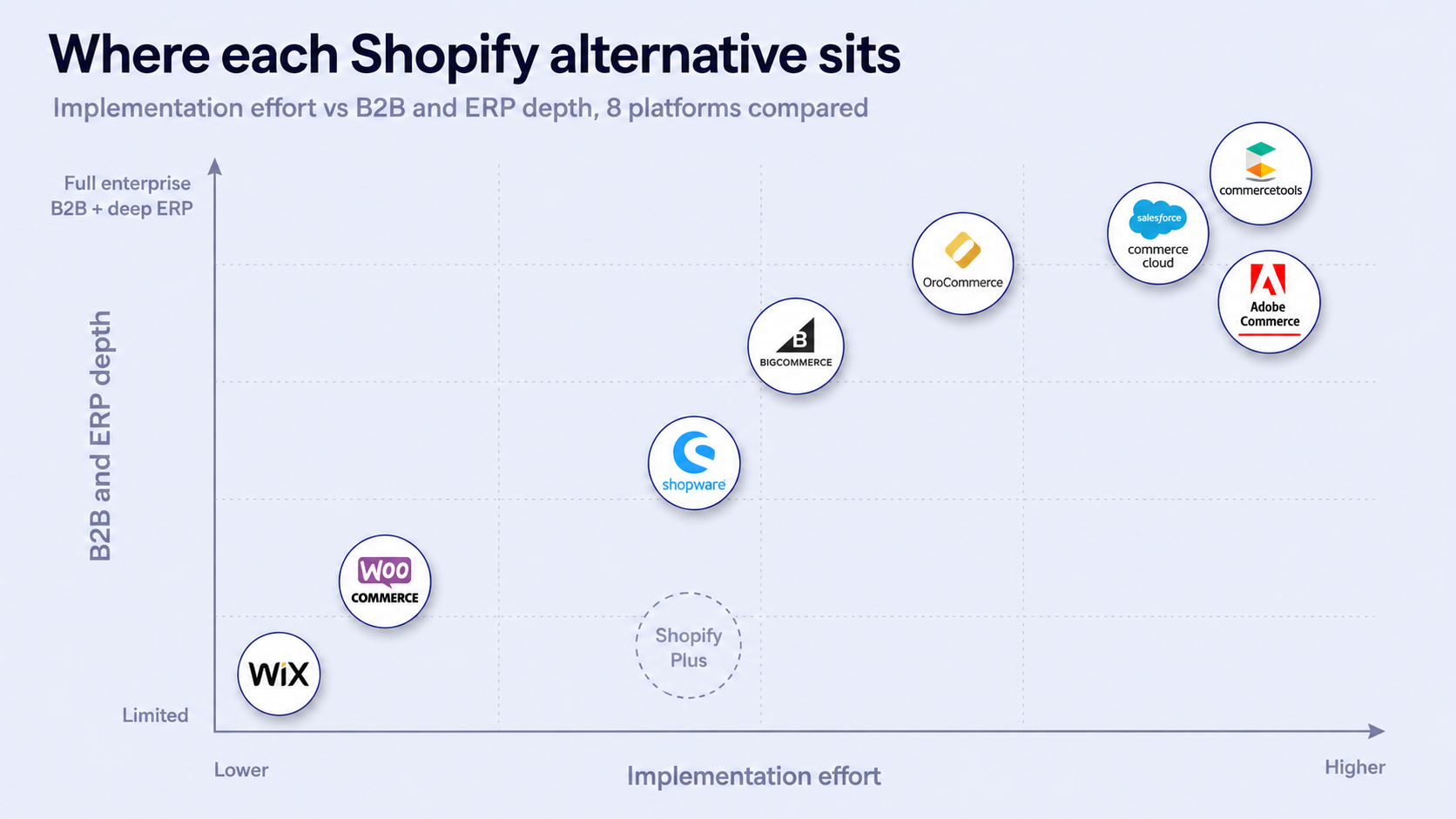
This table compares the eight Shopify alternatives across the six criteria that decide replatforming outcomes: pricing tier, customization, best business size, native B2B, ERP integration depth, and implementation effort. Only four of the eight are genuinely competitive replacements at the upper-mid-market level. The other four serve smaller businesses, EMEA mid-market, WordPress-native operations, or buyers who are not in this market at all.
| Platform | Pricing tier | Customization | Best business size | Native B2B | ERP depth | Implementation effort |
|---|---|---|---|---|---|---|
| Adobe Commerce | Enterprise | High | Mid-market to enterprise | Full | Deep | High |
| BigCommerce | Mid to enterprise | Medium | Mid-market to enterprise | Full | Moderate | Moderate |
| commercetools | Enterprise | High | Enterprise | Full | Deep | High |
| OroCommerce | Mid to enterprise | High | Mid-market to enterprise B2B | Full | Deep | High |
| Salesforce Commerce Cloud | Enterprise | High | Enterprise | Full | Deep | High |
| Shopware | Mid-market | High | Mid-market | Full | Moderate | Moderate |
| WooCommerce | Entry to mid | High | SMB to mid-market | Limited | Basic | Moderate |
| Wix | Entry | Low | SMB and creators | None | Basic | Low |
| Pixpa | Entry | Low to Medium | Creators and creative professionals | None | Basic | Low |
🚀 Quick takeaway
Only four of these eight are genuinely competitive replacements for Shopify Plus at the upper-mid-market level: Adobe Commerce, BigCommerce, commercetools, and OroCommerce. The rest serve different buyers.
1. Adobe Commerce: the deepest Shopify alternative for ERP-driven operations
Adobe Commerce, formerly Magento, is the strongest Shopify alternative when the catalog, the integrations, and the B2B workflows are where the real pressure sits. It supports multiple websites, stores, and store views under one admin. Native B2B includes price lists, account hierarchies, quotes, and RFQs. The trade-off is implementation effort: Adobe Commerce is a code-first platform that needs an experienced agency or in-house team and self-managed hosting.
For multi-brand or multi-region operations with deep system dependencies, Adobe Commerce is usually the first platform on the shortlist. It connects to ERP, PIM, OMS, and payment systems through mature integration patterns, and the customization ceiling is among the highest of any Shopify alternative.
Key strengths:
- Multi-store, multi-region, multi-brand under one admin
- Mature native B2B: price lists, hierarchies, quotes, approvals
- Deep ERP, PIM, and OMS integration patterns
- Highest customization ceiling among major platforms
Watch out for:
- High implementation effort and skilled engineering capacity required
- Hosting and infrastructure are your responsibility, not the vendor’s
- License pricing for Commerce Cloud edition starts in six figures annually
Best for: mid-market to enterprise operations with multi-store, B2B depth, or ERP-heavy catalogs. A structured discovery engagement is the right way to scope an Adobe Commerce build before signing a license.
Read more: Magento vs Shopify platform comparison
🚀 Quick takeaway
Adobe Commerce is rarely the cheapest option, and almost always the most defensible one when the catalog and integrations carry the business.
2. BigCommerce: a SaaS Shopify alternative without platform transaction fees
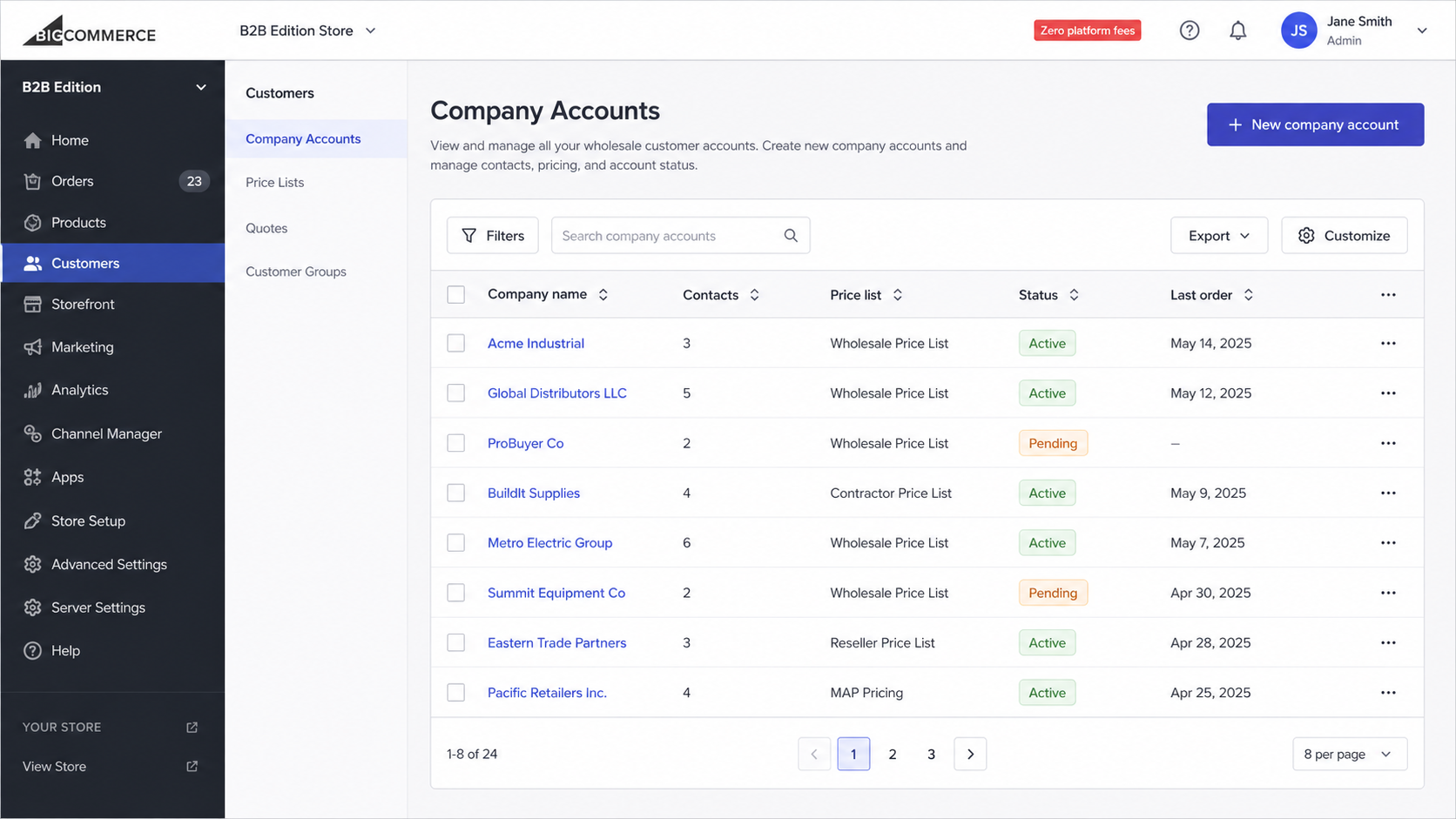
BigCommerce Enterprise is the closest SaaS-to-SaaS replacement for Shopify Plus. It keeps managed-platform simplicity, removes Shopify’s 2 percent third-party gateway fee, and brings stronger native B2B than Shopify Plus offered until late 2024. BigCommerce earned 24 of 24 medals in the 2025 Paradigm B2B Combines for the third year. Trade-offs are a smaller app ecosystem and revenue thresholds that push merchants up tiers automatically.
The architecture is more open than Shopify on payments and integrations. Headless storefronts are well supported, the API surface is broad, and there is no penalty for using your preferred payment processor.
Key strengths:
- Zero platform transaction fees, regardless of payment processor
- Strong native B2B: price lists, customer groups, quotes, bulk pricing
- Open headless and API-driven architecture
- Lower total cost of ownership than Shopify Plus at high volume
Watch out for:
- Smaller app ecosystem and theme library than Shopify
- Annual revenue thresholds can push merchants up tiers automatically
- Some advanced merchandising features still rely on apps
Best for: mid-market to enterprise SaaS-style operations that want managed-platform simplicity without Shopify Plus transaction-fee drag.
Read more: BigCommerce vs Shopify platform comparison
🚀 Quick takeaway
For a clean SaaS-to-SaaS move off Shopify Plus, BigCommerce is the closest fit and the most defensible business case at high volume.
3. commercetools: composable commerce as a Shopify alternative
commercetools is built on MACH architecture: microservices, API-first, cloud-native, headless. Where Shopify bundles storefront, checkout, and admin in one ecosystem, commercetools exposes them as composable services. It is the right Shopify alternative for enterprises that need full architectural control across multiple brands, regions, and channels. The trade-off is real: commercetools is not a lift-and-shift from Shopify and needs frontend, architecture, and integration teams from day one.
scandiweb’s commercetools vs Shopify comparison covers the architectural differences in depth, and the commercetools development team handles the build and the post-launch operation. commercetools is a Forrester Wave Leader in both B2C and B2B Digital Commerce.
Key strengths:
- True composable, headless, API-first architecture
- Designed for multi-brand, multi-region, multi-channel at enterprise scale
- Long-term flexibility: replace any service without replacing the platform
- Forrester Wave Leader for B2C and B2B Digital Commerce
Watch out for:
- Highest implementation effort and skill bar of any platform here
- No managed storefront, you build and host the frontend
- Enterprise-only pricing model
Best for: enterprise organizations pursuing composable commerce with the team and budget to operate it.
Read more: commercetools vs Adobe Commerce platform comparison
4. OroCommerce: the Shopify alternative built for B2B distributors
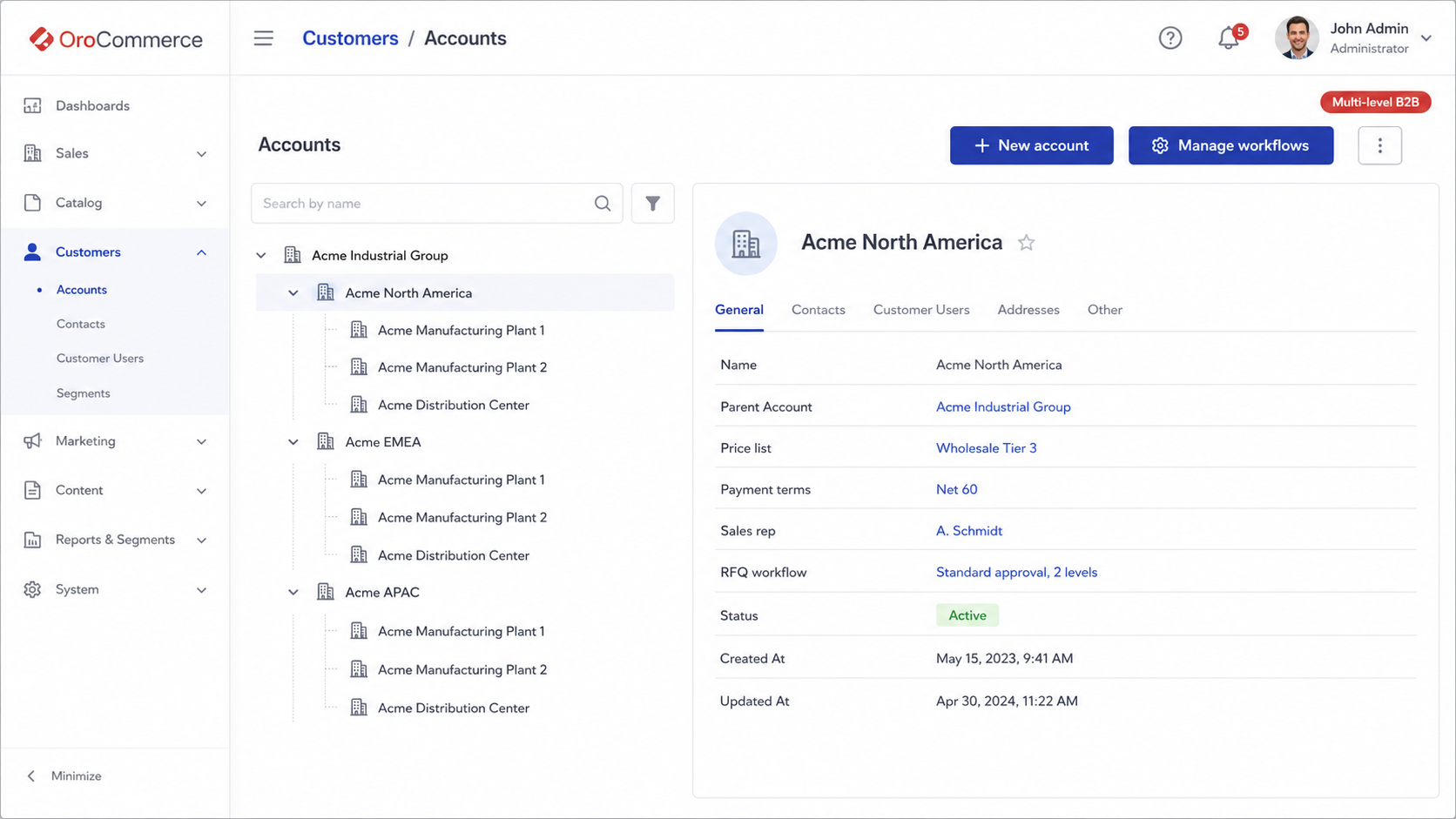
OroCommerce was built B2B-first from day one. The data model assumes multi-level account hierarchies, negotiated pricing, RFQ workflows, contract orders, and ERP-driven catalogs. Native CRM, CPQ, payments, and invoicing are bundled under one license. For a distributor, manufacturer, or B2B-heavy mid-market operation, the system fit is closer than any Shopify alternative built for B2C and retrofitted for B2B.
scandiweb has been an official OroCommerce partner for over seven years. Account-hierarchy depth is the most consistent reason buyers choose OroCommerce over Shopify Plus B2B or Adobe Commerce B2B.
Key strengths:
- B2B-first data model, not retrofitted from B2C
- Native CRM, CPQ, payments, and invoicing in one license
- Strong account hierarchy, RFQ, and approval workflows
- Built for ERP-driven catalogs and contract sales
Watch out for:
- Smaller agency partner network than Adobe Commerce or Shopify
- Pure B2C use cases are not the strongest fit
- Implementation effort is comparable to Adobe Commerce
Best for: mid-market and enterprise B2B distributors and manufacturers, particularly those with negotiated pricing.
🚀 Quick takeaway
If your data model is closer to a CRM than to a catalog, OroCommerce is the only Shopify alternative on this list that was built that way from day one.
5. Salesforce Commerce Cloud: the Shopify alternative for Salesforce-heavy stacks
Salesforce Commerce Cloud is the right Shopify alternative when an organization is already on Salesforce: Sales Cloud, Service Cloud, Marketing Cloud, Data Cloud. The native data integration is the hardest thing to replicate elsewhere. Outside the Salesforce ecosystem, Commerce Cloud’s value over Adobe Commerce or commercetools narrows quickly. It is also the most expensive option in this list and carries the strongest vendor lock-in.
For an organization with Salesforce CRM and Marketing Cloud already in production, the operational gravity of staying inside the ecosystem usually outweighs the cost premium.
Key strengths:
- Native integration with the Salesforce ecosystem
- Mature B2B and B2C, multi-region, headless support
- Strong customer data and personalization capabilities
- Enterprise-grade reliability and support
Watch out for:
- Highest licensing cost in this list
- Strongest vendor lock-in: hard to leave once embedded
- Less compelling outside the Salesforce ecosystem
Best for: enterprises already running on Salesforce CRM and Marketing Cloud who want one connected stack.
🚀 Quick takeaway
Salesforce Commerce Cloud is rarely the right answer if you are not already deep in the Salesforce ecosystem, and almost always the right answer if you are.
6. Shopware: the mid-market Shopify alternative with strong native B2B
Shopware is a German-built platform with traction in European mid-market and B2B segments. It runs on a modern PHP stack, supports headless natively via its API, and ships with a credible B2B Suite covering price lists, customer-specific catalogs, and quote workflows. It sits between Shopify Plus and Adobe Commerce in cost and engineering effort. The main caveat outside Europe is a thinner partner network.
Key strengths:
- Strong native B2B Suite included in commercial editions
- Native headless and modern API architecture
- Mid-market pricing between Shopify Plus and Adobe Commerce
- Active development and roadmap
Watch out for:
- Smaller partner network outside of Europe
- Some enterprise-grade integrations less mature than Adobe Commerce
- English-language documentation and community thinner than Shopify or BigCommerce
Best for: mid-market operations, particularly in EMEA, with B2B requirements and a preference for European tooling.
7. WooCommerce: the open-source Shopify alternative for WordPress-native businesses
WooCommerce is a free, open-source plugin that turns WordPress into an eCommerce platform. License cost is zero and the customization ceiling is high, riding on the largest plugin and theme ecosystem in web publishing. The hidden costs are infrastructure and engineering: WooCommerce is self-hosted, so hosting, scaling, security patching, and plugin maintenance are your responsibility.
For a content-heavy business or a brand whose marketing site already runs on WordPress, WooCommerce is an obvious option to evaluate. A serious WooCommerce build at mid-market scale often needs a dedicated web development team to keep performance and uptime in line with what a SaaS platform delivers by default. Open-source shoppers can also weigh Magento vs PrestaShop.
Key strengths:
- No license cost, fully open-source
- Native WordPress integration: best content-plus-commerce experience
- Largest plugin ecosystem of any open-source eCommerce platform
- Full code-level control
Watch out for:
- Self-hosted: hosting, scaling, security, and patching are on you
- B2B features are plugin-dependent and uneven
- Performance at high SKU and traffic volume needs serious tuning
Best for: content-led brands and SMB-to-mid-market operations that already run on WordPress and have engineering capacity.
8. Wix: the consumer-grade reference point
Wix is included for honesty, not because it is a serious replacement for Shopify Plus. For a creator, a small DTC brand under $1M revenue, or a service business adding light commerce, Wix is faster to launch and easier to maintain than any other platform in this list. For an enterprise B2B catalog, Wix is not the answer. AI tooling has improved meaningfully in 2024 to 2026, but the customization ceiling is still low.
Key strengths:
- Fastest time to launch in this list
- Strong design and AI tooling for non-technical users
- Lowest total cost for very small operations
Watch out for:
- B2B is not on the menu, neither is headless or any serious ERP integration
- The customization ceiling drops fast at mid-market scope
- Not a serious comparator for Shopify Plus replatforming
Best for: SMBs, creators, and service businesses adding light commerce.
🚀 Quick takeaway
If Wix can carry your business, you are not the buyer this article was written for, and that is not a problem.
How to choose between these 8 Shopify alternatives
| System condition | What it means | Recommended next step |
|---|---|---|
| Control | System is unstable or risky | Stabilize before replatforming. Replatforming a broken system rebuilds the broken parts. |
| Foundation | System cannot scale without a rebuild | Replatform — pick by buyer profile: Adobe Commerce for ERP-driven catalogs; BigCommerce for SaaS simplicity without transaction fees; commercetools for composable architecture; OroCommerce for B2B distributors. |
| Growth | System is stable but commercial performance is lagging | The platform may not be the problem. Fix conversion and merchandising first. |
The right Shopify alternative depends on the system condition the business is in, not on the longest feature list. If the system is unstable, stabilize before replatforming. If the system is stable but cannot scale, the question is architecture: Adobe Commerce wins for ERP-heavy operations, BigCommerce for SaaS simplicity without transaction fees, commercetools for composable architecture, OroCommerce for B2B-first data models. If the system is stable and the constraint is commercial performance, the platform may not be the problem at all.
Choose Adobe Commerce if:
- You run multi-brand or multi-region operations on a single product catalog
- You have heavy ERP, PIM, or OMS integration requirements
- You sell B2B with deep account hierarchies, RFQs, and contract pricing
- You have in-house engineering capacity or a long-term agency partner
- You need the highest customization ceiling without leaving SaaS-adjacent tooling
Choose BigCommerce Enterprise if:
- You want SaaS simplicity without Shopify Plus’s 2 percent third-party gateway fee
- You sell B2B but do not need Adobe Commerce’s full hierarchy depth
- You need open headless and API-driven architecture out of the box
- You operate at high volume where transaction fees compound into real money
- You want the closest behavioral match to Shopify Plus with stronger native features
Choose commercetools if:
- You need full architectural control across multiple brands, regions, or channels
- You are pursuing composable commerce and have the team to operate it
- Your customer journey is non-standard and cannot be served by a managed storefront
- You can budget for an enterprise-only license and a custom-built frontend
- You think in 5 to 10 year platform horizons, not 2 year ones
Choose OroCommerce if:
- You are a B2B distributor, manufacturer, or operation with negotiated pricing
- Your catalog is driven by your ERP, not your storefront
- You need multi-level account hierarchies, RFQ, and approval workflows from day one
- You want CRM, CPQ, payments, and invoicing under one license
- You prefer a B2B-first platform over a B2C platform retrofitted for B2B
Before signing a license on any of these, a structured discovery and planning engagement tells you which condition your business is actually in.
Read more: How to choose an enterprise eCommerce platform
🚀 Quick takeaway
Most failed replatforming projects fail because the wrong question was answered first. Diagnose the system condition before choosing the alternative.
Frequently asked questions about Shopify alternatives
What are the best alternatives to Shopify for enterprise eCommerce?
The best alternatives to Shopify for enterprise are Adobe Commerce, BigCommerce Enterprise, commercetools, and OroCommerce. Adobe Commerce wins for ERP-heavy operations and large catalogs, BigCommerce for SaaS teams that want lower transaction costs, commercetools for composable architecture, OroCommerce for B2B distributors with negotiated pricing. The right choice depends on system requirements and operational depth, not feature counts.
When should a business move from Shopify Plus to Adobe Commerce?
Move from Shopify Plus to Adobe Commerce when you have heavy ERP, PIM, or OMS integration requirements, large multi-brand catalogs, custom B2B workflows, or in-house development capability. Adobe Commerce supports bulk pricing rules, custom quoting, and real-time ERP syncs that Shopify Plus cannot match natively. Replatforming typically takes 4 to 9 months and requires structured discovery before commitment.
Is BigCommerce a better alternative to Shopify for B2B?
BigCommerce Enterprise is a better Shopify alternative when you want SaaS simplicity but need native B2B features and zero platform transaction fees. It includes B2B price lists, customer groups, quote management, and bulk order tools without paid apps. BigCommerce earned 24 of 24 medals in the 2025 Paradigm B2B Combines, making it competitive with Shopify Plus B2B for mid-market wholesalers.
What is the difference between Shopify and commercetools?
Shopify is a SaaS platform that bundles the storefront, checkout, and admin in one ecosystem. commercetools is an API-first, headless commerce platform built on MACH architecture: microservices, API-first, cloud-native, headless. commercetools gives full control over front-end and integrations but requires composable architecture skill. Shopify is faster to launch, commercetools is built for organizations that need long-term architectural flexibility.
Why do brands switch from Shopify to Magento or Adobe Commerce?
Brands switch from Shopify to Magento or Adobe Commerce primarily for customization depth, large catalog support, and ERP and PIM integration capability. Shopify caps each product at 3 options and 100 variants, restricts checkout customization on lower plans, and charges 2 percent transaction fees on third-party gateways. Adobe Commerce removes those constraints in exchange for higher implementation effort.
Which Shopify alternative is best for multi-brand or multi-region stores?
For multi-brand or multi-region operations at scale, Adobe Commerce and commercetools are the strongest Shopify alternatives. Adobe Commerce supports multiple websites, stores, and store views under one admin: scandiweb has run 70 store views across 20 languages on a single Adobe Commerce instance. commercetools handles the same scope through composable architecture. Shopify Plus requires separate stores per market, increasing operational overhead.
How much does it cost to migrate from Shopify Plus to a different platform?
A Shopify Plus migration to Adobe Commerce, BigCommerce Enterprise, commercetools, or OroCommerce typically ranges from $80,000 to $500,000 plus, depending on catalog scope, ERP and PIM integrations, custom workflows, and front-end requirements. Implementation timelines are usually 4 to 9 months. The first commercial step should be a structured discovery to scope risk and dependencies before committing to a platform.
Is OroCommerce a real alternative to Shopify for B2B distributors?
Yes, OroCommerce is built specifically for B2B distributors, manufacturers, and organizations with negotiated pricing, multi-level account hierarchies, RFQ workflows, and deep ERP integration needs. It includes native CRM, CPQ, payments, and invoicing under one license. Shopify Plus B2B added similar features but does not match OroCommerce’s account hierarchy depth or B2B-first data model. scandiweb has been an official OroCommerce partner for over seven years.
What are the risks of replatforming from Shopify to another eCommerce platform?
The main replatforming risks are SEO loss from URL changes, integration breakage between ERP, PIM, and OMS systems, data migration errors, checkout regression, and extended go-live timelines. Mitigation requires structured discovery, phased data migration, redirect mapping, parallel-running environments, and integration testing before cutover. Skipping discovery to save time consistently produces the most expensive replatforming failures.
Which Shopify alternative has the lowest total cost of ownership?
Total cost of ownership depends on revenue scale and operational depth, not list price. BigCommerce Enterprise typically has the lowest 3-year TCO for SaaS-style mid-market operations because it eliminates Shopify’s 2 percent third-party gateway fee. Adobe Commerce and commercetools have higher implementation costs but lower per-order costs at high volume. WooCommerce and Magento Open Source are cheapest in license but require infrastructure and engineering investment.
Which Shopify alternative is best for photographers, artists, and designers selling their own work?
For creative professionals who sell their own work rather than run a catalog, none of the enterprise four is the right fit, and neither is Shopify Plus. A portfolio-first builder will be better suited to this use case. A good example is Pixpa, a solid website builder that combines a few options: you can create a portfolio website, use client galleries with proofing, and get ecommerce tools in one no-code platform. Such builders are set up more around selling creative work than managing B2B, headless, or ERP-heavy selling operations. They can also be easier on the budget for independent creators (Pixpa, for example, charges 0 percent platform commission, apart from standard payment processing fees).
Replatforming from Shopify is a system decision, not a platform comparison
The eight Shopify alternatives in this guide each fit a specific system condition. Adobe Commerce for ERP-driven operations. BigCommerce for SaaS simplicity without transaction fees. commercetools for composable architecture. OroCommerce for B2B-first operations. Salesforce Commerce Cloud, Shopware, WooCommerce, and Wix each fit narrower buyers.
The wrong question is “which Shopify alternative is best?” The right question is “which system condition is my business in, and which alternative fits it?” Answer that first and the platform shortlist usually reduces to two or three candidates.
If you are weighing alternatives to Shopify and want to pressure-test the system fit before you commit, get in touch with our eCommerce experts for a structured discovery call.