
If you’re evaluating platforms right now, you’re not alone. Only 14% of merchants say they are satisfied with their current eCommerce platform, and 77% feel real urgency to migrate within the next year. Gartner expects businesses on legacy infrastructure to spend up to 40% more on maintenance through 2026 than peers on modern platforms – and with Salesforce projecting that 90% of B2B purchases will be intermediated by AI agents by 2028, the platform underneath your operation is becoming more consequential by the year.
For CTOs, Heads of Digital, and commerce leads at upper mid-market brands, this guide breaks down how BigCommerce and Shopify actually compare in 2026 – pricing, features, enterprise readiness, and migration risk – with the trade-offs scandiweb sees on real builds.
BigCommerce vs Shopify: key differences at a glance
Shopify is generally the better choice for teams that want to launch quickly and scale with minimal technical overhead. BigCommerce is better for businesses that need more built-in features and greater control without relying heavily on third-party apps. In most cases, the decision comes down to speed and simplicity versus native functionality.
- Shopify is a fully managed SaaS platform; BigCommerce is also SaaS, with more built-in features and fewer app dependencies.
- Shopify relies heavily on apps to extend functionality; BigCommerce includes more features natively.
- Shopify is easier to use and faster to set up; BigCommerce has a steeper learning curve.
- Shopify has a larger partner and app ecosystem; BigCommerce offers more out-of-the-box control.
- The right choice between BigCommerce vs Shopify depends on scale, catalog scope, and internal technical resources.
🚀 Quick takeaway
If launch speed and ecosystem matter most, lean Shopify. If you need native B2B, multi-storefront, or fewer app dependencies, lean BigCommerce.
BigCommerce vs Shopify comparison table
This BigCommerce vs Shopify comparison highlights the key differences in pricing, features, and scalability.
| Category | Shopify | BigCommerce |
|---|---|---|
| Platform type | Fully hosted SaaS | Fully hosted SaaS (feature-rich) |
| Pricing model | Subscription + app costs | Subscription, more built-in features |
| Ease of use | Very easy, beginner-friendly | Moderate, steeper learning curve |
| Apps | Large app ecosystem | Smaller ecosystem, more native features |
| Customization | Moderate (apps + Liquid) | Higher out-of-the-box flexibility |
| B2B | Native from Basic up (3 catalogs); full set on Shopify Plus | Native B2B functionality |
| Transaction fees | Yes (waived with Shopify Payments) | No platform-level fees |
| Scalability | Managed, auto-scaling | Flexible, more setup needed |
| Best for | SMB to mid-market | Mid-market, B2B, complex catalogs |
BigCommerce vs Shopify pricing
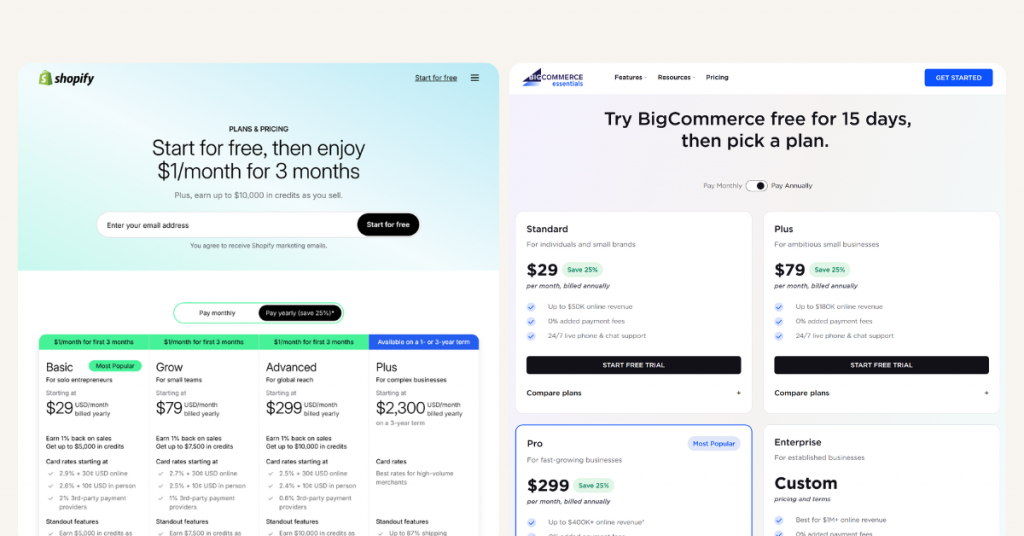
Shopify pricing is predictable, with plans ranging from $29 to $299 per month (billed annually) plus potential app costs. BigCommerce pricing is similar at the base level but includes more built-in features, which can reduce reliance on paid apps. Total cost depends on app usage, integrations, and how much your team relies on the platform versus custom work.
Shopify’s tiers in 2026 are Basic ($29 annually, $39 monthly), Grow ($79 annually, $105 monthly), Advanced ($299 annually, $399 monthly), and Plus (from approximately $2,300 per month). BigCommerce mirrors the structure: Standard ($29 annually, $39 monthly), Plus ($79 annually, $105 monthly), Pro ($299 annually, $399 monthly), and Enterprise (custom pricing). At the headline level, the two look almost identical. The real cost lives further down the page.
Transaction fees are the first divergence. Shopify charges 0.5% to 2% on third-party payment gateways, waived when stores use Shopify Payments. BigCommerce charges no platform-level transaction fees regardless of which gateway a merchant chooses, which can matter for stores routing high volume through Adyen or Authorize.net.
The second divergence is harder to see upfront: BigCommerce ties its plan tiers to annual online sales revenue. Standard caps at $50,000 in annual sales, Plus at $180,000, and Pro at $400,000 in trailing 12-month GMV, with an additional $150 per month for every $200,000 above that. A store growing past a tier ceiling is forced to upgrade, which can introduce cost surprises during a strong quarter. Shopify does not gate plans by revenue, which makes its pricing easier to forecast.
The third, and the one finance teams miss most often, is app cost. A typical mid-market Shopify store on the Advanced plan often layers $400 to $800 per month in essential apps (reviews, subscriptions, advanced search, customer groups) on top of the $299 base, pushing real monthly cost well past $700. The same business on BigCommerce Pro might run closer to $400 because more of those features ship in the platform.
When evaluating total cost of ownership, scandiweb usually finds Shopify cheaper at launch and BigCommerce competitive over a 24 to 36 month horizon for catalog-heavy or B2B stores. “Cheaper” depends on the feature set a business actually uses.
🚀 Quick takeaway
Compare 24 to 36 month TCO, not just the base plan. App stack on Shopify and revenue-tier upgrades on BigCommerce are where pricing really diverges.
Features and customization
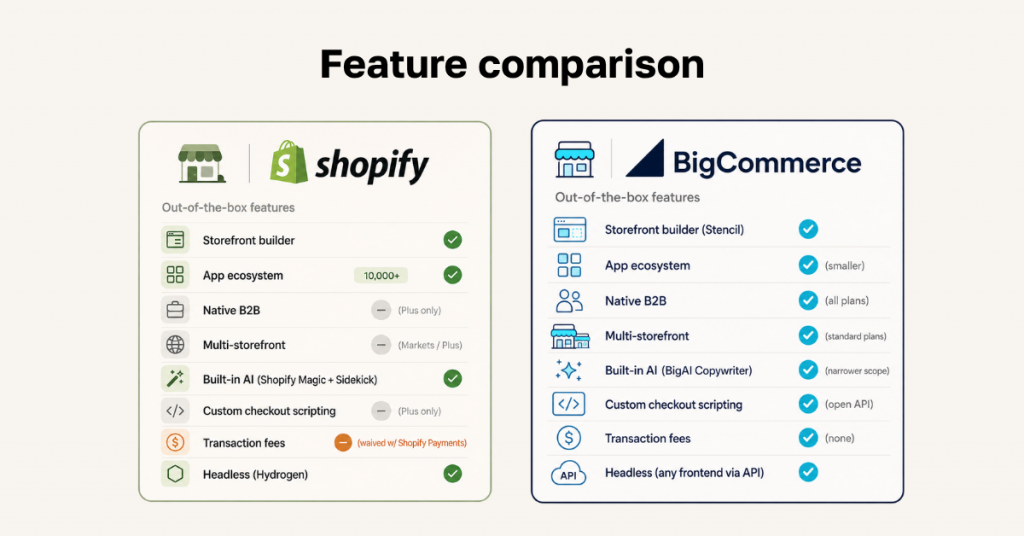
Shopify extends functionality through apps, while BigCommerce includes more features natively. Shopify offers a larger ecosystem, while BigCommerce provides built-in capabilities for areas like B2B pricing, faceted search, and multi-storefront. This is the single most important trade-off in the BigCommerce vs Shopify features comparison, and it shapes almost every downstream decision.
Shopify’s app-heavy model gives merchants flexibility, since there is an app for almost any requirement. The flip side: each app adds a recurring cost, a third-party dependency, and another piece of the stack to monitor when something breaks. BigCommerce’s native features reduce that vendor dependency, at the cost of a smaller ecosystem when a need falls outside what is built in.
Both platforms support custom themes. BigCommerce gives merchants more control over URL structure, which advanced SEO teams sometimes prefer. Shopify’s Liquid templating language is widely supported across the developer community, with extensive documentation and a large pool of available agencies. BigCommerce’s Stencil framework is capable but has a steeper technical learning curve, which narrows the developer pool.
Shopify enforces a fixed /products/ URL path, requires Shopify Plus for full checkout customization, and routes all stores through its managed infrastructure. In practice, performance depends heavily on implementation, and proven Shopify performance optimization strategies can measurably improve Core Web Vitals and load times. Shopify also simplifies development, but there are real trade-offs around URL structure and checkout customization, areas where Shopify has limitations that brands should weigh before committing.
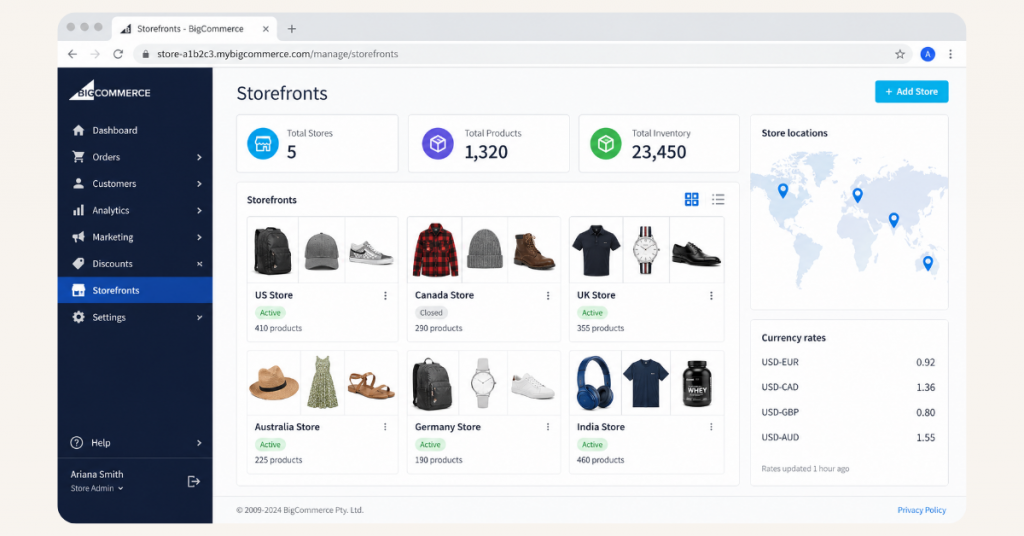
For multi-store operators, the platforms diverge more sharply. BigCommerce ships native multi-storefront on standard plans, useful for brands running multiple regional or category-specific sites with shared inventory. Shopify supports this through Markets and, at Plus, multiple stores under one organization, but full parity sits behind Plus-level pricing.
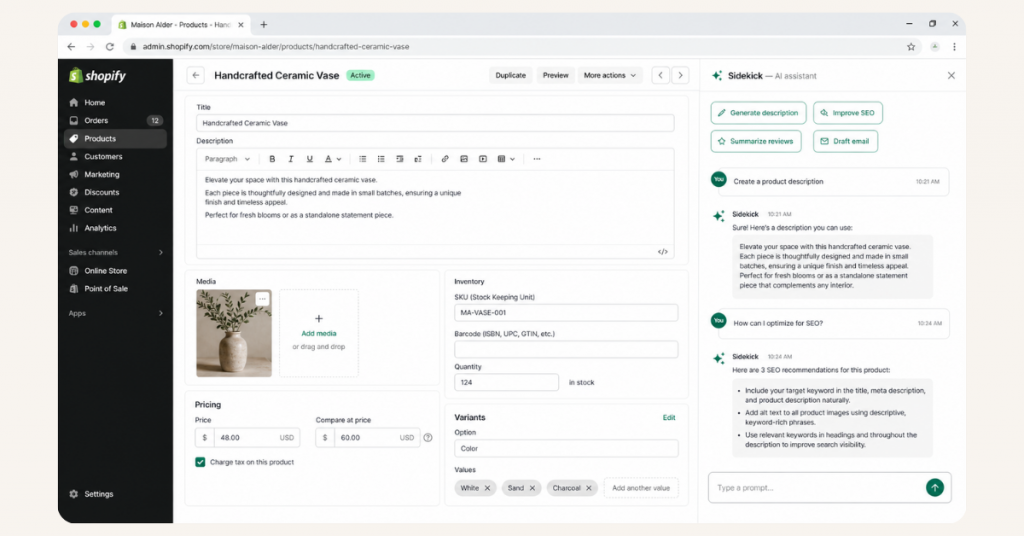
On AI tools, both platforms moved fast in 2025 to 2026. Shopify Magic is free for every merchant and now includes brand voice cloning trained on your past blog and social content, automated product tagging from images, and generative copy across product descriptions, emails, and blogs. Shopify Sidekick, launched in 2025 and expanded with Sidekick Pulse in 2026, surfaces proactive insights and can edit themes, run reports, and execute admin actions through natural language. BigCommerce offers BigAI Copywriter for generative content but with narrower output and less native tie-in with the rest of the admin. Neither replaces an editorial or analytics team. Shopify’s AI layer is currently the more deeply integrated of the two.
🚀 Quick takeaway
Native features on BigCommerce reduce app sprawl. Apps and AI on Shopify reduce build time. Pick based on where you want flexibility, and where you can’t afford it.
Shopify vs BigCommerce for different use cases
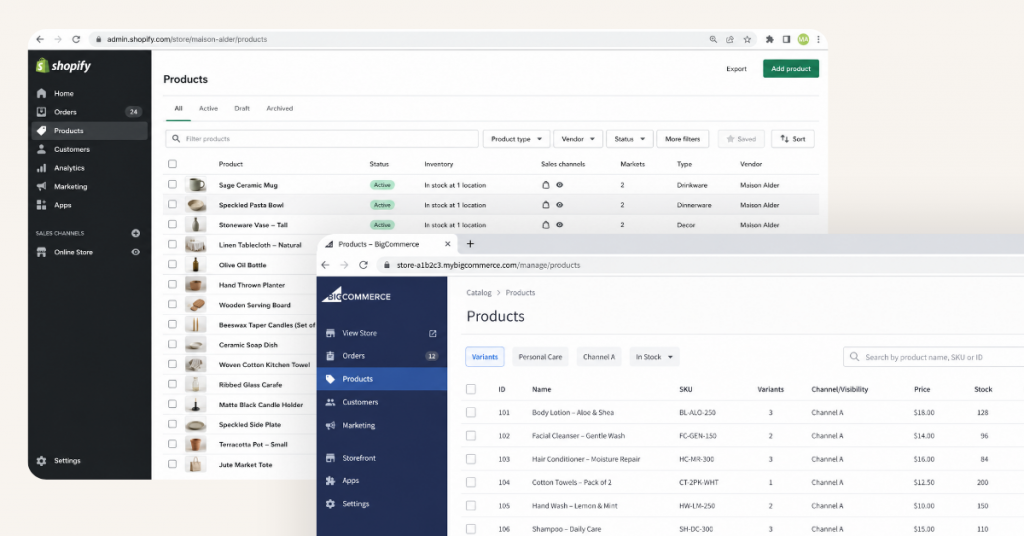
The right platform changes by business model. Below is a direct verdict for each common scenario, then the reasoning.
Small business
Shopify is the better choice for small businesses due to ease of use, faster setup, and a lower barrier to launch. BigCommerce may be more involved than needed at this stage, unless the business already has technical resources.
A non-technical founder can have a Shopify store live, accepting payments, and synced with social channels in a weekend. Honestly, the gap is that wide. The app store covers nearly every common SMB requirement out of the box: email, reviews, shipping, inventory. Onboarding flows guide first-time merchants through the steps a developer would otherwise handle. BigCommerce can serve the same merchant well, but the time-to-launch is typically longer.
B2B
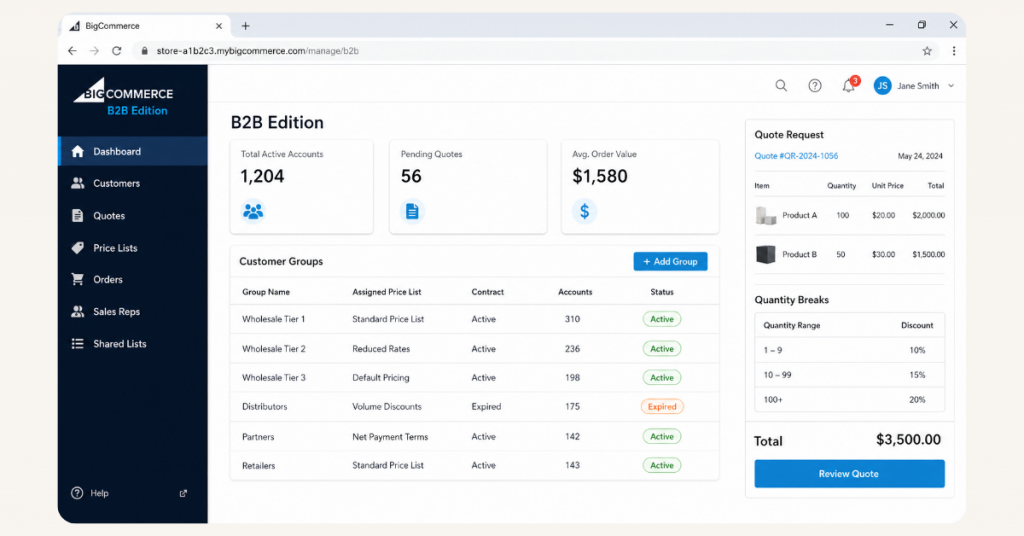
BigCommerce is the stronger choice for B2B due to native features, including pricing rules, customer groups, an invoice portal, and custom catalogs available without additional apps. Shopify has included native B2B on Basic, Grow, and Advanced since April 2026, capped at three catalogs, while customer-specific catalogs, deposits, and partial payments still require Shopify Plus.
BigCommerce ships native quote portals, tiered pricing, customer-group catalog visibility, and account hierarchies on its standard plans. For Shopify, company accounts, net payment terms, and quantity rules are included from the Basic plan up, and Shopify Plus adds unlimited catalogs and customer-specific pricing. For brands already operating on Shopify at scale, Plus’s B2B module is a credible answer. For B2B-first businesses starting fresh, BigCommerce typically gets to a working setup with fewer integrations.
For upper mid-market brands running global B2B operations across ERP, PIM, and multiple regions, the platform is only one input. When scandiweb rebuilt a global B2B environment with a 10,000-product catalog, the work spanned architecture, data, and integration before any storefront change, producing +29.8% YoY revenue and a +132.5% conversion uplift.
Developers
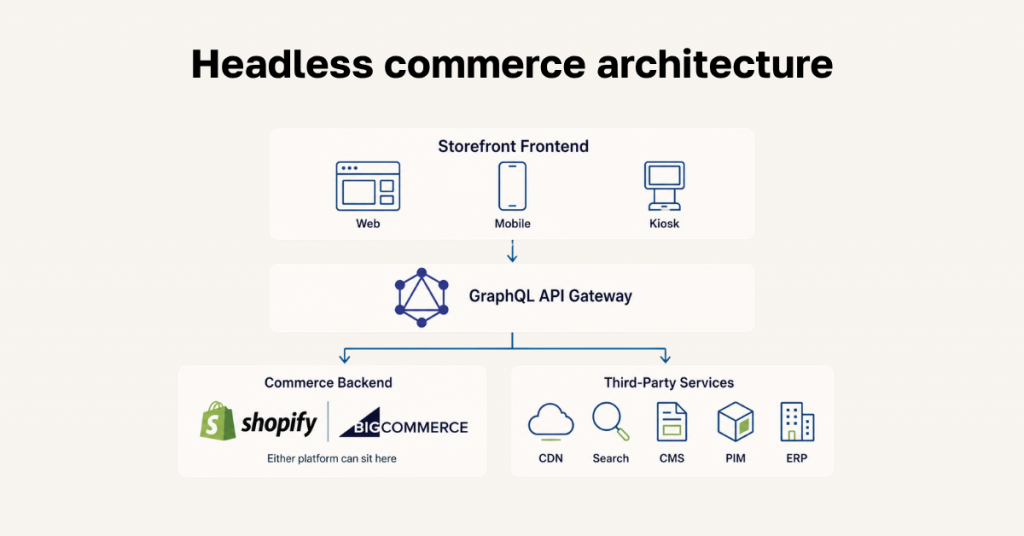
BigCommerce offers more built-in flexibility for developers, with greater URL control and fewer constraints. Shopify works within a defined architecture and APIs, which speeds up builds but limits deeper customization.
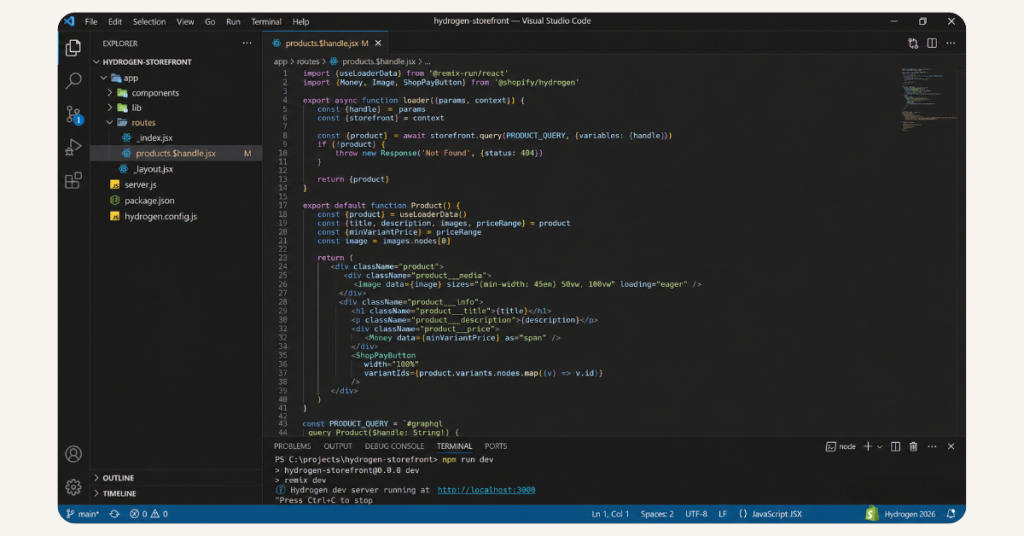
Shopify’s Liquid templating, GraphQL Storefront API, and Hydrogen framework give development teams a mature, well-documented path, particularly for headless builds. For advanced builds, Shopify Hydrogen and headless commerce enable full frontend control while keeping Shopify’s backend. BigCommerce’s Stencil framework and broader API surface allow more out-of-the-box customization but require specialist developers to maintain.
Dropshipping
For dropshipping, Shopify is the stronger choice due to its large app ecosystem and native integrations. DSers, which replaced Oberlo, provides direct AliExpress sourcing and automated fulfillment. BigCommerce supports dropshipping but with a smaller app ecosystem.
Shopify’s ecosystem includes DSers, AutoDS, Spocket, and dozens of niche supplier integrations, which makes testing product-market fit fast and inexpensive. BigCommerce supports the model, but the supplier app catalog is narrower. BigCommerce does offer a 15-day free trial, which is useful for testing before committing.
Enterprise (Shopify Plus vs BigCommerce)
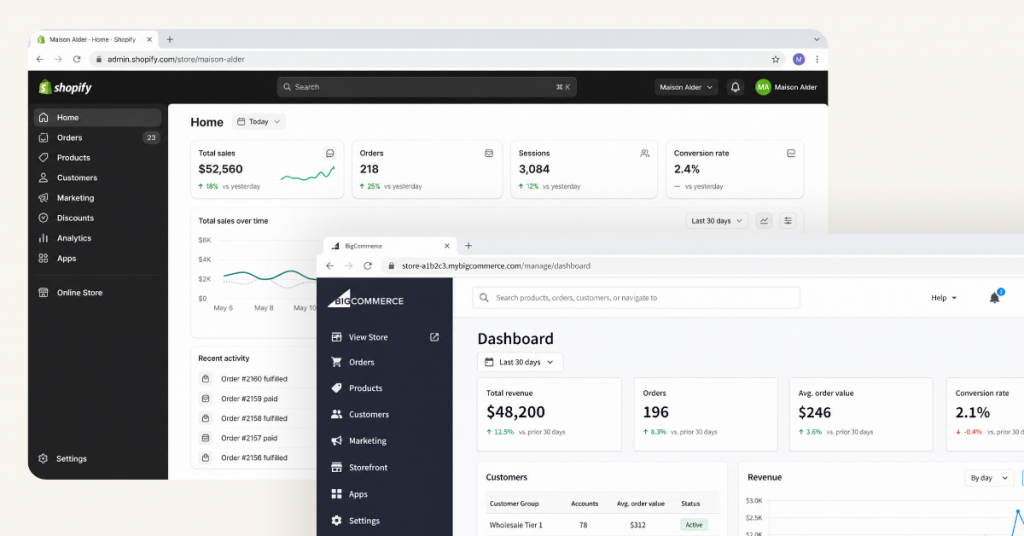
Shopify Plus, from approximately $2,300 per month, is purpose-built for high-volume merchants and includes custom checkout scripting, Shopify Flow no-code automation, B2B company accounts (buyer hierarchies, net payment terms), and a dedicated merchant success manager. BigCommerce offers strong enterprise flexibility and built-in features, particularly for B2B, but requires more custom development to match Shopify Plus’s managed reliability. The right choice depends on operational scope and technical requirements.
For DTC brands prioritizing managed infrastructure and fast scaling, Shopify Plus is the more direct path. The platform absorbs Black Friday-level traffic spikes automatically, and the dedicated success manager shortens the loop on incidents and feature requests. BigCommerce enterprise is the stronger fit for catalog-heavy B2B and teams that want full code ownership. Native B2B is included on all plans, URL structure is more flexible, and API access is broader. The trade-off is that performance under heavy load depends more on hosting and caching configuration that the merchant or agency owns.
A representative example: when a luxury jewelry brand managing 150,000 SKUs moved from Magento 1 to Shopify Plus, the deciding factor was Plus’s managed scaling combined with custom scripting to clean legacy data, something neither platform’s stock tools handled out of the box.
Read more: Magento 1 to Shopify Migration for a Luxury Jewelry Brand
🚀 Quick takeaway
Shopify Plus wins on managed reliability and DTC velocity. BigCommerce wins on native B2B and code ownership at a lower subscription tier.
Migration considerations
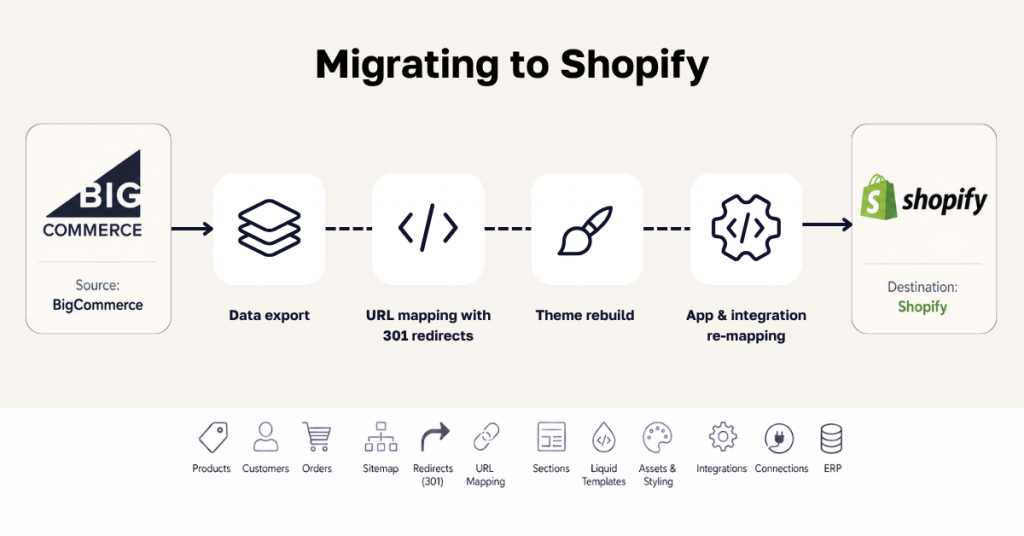
Businesses typically migrate from BigCommerce to Shopify when they want a simpler operational model, faster iteration, and access to a broader app ecosystem. A successful migration requires careful planning to maintain SEO performance and data integrity, including accurate URL mapping with 301 redirects, complete data transfer (products, customers, orders), and rebuilding the storefront in a new theme.
A clean migration follows four phases. First, data export: products, variants, customers, orders, and order history pulled out of BigCommerce in formats Shopify can ingest. Second, URL mapping with 301 redirects: this is the most common point of failure and the single largest SEO risk, since every indexed URL needs to map to its new equivalent before launch. Third, theme rebuild: BigCommerce themes do not port across, so the storefront is rebuilt in Liquid, ideally improving performance and conversion at the same time. Fourth, app and integration re-mapping: each BigCommerce native feature now in use needs a Shopify equivalent, whether through an app, a Plus capability, or custom development, including reconnecting ERP, PIM, and any operational data flows.
The risks worth budgeting for: SEO ranking loss when redirects are incomplete or built incorrectly, data loss when exports are not validated against source records, and downtime risk during the cutover window. DIY migrations using off-the-shelf tools cost less but carry more risk. Agency-managed migrations typically run 4 to 8 weeks for mid-size stores and trade higher upfront cost for lower SEO and data risk.
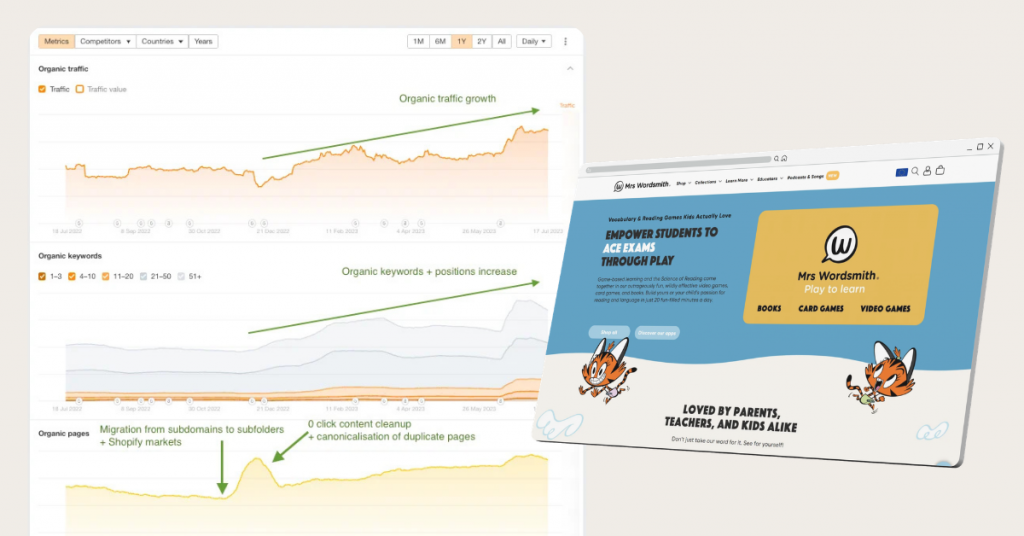
In one Magento 2 to Shopify migration scandiweb supported, an SEO-led approach with full metadata and redirect mapping helped the merchant grow organic revenue 107% post-launch, a useful illustration of why the SEO workstream cannot be an afterthought.
Read more: SEO Program Secures Kouboo Migration and Drives Organic Growth
For the full step-by-step process, see our guide on migrating from BigCommerce to Shopify, covering data, redirects, and integrations without ranking risk.
🚀 Quick takeaway
The biggest migration risk is SEO, not the data move. Get URL mapping and 301 redirects locked before anyone touches a theme.
Which is better: Shopify or BigCommerce?
Choose Shopify if you need to launch quickly, iterate without heavy technical overhead, and rely on a large ecosystem of apps and integrations to extend functionality. Choose BigCommerce if your business depends on built-in features, structured catalog management, or B2B workflows that would otherwise require multiple integrations.
Choose Shopify if…
- You’re a non-technical founder or small team that needs to launch quickly.
- You want access to a large app ecosystem for customization and growth.
- You need multichannel selling (TikTok, Amazon, Instagram) with native integrations.
- Predictable pricing and a managed platform matter more than built-in features.
- You’re scaling globally and want Shopify Markets or Shopify Plus infrastructure.
Choose BigCommerce if…
- You need native B2B features (pricing rules, customer groups, invoice portal) beyond Shopify’s three-catalog limit without paying for Shopify Plus.
- You manage a catalog with high SKU and variant counts.
- You want no platform-level transaction fees regardless of payment gateway.
- Your team has technical resources and wants more out-of-the-box flexibility.
- You’re migrating from a custom cart and want strong built-in tools.
Frequently asked questions
Which is better, Shopify or BigCommerce?
Shopify is better for most businesses due to ease of use, a larger app ecosystem, and managed scalability. BigCommerce is better for businesses with B2B requirements, large catalogs, or teams that want more built-in features without third-party app dependency. The right choice depends on your technical capacity and business model.
Should I use BigCommerce or Shopify for SEO?
Shopify is easier to manage for SEO because hosting, HTTPS, canonical tags, and sitemap generation are handled automatically. BigCommerce offers more flexibility in areas like URL structure and faceted navigation, which can benefit advanced SEO strategies. The better option depends on whether you prioritize simplicity or control.
BigCommerce vs Shopify pricing: which costs more?
Base plan pricing is similar, with both starting at $29 per month billed annually. Shopify’s total cost can rise with app subscriptions for features BigCommerce includes natively. BigCommerce pricing is tied to annual sales revenue, which can trigger forced plan upgrades for fast-growing stores. Total cost of ownership depends on your app usage, integrations, and growth rate.
What happened to BigCommerce?
BigCommerce has shifted its strategic focus toward enterprise and B2B merchants, scaling back from the SMB market where Shopify dominates. The platform continues to operate and serve over 130,000 merchants globally, but has seen slower merchant growth compared to Shopify. It remains a strong option for mid-market and B2B businesses with catalog-heavy requirements.
Shopify vs BigCommerce vs Volusion: which should I choose?
Shopify and BigCommerce are both modern, actively developed SaaS platforms with strong scalability and ecosystems. Volusion is an older platform with more limited development investment and a smaller ecosystem. For most businesses evaluating eCommerce platforms in 2026, Shopify or BigCommerce are the more viable long-term choices.
Shopify vs WooCommerce vs BigCommerce: how do they compare?
Shopify and BigCommerce are both fully hosted SaaS platforms: you pay a subscription and the platform manages hosting, security, and infrastructure. WooCommerce is a free self-hosted WordPress plugin that requires you to manage your own hosting, security, and updates. Shopify suits most growing businesses, BigCommerce suits B2B or catalog-heavy needs, and WooCommerce suits technically capable teams who need full code control or deep WordPress content integration. For a deeper view, see how Shopify compared to WooCommerce plays out across hosting, cost, and customization.
Planning a Shopify or BigCommerce build? scandiweb takes responsibility across the full commerce system: architecture, integrations, delivery, and performance. Get in touch and we’ll walk through the trade-offs against your catalog, team, and growth targets.