You can run a B2B brand on social media that earns trust, builds pipeline, and recruits talent. Or you can run one that posts product announcements into the void while your CMO wonders why the LinkedIn budget is not converting. The difference between the two is not budget or platform sophistication. It is whether the strategy is shaped around how B2B buyers actually behave in 2026, which is very differently from how the 2020 social-media playbook assumed.
What follows is the playbook scandiweb’s growth marketing team runs for $50M+ brands across DTC and B2B. It covers what genuinely works, what is finally provably dead, and how to think about the 95/5 Rule, the single most important framing shift in B2B marketing this decade.
Overview
- The 95/5 Rule (Ehrenberg-Bass Institute): only 5% of your target B2B audience is in-market at any moment. Your social-media strategy needs to build mental availability with the 95% who are not yet buying so you are the obvious choice when they enter the market.
- LinkedIn drives ~80% of B2B social-media leads in 2026, but the engagement model has shifted from corporate-page broadcasts to employee-advocacy and personal-brand content. Brands that rely solely on the corporate page are losing share to brands that activate their leadership team.
- Vanity metrics (follower count, reach, impressions) are increasingly disconnected from pipeline contribution. The metrics that matter in 2026 are share of voice in your category, engagement quality from named decision-makers, and dark-social attribution from sales-call sources.
🚀 Quick takeaway
If your B2B social strategy is “post the case study, boost the post, watch the impressions number” you are running a 2020 playbook in a 2026 market. The playbook that works now is employee-advocacy first, LinkedIn-first, and built for the 95% of your audience who are not yet buying.
What is B2B social media marketing in 2026?
B2B social media marketing is the strategic use of platforms, primarily LinkedIn, YouTube, and X, to build category authority, generate qualified pipeline, and shorten enterprise sales cycles through trust signals that show up in dark-social conversations long before a buyer fills out a contact form. The 2026 version is decisively LinkedIn-led, decisively content-led (not ad-led), and decisively grounded in employee advocacy rather than corporate broadcasts.
The 95/5 Rule and why it changes everything
The single most important research finding in B2B marketing this decade is the Ehrenberg-Bass Institute’s “95/5 Rule”. At any given moment, only about 5% of your total addressable market is actively in-market for what you sell. The other 95% are not. They have suppliers. They have budgets allocated. They are not evaluating you because they do not need to.
If you optimize your social strategy purely for the 5% in-market, you compete head-on with every other vendor’s bottom-funnel content and you ignore the 95% that will buy from someone in the next 6–24 months. The brands that win in B2B are the ones the 95% have already decided to consider when they finally enter the market, which means your social strategy has to be built for memorability and mental availability now, not for conversions today. This is the same framing that powers our broader marketing-strategy work across DTC and B2B.
🚀 Quick takeaway
The 95/5 Rule reframes B2B social from “drive leads” to “build the brand that 95% of your future buyers already trust.” If you measure success purely on form fills, you will under-invest in exactly the content that creates the conditions for those form fills.
1. Social media accounts as landing pages for social ads
When you run social ads in 2026, a meaningful share of the people who see them will click through to your profile before they click through to the linked offer. The corporate profile is no longer a checkbox. It is the second touchpoint in the ad funnel.
Two patterns work well across our client portfolio.
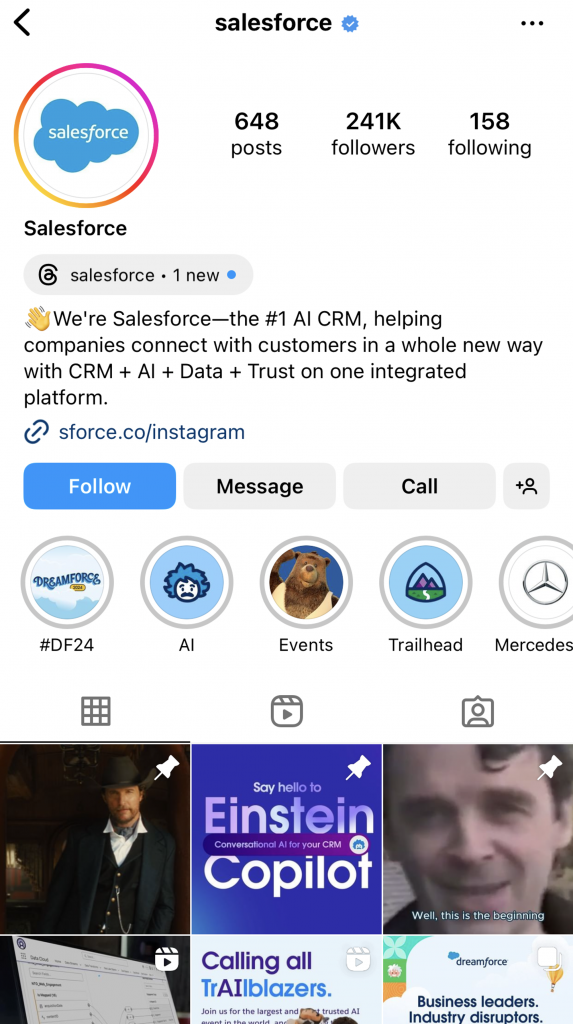
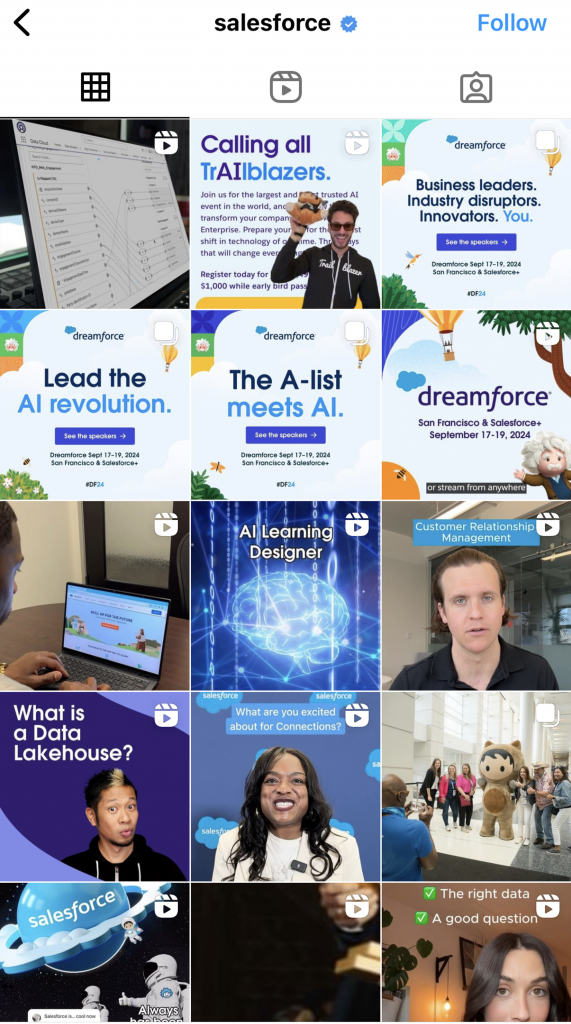
The good pattern (Salesforce above): bio that communicates what the company actually does in one line, story highlights that route to the most-requested information, recent posts that mix educational content with brand story, and a clear visual identity. A first-time visitor learns what Salesforce sells, who it is for, and what credibility signals exist within 5 seconds.
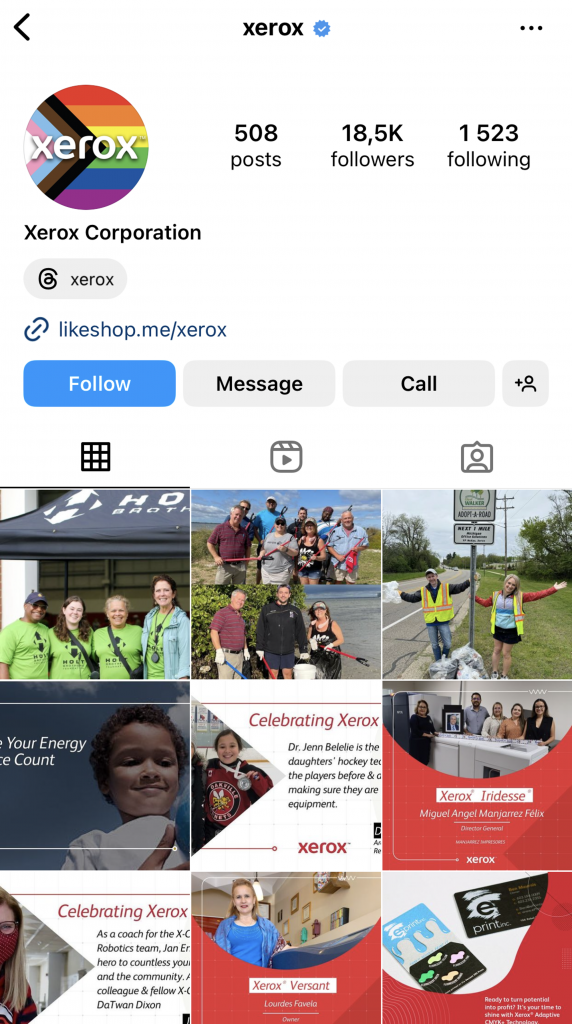
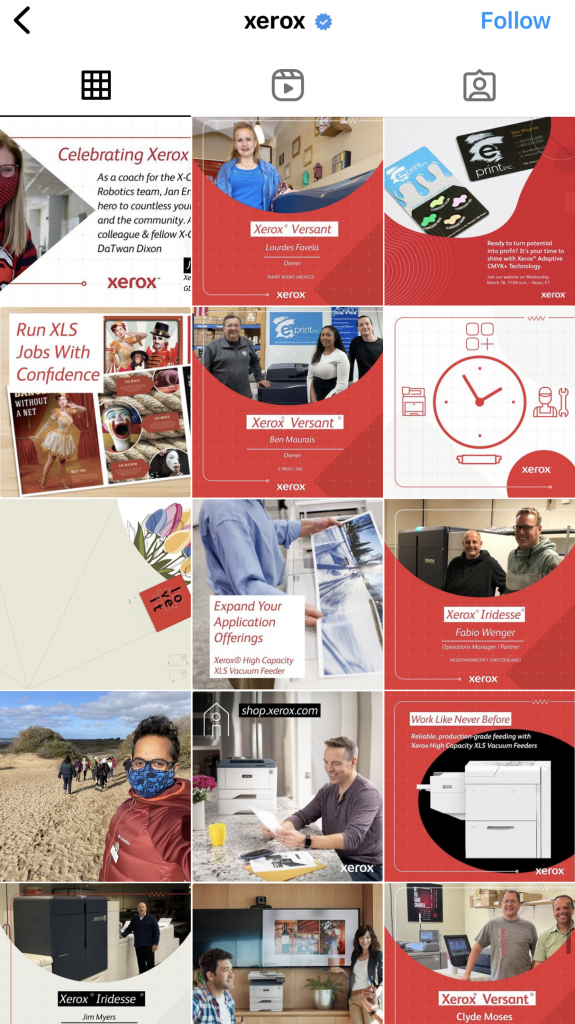
The weak pattern (Xerox above): bio that does not communicate the value proposition, no story highlights, content focused on employee photos without clear strategic intent. A first-time visitor leaves without knowing what to do next, which means the ad budget that drove them here was wasted.
2. Social media to build category authority and named-client trust
The strongest B2B social-media content is content that demonstrates expertise on a problem your buyer recognizes. The format does not matter much. Long-form LinkedIn posts, podcast clips, webinar recordings, named-client case studies. The test is whether the content shows up in the dark-social conversations where B2B decisions actually get made.
Content patterns that consistently earn engagement from named decision-makers:
- Industry insights with a specific take, not summarizing the trend, telling the reader what to do about it
- Named-client case studies with the metric that moved: “We helped Macron triple B2B revenue with 132% conversion uplift” beats “We help B2B brands grow”
- Honest takes on industry news: when a competitor launches something or a platform changes a rule, a sharp take from a named exec beats a corporate press release every time
- How-to content with real screenshots: a tutorial that uses real product UI and real data outperforms a generic explainer
- Behind-the-scenes from named employees: what your engineering lead is actually working on this week is more interesting than your marketing team’s “thought leadership”
- Interactive polls and surveys: fastest way to surface what your audience actually thinks, and the engagement on the poll itself signals to the algorithm
- Event highlights and recaps, only when there is original commentary, not just “great to be at the conference!”
3. Social media for recruiting and employer brand
Jobvite’s 2024 research found that 72% of job seekers research potential employers on social media before applying. For B2B services brands competing for senior engineering and growth talent, your LinkedIn presence and Glassdoor reviews are part of the recruiting funnel whether you treat them that way or not.
What works in 2026 for employer brand on social:
- Named-employee content where the employee speaks in their own voice, not the corporate communications template
- Honest content about the work, including the parts that are hard, not just the wins
- Project-of-the-week kind of content from named teams, not anonymized “we shipped X” announcements
- Recognition for employees that earns engagement from the employee’s network, not just the company’s
4. LinkedIn-first, then everything else
LinkedIn is where ~80% of B2B social-media-driven leads come from in 2026. Your B2B social strategy should be a LinkedIn strategy with selected supporting channels, not a five-platform spread that under-resources each one.
Honest assessment of each platform’s 2026 B2B role:
- LinkedIn, primary. Long-form posts, original video, employee advocacy, account-based ads targeting decision-makers by job title and industry. The platform that consistently delivers SQL pipeline.
- YouTube, secondary. Long-form educational content, webinar recordings, product walkthroughs. Strong for top-of-funnel awareness, weaker for direct lead generation.
- X (Twitter), tertiary. Still useful for real-time category conversation and engineering-leadership content. Less useful than it was for lead generation.
- Instagram, niche. Strong for visual product categories and employer brand. Not a primary B2B lead channel.
- TikTok, emerging. Works for B2B brands with a specific talent or audience overlap (developer tools, design tools, agencies). Not yet a default B2B channel.
🚀 Quick takeaway
Cut three of your B2B social channels and invest 80% of the freed budget into LinkedIn. The 20% that wins is invariably the channel that has critical mass. The four channels at half-effort are vanity infrastructure.
5. Employee advocacy and personal brands
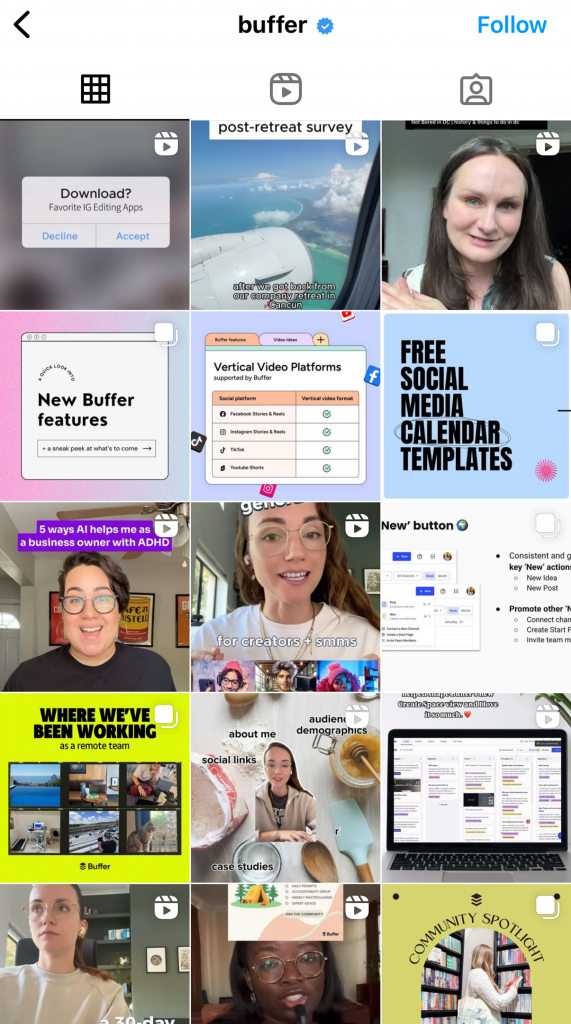
The most engaged B2B content on LinkedIn in 2026 comes from individuals, not from corporate pages. The algorithm has been clear about this for two years. Brands that activate their CEO, head of product, head of growth, and senior engineers consistently outperform brands that only post from the corporate account.
What works:
- The CEO posts personally, at least weekly, in their own voice, on topics adjacent to the company’s market
- Subject-matter experts post about their craft: engineering, growth, design, customer success leads publishing thoughts on what they actually work on
- The company comments on, reshares, and amplifies employee posts, earning algorithmic reach for the corporate account through the employee network
- Employee advocacy programs like EveryoneSocial or HootSuite Amplify make this systematic, not optional
🚀 Quick takeaway
The aggregate output from a 5-person leadership activation (CEO + 4 senior leaders posting 3+ times per week each) typically delivers 5 to 10 times the reach of the corporate page alone, at zero incremental media spend. The unit economics of employee advocacy beat paid social by a wide margin.
6. Measuring B2B social media in 2026
The vanity metrics (followers, impressions, reach) are increasingly disconnected from pipeline contribution. The metrics that matter in 2026:
- Share of Voice in your category: how much of the industry conversation mentions your brand relative to competitors, measured via social-listening tools (Sprout Social, Brandwatch, Mention)
- Engagement quality: comments and reposts from named decision-makers at target accounts, not the total engagement count
- Dark-social attribution: sales-call source field captures “saw your LinkedIn post” and “heard about you on a podcast” mentions. Track this systematically
- Pipeline influence: closed-won deals where the prospect engaged with branded social content during the buying cycle, even if social was not the first-touch channel
- Talent funnel: applicants who cite social content in their cover letter or “how did you hear about us” field
If your reporting still leads with follower count and impressions, the rebuild starts in the same place we approach a broader conversion analytics engagement: the metric that should sit at the top of the dashboard is the one closest to revenue.
🚀 Quick takeaway
Share of voice and dark-social attribution are the two metrics that move budget conversations. Bring those to the next QBR and the conversation shifts from “how many followers” to “how much of the category we own.”
What is the biggest B2B social media mistake in 2026?
The biggest mistake is treating B2B social as a top-funnel lead-generation channel and measuring it by form fills. B2B buying happens in dark social, Slack groups, WhatsApp threads, conference hallways, peer recommendations, and B2B social media’s job is to put your brand into those conversations, not to be the conversion event. If you measure social purely on conversions, you under-invest in exactly the content that makes the conversions happen elsewhere.
Should small B2B brands invest in social media in 2026?
Yes, but disciplined. The pattern that works for small B2B brands under $20M revenue: pick LinkedIn only, activate the founder/CEO and one or two senior employees personally, post original content consistently (3+ times per week from each named individual), use the corporate account only to amplify employee posts. Skip paid LinkedIn ads until you have organic traction. The audience and content learnings from organic make the paid investment 3 times more efficient when you do add it. The same compounding effect shows up on B2B eCommerce engagements, where organic LinkedIn presence cuts ad CPL meaningfully once the brand is in-category.
About this guide
Maintained by Salome Tevdorashvili, Social Media & Creative Strategist at scandiweb. We run B2B social strategies for eCommerce-adjacent brands from $5M to $500M+ revenue across LinkedIn-led pipeline, YouTube content, and integrated employee advocacy. Reviewed against the 2024-2026 HubSpot State of Social Media reports and the Ehrenberg-Bass Institute 95/5 research.
Frequently Asked Questions
What is the 95/5 Rule in B2B marketing?
The Ehrenberg-Bass Institute’s finding that only ~5% of your B2B target market is in-market at any moment. The 95% are not. The implication: B2B social strategy should focus on building mental availability with the 95% so you are the obvious choice when they enter the market, rather than competing only on bottom-funnel conversion content.
Which social media platform is best for B2B in 2026?
LinkedIn, by a wide margin. Roughly 80% of B2B social-media-driven leads come from LinkedIn. YouTube is the strongest secondary channel for educational content. X is useful but not dominant. Instagram and TikTok are niche.
How often should a B2B brand post on LinkedIn?
For the corporate page, 3 to 5 times per week. For activated employees (CEO, leadership team, subject-matter experts), 3+ times per week per individual. The aggregate output from a 5-person leadership activation typically delivers 5 to 10 times the reach of the corporate page alone.
What is the ROI of B2B social media marketing?
Hard to measure directly because B2B buying happens across many touchpoints. The measurable proxies: cost per qualified lead from LinkedIn ads (typically $200 to $800 for mid-market B2B), reach lift from employee advocacy programs (often 5 to 10 times corporate-page baseline), and dark-social influence (captured via sales-call source attribution).
Should I use AI to write B2B LinkedIn posts?
For first drafts and structural scaffolding yes. For the final post no. AI-generated posts read as AI-generated to decision-makers who spend serious time on LinkedIn, and the algorithm appears to under-amplify content that lacks the patterns of authentic human posts. Use AI to outline, then edit aggressively into the voice of the named human posting it.
What B2B social metrics actually matter in 2026?
Share of voice in your category, engagement from named decision-makers at target accounts, dark-social attribution from sales-call source data, pipeline influence on closed-won deals, and applicants citing social content in cover letters. Vanity metrics (follower count, total reach, impressions) are increasingly disconnected from pipeline.
How do I get my CEO to post on LinkedIn?
Make it 15 minutes per week, not an hour. A monthly content-planning session where the CEO records voice notes on 3 to 4 topics, a ghostwriter turns each into a draft post, the CEO approves with minor edits, the social team schedules. The barrier is process design, not founder willingness.
If your B2B social-media work currently lives across five platforms with no clear pipeline contribution, scandiweb’s growth marketing team runs LinkedIn-first B2B social strategies for $50M+ brands. Get in touch and we will walk you through the playbook in 30 minutes.