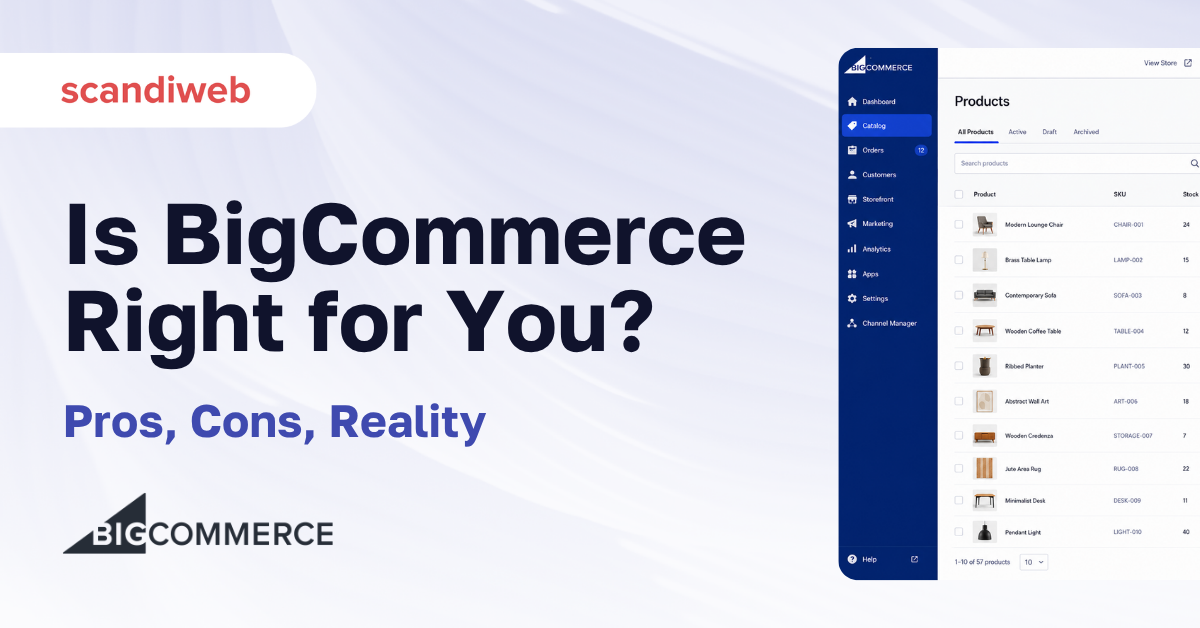
BigCommerce changed more in 2026 than in the previous three years combined. New pricing tiers landed in June 2026 (Core, Growth, Scale, Performance), a new transaction fee structure now penalises stores using outside payment gateways, and Catalyst (the Next.js + React reference storefront) gave the platform a headless option that Shopify only matches through Hydrogen.
This review is written by the scandiweb BigCommerce team as a certified partner. The goal is an honest read on where BigCommerce wins, where it frustrates, and which kinds of stores it is the right call for in 2026.
Overview
- BigCommerce is a hosted eCommerce platform best suited to mid-market and enterprise stores that want built-in B2B features and headless flexibility without the Shopify Plus price tag.
- The June 2026 pricing change is material: new plan names, new sales caps, and a new transaction fee that applies when using non-approved payment gateways.
- Catalyst is genuinely competitive as a headless storefront and gives BigCommerce a credible answer to Hydrogen.
🚀 Quick takeaway
The headline change for 2026: BigCommerce now charges a transaction fee (2% on Core, 1% on Growth, 0.6% on Scale) when you use a payment gateway that is not on the approved Embedded Payment Providers list. That single change shifts the TCO math for many stores.
Exploring BigCommerce: an overview
BigCommerce is a hosted eCommerce solution that helps businesses build, host, and maintain their online stores. It is used by well-known brands including:






Two of those (Digilent, Nature’s One) are scandiweb-supported BigCommerce stores. A 14-day free trial lets you test the platform before committing to a plan, and the BigCommerce admin’s onboarding tour walks new users through the core features in around 30 minutes.
The platform does not require coding to launch. The admin sidebar gives access to product management, order processing, marketing, and the channel manager, which together cover most operational needs out of the box.
What is new in BigCommerce for 2026?
Three changes landed in 2026 that materially affect the BigCommerce evaluation.
New pricing structure (June 2026)
Per BigCommerce’s official 2026 pricing update, plans were renamed and restructured:
- Standard → Core: $39/mo ($29/mo annually), up to $50k in trailing 12-month sales
- Plus → Growth: $105/mo ($79/mo annually), up to $180k in sales
- Pro → Scale: $399/mo ($299/mo annually), up to $400k in sales
- Enterprise → Performance: custom pricing, negotiable sales limits
New transaction fee on non-approved gateways
BigCommerce now charges a transaction fee on orders processed through payment gateways outside the approved Embedded Payment Providers list: 2% on Core, 1% on Growth, 0.6% on Scale, custom on Performance. Stores using BigPay or one of the approved gateways avoid the fee entirely.
Catalyst as a first-party headless option
Catalyst is BigCommerce’s MIT-licensed Next.js + React reference storefront, free to use. It is the closest analogue to Shopify’s Hydrogen, and for headless-curious teams on BigCommerce it removes the previous “you need a custom build” friction.
🚀 Quick takeaway
If you process a meaningful share of orders through Stripe, Adyen, or another non-embedded gateway, recalculate your BigCommerce TCO with the 2026 transaction fee included. The math changes a lot for mid-volume stores.
Advantages of choosing BigCommerce
BigCommerce stands out for ease of use, comprehensive built-in features, and strong SEO and marketing tools. The advantages worth weighing:
Ease of use
BigCommerce’s interface is intuitive, with a quality and feel comparable to Shopify and Squarespace. Beginners can launch a store without coding, and the admin’s drag-and-drop page builder makes design changes accessible.
Built-in features that reduce app dependency
BigCommerce includes product management, order processing, marketing tools, and abandoned cart recovery out of the box. Compared to Shopify, where the same feature set typically requires four or five paid apps, the built-in approach saves on the monthly app bill and reduces the third-party script weight on page loads.
SEO and marketing tools
BigCommerce ships with strong technical SEO defaults: SSL certificate and HTTPS, ISO/IEC 27001:2013 and Level 1 PCI DSS 3.1 certifications, high-availability infrastructure with 99.99% uptime, and a channel manager for tracking performance across sales channels.
B2B and multi-storefront capabilities
Per BigCommerce’s own customer reviews, the platform’s B2B features (customer groups, tiered pricing, quote management) and multi-storefront capability are consistently rated above Shopify equivalents for mid-market merchants.
BigCommerce 2026 pricing plans explained
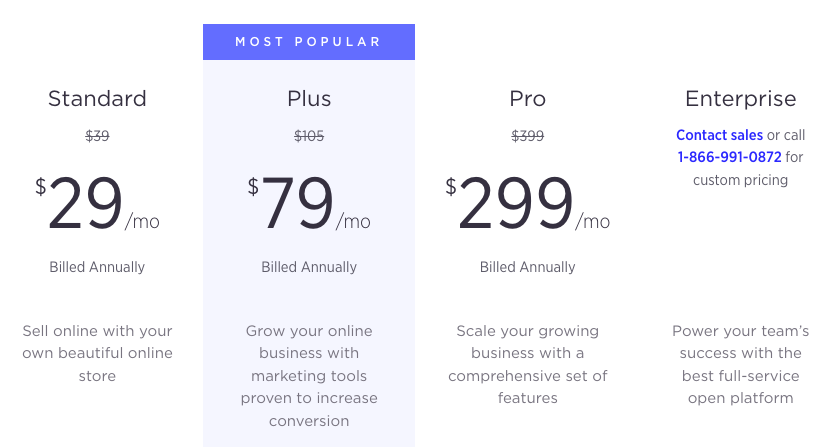
BigCommerce offers four pricing plans, each with different feature sets and sales caps. The 2026 names and ranges:
Core plan ($39/mo)
Entry-level option for small businesses. Sales cap of $50,000 per trailing 12 months. Includes unlimited products, unlimited storage, 24/7 customer support. Does not include abandoned cart recovery. 2% transaction fee on non-embedded gateways.
Growth plan ($105/mo)
Step-up for growing businesses. Sales cap of $180,000 per year. Adds abandoned cart recovery, customer segmentation, gift cards, and real-time shipping rates. 1% transaction fee on non-embedded gateways.
Scale plan ($399/mo)
For larger businesses. Sales cap of $400,000 per year. Adds custom SSL, Google Customer Reviews, advanced reporting, customer groups, and advanced SEO tools. 0.6% transaction fee on non-embedded gateways.
Performance plan (custom pricing)
For high-volume merchants. Negotiable sales caps, custom transaction fees, priority support, API access, multi-storefront support, and tailored integrations.
Customizing your BigCommerce store
BigCommerce offers around 180 paid themes and 12 free themes, each with several variations. Free themes are basic; premium themes carry more features, sharper design, and ongoing updates. The drag-and-drop page builder lets non-developers customize layouts without code.
For deeper customization or headless storefronts, Catalyst opens a development path that mirrors what Shopify offers through Hydrogen. The scandiweb BigCommerce team has shipped both traditional Stencil-themed builds and headless Catalyst builds, and the right choice depends on the operational complexity of the store rather than on the platform’s capability.
Integrations and add-ons
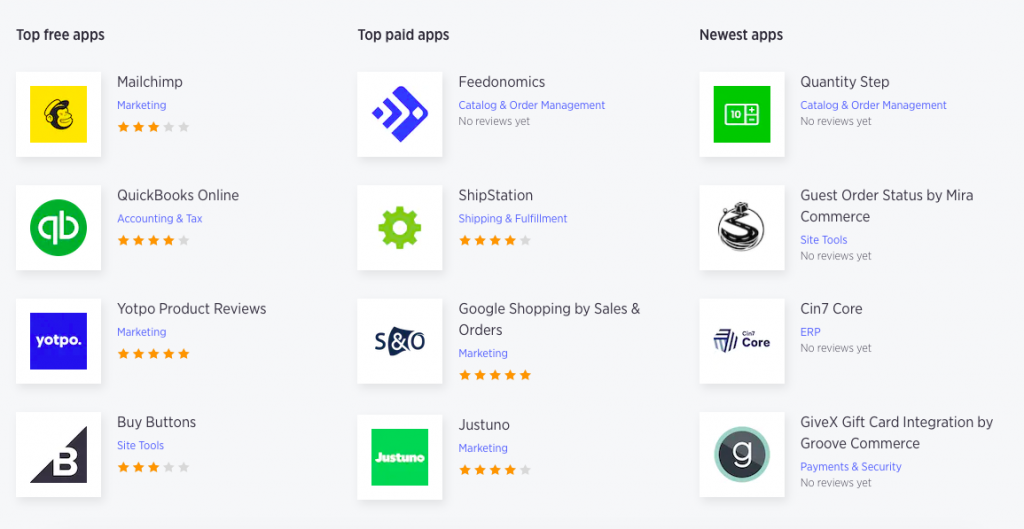
BigCommerce’s app marketplace lists around 1,290 integrations in 2026, fewer than Shopify’s roughly 8,000 but covering all the common use cases: email marketing (Mailchimp, Klaviyo), customer support (Zendesk), accounting (Xero), CRM (Salesforce). For mid-market stores, the more curated marketplace is usually a feature, not a limitation: fewer competing apps for the same problem, lower decision fatigue.
Payment processing and gateways
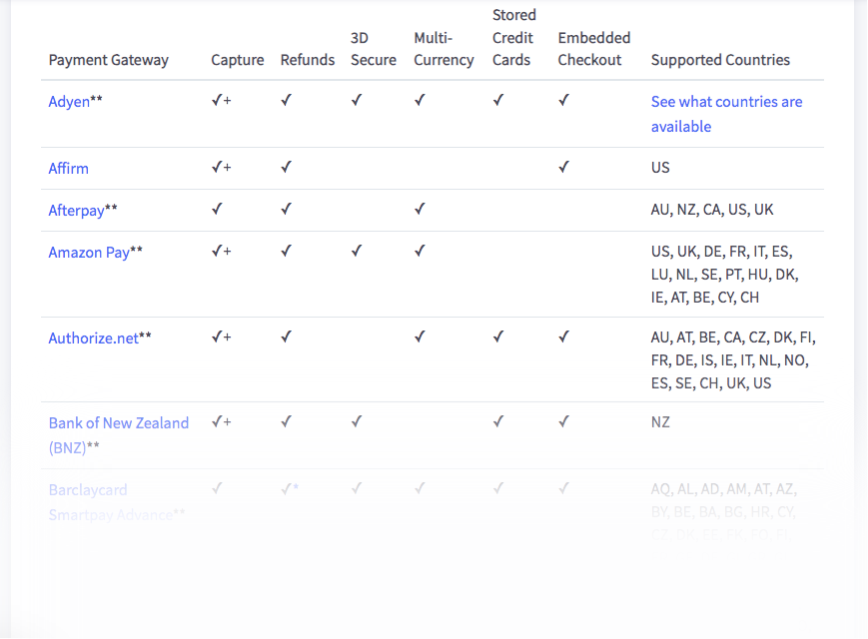
BigCommerce supports a wide range of payment gateways including PayPal, Stripe, Authorize.net, Square, and Braintree. The 2026 transaction fee structure changes the calculus: stores using BigPay or another approved Embedded Payment Provider avoid the fee, stores using outside gateways pay 0.6 to 2% per transaction depending on plan.
For most stores, integrating a payment gateway involves setting up a merchant account with the gateway provider and configuring it within BigCommerce. The integration is straightforward but adds 1 to 3 days of setup time per gateway. See our eCommerce payment methods guide for the wider gateway selection context.
🚀 Quick takeaway
The 2026 transaction fee on non-embedded gateways is the single biggest TCO change. Run the numbers on your current gateway choice before signing a multi-year BigCommerce contract.
Shipping and fulfillment
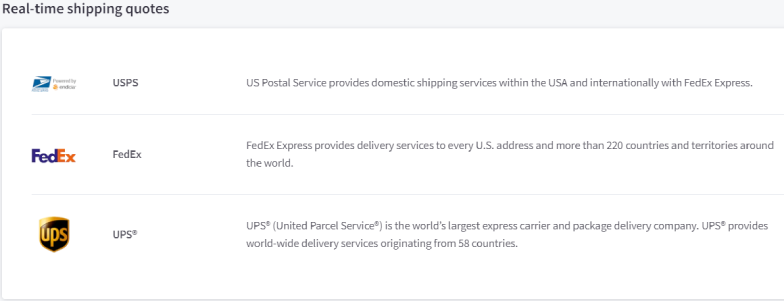
BigCommerce offers real-time shipping rates, integrations with major carriers, and partner apps for fulfillment: Shipstation, Shipper HQ, Brightpearl. The platform supports dropshipping and offers pickup, curbside, and delivery options for local sellers. For B2B stores, freight quoting and palletized shipping are built-in on the Scale and Performance plans.
Analytics and reporting
BigCommerce ships with reports covering customer behaviour, product performance, abandoned carts, and sales trends. The standard reporting suite is adequate for most stores; the optional eCommerce Insights add-on (extra fee) provides deeper customer-segment analysis and is typically only worth it for stores doing seven figures plus.
BigCommerce vs Shopify: which is better in 2026?
BigCommerce and Shopify are the two most common comparison points. The honest answer in 2026: pick BigCommerce if you need built-in B2B and headless flexibility without paying Shopify Plus rates; pick Shopify if you prioritise the larger app ecosystem and a simpler admin for non-technical teams. See our BigCommerce vs Shopify comparison for the full breakdown across pricing, features, and TCO.
WooCommerce is a viable option if you are already deep in the WordPress ecosystem, though it carries the same operational cost as managing a self-hosted store. Magento (Adobe Commerce) is the right call for enterprise B2B with deep ERP integration; for everyone else, BigCommerce or Shopify is the simpler answer.
scandiweb’s take as a BigCommerce partner
Across BigCommerce client work, the scandiweb BigCommerce team consistently sees the same pattern: stores doing $500k to $5M annually are the sweet spot for the Growth and Scale plans. Above that, the Performance plan’s negotiable terms become the more cost-effective option.
The platform’s strongest fit is mid-market B2C and B2B brands that need built-in features (multi-currency, customer groups, quote management) without paying for a Shopify Plus seat. The weakest fit: very small stores doing under $50k annually (a free Shopify or WooCommerce build is usually more cost-effective at that scale) and high-end enterprise that needs deep ERP integration on Magento.
scandiweb became a certified BigCommerce partner in 2020 and has shipped both traditional Stencil and Catalyst headless builds since.
When is BigCommerce the right call?
BigCommerce is the right platform when at least two of the following are true: you are doing $500k+ annually, you need built-in B2B features without a Shopify Plus contract, you want headless flexibility through Catalyst, or you process orders through an embedded payment gateway (avoiding the 2026 transaction fee).
It is the wrong call when: you are below $50k annual revenue (overkill), you are deeply integrated with an ERP that BigCommerce does not have a native connector for (Magento often wins here), or your team’s strength is heavy app-based customisation (Shopify’s app ecosystem is wider).
🚀 Quick takeaway
BigCommerce is a mid-market platform with enterprise-adjacent features. If you are mid-market, it is often the cheapest path to functionality that Shopify Plus charges enterprise rates for.
Frequently Asked Questions
Is BigCommerce worth it in 2026?
For mid-market stores ($500k to $5M annual revenue) needing built-in B2B features or headless flexibility, BigCommerce is consistently a strong value. For very small stores or enterprise with deep ERP integration needs, other platforms usually win.
How much does BigCommerce cost in 2026?
Core plan starts at $39/mo ($29/mo annually) up to $50k in sales. Growth is $105/mo, Scale is $399/mo, Performance is custom. New 2026 transaction fees apply when using non-approved payment gateways: 2% on Core, 1% on Growth, 0.6% on Scale.
What is the disadvantage of BigCommerce?
Three common ones: revenue-based plan limits force upgrades as sales grow, theme customization beyond the drag-and-drop builder typically needs developer help, and the app marketplace is smaller than Shopify’s.
Is BigCommerce better than Shopify?
Neither is universally better. BigCommerce wins on built-in B2B, multi-storefront, and headless via Catalyst at a lower price point than Shopify Plus. Shopify wins on app ecosystem size, admin simplicity for non-technical teams, and theme customization options.
What is Catalyst in BigCommerce?
Catalyst is BigCommerce’s MIT-licensed Next.js + React reference storefront, free to use. It is the platform’s official headless option and is BigCommerce’s closest answer to Shopify’s Hydrogen.
Does BigCommerce charge transaction fees?
As of June 2026, yes, but only when using payment gateways outside the approved Embedded Payment Providers list. Rates are 2% on Core, 1% on Growth, 0.6% on Scale, and custom on Performance. Stores using BigPay or an approved embedded gateway pay no transaction fee.
About this guide
Maintained by the scandiweb BigCommerce team. Reviewed by the scandiweb eCommerce strategy team. scandiweb is a certified BigCommerce partner with live client work on Digilent, Nature’s One, and other BigCommerce stores.
Thinking about BigCommerce for your store or evaluating it against Shopify and Magento? Get in touch with the scandiweb BigCommerce team for a partner-level read on platform fit, 2026 TCO modeling, and a Catalyst feasibility check.