
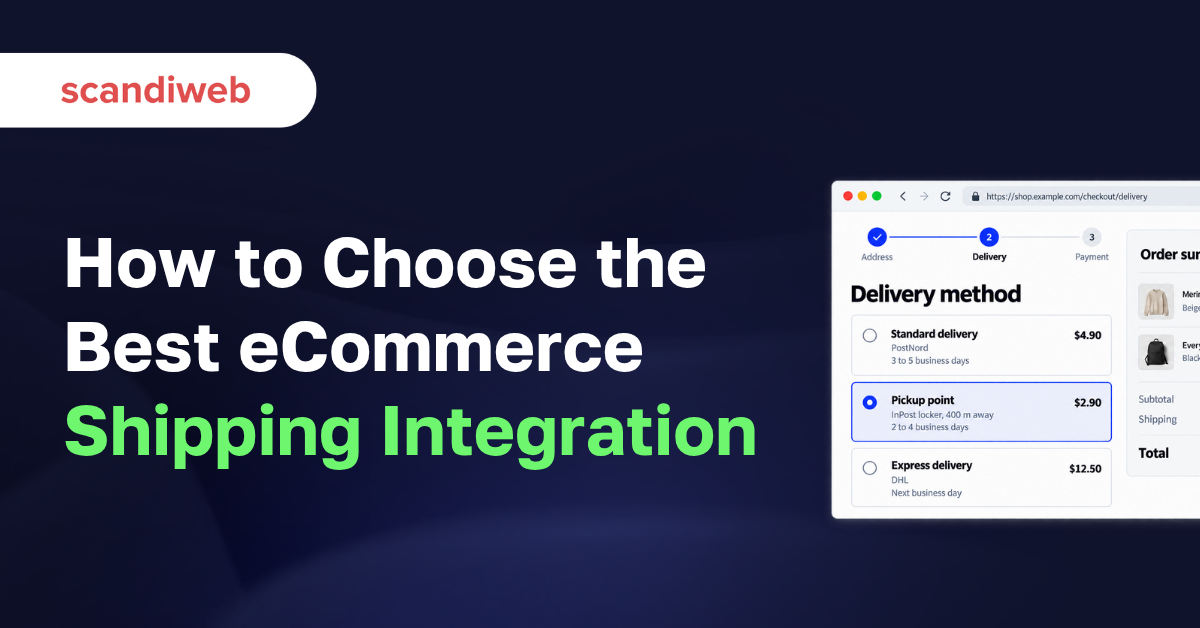
If your checkout quotes one shipping price and the carrier invoices another, or nobody can answer “where is my order” without opening three systems, the problem is usually not the carrier you picked.
eCommerce shipping integration connects your store to the systems that price, label, dispatch, and track physical orders, so the rate a customer sees matches what you pay and the status they see matches what the warehouse did. The work splits across four jobs, and most projects underestimate how many separate systems those four jobs touch.
What is eCommerce shipping integration?
eCommerce shipping integration is the connection between a storefront and the software that handles delivery, covering rate calculation at checkout, label generation, dispatch instructions to whoever picks the order, and tracking updates back to the customer. It runs through a carrier’s own API, a multi-carrier aggregator, a warehouse or order management system, or some combination of all three, and the right shape depends on how many carriers and warehouses you use rather than how large you are.
Most stores already have part of this. A flat rate table is an integration. So is somebody pasting tracking numbers into a spreadsheet every afternoon. The question is which parts are worth automating before the cost of automating them passes the cost of living with them.
Our wider guide to Magento integrations covers the other systems a store connects to. Every carrier, warehouse, and tracking tool named in this guide has a page of its own in our integration directory, documented separately for each platform.
🚀 Quick takeaway
Shipping is rarely one integration. It is four jobs that can involve one system or six, and the count is what sets your scope.
The four jobs a shipping integration has to do
Four jobs account for nearly all the work, and a project’s size is set by how many of them you need and how many systems each one touches.
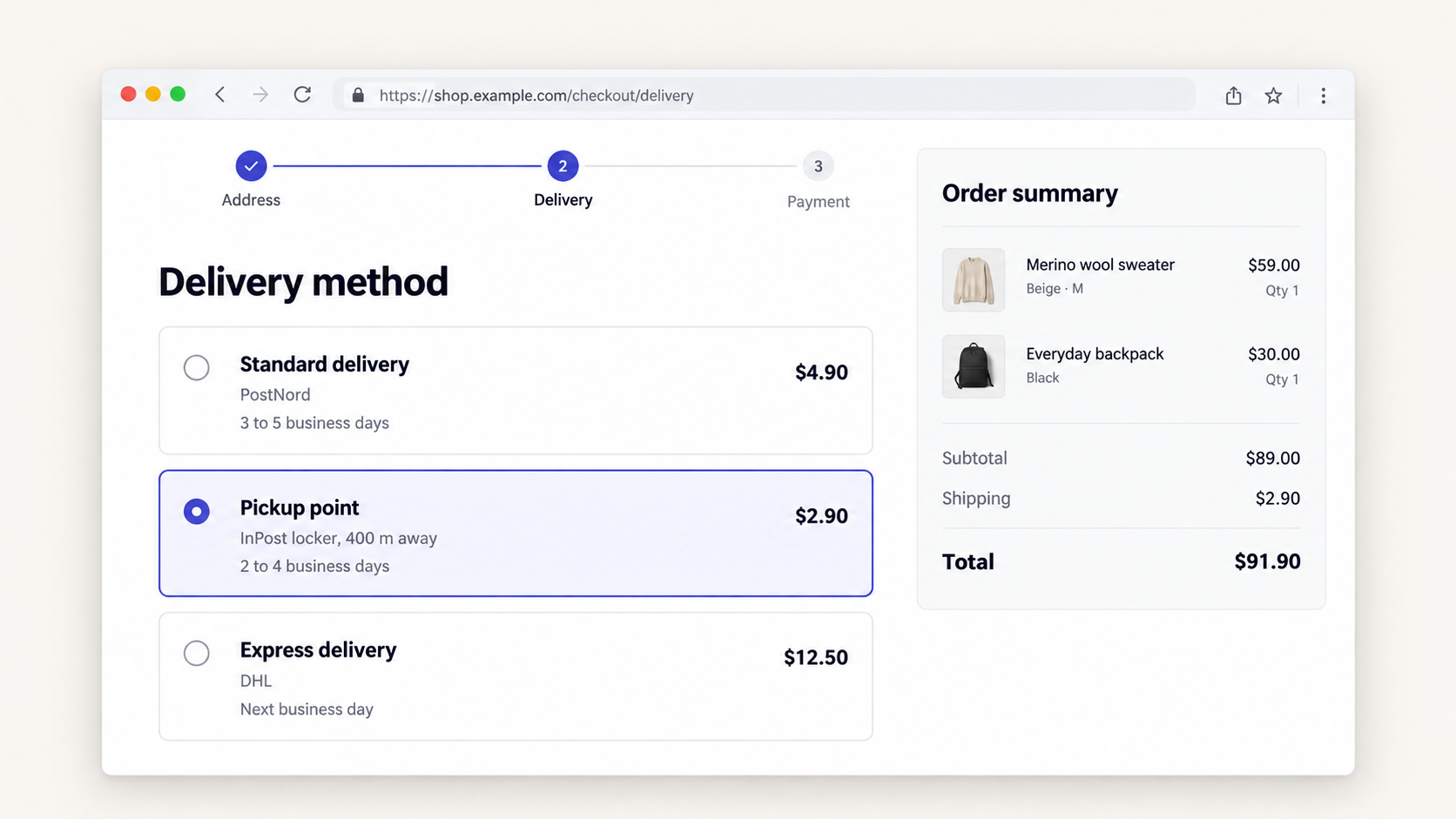
Rating. The store asks what delivery will cost and when it will arrive, then shows that at checkout. This is the only one of the four the customer sees before they buy, and the only one where being wrong costs margin on every order.
Labeling. Once an order is paid, something has to produce a compliant carrier label, with the right service level, customs data where relevant, and a barcode the carrier will accept.
Orchestration. Somebody has to decide which warehouse or which carrier handles each order. On a single warehouse with one carrier this is trivial. Across several locations it becomes an allocation rule, and allocation rules are where undocumented business logic accumulates.
Tracking. The carrier’s status updates need to reach the customer and your support team. This is the job most often left until last and the one that generates the most support tickets when it is missing.
🚀 Quick takeaway
Rating is the job that costs you money when it is wrong. Tracking is the job that costs you support hours. Teams usually budget for labeling and forget both.
Carrier direct, aggregator, or 3PL
Three shapes cover almost every setup, and the right one follows from how many carriers and warehouses you run rather than from order volume.
Connect carriers directly when you use one or two and your volume justifies a negotiated contract. You get the carrier’s full service catalog, your own negotiated rates, and no intermediary. You also take on every carrier’s API separately, and each one has its own authentication, its own address format, and its own rate structure. Two carriers is manageable. Six is a maintenance problem.
Use a multi-carrier aggregator when you run several carriers, several markets, or both. Sendcloud, MetaPack, ShipperHQ, EasyPost, and Shippo each normalize many carriers behind one API, so adding a carrier becomes configuration rather than development. You pay a per-label or subscription fee and you inherit whatever the aggregator supports, which occasionally excludes a regional service you need.
Use a 3PL or warehouse system when somebody else holds your stock, or when you hold it across several sites. ShipBob, ShipHero, and Logiwa own the pick, pack, and dispatch layer. Your store sends orders and receives stock levels and tracking back. The integration surface is smaller than connecting carriers yourself, and the trade is control over service levels.
The three also cost money in different shapes, which matters more than the headline price. A direct carrier connection costs development time once and very little afterwards, until a carrier changes its API and the work returns. An aggregator costs a recurring fee that scales with parcel volume, so it gets more expensive exactly as you grow, but it absorbs carrier API changes on your behalf. A 3PL bundles the software into a per-order fulfillment fee, which hides the integration cost entirely until you want to leave. Comparing them on subscription price alone will point you at the wrong one.
Most stores end up mixing these. A common shape is an aggregator for domestic parcels, a direct contract with one carrier for a high-volume lane, and a 3PL for a second market. That mixture is usually correct, and it is rarely what any single vendor recommends.
🚀 Quick takeaway
Counting your carriers and your warehouses answers the architecture question faster than any feature comparison will.
Which shipping systems connect to which platform
There is no single best shipping stack. The practical question is which layer you are missing and how mature its integration path to your platform already is.
| Layer | What it does | Typical fit | Integration notes |
|---|---|---|---|
| Carrier | Rates, labels, and pickup for one network | Stores with one or two carriers and negotiated rates | Each carrier is its own API. The Magento Royal Mail integration and the Salesforce DPD integration show what a single-carrier connection covers |
| Aggregator | One API across many carriers | Several carriers, several markets, or frequent carrier changes | Adding a carrier becomes configuration. See the Shopify MetaPack integration and the Magento Sendcloud integration |
| Rate engine | Complex rules on top of carrier rates | Dimensional pricing, per-product rules, free-shipping thresholds | Often the missing piece when checkout rates are wrong. The Magento ShipperHQ integration covers the rules layer |
| 3PL | Outsourced pick, pack, and dispatch | Stock held by a partner, or a second market | Smaller integration surface, less control. See the Shopify ShipBob integration, the BigCommerce ShipBob integration, and the Shopify ShipHero integration |
| WMS | Your own warehouse operations | Stock you hold and pick yourself, across one or more sites | Allocation logic usually belongs here. The Shopify Logiwa integration covers the warehouse side |
| OMS | Order orchestration across channels and locations | Multichannel selling, or several fulfillment locations | The system that decides who ships what. See the Magento Linnworks integration and the Magento Brightpearl integration |
| Post-purchase | Branded tracking, delivery notifications, returns | Any store where support answers delivery questions | Usually added last, usually reduces tickets immediately. The Magento parcelLab integration covers this layer |
The pattern worth noticing is that the storefront work does not vary as much as the vendor names suggest. The four jobs are the same everywhere. What changes is how many systems share them and which system owns the allocation rule.
🚀 Quick takeaway
If two systems both think they own allocation, you will oversell. Decide which one is the source of truth before anyone writes code.
Where shipping integrations fail in production
Four failure modes account for most of the pain, and none of them appear on a vendor’s feature list. Each is invisible in a test environment and obvious in production, usually within the first week of real volume.
Rate accuracy at checkout
The rate shown at checkout and the rate the carrier invoices come from different calculations. Dimensional weight, fuel surcharges, residential delivery fees, and remote area surcharges are often missing from the checkout quote. The gap does not produce an error. It produces a slightly smaller margin on every order, which finance notices at the end of the quarter rather than the day it starts.
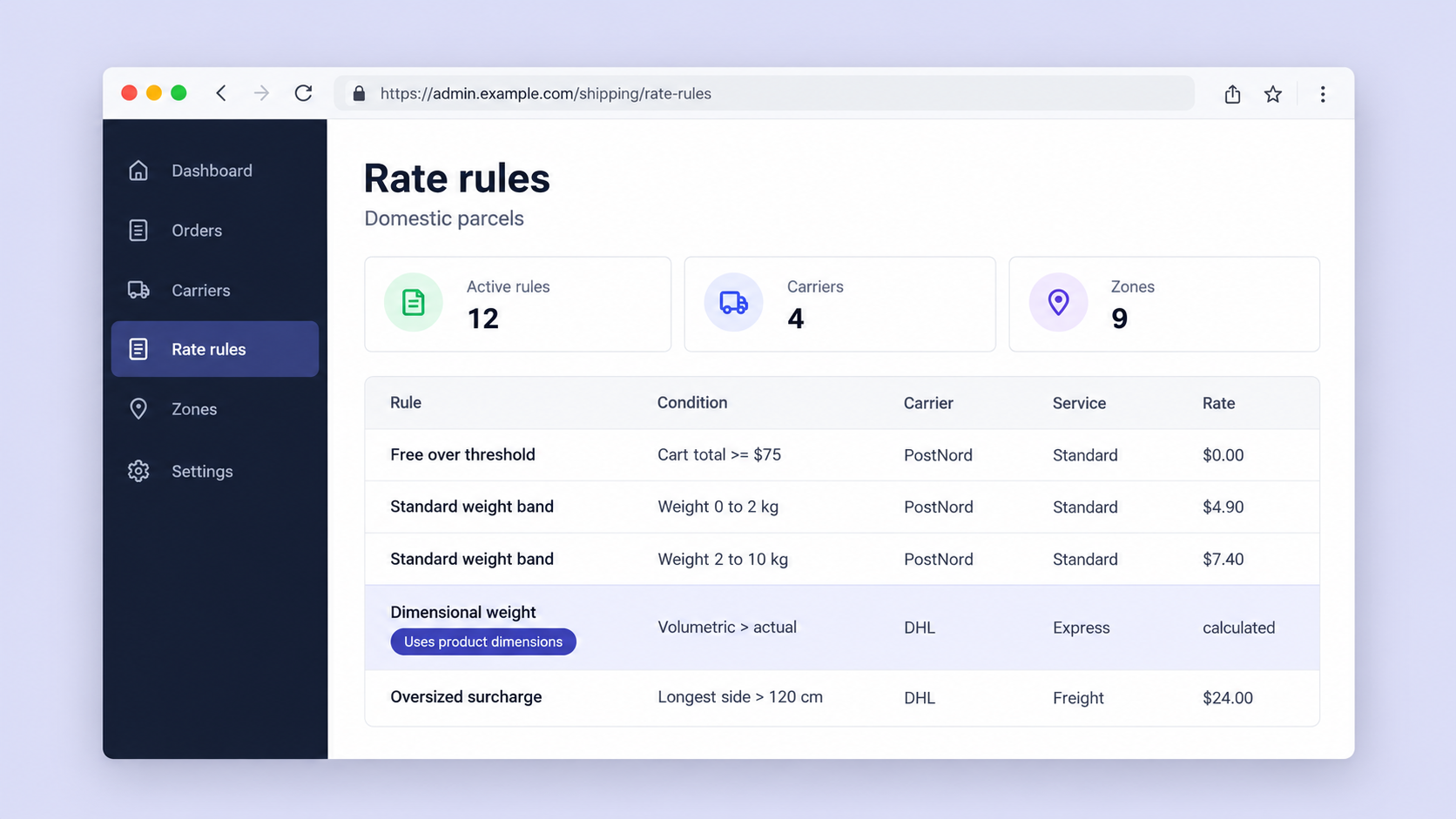
Dimensional weight is the usual culprit. Carriers bill on whichever is greater, actual weight or the volume the parcel occupies, so a light bulky item costs far more to send than its weight suggests. A storefront that quotes on weight alone will underprice every oversized order. Fixing it means the store knows product dimensions and packaging rules, which is a product data problem before it is a shipping one. The Magento DHL integration and the Magento UPS integration both expose dimensional rating, but only if the catalog supplies the dimensions.
Address validation and international formats
Address fields that work for one country break for another. Postal code formats differ, some countries put the house number before the street and others after, and several carriers reject an address that a storefront accepted. Validating at checkout costs a little friction. Not validating costs failed deliveries, which cost far more.
Split shipments and partial fulfillment
An order containing items from two warehouses is two shipments with two tracking numbers against one order number. Many storefronts assume one order equals one shipment, and the assumption holds until the day it does not. Then the customer receives half an order with a tracking link that says delivered, and support has no way to explain it.
The post-purchase tracking gap
The carrier knows where the parcel is. The customer does not, unless something pushes that status to them. Without a tracking integration, every delivery question becomes a support ticket, and the volume scales directly with order count. This is the cheapest of the four to fix and the one most often left out of the first scope.
Returns as an afterthought
Returns are the same four jobs in reverse, and they are almost always scoped last. A return needs a label the customer can print or scan, a way to tell the warehouse what is coming back, a rule for when stock becomes sellable again, and a refund trigger tied to the moment of receipt rather than the moment of dispatch. Stores that automate outbound shipping and leave returns manual find that returns become the bottleneck within a season, because return rates in categories like fashion routinely run far above the order failure rates everyone plans for.
🚀 Quick takeaway
None of these four produce error messages. They produce plausible-looking wrong numbers and unhappy customers, which is why they reach finance or support before they reach engineering.
Cross-border and multi-carrier change the calculation
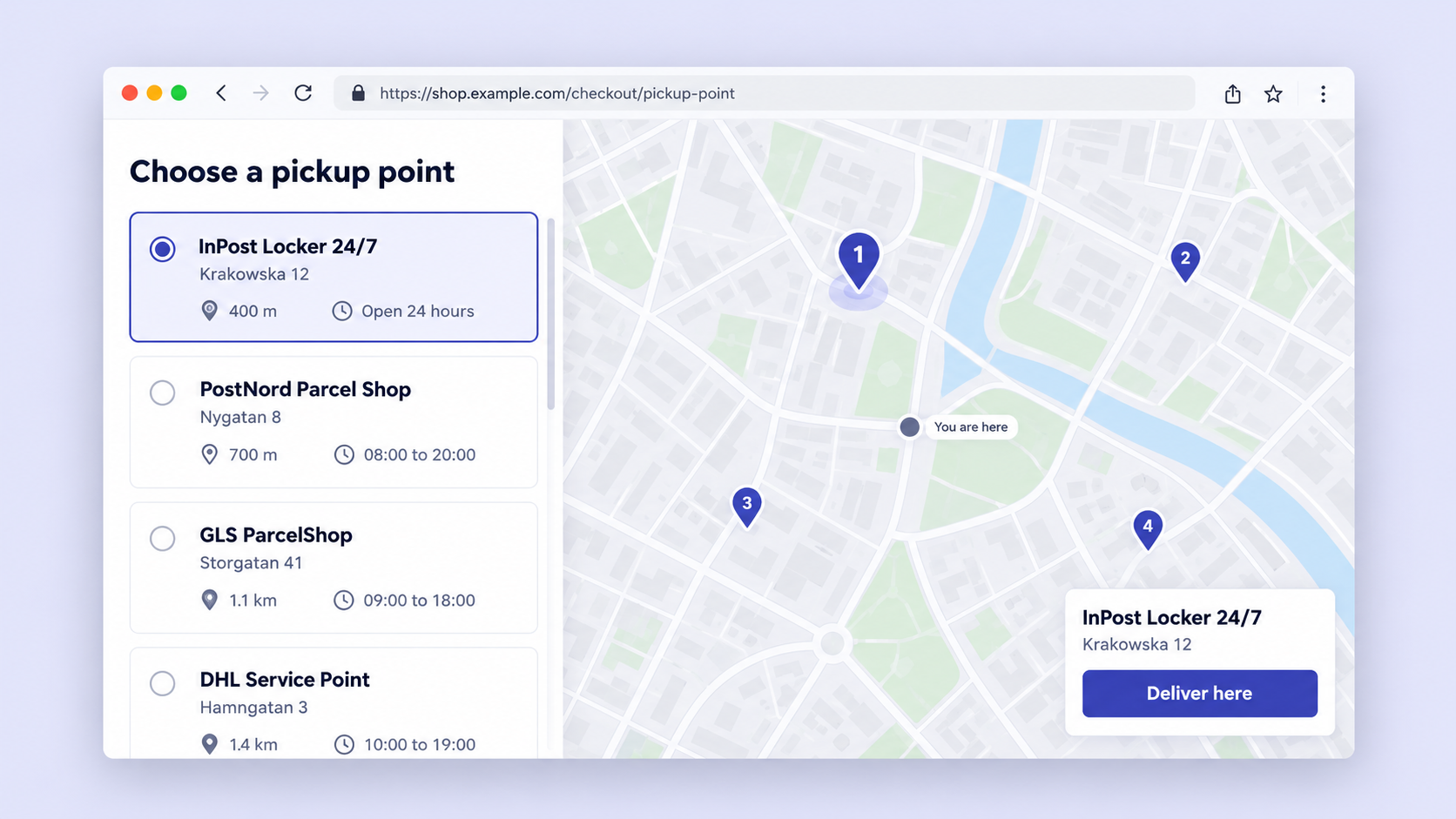
Selling into a second country multiplies the work in ways that are easy to underestimate. Customs documentation, duties and tax handling, restricted goods, and per-country carrier preferences all become part of the integration rather than a setting inside it. Buyers in many European markets also expect a parcel locker or pickup point option rather than home delivery, and offering it means connecting to that network directly.
Duties are the part that changes the customer experience most. Shipping delivered duty unpaid means the carrier collects from the customer at the door, which produces refused parcels and chargebacks. Shipping delivered duty paid means calculating the landed cost at checkout, which needs commodity codes on every product and a tax engine that understands the destination. Neither option is free, and the decision belongs to finance rather than to whoever configures the carrier.
This is also where regional networks matter. The Magento PostNord integration and the Magento InPost integration cover the Nordic and Polish networks that a US-centric stack will not include by default, and the Magento GLS integration covers one of the larger pan-European parcel networks.
scandiweb built this kind of multi-system setup for PUMA Argentina, where a Magento 2 storefront integrates EnvioPack for end-to-end fulfillment logistics alongside a third-party order management system, plus Facturante for legally compliant invoicing and ID validation for business customers. Cross-border retail rarely allows a clean separation between shipping, tax, and compliance.
Delivery choice is its own project. Technodom, a retailer with 9,000 employees, 80,000 square meters of retail space, and $800 million in annual revenue, runs four delivery methods in parallel: in-store pickup, home delivery, post office delivery, and delivery box. Each one is a separate flow through the same order pipeline, and each one needs its own status handling.
🚀 Quick takeaway
A second market is not a setting. Customs data, duties, local carrier preferences, and pickup networks each add work to the same four jobs.
How to scope a shipping integration
Scoping runs in five stages, and the order matters more than the time spent on any one of them.
- Map what moves today. Every rate rule, every carrier account, every manual step somebody performs. The manual steps are the ones that never appear in documentation
- Decide who owns allocation. One system chooses the warehouse and the carrier for each order. Name it before anything else is built
- List the delivery methods you actually offer. Home, pickup point, locker, in-store, and each market’s variation. Each is a separate flow
- Test against real order shapes. Multi-warehouse orders, oversized items, international addresses, and returns. A single-item domestic order proves almost nothing
- Run parallel through one peak. Shipping load is seasonal in a way most integrations are not. A system that holds in March can fail in November
What to gather before the audit starts
Four things shorten the first stage considerably, and none of them need a developer.
- A list of every carrier account and contract rate you hold
- Your current rate rules, including free-shipping thresholds and any per-product overrides
- A sample of orders that went wrong last quarter, with what happened to each
- The list of delivery methods you offer per market
🚀 Quick takeaway
Teams that arrive with those four documented get a tighter scope and fewer surprises, because most of what an audit finds is one of them written down for the first time.
Frequently asked questions about eCommerce shipping integration
What is ecommerce shipping?
eCommerce shipping is everything that happens between a customer paying and a parcel arriving. It covers calculating a delivery price, choosing a carrier and service level, producing a compliant label, picking and packing the order, dispatching it, and keeping the customer informed until it is delivered. Returns are usually counted as part of it too.
What is an ecommerce integration?
An eCommerce integration is a connection between an online store and another system, built so data moves between them without anyone retyping it. For shipping, that means rates and delivery options moving into the store and orders moving out to whoever fulfills them, with tracking coming back. The connection runs on a vendor connector, a middleware platform, or a custom build against the other system’s API.
What is a shipping API for e-commerce?
A shipping API is the interface a carrier or shipping platform exposes so your store can request rates, create labels, and retrieve tracking programmatically. Carrier APIs differ from each other in authentication, address format, and rate structure, which is why stores running several carriers often use an aggregator that presents one API across all of them.
What is the best shipping software for e-commerce?
There is no single best one. The right choice follows from how many carriers and warehouses you run. A single-carrier domestic store is well served by a direct carrier connection. Several carriers or markets usually justify an aggregator. Stock held by a partner points to a 3PL platform, and stock you hold across several sites points to a warehouse or order management system.
How long does a shipping integration take?
Timelines follow complexity rather than platform. A single carrier with flat rates on one warehouse is a short project. Multi-warehouse allocation with several carriers, international customs data, and pickup point networks is a substantially longer one. The audit stage is what tells you which of those you are, which is why it comes first.
Do we need an OMS for shipping?
Only when something has to choose between fulfillment locations or channels. One warehouse and one sales channel rarely justifies one. Several warehouses, or selling through marketplaces alongside your own store, usually does, because that decision has to live somewhere and encoding it inside a carrier integration makes it very hard to change later.
Getting eCommerce shipping integration right
A shipping integration is a storefront project as much as a logistics one, and the parts that overrun are usually on the storefront side. The four jobs tell you the shape. The four failure modes give you a test plan. Naming the system that owns allocation prevents the most expensive mistake.
If you run one or two carriers from a single location, connect them directly and add tracking early. If you run several carriers, several markets, or several warehouses, an aggregator or an order management layer will cost less over time than maintaining each carrier connection yourself.
Stock accuracy is the point where shipping and finance meet, and it is worth reading alongside eCommerce ERP integration if an ERP holds your inventory.
Planning a shipping or fulfillment integration and want a scope you can defend? Talk to our integration team.