
You watch the orders come in, and something feels off. A run of small charges from the same card range overnight, three high-value orders shipping to one freight forwarder, then the chargeback notices start landing a few weeks later, each one quietly clawing back revenue you already counted. If you run a Magento (Adobe Commerce) store, that slow drip of fraudulent orders and disputes is one of the most expensive problems you can leave unaddressed, and it almost never fixes itself.
The good news is that Magento fraud prevention is a solvable engineering and operations problem. This guide walks through the fraud types that hit Adobe Commerce stores, the prevention layers that stop them, and how to configure each one without strangling your conversion rate. It is a proactive prevention guide. If you are mid-incident right now, with a flood of authorization attempts hammering checkout, skip ahead to our note on live response and come back here after.
🚀 Quick takeaway
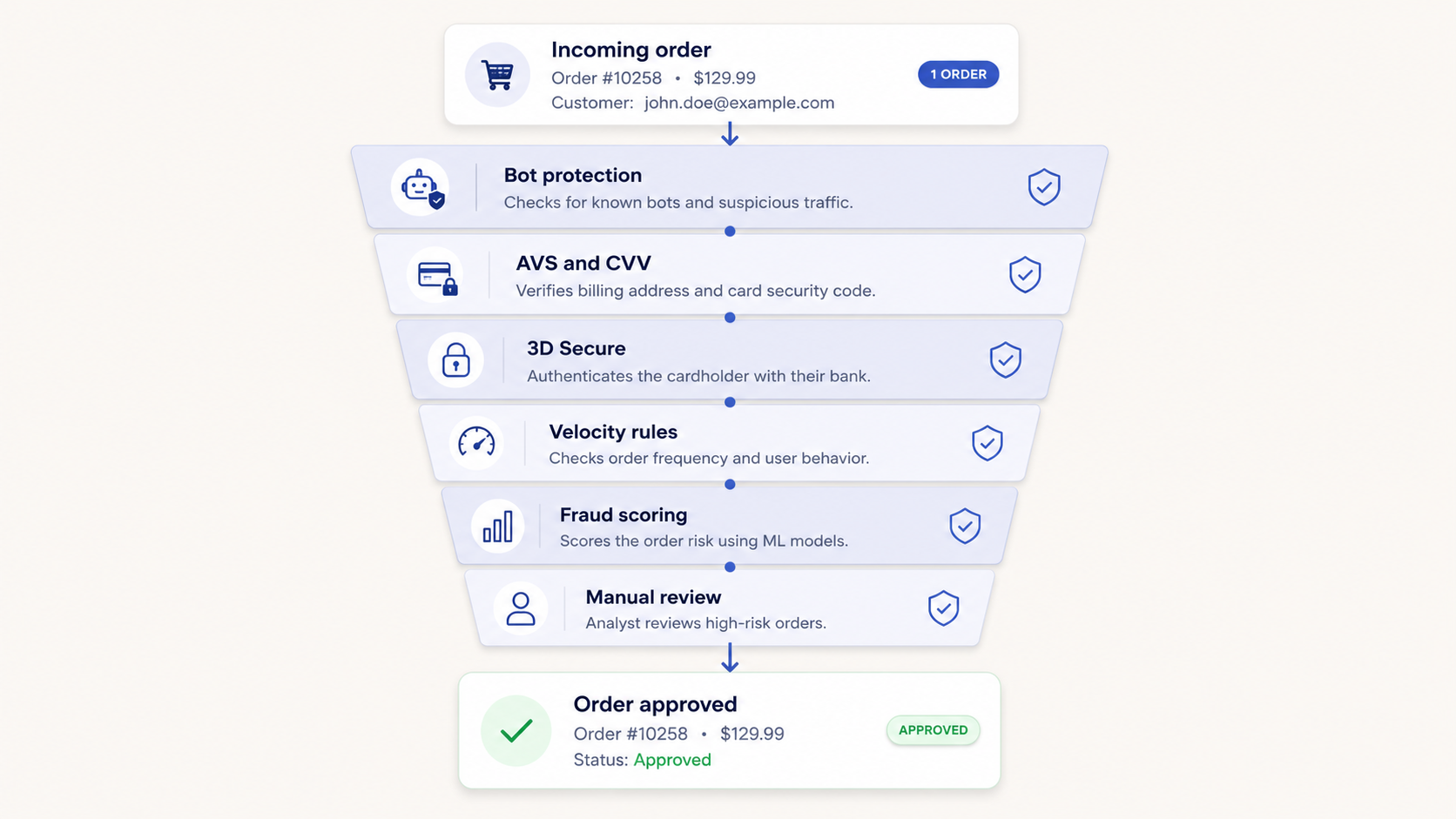
No single setting stops eCommerce fraud on Magento. Protection comes from layers: bot defense at the edge, AVS and CVV and 3D Secure at payment, velocity rules and fraud scoring at order placement, and a tight manual-review queue for the gray zone.
What Magento fraud prevention means
Magento fraud prevention is the combined set of platform settings, payment controls, third-party tools, and review processes that detect and block fraudulent orders before they cost you money. On Magento Open Source, you assemble most of it yourself. On Adobe Commerce, you get more built in, including native integration with Signifyd for automated order screening, but the strategy is the same on both editions. If you are weighing the two, our breakdown of Adobe Commerce vs Magento Open Source covers where the built-in protections differ.
The word that matters is layers. Fraudsters probe for the one gap you left open, so a single control, however good, is a single point of failure. Effective prevention stacks independent checks so that an order has to pass several of them to go through, and so that a suspicious order gets caught by at least one even when it slips past the rest.
Why fraud on Magento is worth taking seriously
According to Juniper Research, global eCommerce fraud losses are on track to climb from roughly $44.3 billion in 2024 to about $107 billion by 2029, driven largely by automated and AI-assisted attacks. The damage compounds, too. The LexisNexis True Cost of Fraud study puts the cost at around $4.61 for every dollar of fraud lost by US merchants, once you add chargeback fees, restocking, labor, and the freight cost of the never-recovered product.
Chargebacks are their own tax. When fraudulent orders convert into disputes, your dispute ratio rises, and card networks penalize merchants who cross their thresholds with higher fees and, in severe cases, monitoring programs that put your ability to accept cards at risk. Fraud prevention is therefore about protecting the payment relationship that the whole store depends on.
There is also a quieter cost most teams underestimate: false declines. Aggressive rules that reject legitimate customers to feel safe can cost more revenue than the fraud they prevent.
The fraud types that hit Magento stores
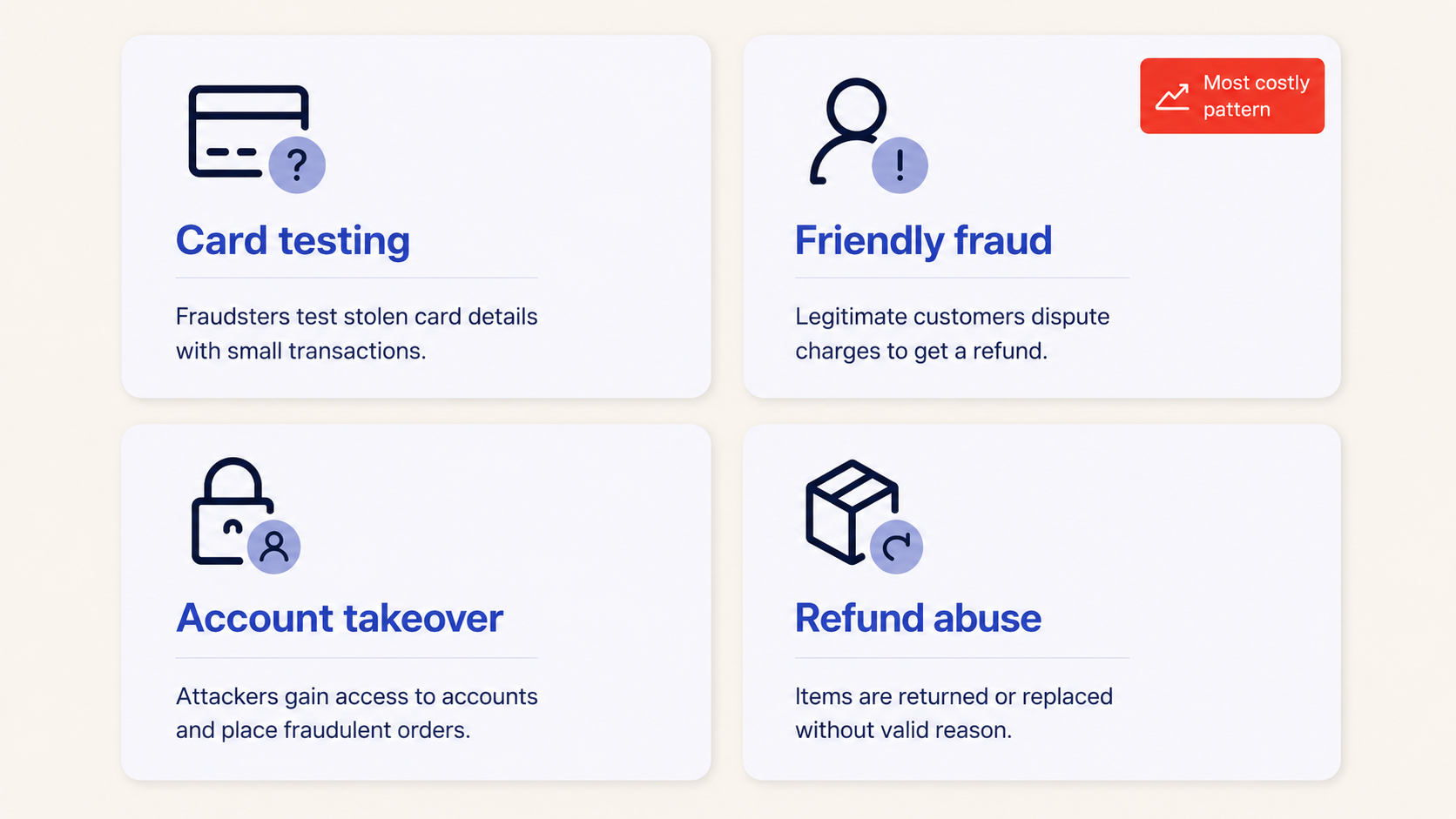
Before you configure a single control, you need to know what you are defending against. Four patterns account for most of the losses we see on Adobe Commerce stores.
Card testing (carding)
Attackers use your checkout as a free validator for stolen card numbers, firing hundreds or thousands of small authorization attempts to learn which cards are still live. This is the most common automated attack on Magento, and it shows up as a spike in failed payments, gateway fees for declined authorizations, and a flood of tiny orders. Card testing is frequently the prelude to larger fraud once the validated cards are sold on.
Friendly fraud (first-party fraud)
A real customer places a real order, receives the goods, then disputes the charge with their bank claiming they never authorized it or never received it. This has become the dominant fraud category. Chargebacks911 reports that first-party (friendly) fraud has grown into the single largest source of disputes, with the majority of consumer chargebacks now traceable to it rather than to true criminal fraud. It is hard to block at checkout because the order looks legitimate, so the defense is evidence and clear policies.
Account takeover (ATO)
Attackers use stolen or stuffed credentials to log into existing customer accounts, then exploit saved cards, loyalty balances, and stored addresses. The trend line is steep. TransUnion’s H1 2026 fraud report flagged a roughly 37% year-over-year increase in the suspected account-takeover fraud rate, and Sift’s fraud index has tracked credential-stuffing volume against consumer logins jumping well over 100% year over year. ATO is dangerous because the resulting order comes from a trusted, aged account that most rules would wave through.
Refund and promo abuse
This covers customers who weaponize your policies: claiming non-delivery on items they received, stacking single-use coupons, creating throwaway accounts to repeat first-order discounts, or returning different goods than they bought. It rarely triggers fraud scoring because no stolen instrument is involved, so it has to be caught with velocity rules, account-level history, and policy design.
The prevention layers, and how to set them up on Magento
Here is the stack, ordered roughly by where an order encounters each control. Aim to have something working at every layer rather than one very strong layer and several gaps.
1. Bot and edge protection
Most card testing and credential stuffing is automated, so the cheapest win is stopping bots before they reach checkout logic. Put a WAF and rate limiting in front of the store at the CDN or hosting edge, add a modern invisible CAPTCHA on login, registration, and checkout, and enable Magento’s native Google reCAPTCHA on those forms. Block or challenge traffic from data-center IP ranges and known anonymizing proxies. Well-tuned edge protection removes the bulk of low-effort attacks before any payment or fraud-scoring cost is incurred.
2. AVS and CVV at the gateway
Address Verification Service and the CVV check are the baseline payment controls every Magento store should enforce through its gateway. Configure the gateway, not just Magento, to decline or hold orders where AVS or CVV does not match, and decide deliberately how strict to be. These checks are weak on their own against stolen cards used with correct billing details, but they are nearly free and they filter out a lot of sloppy fraud.
3. 3D Secure 2
3D Secure 2 (sold as Visa Secure, Mastercard Identity Check, and similar) shifts liability for many fraudulent chargebacks from you to the card issuer when the customer authenticates. Modern 3DS2 uses risk-based, often frictionless, authentication, so most genuine customers never see a challenge. Enable it through your payment provider and, where the rules allow, apply it selectively to higher-risk orders so you keep checkout smooth for the safe majority. For card-not-present fraud this is one of the highest-leverage controls available.
4. Velocity rules
Velocity rules cap how often an action can repeat in a window: orders per card, attempts per IP, accounts per device, redemptions per coupon. As Enzoic and other fraud researchers note, velocity checks are one of the most reliable ways to catch automated abuse before it turns into loss, because real shoppers do not place twelve orders in ten minutes. Implement velocity limits at the gateway, in a fraud tool, or with custom Magento logic, and set thresholds against your real order patterns so you do not throttle legitimate repeat buyers.
5. Fraud scoring tools
This is the layer that does the heavy lifting against sophisticated fraud. Tools such as Signifyd (natively integrated with Adobe Commerce Payment Services), Riskified, Sift, NoFraud, and MaxMind minFraud score each order in real time using device fingerprinting, IP intelligence, email and phone reputation, and machine-learning models trained across a huge merchant network. Many of these vendors offer chargeback guarantees on orders they approve, effectively moving fraud risk off your books. For mid-market and enterprise Magento stores this is usually the single most impactful investment.
6. Manual review
No automated system should auto-approve or auto-cancel every order. The gray zone, medium-risk orders that are neither clearly safe nor clearly fraudulent, belongs in a manual-review queue where a trained person checks signals such as billing-shipping mismatch, freight-forwarder addresses, mismatched account age and order value, and reused details across accounts. Keep this queue small and fast by letting the layers above auto-clear the obvious cases, so reviewers spend their time only where human judgment adds value.
7. PCI hygiene and account security
Prevention also means not becoming the breach, and it starts with PCI compliance. Use a PCI-compliant, tokenized, hosted-fields or redirect payment integration so raw card data never touches your servers, keep Magento and every extension patched on Adobe’s security release cadence, restrict and audit admin access with two-factor authentication, and enforce strong password and login protection for customer accounts to blunt account takeover. Solid hosting and DevOps practice underpins all of this, because an unpatched server or exposed admin is a fraud vector before it is anything else.
A summary of the prevention layers
| Layer | What it stops | Effort to set up |
|---|---|---|
| Bot and edge protection (WAF, rate limiting, CAPTCHA) | Card testing, credential stuffing, scraping | Low to medium |
| AVS and CVV | Low-effort stolen-card fraud | Low |
| 3D Secure 2 | Card-not-present fraud, shifts chargeback liability | Low |
| Velocity rules | Automated abuse, coupon and refund abuse | Medium |
| Fraud scoring tools | Sophisticated and organized fraud | Medium |
| Manual review | Gray-zone orders that rules cannot judge | Ongoing |
| PCI hygiene and account security | Breaches, admin compromise, account takeover | Ongoing |
How do you balance fraud prevention against false declines?
Set your rules to your actual fraud rate and margin, then watch the false-decline and manual-review rates as closely as you watch fraud. The goal is the lowest total cost, fraud loss plus declined-legitimate revenue plus review labor.
In practice, that means starting with the high-liability, low-friction controls (3DS2, AVS, CVV, bot protection) that rarely hurt good customers, adding a scoring tool to triage the rest, and reserving manual review for the narrow middle. Review the numbers monthly. A rule that blocks $500 of fraud while declining $5,000 of good orders is a losing rule, even though it feels safe.
What about a live carding attack right now?
If your checkout is being hammered with authorization attempts at this moment, that is incident response, and it needs different, faster moves than this prevention guide covers. We deliberately keep that scope separate. Our dedicated walkthrough on what to do when your store is under a carding attack covers the emergency steps: rate limiting, CAPTCHA enforcement, gateway throttling, and damage control while the attack is active. Use that first, then return here to build the layered defenses that keep it from recurring.
A decision framework for getting started
You do not need every tool on day one. Sequence the work by impact and effort:
- Audit what you already have. Check which gateway controls, CAPTCHA, and patches are enabled. Many stores own controls they never switched on.
- Turn on the cheap, high-liability layers first. Enforce AVS and CVV, enable 3D Secure 2, and put bot protection at the edge. These cut a large share of fraud at near-zero conversion cost.
- Add velocity rules tuned to your real order patterns to stop automated abuse and coupon stacking.
- Adopt a fraud-scoring tool sized to your volume, ideally one with a chargeback guarantee, to triage orders automatically.
- Stand up a lean manual-review queue for the gray zone, with a clear checklist so decisions are consistent.
- Lock down PCI hygiene and account security as ongoing operational discipline.
If fraud is making you question the platform itself, it should not. The same open architecture that lets attackers probe Magento is also what lets you bolt on best-in-class controls, and it is one reason the platform stays a strong choice when you compare Magento and Shopify. For a broader view of the platform’s trajectory, our analysis of whether Magento is still worth it puts the security question in context.
Frequently asked questions
What is the best fraud prevention solution for a Magento store?
There is no single best tool. The strongest setup is layered: 3D Secure 2 and gateway-level AVS and CVV for payment, bot protection at the edge, and a fraud-scoring service such as Signifyd, Riskified, NoFraud, or MaxMind minFraud sized to your order volume. For Adobe Commerce, Signifyd’s native integration is the most direct starting point.
How does Magento 2 fraud prevention differ from older versions?
Magento 2 (the only supported line, as Magento 1 reached end of life) supports modern protections that older versions could not, including native reCAPTCHA, two-factor admin authentication, current 3D Secure 2 flows through supported gateways, and clean integrations with fraud-scoring vendors. Staying on patched Magento 2 is itself a fraud-prevention measure.
Will 3D Secure hurt my conversion rate?
Modern 3D Secure 2 uses risk-based authentication, so most legitimate customers complete checkout without seeing a challenge. Applied selectively to higher-risk orders, it typically protects far more revenue through liability shift and blocked fraud than it costs in added friction.
Can fraud prevention stop chargebacks completely?
No. It can sharply reduce criminal fraud and the chargebacks that follow, but friendly (first-party) fraud comes from real customers disputing real orders, so it is fought with clear policies, delivery and authentication evidence, and a disciplined dispute-response process rather than a checkout gate.
Does Adobe Commerce include fraud protection out of the box?
Adobe Commerce offers more built in than Magento Open Source, including native integration with Signifyd through Payment Services for automated order screening and chargeback protection. You still configure gateway controls, bot protection, velocity rules, and review processes around it, but the starting baseline is higher.
How much does eCommerce fraud actually cost merchants?
More than the stolen goods. The LexisNexis True Cost of Fraud study estimates roughly $4.61 in total cost for every dollar of fraud lost by US merchants once chargeback fees, labor, and freight are counted, and Juniper Research projects global eCommerce fraud losses reaching about $107 billion by 2029.
Stop losing orders and revenue to fraud. Talk to scandiweb and protect your store with layered fraud prevention tuned to real risk.