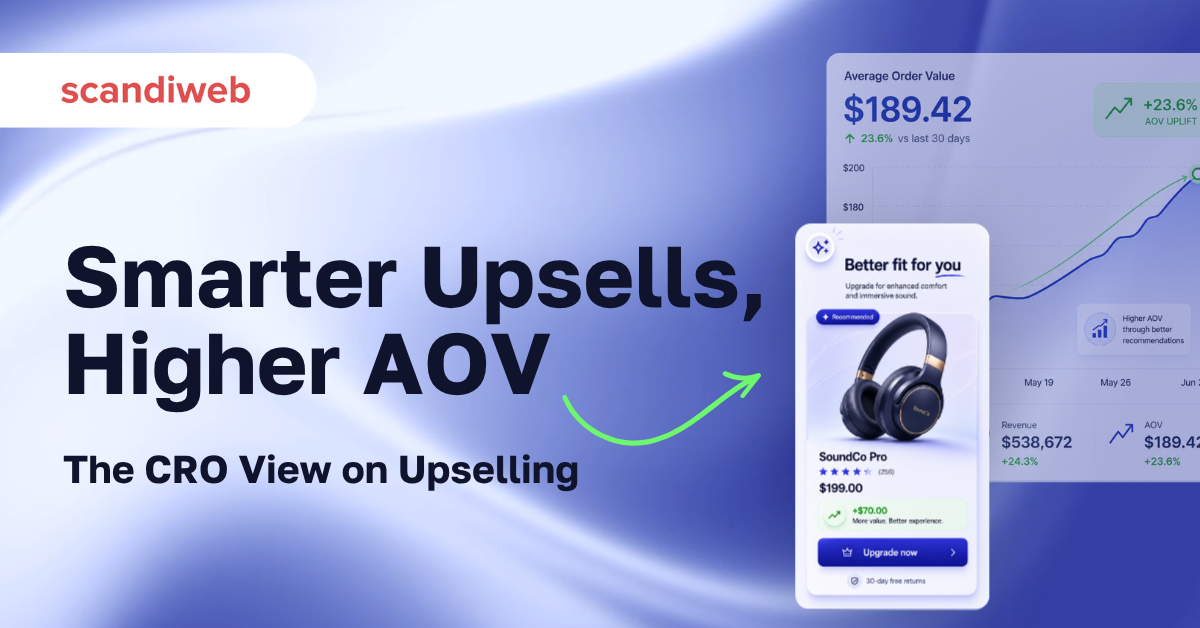
Upselling lifts average order value by 10 to 30% when it works (Envive 2026 AOV benchmarks). Customers hate being upsold when it does not. The way out of that tension is timing and relevance, not pressure.
This guide walks through what upselling is, the techniques that actually work in 2026, real-world examples from stores doing it well, and the placement-and-timing playbook the scandiweb CRO team uses on client projects.
Overview
- Upselling is recommending a higher-value version of a product the customer is already buying; cross-selling is recommending something complementary.
- Best-placed upsells deliver 10 to 30% AOV lift, with post-purchase upsells accepted by 15 to 25% of buyers.
- Timing (PDP, cart, post-purchase) and relevance to the chosen product matter far more than the upsell offer itself.
🚀 Quick takeaway
Upsells that work feel like a recommendation from someone who knows the product. Upsells that fail feel like a sales pitch. Same offer, different framing, very different outcomes.
What is upselling?
Upselling is the practice of offering a customer a better, larger, or upgraded version of the product they are already considering. The goal is not to extract more money from the same sale; it is to help the buyer end up with something that fits their need more closely, which usually costs more.
The distinction that gets confused often: upselling versus cross-selling.
- Upselling = a better version of the same product. A buyer adds a 50-inch TV to cart; you suggest the 65-inch.
- Cross-selling = a complementary product. The same buyer gets the 50-inch TV recommendation, plus a wall mount and a soundbar.
Done well, both lift AOV. Done badly, both train customers to ignore your recommendations.
What is a good upselling conversion rate?
In 2026, the benchmarks for upsell performance are well-documented. Across stores running structured upsell programs, the best-in-class numbers from Blend Commerce’s 2026 CRO benchmarks and Optimonk’s 2026 CRO data:
- Post-purchase upsells accepted by 15 to 25% of buyers (the highest-performing placement)
- Cart-page upsells accepted by 4 to 12% of buyers
- PDP-level upsells accepted by 2 to 6% of buyers
- Average AOV lift from a well-designed upsell program: 10 to 30%
- Bundling-based upsells: 20 to 35% AOV lift, up to 55% in best-in-class implementations
Only 5% of brands hit a 3 to 4% upsell conversion rate, which means there is significant room to improve on most stores. The gap between top-performing programs and the average is wider than the gap between platforms.
🚀 Quick takeaway
Post-purchase placement wins on accept rate because the buying decision is already made. The customer is in a yes-mood, and the friction of an extra step is low.
5 upselling techniques with real examples
The five techniques below cover the most common upsell patterns in 2026 eCommerce. Each one has a worked example from a store doing it well.
Increase size
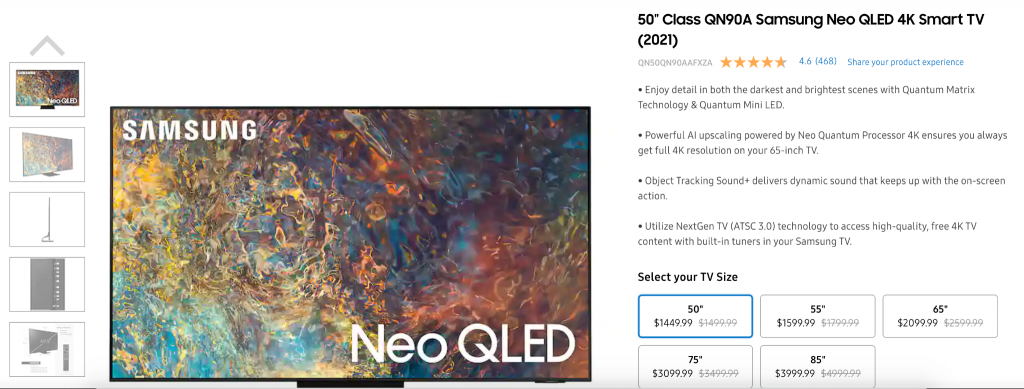
The simplest upsell: same product, larger size. The customer has already chosen the category, so the only question is the size of the spend. Samsung does this consistently on its product detail pages, showing a discounted larger model alongside the chosen one.
Increase performance or features
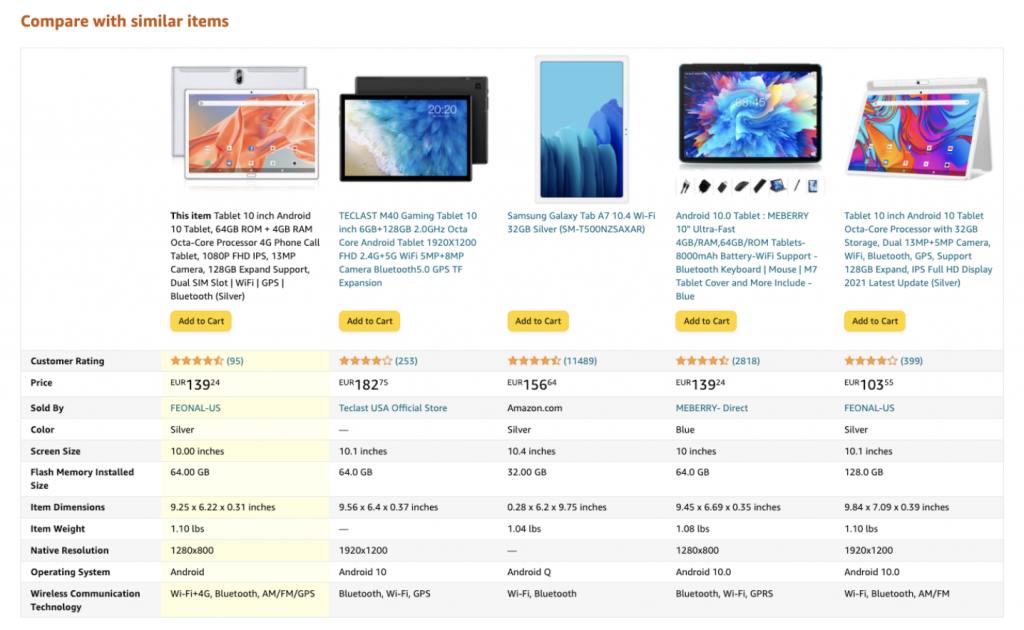
The “better version” upsell. Same product family, higher-spec model. Amazon reportedly generates around 30% of revenue from this pattern, recommending a more capable model right next to the chosen one on the PDP.
Add-ons to a product
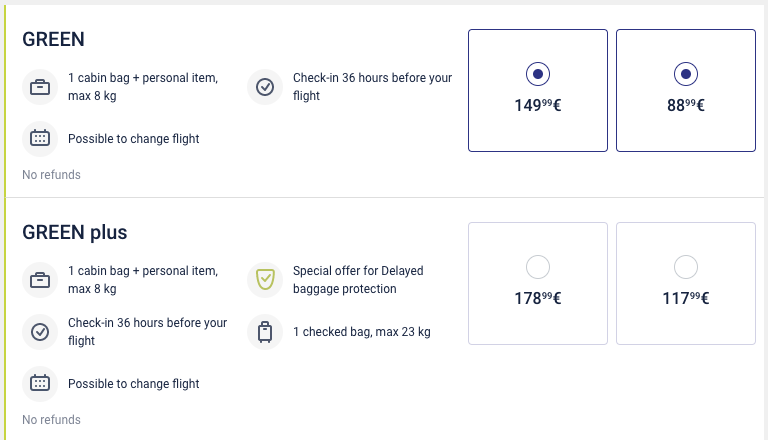
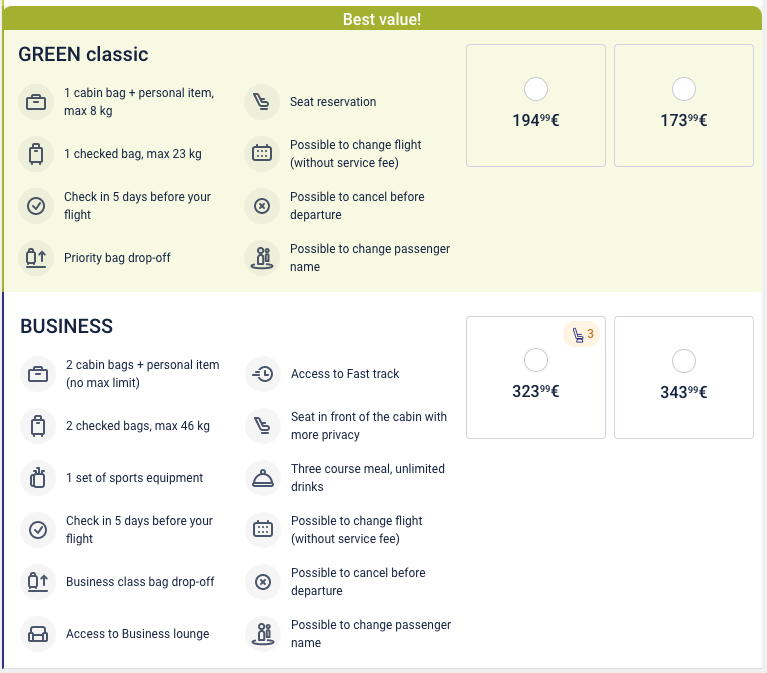
This is the dominant upsell pattern in the travel industry. Airlines have refined it into a multi-step funnel: pick a fare tier, then bags, then seats, then meals, then priority. airBaltic offers the same flight at four different fare levels first.
Then travel extras come next:

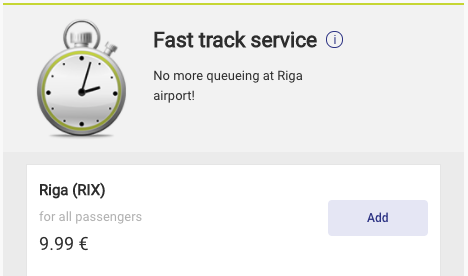
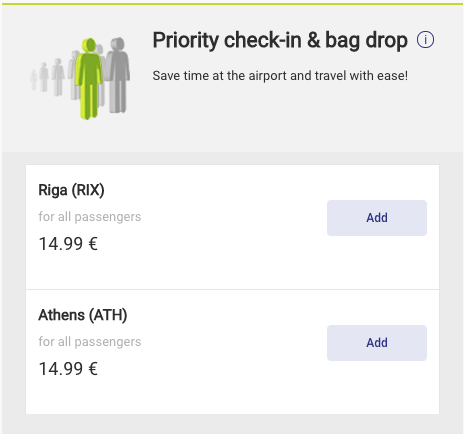
By the time the buyer reaches the final cart, the original ticket cost can have doubled through small, individually defensible decisions.
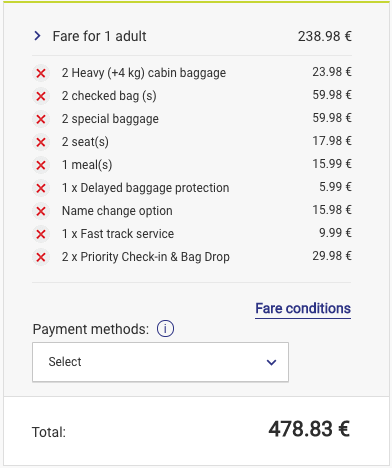
Spend more, get more
The volume-based upsell. Buy two, get a discount on the second. Hit a spend threshold, unlock free shipping or a gift. Amazon’s “frequently bought together” with a built-in price advantage is the canonical example.

Gifts and personalisation upsells
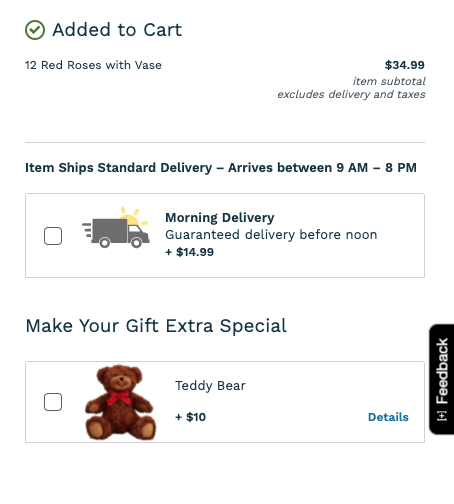
For gift purchases, the upsell is personalisation: hand-written notes, gift wrapping, scheduled delivery. ProFlowers turns each gift into a multi-step personalisation funnel that compounds AOV without ever feeling pushy.
🚀 Quick takeaway
Five techniques, one common rule: every successful upsell is anchored to a decision the buyer has already made. You are not changing their mind; you are giving them a better version of the choice they made.
Where should upsells appear: PDP, cart, or post-purchase?
Placement determines accept rate, and accept rate determines the program’s value. The three viable placements:
Product detail page (PDP)
The PDP upsell catches the buyer at the consideration stage. Accept rates of 2 to 6% are typical. The constraint: too many alternatives at this stage triggers the paradox of choice and reduces overall conversion. PDP upsells work best as a “two paths” comparison, not a long list of alternatives.
Cart and pre-checkout
Cart-page upsells sit at the moment the buyer is about to commit. Accept rates of 4 to 12% are typical. The best ones surface a single complementary or upgraded option with a clear price delta, and avoid blocking the checkout button. See our add-to-cart best practices guide for the wider cart UX context.
Post-purchase
The highest-converting placement. The buyer has already made the purchase, the payment friction is removed, and the upsell is framed as “one-click add to your order”. Accept rates of 15 to 25%. The constraint: the upsell must arrive immediately after order confirmation, not in a follow-up email.
🚀 Quick takeaway
If you only run one upsell placement, run post-purchase. The accept rate is two to four times higher than PDP, with no downside risk to the original conversion.
The scandiweb CRO take on upselling
Across CRO engagements for clients running on Magento (Adobe Commerce), Shopify, and BigCommerce, the scandiweb CRO team consistently sees the same pattern: most stores have one upsell program running, usually on the PDP, and most of them are leaving the bigger win on the table by not running post-purchase.
The CRO sequence we run on new clients with upsell room:
- Audit current upsell placements and measure accept rate per placement
- Add a post-purchase upsell flow if missing, A/B test against control
- Tighten PDP upsells to two-path comparisons with clear price deltas
- Move broad cart-page recommendations to a single, highly-relevant suggestion
- Layer AI-driven product recommendations on top once the structural placements are sound
AI-powered recommendation engines drive an additional 26% AOV lift on top of structural upsells (per Envive 2026 benchmarks), but only after the placements are right. Layering AI on top of a broken placement just makes the broken placement run faster. See our AI personalization tools guide for the recommendation engine landscape.
Upselling best practices
The principles that separate effective upselling from annoying upselling:
- The upsell must offer the buyer a clear gain, not just a higher price
- Relevance to the chosen product is non-negotiable; unrelated suggestions train customers to ignore your recommendations
- Timing matters more than price; the right offer at the wrong moment fails
- Keep the price delta reasonable; the rule of thumb is upsell within 30% of the original product price
- Side-by-side comparison reduces friction; the buyer can see what they get for the extra spend
- Never block the buyer from completing the original purchase; the upsell is optional, always
- Avoid choice overload; one or two well-chosen options beat five mediocre ones
- Reward repeat upsell acceptance with loyalty perks; the next upsell is easier when the first one paid off
Frequently Asked Questions
What is the difference between upselling and cross-selling?
Upselling is offering a better, larger, or upgraded version of the same product the customer is already buying. Cross-selling is offering a complementary product. Both can run together: a buyer adding a TV to cart sees a larger TV (upsell) and a wall mount (cross-sell).
What is a realistic upsell conversion rate?
It depends on placement. Post-purchase upsells accept at 15 to 25%, cart-page upsells at 4 to 12%, PDP upsells at 2 to 6%. Best-in-class programs at any placement double these numbers.
Where is the best place to put an upsell?
Post-purchase is the highest-converting placement because the buyer has already committed to spending and the friction of an extra step is low. PDP and cart upsells work but accept at lower rates and carry conversion-rate risk if poorly designed.
How much can upselling lift average order value?
A well-designed upsell program lifts AOV by 10 to 30% on top of baseline. Bundling-based upsells can reach 20 to 35%, with best-in-class implementations hitting 55%. AI-driven recommendations add another 26% on top of structural placements.
Does upselling work for B2B?
Yes, but the patterns differ. B2B upsells are typically volume-based (tiered pricing on larger orders), feature-based (premium tiers with workflow features), or support-based (priority service tiers). The same timing and relevance rules apply.
How do I avoid annoying customers with upsells?
Three rules. Make every upsell relevant to the chosen product. Keep the price delta within 30% of the original. Never block the buyer from completing the original purchase. If the upsell feels like a sales pitch, redesign it.
About this guide
Maintained by the scandiweb CRO team. Reviewed by Anna Ivuškāne, UX & CRO Specialist. scandiweb runs Conversion Rate Optimization programs across Magento, Shopify, and BigCommerce stores.
Want to find the upsell program that actually fits your store? Get in touch with the scandiweb CRO team for an upsell audit, a post-purchase placement plan, and an AOV-lift projection.