Should you keep full control of your store on open-source software, or hand the infrastructure to a hosted platform and move faster with a smaller team? That is the real question behind Magento versus BigCommerce, and it is rarely about features alone. It is about who owns the code, who carries the maintenance burden, and which trade-off your business can live with for the next five years.
Magento (Adobe Commerce) is open-source and self-hosted (or runs on Adobe’s PaaS), built for merchants who need to control every part of the experience. BigCommerce is a fully hosted SaaS platform that handles servers, scaling, and security for you. Both are credible enterprise choices. The right answer depends on your catalog complexity, your B2B requirements, and how much engineering capacity you want to own.
This comparison covers hosting model, total cost of ownership, customization and B2B depth, ease of use and time-to-market, security, SEO, and support, then closes with a decisive “choose this one if” verdict. scandiweb has built and migrated stores on both platforms since 2003, so our take here is partner-neutral.
🚀 Quick takeaway
Choose Magento when you need deep customization, complex catalogs, or serious B2B, and you have or will hire engineering capacity. Choose BigCommerce when you want predictable costs, fast time-to-market, and managed hosting without a dedicated dev team. Magento gives control at a typically 3-5x higher total cost of ownership. BigCommerce gives speed and simplicity inside SaaS boundaries.
Magento vs BigCommerce: the key differences
The single biggest difference is the operating model. Magento is open-source software you (or your agency) host and maintain, which means total control and total responsibility. BigCommerce is SaaS, so the platform owns uptime, patching, and scaling, and you work inside its guardrails.
Everything else, cost structure, customization ceiling, B2B depth, ease of use, flows from that one architectural choice. The table below frames the comparison before we go angle by angle.
| Category | Magento (Adobe Commerce) | BigCommerce |
|---|---|---|
| Software model | Open-source / PaaS, self-hosted or Adobe-hosted | Fully hosted SaaS |
| Hosting and scaling | You own it (or Adobe Commerce Cloud manages it) | Managed by BigCommerce, auto-scaling and CDN included |
| Maintenance and patching | Merchant responsibility | Automatic, handled by the platform |
| Customization ceiling | Virtually unlimited, full code access | High via APIs, bounded by the SaaS model |
| B2B depth | Native, deeply configurable | Strong built-in B2B Edition, less custom logic |
| Pricing model | Free Open Source core or revenue-based Adobe Commerce license, plus build and hosting | Predictable monthly tiers, roughly $39 to $399+ |
| Time-to-market | Months for complex builds | Weeks to a few months |
| Best fit | Complex, high-customization, enterprise and B2B | Mid-market brands prioritizing speed and low overhead |
Hosting model: open-source control vs SaaS simplicity
Magento Open Source is free to download and runs on the infrastructure you choose, from a single server to a multi-node cloud setup. Adobe Commerce adds a licensed feature set and an optional managed PaaS (Adobe Commerce Cloud). Either way, the architecture is yours to shape, which is exactly why it appeals to teams with unusual requirements.
BigCommerce removes that decision entirely. Hosting, scaling, CDN, and PCI infrastructure are part of the subscription, and the platform handles traffic spikes without you provisioning anything. The trade is real: you gain operational calm and lose the ability to alter how the platform runs underneath you.
If the words “we will manage our own servers” make your CTO nervous, that anxiety is telling you something. Magento rewards teams that want control. BigCommerce rewards teams that want the control question to disappear.
Total cost of ownership
Which platform costs more over three years?
Magento typically carries a 3-5x higher total cost of ownership than BigCommerce for comparable mid-market stores, because the free or licensed core is only the starting line.
With Magento, the real budget lives in hosting, development, third-party extensions, and ongoing upgrades. Adobe Commerce licensing is revenue-based and can run into five or six figures annually before a single line of custom code is written. The upside is that, at a very large scale, owning the software can flatten the per-order cost curve imposed by fixed SaaS fees.
BigCommerce bundles hosting, security, and updates into predictable monthly tiers, roughly $39 to $399+, with enterprise pricing quoted above that. There are no surprise infrastructure bills and far less developer time. The ceiling is that you pay for the convenience, and high-GMV merchants can hit revenue-based pricing thresholds that change the math.
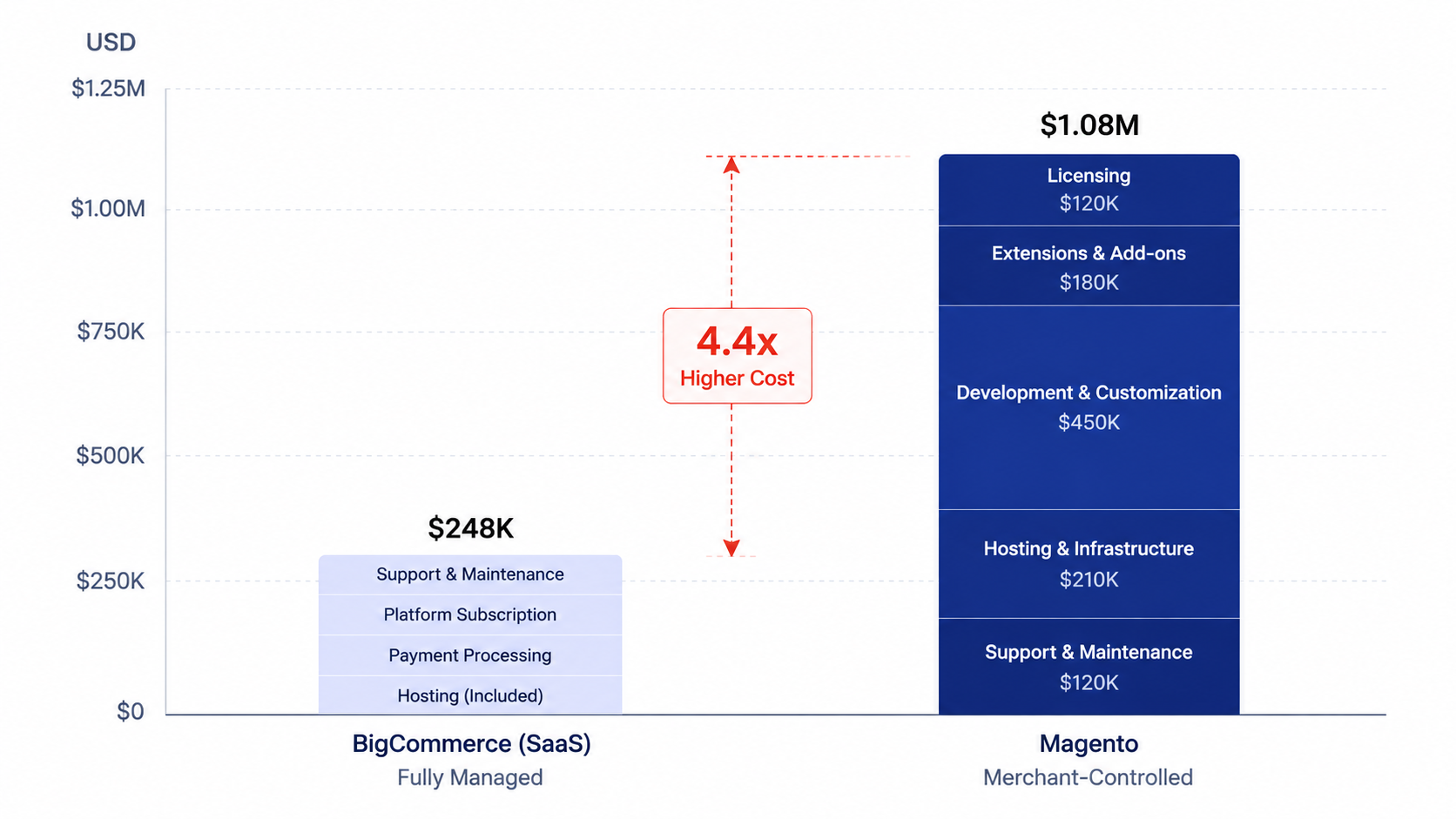
A 2023 Forrester Total Economic Impact study commissioned by BigCommerce found a composite enterprise merchant achieved 211% ROI over three years with an eight-month payback, driven in part by developer time savings of 50% to 90% from the platform’s managed model and open APIs. Those numbers come from BigCommerce-sponsored research, so read them as directional rather than universal, but the direction is consistent with what merchants report: SaaS lowers the people cost of running a store.
🚀 Quick takeaway
Do not compare license price to license price. Build a three-year total cost of ownership model that includes hosting, development hours, extensions, upgrades, and the internal team you will need. Magento usually wins on flexibility and loses on overhead. BigCommerce usually wins on predictability and loses on custom-logic ceilings.
Customization and B2B depth
This is Magento’s home turf. With full access to the codebase, you can build multi-store networks, intricate catalog logic, custom pricing engines, and headless frontends without asking permission from a platform roadmap. For merchants running hundreds of thousands of SKUs or unusual fulfillment rules, that freedom is the entire reason to choose it.
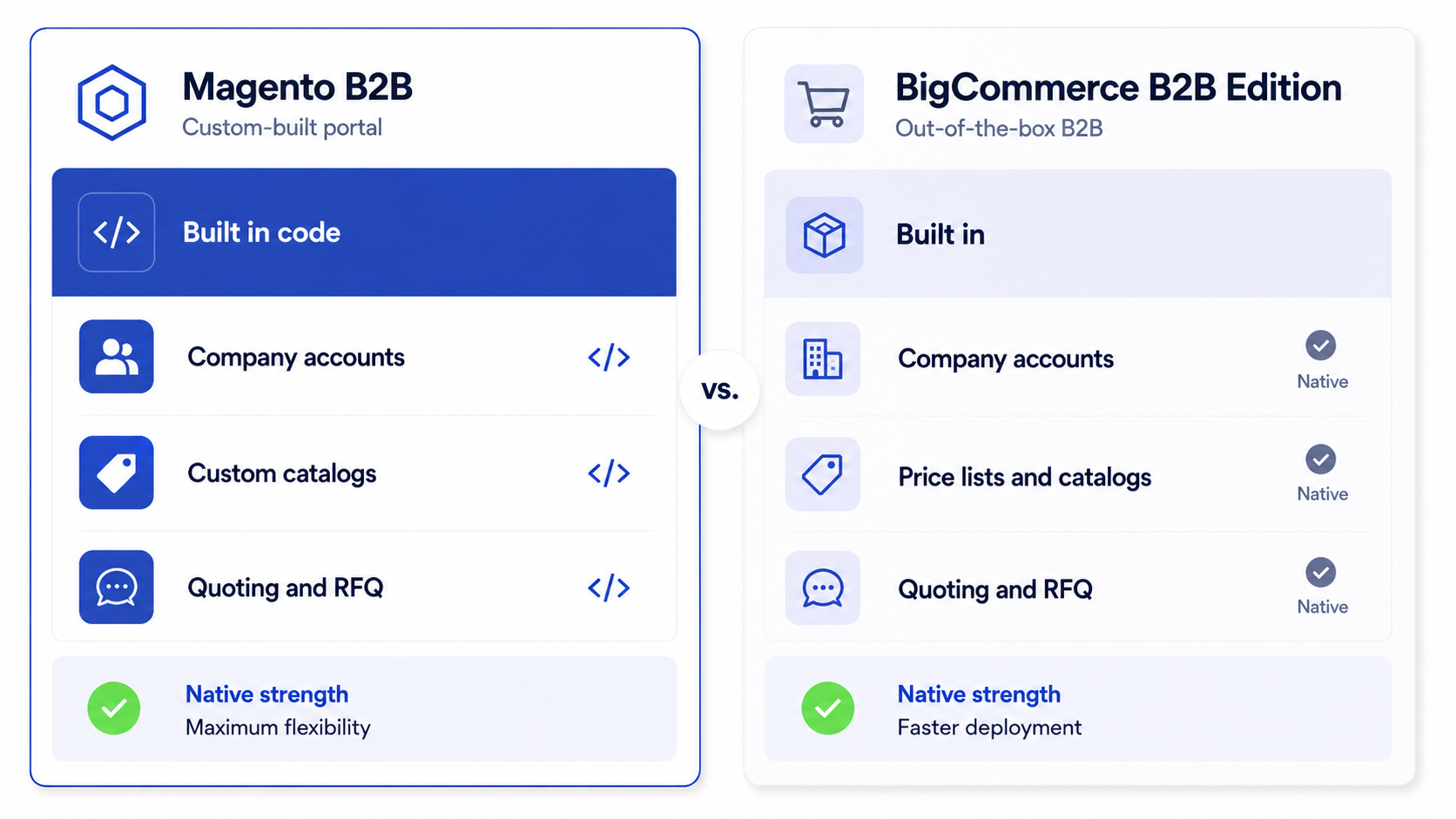
B2B is the clearest dividing line. Adobe Commerce ships native B2B features, company accounts, shared catalogs, custom pricing, quoting, and approval workflows that are deeply configurable down to individual buyer behavior. BigCommerce offers a capable B2B Edition that delivers price lists, customer groups, quoting, and buyer portals out of the box, which covers most mid-market needs without development.
BigCommerce gets most B2B teams live faster, while Magento lets you model B2B relationships that a SaaS platform simply cannot express. If your B2B logic is standard, BigCommerce saves you months. If it is genuinely complex, Magento is the only one of the two that bends to fit.
Both platforms support headless and API-first builds, so neither locks you out of a modern composable frontend. The difference is depth: Magento exposes the full domain model to your developers, while BigCommerce exposes a well-documented but bounded API surface. For a broader composable comparison, our look at commercetools vs Adobe Commerce covers where pure headless platforms fit.
Ease of use and time-to-market
Which platform is faster to launch?
BigCommerce is meaningfully faster to launch and easier for non-technical teams to run day-to-day, because setup, hosting, and core features work out of the box.
Marketers and merchandisers can manage catalogs, content, promotions, and checkout in BigCommerce without a developer on call for routine work. A straightforward store can go live in weeks. Magento, by contrast, expects technical hands for setup and most meaningful changes, and a serious build usually takes months.
That gap is the cost of flexibility. The platform assumes you have a development partner. BigCommerce assumes you would rather not. Be honest about your internal capacity here, because choosing Magento without engineering support is the most common way these projects stall. If a hosted model appeals but you are weighing other SaaS options, our BigCommerce vs Shopify breakdown is a useful companion read.
Security and maintenance
On BigCommerce, security is the platform’s job. PCI DSS Level 1 compliance, patches, and infrastructure hardening are handled centrally, and updates roll out without merchant action. For lean teams, removing that burden is a genuine advantage and a quiet risk reducer.
On Magento, security ownership rests with you. You apply patches, monitor for vulnerabilities, manage PCI scope, and schedule upgrades. Done well, with a competent partner and a maintenance plan, Magento stores are highly secure. Done poorly, an unpatched Magento store is a known target.
This is why a Magento decision is really a decision about your operating model. The platform is only as safe and current as the team behind it, which is the same reason a structured Magento Migration matters as much as the build itself.
SEO and performance
Both platforms can rank. BigCommerce includes solid built-in SEO controls, customizable URLs, meta data, redirects, and a content delivery network tuned for Core Web Vitals, with little setup required. For most merchants, that is enough to compete.
Magento offers deeper, more granular SEO control, the kind that matters for large multi-language, multi-store catalogs where URL architecture and faceted navigation get complicated. The catch is that Magento performance depends on how well it is hosted, configured, and optimized.
BigCommerce gives you good SEO with almost no effort, while Magento gives you maximum SEO control if you invest in doing it right. Neither has an inherent ranking advantage at the same level of care.
Support: managed vs. partner-led care
BigCommerce provides 24/7 support across all plans through live chat, phone, and email, which suits teams without an agency on retainer. Help is a ticket away, and the SaaS model means most issues are the platform’s to resolve.
Magento support depends on your edition and partners. Magento Open Source leans on a large global community, while Adobe Commerce adds Adobe’s enterprise support. In practice, most serious Magento merchants work with a solution partner who owns development, monitoring, and incident response, which is closer to having an embedded team than a help desk.
Is Magento dying, and should that worry you?
Short answer: no. Magento powers well over 100,000 live stores in 2025, according to BuiltWith tracking, and remains a leading platform for complex and enterprise commerce, even as its store count trends gently downward year over year. BigCommerce, by the same trackers, runs roughly 37,000 to 42,000 live stores, concentrated in mid-market and B2B.
The “Magento is dying” worry usually stems from migration headlines and Adobe’s pricing, not from the platform losing capability. It is very much alive and actively developed. We dug into the numbers in detail in our analysis of whether Magento is dying, and the data does not support the obituary.
What is true is that some merchants outgrow the overhead and move to SaaS, while others move the other way for control.
Which should you choose: Magento or BigCommerce?
The verdict comes down to control versus convenience, and there is no universally right answer, only the right answer for your business.
Choose Magento (Adobe Commerce) if you run complex catalogs, need deep or custom B2B, want full ownership of the code and experience, plan to scale to high volume where owning the software pays off, and either have or will commit to engineering capacity (in-house or a partner). You are buying flexibility and control, and accepting a higher total cost of ownership and maintenance responsibility to get them.
Choose BigCommerce if you want predictable costs, a fast launch, managed hosting and security, and a platform your marketing and operations teams can run without a developer for everyday work. You are buying speed and simplicity, and accepting that highly unusual logic may require workarounds or third-party apps. For most mid-market brands with standard requirements, that trade is a good one.
If you find yourself listing many “we need it to work differently from the default” requirements, Magento is likely the fit. If your list is mostly “we need it to work well and launch soon,” BigCommerce probably is. For context on how Magento stacks up against the other dominant SaaS option, our Magento vs Shopify comparison is worth a look, and our honest BigCommerce review goes deeper on the SaaS side.
Also read: Magento vs Wix.
Frequently asked questions
Is Magento the same as Adobe Commerce?
Magento is the underlying software. Adobe Commerce is Adobe’s commercial edition, with added enterprise features, B2B tooling, and support, built on the same core. Magento Open Source is the free version. People still call both “Magento.”
Is BigCommerce cheaper than Magento?
For most mid-market stores, yes. BigCommerce bundles hosting, security, and updates into a predictable subscription, while Magento’s total cost of ownership is typically 3-5x higher once you add hosting, development, extensions, and upgrades. At very high volume, owning the Magento software can become more cost-efficient per order.
Which platform is better for B2B?
Both are strong. BigCommerce B2B Edition delivers price lists, quoting, and buyer portals out of the box and launches faster. Adobe Commerce offers a deeper, fully configurable native B2B that fits genuinely complex relationships and custom logic. Standard B2B favors BigCommerce; complex B2B favors Magento.
Can BigCommerce handle large, complex catalogs?
It handles substantial catalogs well and scales automatically, but very large SKU counts with intricate custom logic can hit SaaS limits that require apps or headless workarounds. Magento was designed for that level of catalog complexity natively.
How long does it take to launch on each platform?
A straightforward BigCommerce store can launch in weeks because hosting and core features are ready out of the box. A meaningful Magento build is usually measured in months, since it is custom by nature and assumes a development team.
Is Magento still a safe long-term choice in 2026?
Yes. Magento still powers well over 100,000 live stores and is actively developed by Adobe. It remains a leading platform for complex and enterprise commerce. The risk is choosing one that does not match your team and operating model.
Do I need a developer to run a store on either platform?
For BigCommerce, no, for everyday operations. Marketing and merchandising teams can manage most tasks themselves. For Magento, yes, a developer or solution partner is expected for setup and most meaningful changes. Plan for engineering capacity before choosing Magento.
This is the platform call you will live with for multiple years, so it is worth getting right. Talk to a team certified on both Magento and BigCommerce and pressure-test the decision against your real catalog, B2B, and growth requirements.