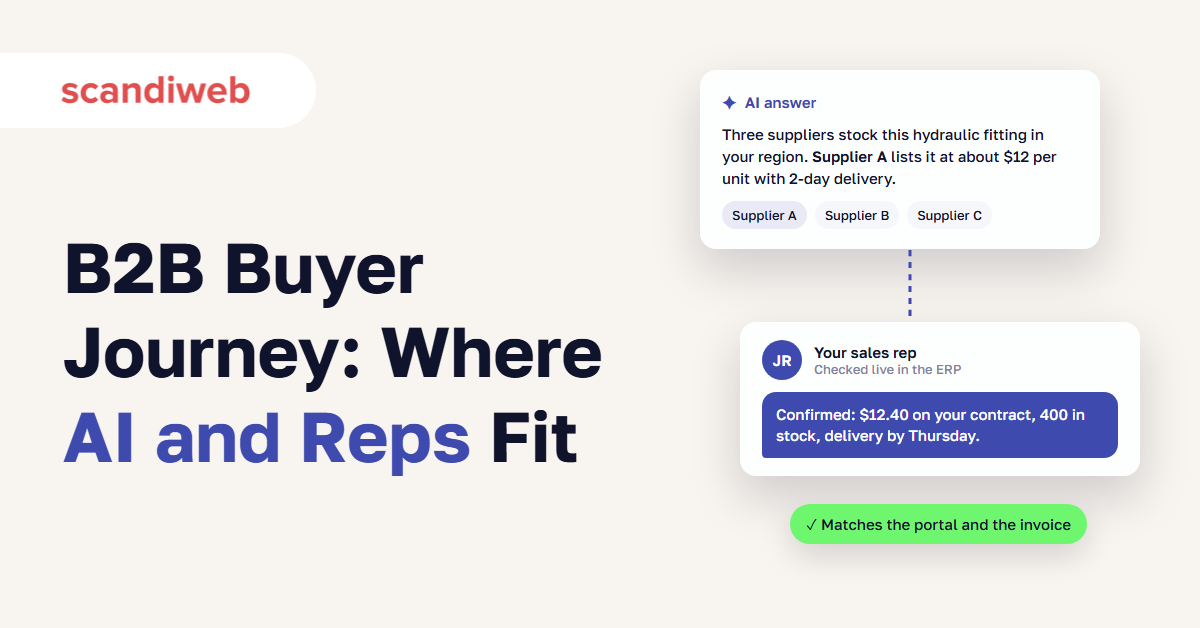
If your sales team keeps hearing “we already looked you up in ChatGPT” on the first call, or your reps spend more time correcting what buyers read than selling, the B2B buyer journey has changed under them. In a Gartner survey of 645 B2B buyers, 67% said they prefer a rep-free experience. In the same survey, 69% said they prefer to check AI-generated insights with a sales rep.
Those two numbers describe the same buyer. They research alone, with AI tools and supplier websites, and they bring in a person when they need to know the answer is right. The rep’s job moves from explaining the product to confirming what the buyer already found: the price, the lead time, and the fit for their application.
This guide walks through the six stages of that journey, who is in the buying group, where AI and reps each fit, and what a manufacturer or distributor has to keep consistent so that the website, the AI answer, the rep, and the invoice tell the buyer the same thing.
What is the B2B buyer journey in 2027?
The B2B buyer journey is the path a business buyer, or more often a buying group, takes from noticing a problem to placing an order and reordering. In 2027 most of that path happens before a supplier hears from the buyer. AI assistants and search build the shortlist, supplier websites provide the evidence, and sales reps come in to validate the choice and close it.
Gartner describes the B2B buying journey as six buying jobs: identifying the problem, exploring solutions, building requirements, selecting a supplier, validating the choice, and creating consensus inside the buying group. Buyers loop back between them. A plant manager can be halfway through supplier selection when finance asks for a different budget, and the group goes back to requirements.
For a manufacturer or distributor, the journey continues after the first order. A first order from a new account is often small. The value is in the next fifty orders, and those are won or lost in the portal, the ERP, and the account team long after the first sale.
The 6 stages of the B2B buyer journey
The six stages of the B2B buyer journey are problem definition, research and shortlist, evaluation by the buying group, validation, purchase and approval, and reorder. AI tools now do most of the work in the first two stages. Sales reps matter most in validation and in getting the purchase approved.
| Stage | What the buyer does | Where AI fits | Where the rep fits | What the supplier must provide |
|---|---|---|---|---|
| 1. Problem definition | Names the problem and the budget | Explains options and terms | Frames complex problems | Content by problem and application |
| 2. Research and shortlist | Builds a list of 3–4 suppliers | Names suppliers, compares specs | Rarely involved | Public specs, documents, coverage |
| 3. Evaluation | Each role checks its part | Summarizes specs and terms | Answers technical questions | Datasheets, certifications, case studies |
| 4. Validation | Checks AI answers with a person | The claim being checked | Confirms price, stock, and fit | Rep access to the buyer’s data |
| 5. Purchase and approval | Procurement negotiates and approves | Drafts comparisons | Builds the quote, handles terms | Accurate quotes, contract prices, terms |
| 6. Reorder and expansion | Reorders and adds products | Automates repeat orders | Grows the account | Portal with prices, history, invoices |
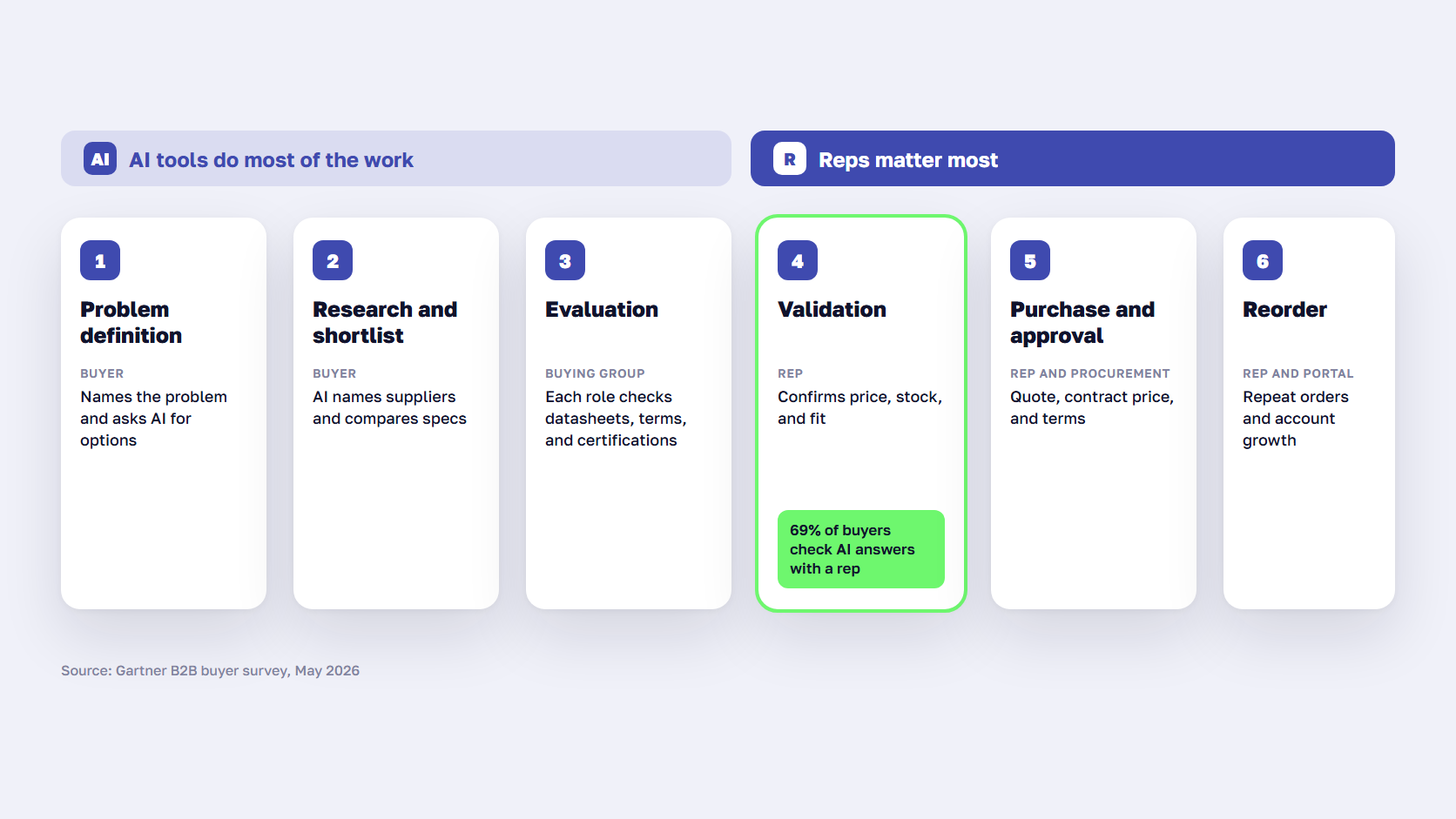
1. Problem definition
The journey starts when someone in the business names a problem, such as a packing line that keeps stopping or a new product that needs a component the current supplier doesn’t stock. Today that person often asks an AI assistant to explain the options before speaking to anyone.
Gartner found that reps are still the most important source of information when buyers define a business problem. That applies mostly to complex problems, where the buyer doesn’t yet know what to ask. Your website helps at this stage with content organized by problem and application, such as “how to cut changeover time on a filling line,” linked to the products that solve it.
2. Research and shortlist
Research has changed more than any other stage. Buyers ask ChatGPT, Gemini, or Google which suppliers make what they need, ship to their region, and hold the right certifications. The answer becomes the shortlist. 6sense found that 94% of buying groups rank their preferred vendors before first contact, and they buy from that favorite 77% of the time.
Suppliers get on that list through what AI tools and search engines can read: open product pages, full specs, coverage and certification details, and mentions on sites those tools trust. Our guide to B2B SEO in 2027 covers how to rank on Google and get recommended by AI for this stage.
3. Evaluation by the buying group
Once the shortlist exists, each member of the buying group checks the part they are responsible for. Engineering reads the datasheet. Quality checks the certifications. Finance compares total cost. Sustainability asks for material and origin data, which EU rules such as the digital product passport are turning into a requirement.
Each of them may run their own AI query, on their own schedule, and get a slightly different answer. A supplier whose data is complete and identical everywhere gives every member the same facts.
4. Validation
Validation is the stage where buyers bring in a person. Gartner found that 69% of B2B buyers prefer to validate AI-generated insights with a sales rep. The questions are specific: is this the current price for our account, can you deliver 400 units by the 15th, and is this part compatible with the pump we already run?
The rep wins this stage by answering quickly, with numbers that match what the buyer already saw. A rep who has to check three systems and call the warehouse gives the buyer a reason to doubt everything else.
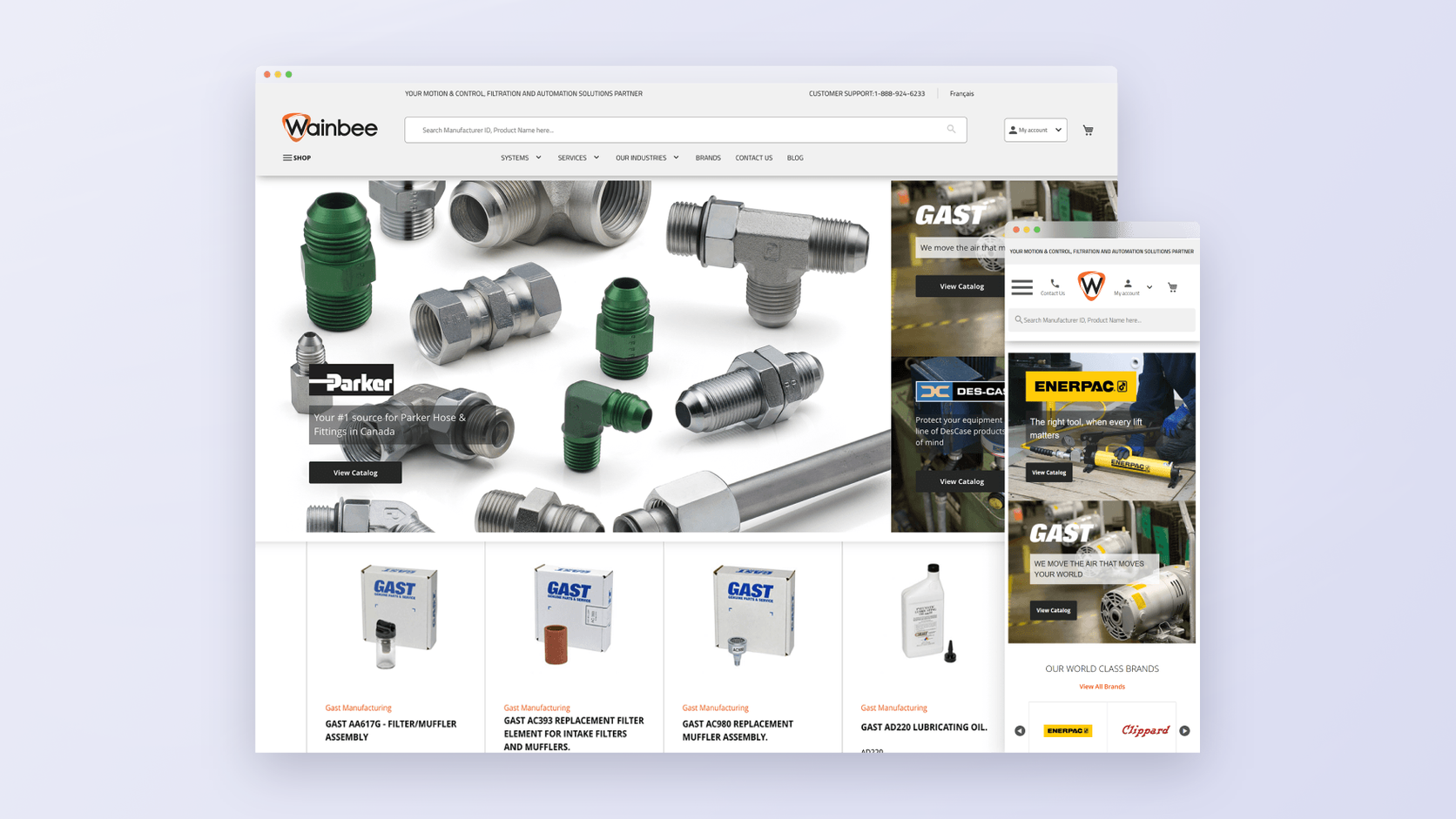
Many industrial buyers start this stage by phone. Wainbee, an engineering systems distributor in Canada with 14 locations, has many customers who call or write before they buy. When we rebuilt its Google Ads account, we added tracking for phone calls and other contacts the customer starts, so the team could see which searches led to a conversation. In six months, contact form submissions grew 320% and phone calls 21%, while the cost per conversion fell 60.6%.
Read more: PPC Case Study: 320% More Leads in 6 Months with Less Costs
5. Purchase and approval
Procurement usually leads this stage. They want the quote, the contract price, the payment terms, and the PO process to work without surprises, and they compare the final offer against what the buyer saw online.
This is where a broken handoff costs the most. If the quote doesn’t match the web price, or the portal can’t take a PO with net terms, the buyer’s internal approval stalls. B2B platforms such as Adobe Commerce include company accounts with buyer roles, approval rules, and negotiable quotes for this stage. Our list of Adobe Commerce B2B features shows what comes built in.
6. Reorder and expansion
After the first order, the journey turns into a loop. Buyers want to reorder in a few clicks, see their contract prices, track deliveries, and download invoices without asking anyone. Some of those reorders will be placed by software: procurement systems, punchout, and, over time, AI agents using protocols such as the Universal Commerce Protocol.
The rep’s job here is the account. They spot the categories the customer buys elsewhere and bring them in. The first order is day 0 of the relationship, and most of the revenue comes after it.
🚀 Quick takeaway
Two stages of the journey now happen almost entirely without you: problem research and the shortlist. The rep’s first real chance to change the outcome comes at validation, so that conversation has to be fast and exact.
Who is in the B2B buying group
A B2B buying group is everyone who shapes a purchase decision. Forrester’s 2026 State of Business Buying report puts the typical group at 13 internal stakeholders and nine external influencers, such as consultants, peers, and analysts. The number grows for complex or strategic purchases.
In an industrial purchase, the internal group usually includes engineering or maintenance, operations, quality, procurement, and finance, and sometimes sustainability and IT. Procurement carries real weight: Forrester found procurement professionals are decision-makers in 53% of business buying cycles.
Buyers also test before they commit. More than 60% of business buyers now use a trial, and 78% of those spending $10 million or more do. For a distributor, a trial often means a sample order, a pilot site, or a first small PO.
Every member of the group needs to find their answer without calling. Here is what each role usually checks:
- Engineering and maintenance: specs, drawings, compatibility, and substitutes.
- Quality: certifications, test reports, and standards.
- Procurement: contract prices, lead times, and the PO and invoice process.
- Finance: total cost, payment terms, and credit.
- Sustainability: material, origin, and carbon data.
- IT: punchout and integration with procurement systems and the ERP.
🚀 Quick takeaway
Thirteen people rarely read the same page. Plan product pages and documents for each role in the buying group, because the person who blocks the deal is often one your rep never met.
How AI changes B2B buying behavior
AI changes B2B buying behavior mainly at the research stage. In Gartner’s survey, 45% of buyers used generative AI in a recent purchase, mostly to research vendors and products, alongside an average of seven information sources. Buyers use it for speed, and they still check its answers with people.
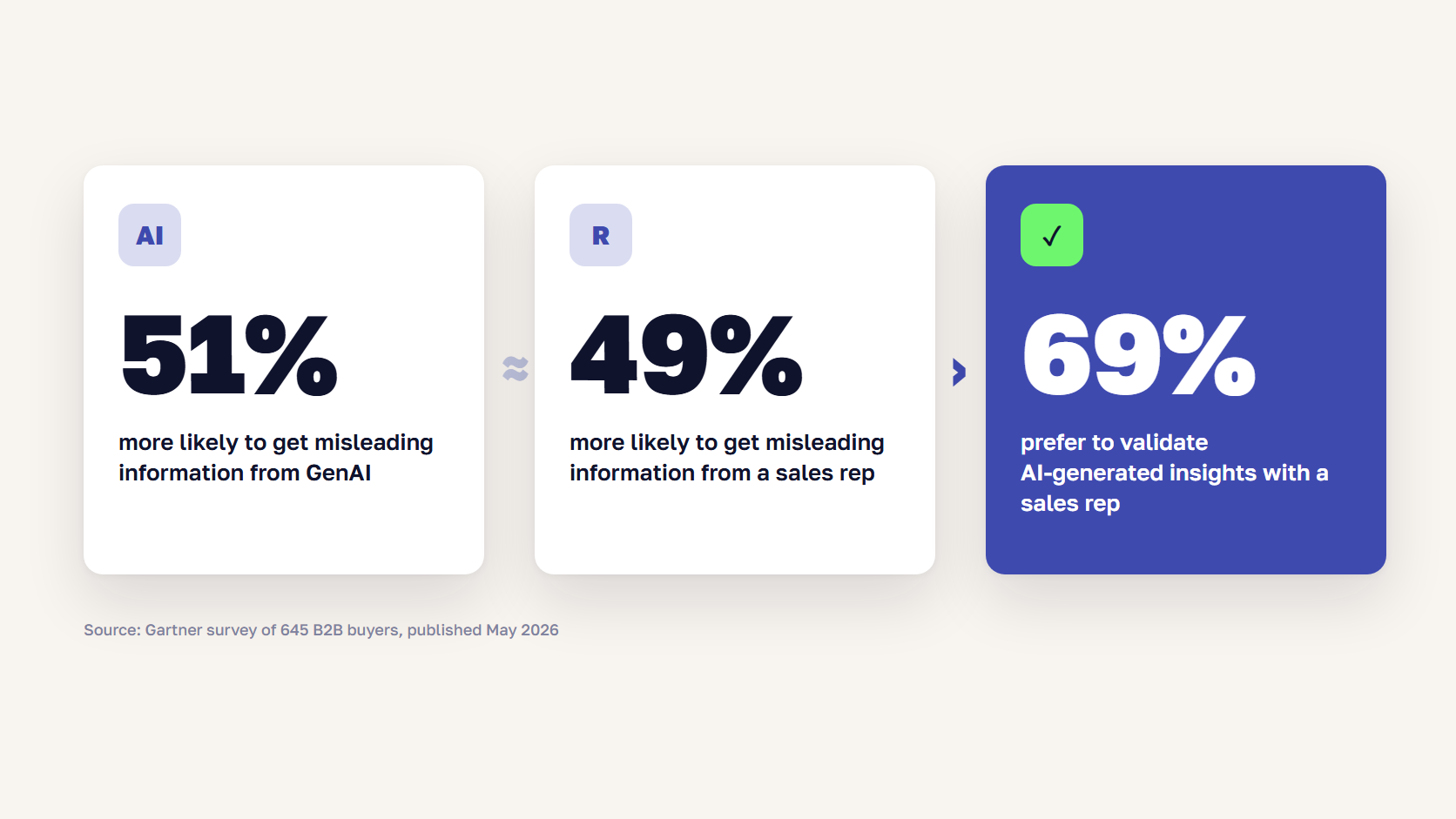
Buyers also doubt AI and reps about equally. In the same survey, 51% said they are more likely to get misleading information from generative AI, and 49% said the same about sales reps. Buyers treat both as sources that can be wrong. They use AI because it is fast and available at 11 p.m., and reps because a rep can be held to an answer.
Forrester’s 2026 research found the same pattern: AI answer engines are now the starting point for business buyers, but they often deliver incomplete or unreliable information, so buyers look for validation from trusted sources.
For suppliers, that creates two jobs. Make sure the AI answer about you is right, by publishing complete and consistent product data. Then make sure the person the buyer calls can confirm it in one conversation. To see what AI tools say about you today, our guide to tracking brand mentions in LLMs shows a repeatable method, and our AI search optimization team runs the same check across hundreds of buyer prompts.
What the B2B sales rep does now
The B2B sales rep in 2027 mainly validates what buyers have already found and manages the account after the first order. Buyers come to the rep with research already done and ask them to confirm price, availability, and technical fit, to help win internal approval, and to finalize the order.
Gartner names four moments where reps remain the most important information source: defining the business problem, identifying a preferred supplier, securing internal support, and finalizing the purchase. Robert Blaisdell, VP Analyst at Gartner, warned sales leaders not to read the preference for digital self-service as “a signal that sellers matter less.” Gartner’s advice is to stop adding reps to every stage and bring them in where they add the most.
The validator job needs four things many B2B sellers don’t have yet:
- The customer’s view. The rep sees the same prices, stock, and order history the buyer sees in the portal.
- Live data. Stock and lead times come straight from the ERP during the call.
- One price logic. A rep’s quote uses the same contract price rules as the website.
- The research trail. The rep knows which products and pages the account viewed before calling, from the CRM and web analytics.
Macron, the teamwear and sportswear brand, solved the first of these on Adobe Commerce. Its “Shop as a Customer” feature lets Macron’s team log in under a partner’s account and help with bulk orders and complex configurations, using the prices and catalog that partner sees. Macron serves distributors, sports clubs, and retailers in more than 150 countries, and the platform is integrated with its SAP ERP. Order creation time fell 40%.
Read more: Case Study: Macron’s B2B Platform Evolution with Adobe Commerce
🚀 Quick takeaway
A rep who sees exactly what the customer sees can validate in one call. A rep working from a different price list creates the inconsistency that makes buyers switch suppliers.
What suppliers must keep consistent across the journey
Suppliers must keep product data, prices, stock, lead times, and terms the same everywhere a buyer meets them: the website, AI answers, the rep’s quote, the portal, and the invoice. McKinsey’s 2026 B2B Pulse survey of nearly 4,000 decision-makers names inconsistent information as a leading reason buyers switch suppliers.
McKinsey also found that buyers use around ten channels during a purchase. Each channel is a chance for a different number. Most inconsistencies have the same cause: the fact is stored in more than one system, or typed by hand into a quote.
| Fact | Where buyers see it | Where it should come from |
|---|---|---|
| Specs and compatibility | Product pages, AI answers, datasheets | PIM |
| Contract price | Portal, rep quote, invoice | ERP price rules |
| Stock and lead time | Product page, checkout, rep call | ERP or warehouse system, live |
| Payment terms and credit | Checkout, quote, invoice | ERP customer record |
| Certifications and documents | Product pages, tenders, AI answers | PIM or DAM |
| Order history | Portal, rep view, account review | ERP, through the commerce platform |
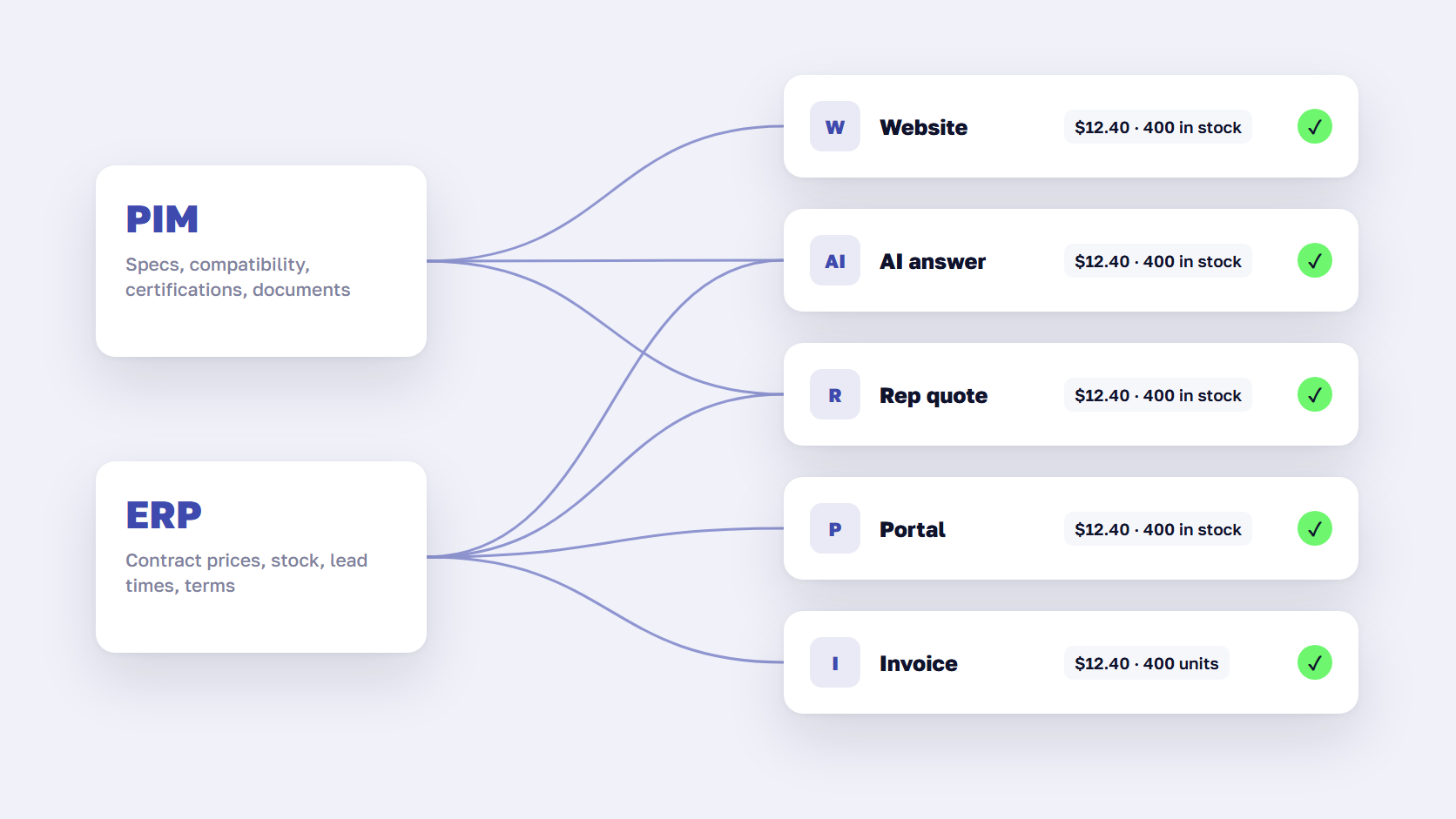
The fix is usually integration work. Connect the PIM and the ERP to the storefront, the rep tools, and the feeds AI tools read, so every channel reads from one source. Our guides to eCommerce ERP integration and PIM and eCommerce integration explain how to scope both.
Test for your team: ask ChatGPT for the lead time and price range of your three bestsellers, then ask a rep, then check the portal. Every answer that differs is a question a buyer will ask too.
🚀 Quick takeaway
A buyer can catch a mismatch in any fact that appears in two places. Count how many systems store your contract prices: each extra one is another chance for the quote and the invoice to differ.
How to map your B2B buyer journey
To map your B2B buyer journey, start from real deals. Interview recent customers, list the roles in each buying group, record which sources each role used at each stage, and mark where your website, AI answers, and reps gave different information. Then fix the stage where the most deals stall.
- Pick ten recent deals, won and lost. Ask each customer how they found you, who was involved, and what made them get in touch.
- Name the roles. Write down who in each buying group checked what, using the six stages above.
- Ask AI what your buyers ask it. Run your buyers’ real questions in ChatGPT, Gemini, and Perplexity, and record whether you are named and whether the facts are right.
- Trace each fact to its source. For price, stock, lead time, and specs, find the system it comes from on the website, in quotes, and on invoices.
- Find where deals stall. CRM data on time in stage and lost reasons shows where the journey breaks.
- Fix one stage at a time. Start with the stage that loses the most revenue, which is usually validation or reorder.
If you are deciding what to fund first next year, our guide to B2B eCommerce trends for 2027 covers which gaps to close first, and our B2B eCommerce solutions page shows how we approach the work after go-live.
FAQ about the B2B buyer journey
What are the stages of the B2B buyer journey?
The B2B buyer journey has six stages: problem definition, research and shortlist, evaluation by the buying group, validation, purchase and approval, and reorder. Buyers often loop back to an earlier stage when the group’s needs change. In 2027, AI tools handle much of the research and shortlist, and sales reps matter most at validation and approval.
Do B2B buyers still want to talk to sales reps?
Yes, at specific moments. Gartner found that 67% of B2B buyers prefer a rep-free experience, and 69% prefer to validate AI-generated insights with a sales rep. Buyers want to research and reorder on their own, then talk to a rep to confirm price, availability, and technical fit, and to get internal approval for larger orders.
How do B2B buyers use AI in the buying journey?
B2B buyers use AI mostly to research suppliers and products. In a 2026 Gartner survey, 45% had used generative AI in a recent purchase, alongside about seven other information sources. Buyers ask AI tools to explain options, name suppliers, and compare specs, then check the answers with a sales rep or the supplier’s website.
How many people are in a B2B buying group?
Forrester’s 2026 research puts the typical B2B buying decision at 13 internal stakeholders and nine external influencers, and the number grows for complex purchases. In manufacturing and distribution, the group usually includes engineering, operations, quality, procurement, and finance. Procurement professionals are decision-makers in 53% of buying cycles.
How is the B2B buyer journey different from B2C?
A B2B purchase involves a buying group instead of one shopper, longer evaluation, contract prices and payment terms, and procurement approval. It also continues after the first order through reorders. A B2C journey usually ends at checkout and depends on one person’s decision, while a B2B journey depends on many people agreeing on the same facts.
What does a B2B sales rep do?
A B2B sales rep helps business customers choose, buy, and reorder products. In 2027 that job is shifting toward validation: confirming the price, stock, and fit that buyers already researched online or with AI, helping them win internal approval, and growing the account after the first order. Reps need access to the same data the customer sees.
The B2B buyer journey in 2027 runs on one set of facts
The B2B buyer journey in 2027 starts with AI and search and ends with a rep, a quote, and a portal that the buyer comes back to. Buyers move between those sources freely and check one against another. Suppliers keep winning orders when their website, AI answers, reps, and invoices all show the same price, stock, and specs. Start by tracing where each of those facts comes from, then give your reps the same view of the account that the customer has.
Hearing "we already compared you in ChatGPT" from new buyers? Tell us where your deals stall today, and we'll show you which part of the journey to fix first.