
Most of the SEO advice you read applies to any website: write good content, earn links, fix your titles. That advice is not wrong, but it quietly assumes a platform that behaves itself. Magento (Adobe Commerce and Magento Open Source), does not. It generates URLs you never asked for, indexes filter combinations by the thousand, and arrives with defaults that can bury your real pages under crawl waste. A generalist agency that has only ever optimized WordPress blogs will treat the symptoms and miss the cause.
Below, we lay out the criteria that separate a Magento SEO company from a marketing firm that happens to have a Magento client, then walk through how to vet candidates on the work that protects your rankings through an upgrade or a replatform.
🚀 Quick takeaway
The best Magento SEO companies are judged on five platform-specific things: control of crawl and index bloat from layered navigation, Core Web Vitals on a heavy catalog, redirect and migration SEO that survives a replatform, complete and valid structured data, and documented ranking or revenue results. A generalist that scores well on none of these will cost you more in lost organic revenue than its retainer ever saves.
Why Magento SEO is a specialist discipline, not a generalist add-on
Organic search is not a side channel for a Magento store. By 2025, organic search accounted for roughly 43–53% of eCommerce website traffic, depending on the source, making it the single largest acquisition channel for most retailers (SEOInc, 2025). When that channel runs on a platform with platform-specific traps, the traps become a revenue problem.
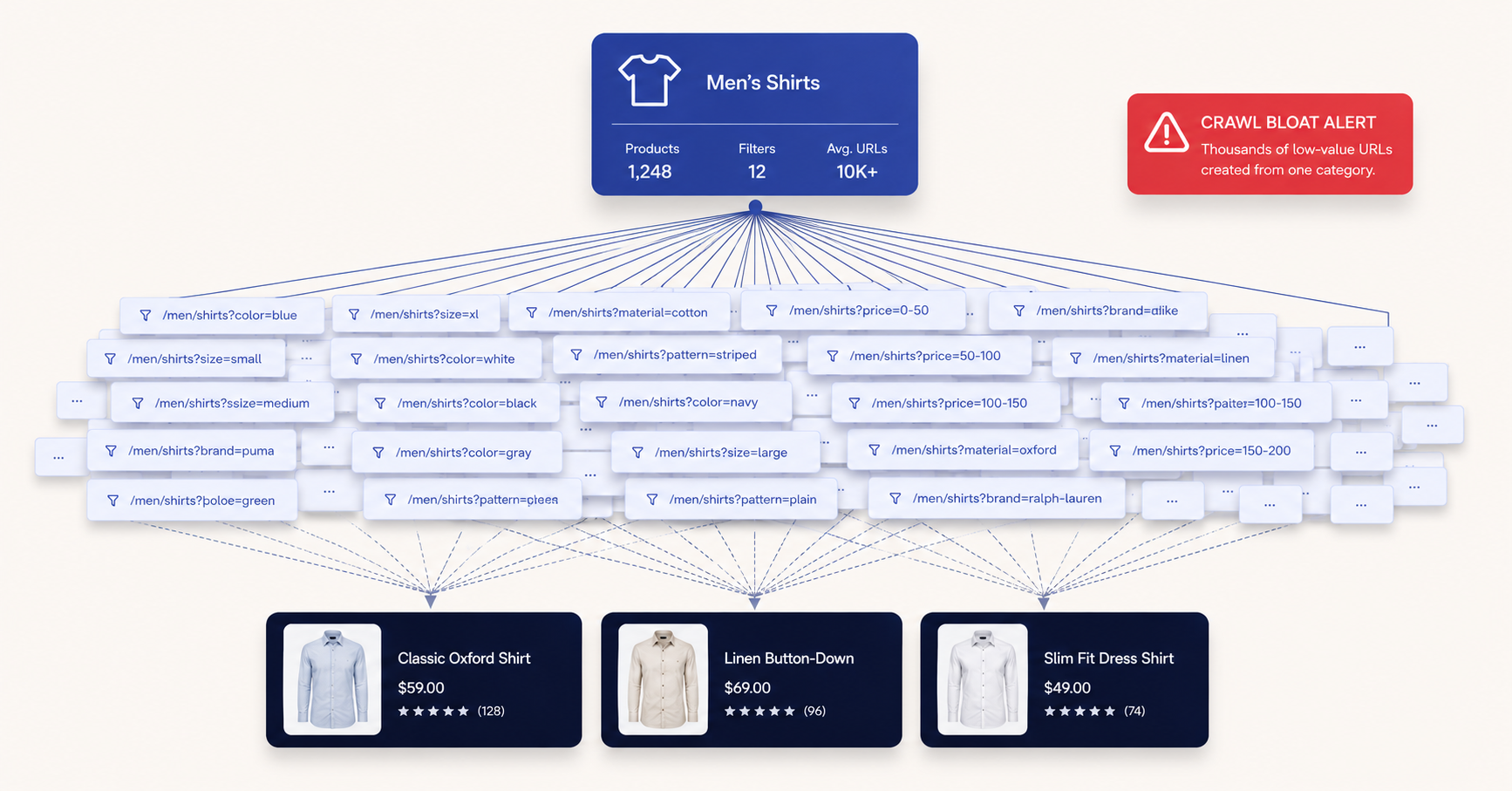
The clearest example is layered navigation. A single category with 8 filters across 100 products can generate around 4,000 indexable URL combinations (Velsof, 2026). Multiply that across a catalog and Google ends up crawling five to ten times more URLs than you have products. Crawl budget is spent on color-and-size permutations rather than the pages you want ranked, and thin near-duplicate pages dilute the authority of the originals.
A Magento specialist knows this is the first place to look. A generalist often does not, because the WordPress and Shopify stores they cut their teeth on never produced the problem at this scale.
What does a Magento SEO company actually do differently?
A Magento SEO company works at the platform layer: it controls how Magento generates URLs, what gets indexed, how canonicals resolve, and how the catalog renders for speed. A generalist works at the content and link layer and leaves the platform untouched. That difference shows up across a handful of areas that recur on every serious Magento project, and they are the same areas we use as the selection criteria below.
Selection criteria: how to judge a Magento SEO company
Use these five criteria as a scorecard. A strong partner can show concrete work, not just claims, against each one. We have ordered them by how often they decide whether organic revenue grows or quietly leaks away.
1. Magento technical SEO: crawl, index, and faceted navigation control
This is the foundation. Ask exactly how a candidate handles layered navigation, URL parameters, and canonical tags. The right answer is specific: a defined policy for which filter combinations are crawlable, robots rules that match it, canonical tags that resolve multi-category products to one URL, and an XML sitemap that lists only the pages you want indexed.
Weak answers stay abstract. If an agency cannot describe how it would stop a category with thousands of filter permutations from being crawled, it is a content team, not a Magento SEO company. Our breakdown of an SEO-safe robots.txt shows the level of platform detail a specialist works at.
2. Core Web Vitals and performance on a heavy catalog
Magento arrives feature-rich and heavy. Large JavaScript payloads, unoptimized images, and full-page-cache misconfigurations routinely push Largest Contentful Paint past the 2.5-second threshold and Interaction to Next Paint past 200 milliseconds. On a heavy catalog, those numbers do not fix themselves.
The business case is direct. Rakuten increased conversions by 33% and revenue per visitor by 53% after improving all three Core Web Vitals (web.dev case study). A Magento SEO company should treat performance as an SEO and conversion lever together, and work alongside developers on caching, image delivery, and front-end strategy, including modern stacks like Hyvä.
3. Migration and redirect SEO that survives a replatform
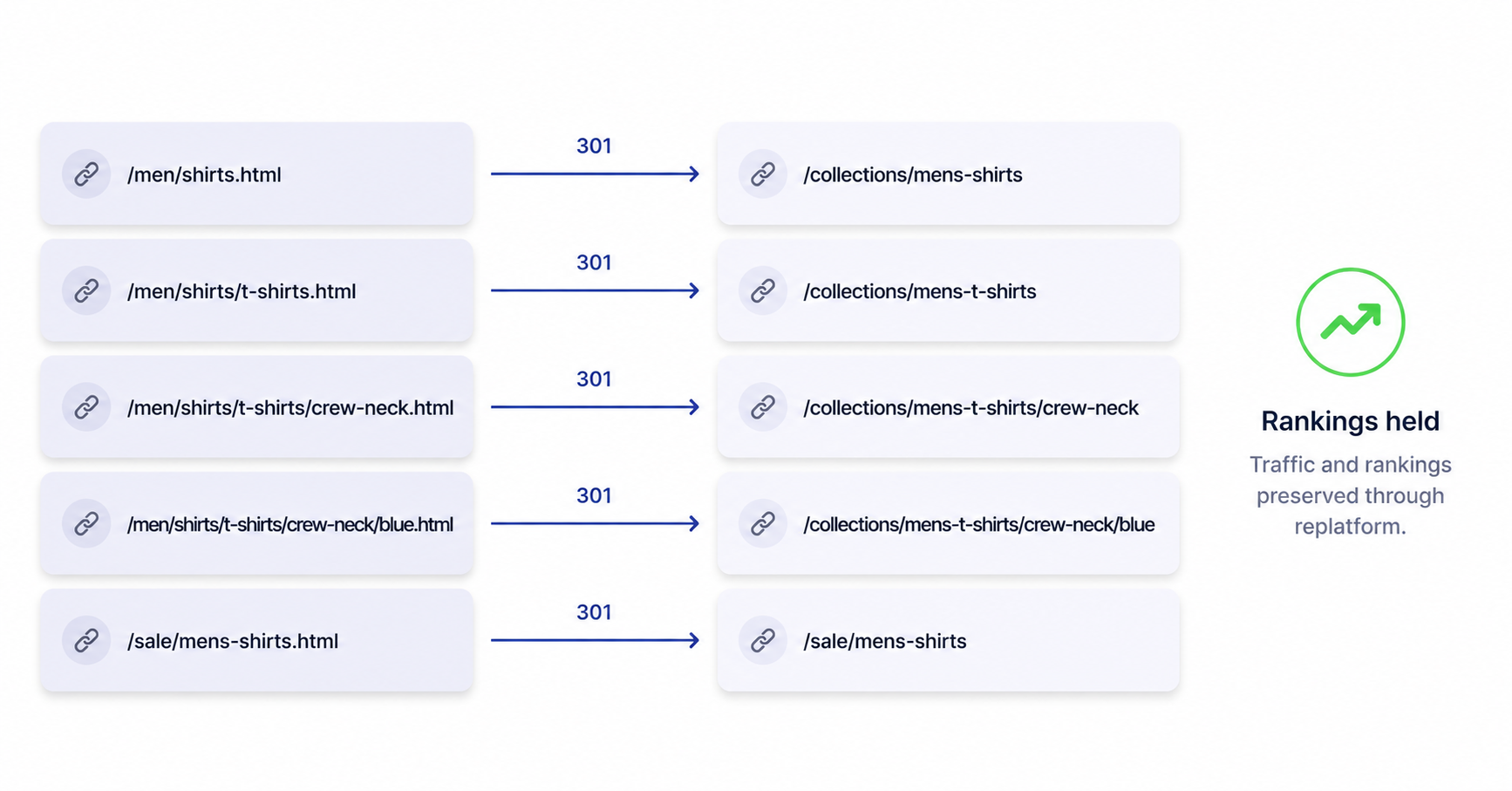
The fastest way to lose years of organic equity is a careless migration or version upgrade. URLs change, redirects get missed, and rankings fall off a cliff. A Magento SEO company mitigates that risk with disciplined 301 redirect mapping and a pre-launch SEO checklist.
Ask for the process. A good partner can describe full URL-to-URL mapping, redirect testing in staging, and post-launch monitoring. Our 301 redirect mapping guide outlines the approach that preserves rankings during a Magento 2 move, and it is a fair benchmark for what a specialist should already do by default.
4. Structured data and AI Overview readiness
Product, breadcrumb, and review schema are no longer optional. They drive rich results and, increasingly, whether your pages are eligible to be cited in AI-generated answers. Google AI Overviews already appear in around 16% of eCommerce searches and have been measured to cut click-through rates from 1.41% to 0.64% on affected queries (The Digital Bloom, 2025).
A Magento SEO company should deliver complete, valid structured data across product and category templates, not a half-filled snippet that throws errors in validation. Ask to see the live schema on a store they manage and run it through a validator yourself.
5. Proven ranking and revenue results
Certifications and tidy decks are table stakes. What separates real specialists is documented outcomes tied to organic search: traffic recovered after a migration, rankings held through an upgrade, and revenue attributable to organic growth. scandiweb has published cases such as a 17% organic traffic gain following a Magento 2 migration, which is the kind of before-and-after evidence you should ask every candidate to produce.
How Magento SEO pricing maps to revenue at stake
Retainers for Magento SEO typically range from roughly 1,500 to 5,000 US dollars per month, with technical audits costing a few thousand dollars up front and larger projects climbing from there. Those numbers only mean something against the revenue they protect, so read a quote as a percentage of the organic revenue at risk, not as a line item to minimize.
Anchor it to a real number. The average return on SEO investment across industries is about 748%, or roughly 22 US dollars back for every dollar spent, with eCommerce specifically near 1,600% over time (FirstPageSage, 2025). On a store doing several million in annual organic-attributed revenue, a 4,000-dollar-a-month specialist who protects that channel through an upgrade is cheap insurance. A 1,200-dollar generalist who lets a botched migration drop you 30% is the expensive option, even though the invoice is smaller.
So the pricing question is really a scope question. Ask each candidate what share of your organic revenue their work touches and how their fee compares to a worst-case ranking loss in your category. A specialist answers in revenue terms. A generalist retreats to deliverables and hours, which is the tell.
Multi-store and multi-language SEO: the Magento trap generalists miss
Magento’s native multi-store and multi-website architecture is one of its biggest commercial strengths and one of its quietest SEO liabilities. A single Magento installation can serve many store views across domains, languages, and regions, and each store view can produce its own URLs for the same underlying products. Done wrong, that means duplicate content competing against itself across markets.
The platform-specific fixes are exact: hreflang annotations so Google serves the right language and regional version, canonical tags that respect store-view boundaries rather than collapsing them, and a sitemap and robots strategy scoped per store. Cross-domain duplication between, say, a .com and a .de view is a common and costly mistake when a generalist treats each domain as an unrelated site.
This is not a niche concern. International sales now account for close to 29% of total eCommerce revenue, and cross-border eCommerce is forecast to continue outpacing domestic growth into 2026 (DHL, 2025). For any brand running multiple store views, the agency you choose must detail a store-view-level SEO model in detail. Ask a candidate to walk you through structuring a three-country Magento store, and the depth of the answer tells you whether they have done it before.
Best Magento SEO companies to evaluate in 2026
The agencies below specialize in Magento and Adobe Commerce SEO. Use the entries as a starting shortlist, then score each against the five criteria above. We have noted who each fits and what to watch for, with the summary table after the entries as your at-a-glance recap.
scandiweb
scandiweb is an eCommerce agency that has worked with Magento since the platform’s early days, and it combines technical SEO with the engineering and conversion optimization needed to act on its findings. It fits mid-market to enterprise brands that want SEO, development, and conversion work under one roof rather than coordinated across three vendors. The core strength is that the recommendations and the code that delivers them live in the same team, because most Magento SEO fixes are platform changes: a redirect map, a caching strategy, a template-level schema rollout.
scandiweb is built for ambitious budgets and complex stores, so the smallest single-store merchants may find the model heavier than they need. If your real question is whether you need an SEO specialist or a development partner first, our roundup of top Magento development companies is a useful companion read, because on Magento, those two decisions usually overlap.
OuterBox
OuterBox is a US-based digital agency with a long track record in eCommerce SEO and paid search. It fits American brands that want full-funnel Adobe Commerce marketing, where organic and paid are planned together rather than bought from separate shops. Its strength is a catalog-scale indexation strategy tied to a wider performance-marketing program, which suits retailers thinking about blended acquisition cost rather than channels in isolation.
Because OuterBox spans the full digital-marketing spectrum, confirm the depth of dedicated Magento technical expertise for your specific account and ask who owns the platform-level work as opposed to the campaign layer. Press for named examples of faceted navigation and migration work, not just traffic charts.
Inchoo
Inchoo is a European agency with a deep Magento engineering heritage that predates many of its competitors. It fits merchants who want SEO led by people who genuinely understand the codebase, particularly where technical fixes and development happen in the same conversation. The strength is developer-led SEO: when the highest-impact work is redirect logic, caching, and template-level structured data, an agency that built Magento stores for years brings platform fluency that content-first shops cannot match.
The watch-out is the size of the dedicated SEO bench relative to a full-service performance agency. Confirm that strategic SEO, content, and reporting get the same attention as the engineering, and clarify how ongoing monitoring is staffed once the technical groundwork is complete.
Meetanshi
Meetanshi is best known as a Magento extension developer and also offers SEO and store optimization services. It fits stores that already lean on Magento extensions and want SEO support from a team fluent in the same technical environment. The strength is genuine product knowledge: because the team builds and maintains modules, it understands how they interact with crawl, indexation, and performance, which can make technical recommendations more grounded than a pure agency might offer.
SEO is one service among many. Confirm you are getting a dedicated SEO strategy; ask for organic outcome data with timeframes, and validate that strategic search work is staffed independently of the product team.
Amasty
Amasty is a major Magento extension vendor whose services arm offers on-page and technical SEO close to the codebase. It fits Open Source stores already running Amasty extensions that want optimization from a team that knows those modules intimately. The strength is proximity to the code: recommendations land faster when the same team understands exactly how the installed extensions generate URLs, schema, and cached output.
A vendor naturally frames problems in terms of its own modules, so confirm the SEO work is platform-agnostic where it needs to be and is judged on organic results. Ask for case evidence outside their own extension catalog.
| Company | Best fit for | Strength | Watch-out |
|---|---|---|---|
| scandiweb | Mid-market to enterprise brands wanting SEO, development, and CRO under one roof | Technical SEO tied to Magento engineering and migration work | Built for ambitious budgets, not the smallest stores |
| OuterBox | US brands wanting full-funnel Adobe Commerce SEO | Catalog and indexation strategy, paid plus organic | Broad digital-marketing focus beyond Magento alone |
| Inchoo | European merchants needing deep Magento engineering | Long Magento heritage and developer-led SEO | Smaller dedicated SEO bench than full-service agencies |
| Meetanshi | Stores wanting Magento extensions plus SEO support | Strong Magento product and technical knowledge | SEO is one line among many services |
| Amasty | Open Source stores already using their extensions | On-page and technical SEO close to the codebase | Extension-vendor lens rather than pure agency |
How to choose: a short decision framework
Run every candidate through the same four questions. The answers separate specialists from generalists faster than any sales call.
- Show me your faceted navigation policy. A specialist describes a concrete crawl-and-index rule set. A generalist talks about meta titles.
- Walk me through your last migration. Look for redirect mapping, staging tests, and post-launch monitoring, not just a launch date.
- Show live structured data on a store you run. Then validate it yourself. Errors here are a fast disqualifier.
- Prove a result. A documented organic traffic or revenue gain, with the timeframe, beats a list of logos.
How long until a Magento SEO company shows results?
Technical fixes such as crawl control, redirects, and Core Web Vitals can show measurable movement within 3 to 4 months. Sustained ranking and revenue growth usually take 6 to 12 months, depending on competition and catalog size.
Do you need a developer as well as an SEO agency?
Often yes, because the highest-impact Magento SEO work is code: redirect rules, caching, template-level schema, and performance tuning. A partner that handles SEO and development together removes the handoffs where fixes stall.
Scope note: SEO partners versus development and platform choices
This guide covers SEO and technical SEO firms for Magento only. Two adjacent decisions deserve their own scope. If you are choosing who builds or rebuilds the store, the development roundup linked above is the right reference. If you are still deciding whether Magento is the right platform at all, our Magento vs Shopify comparison covers the SEO and total cost trade-offs first.
Frequently asked questions
What is Magento SEO?
Magento SEO is search engine optimization for stores running Adobe Commerce or Magento Open Source. It combines standard SEO with platform-specific work: controlling crawl and index bloat from layered navigation, fixing canonicals, tuning Core Web Vitals on a heavy catalog, and protecting rankings through migrations and upgrades.
Why hire a Magento SEO company instead of a generalist agency?
Because Magento creates platform-specific problems a generalist rarely encounters, such as thousands of filtered URLs from faceted navigation and full-page cache misconfigurations that wreck performance. A specialist knows where to look and can fix the platform, not just the content around it.
How much do Magento SEO services cost?
It varies by scope. Technical audits commonly run a few thousand dollars, ongoing retainers range from roughly 1,500 to 5,000 US dollars a month, and larger project-based work runs higher. Pricing should map to the revenue at stake, not to a fixed package.
How is Magento SEO different from generic eCommerce SEO?
The strategy layer is similar, but the technical layer is not. Magento’s URL generation, layered navigation, multi-store setup, and caching all behave in ways that demand platform knowledge. Generic eCommerce SEO advice usually skips these because it assumes a simpler platform.
Does Magento SEO protect rankings during a replatform or upgrade?
It should be the main reason you hire a specialist for one. Disciplined 301 redirect mapping, staging tests, and post-launch monitoring are what keep organic traffic and rankings intact when URLs change. Skipping this is the most common way stores lose years of organic equity.
What results should a Magento SEO company be able to prove?
Documented organic outcomes with timeframes: traffic recovered after a migration, rankings held through an upgrade, or revenue growth attributable to organic search. Logos and certifications are table stakes, not evidence.
Can the same partner handle both SEO and Magento development?
Yes, and on Magento it is often the better setup. Because most high-impact fixes are code changes, a partner that handles SEO and development together avoids the handoffs where recommendations get stuck in a backlog.
Want rankings that survive a replatform and an upgrade? Have our specialists review your Magento SEO and pressure-test it against the criteria above.