
“We are writing to inform you about an incident that may involve some of your information.”
That sentence opens a breach notice, the letter a business must send customers and some state regulators after a breach. It comes from an online store’s letter, one of several we read that open this way.
If your store runs on Magento (Adobe Commerce), you may be earlier in that story. Before a store writes that sentence, it goes through what you may be in right now: a Magento security breach, with malware (code an attacker planted) on the site and no clear first step.
What do you do first, how long has this been going on, and who do you have to tell?
Key findings
scandiweb read every breach notice Washington State’s Attorney General has published and counted what happened in the ones where a card skimmer, code that copies card details as a shopper types them at checkout, was found on a store’s website.
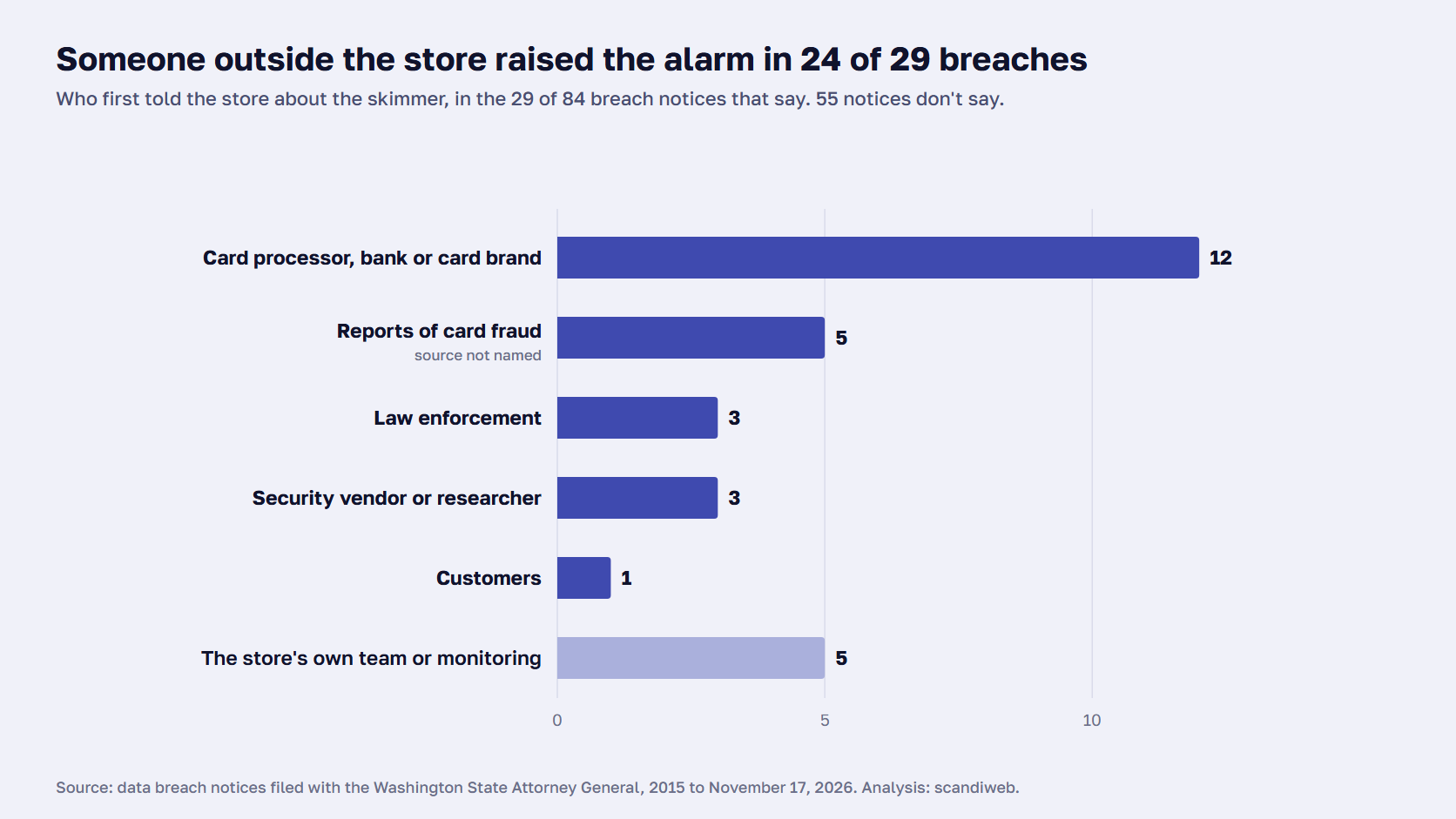
- When a card skimmer is found on an online store, someone outside the store usually raised the alarm: in 24 of the 29 breach notices that say how the store found out, it was a card processor, bank, card brand, law enforcement, a security firm or customers, scandiweb’s analysis of 84 skimming notices filed in Washington State from 2015 to November 2026 found.
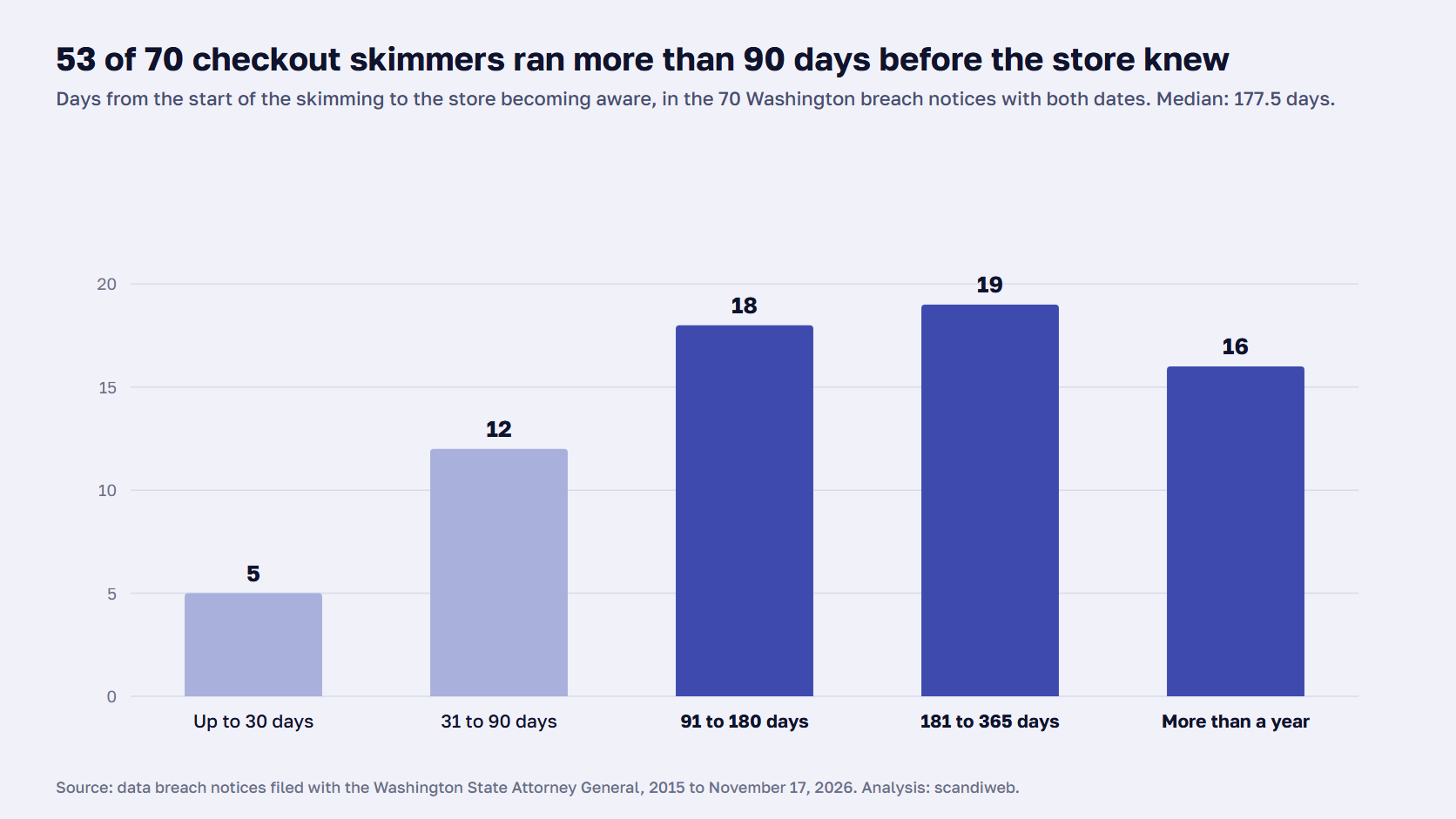
- Card skimmers on breached online stores ran for a median of 177.5 days, almost six months, before the store became aware, and 53 of 70 ran longer than 90 days, according to scandiweb’s analysis of Washington State breach notices with both dates.
- In 15 of the 59 skimming notices that give both dates, the skimming had already stopped before the store found out, scandiweb’s count of Washington State breach letters shows.
- From the start of the skimming to the notice reaching Washington’s Attorney General took a median of 280 days across 75 cases, and 32 of the 41 stores that learned of a breach after March 1, 2020 filed more than 30 days after the awareness date they reported, scandiweb’s analysis found.
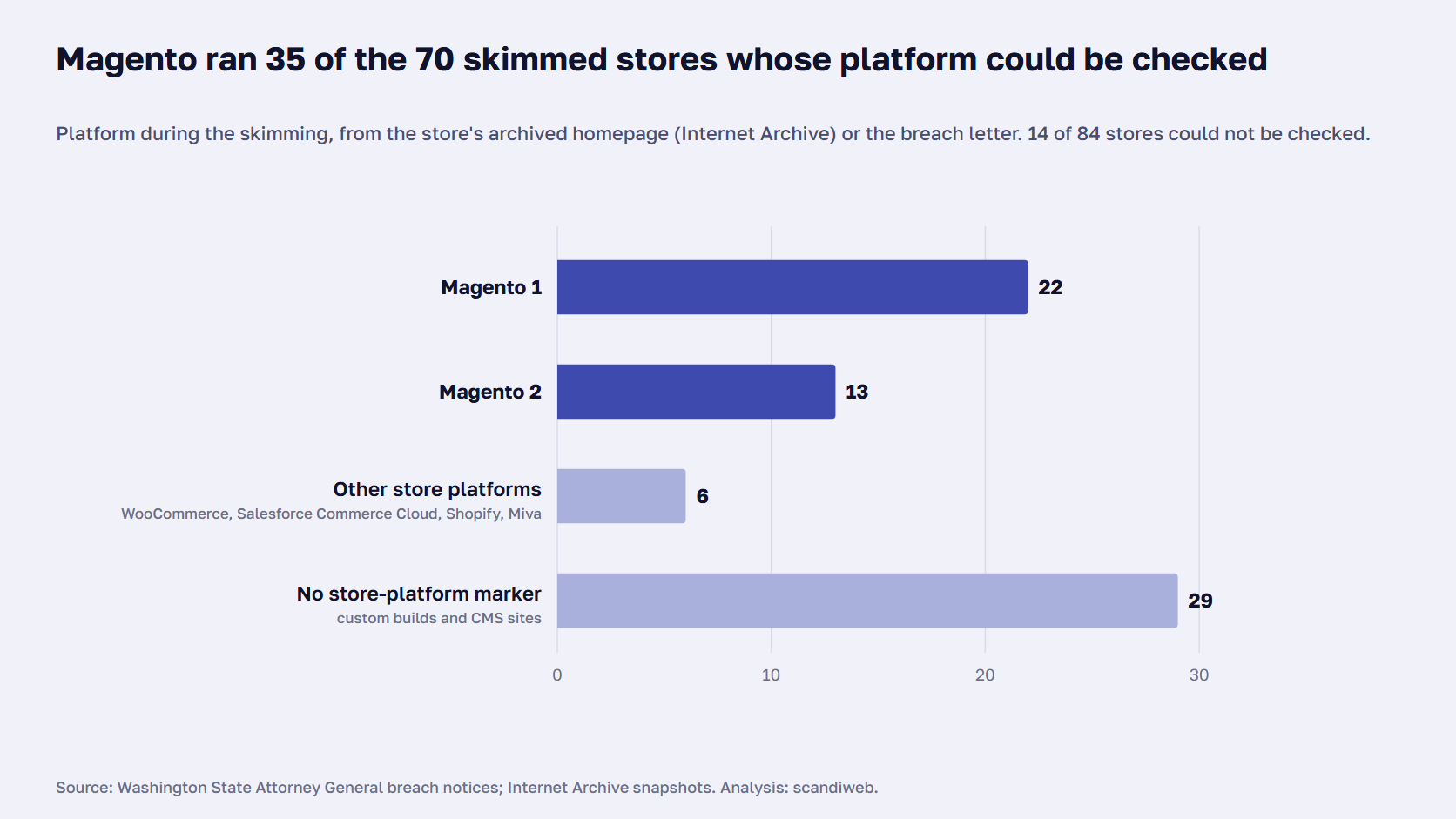
- Magento (Adobe Commerce) ran 35 of the 70 skimmed stores whose platform scandiweb could check from archived copies of their homepages and the letters: 22 on Magento 1 and 13 on Magento 2.
- Of the 26 checkable skimmed stores that filed from 2021 on, 11 ran Magento and 9 of those ran Magento 2, scandiweb’s analysis of Washington State breach notices found.
- On Magento Stack Exchange, 21 of the 42 hacked-store reports that say where the malicious code was found it in the database rather than in files, scandiweb’s review of 95 incidents posted from 2014 to 2026 found.
What to do first after a Magento security breach
After a Magento security breach, preserve evidence before you clean. Stop card data from leaving the checkout, call your payment processor (the company that runs your card payments) the same day, and bring in a forensic investigator, a firm that works out how and when the attacker got in. Then remove the code and stop sharing an admin password, patch level, or hole with the attacker.
The first hour
- Don’t wipe, restore, or rebuild yet. Copy the site files, database, and server and web logs first, and ask your host in writing to keep its logs and system images.
- Stop card data from leaving the checkout with maintenance mode, or by turning off the affected payment method. Visa’s guide says compromised systems should come off the internet and stay out of payment processing.
- Don’t log in to the compromised server to clean it or change passwords before the copy is made, and don’t reboot it, as Visa’s guide says. Change passwords afterward, from a clean computer.
- Call your payment processor or acquiring bank, the bank behind your merchant account, the same day. Visa requires a report within three calendar days, and the card networks may already know.
- Write down what you saw, when, who has admin access, and what you changed, with times.
The first day
- Bring in a forensic investigator before you clean, or at the same time.
- Find the code, in the database as well as the files. The removal section below lists where to look.
- Close the way in once the investigator has what they need. Remove unknown admin accounts, reset every password and API key, and apply the latest security patch.
- Watch for a second infection, since one store reported malware reinstalled about ten weeks after its first cleanup. Run Adobe’s Security Scan Tool and check the checkout daily for a few weeks.
- Prepare notices with your lawyer, as covered below.
🚀 Quick takeaway
Because 15 of 59 skimmers had already stopped when the store found out, a clean-looking checkout proves little. Copy the logs first.
How scandiweb measured Magento security breaches
scandiweb measured Magento security breaches through public breach notices. We downloaded all 1,896 notices the Washington State Attorney General’s Office published from August 11, 2015 to November 17, 2026, read the 349 that matched a keyword search, and found checkout skimming in 84.
A letter counts as checkout skimming when it says code, malware, or a script on the store’s own site took shoppers’ card details. A second reader recoded the letters independently. The sources are public.
- Washington State breach notices, the one state where anyone can download every letter
- The Attorney General’s dataset, for each breach’s dates
- The Internet Archive, for each store’s homepage at the time
- HTTP Archive, for each platform’s share of US websites
- Magento Stack Exchange, for what owners of hacked stores reported
No merchant is named in this article or the data file.
How long does a skimmer run before the store notices?
A skimmer runs for a median of 177.5 days, almost six months, before the store becomes aware of it, across the 70 Washington notices with both dates. The middle half ran 97 to 347 days, 35 ran longer than 180 days, and 16 longer than a year.
| Days from the start of the skimming to the store becoming aware | Notices |
|---|---|
| Up to 30 days | 5 |
| 31 to 90 days | 12 |
| 91 to 180 days | 18 |
| 181 to 365 days | 19 |
| More than a year | 16 |
| Total with both dates | 70 |
The letters’ own dates agree, with a median of 180.5 days from the start of the skimming to the store’s discovery (60 letters). In 15 of 59 letters, the skimming had already stopped before the store found out.
The notice reached Washington’s Attorney General a median of 48 days after the store became aware (76 cases), and 280 days, about nine months, after the skimming started (75 cases).
Washington’s law has given 30 days from discovery since March 1, 2020, and 45 days before. Of the 41 stores that became aware on or after that date, 32 filed more than 30 days after the awareness date they reported. The law allows delays, for example at law enforcement’s request, so read this as a count only.
🚀 Quick takeaway
With a median of 177.5 days, last month’s backup probably holds the skimmer too. Date the start of the skimming before you restore.
How do I know if my Magento store is hacked?
Usually someone else tells you first. In 24 of the 29 notices that say how the store learned of the skimmer, the news came from outside. Treat a call from your processor or bank about fraud traced to your store as the sign.
| Who first told the store | Notices |
|---|---|
| Card processor, bank or card brand | 12 |
| Reports of card fraud, source not named | 5 |
| Law enforcement | 3 |
| Security vendor or researcher | 3 |
| Customers | 1 |
| The store’s own team or monitoring | 5 |
| Letter doesn’t say | 55 |
| Total | 84 |
Two of the letters name a “common point of purchase” report. Card networks produce one when many stolen cards were all used at the same store, then trace the fraud back to it.
Owners who found their Magento hacked and posted on Magento Stack Exchange saw other first signs. In 95 incidents from 2014 to 2026, the most common were unknown code found while looking (22), redirects or spam (15), a host or scanner warning (15), a broken or odd checkout (8), and an unknown admin user (4). Card fraud reports came first once.
That sample is mostly Magento 1 (74 of 95 incidents) and mostly from before 2018.
| Where the malicious code or change was found | Reports |
|---|---|
| Database: store configuration (for example the admin’s HTML head or footer scripts) | 12 |
| Database: admin user accounts | 5 |
| Database: CMS blocks or pages | 4 |
| Core or module PHP files | 12 |
| Theme or template files | 3 |
| Third-party extension files | 3 |
| JavaScript files | 2 |
| .htaccess or server configuration | 1 |
| Total that say where | 42 |
Of the 42 reports that say where the Magento malware was, 21 found it in the database and 21 in files.
🚀 Quick takeaway
Stores’ own teams found 5 of the 29 skimmers. Ask your processor who it would call about fraud at your store.
Which platforms do breached stores run?
Magento ran 35 of the 70 skimmed stores whose platform scandiweb could check, 22 on Magento 1 and 13 on Magento 2. Of the 26 checkable stores that filed from 2021 on, 11 ran Magento, and 9 of those ran Magento 2.
| Platform during the skimming | Stores |
|---|---|
| Magento 1 | 22 |
| Magento 2 | 13 |
| Other store platforms (WooCommerce 2, Salesforce Commerce Cloud 2, Shopify 1, Miva 1) | 6 |
| No store-platform marker (custom builds and CMS sites) | 29 |
| Could not be checked | 14 |
| Total | 84 |
As a base rate, HTTP Archive puts Magento at about 10% of US websites running a major eCommerce platform in 2020 (9.6%), and 13% to 14% of the 100,000 most-visited ones in 2021 and 2022. Magento stores are overrepresented in these notices, but the data can’t say by how much.
Our reading: on a self-hosted platform like Magento, the checkout code runs on the merchant’s own server, so keeping it clean and patched is the merchant’s job, and attackers have long built tools aimed at Magento. Hosted platforms move more of that risk to the provider, but not all of it.
The letters don’t say whether the Magento stores were patched, so they can’t show that Magento’s code is less secure than any other platform’s. Our Magento security news hub lists the vulnerabilities attackers have used against it.
Another 48 online stores (55 letters) were breached through their hosted eCommerce platform or vendor, so they aren’t in the platform count.
🚀 Quick takeaway
Of the 11 Magento stores that filed from 2021 on, 9 ran Magento 2. Ask your developer for your exact version and patch level.
How do I remove malware from Magento?
To remove malware from Magento, follow the five steps of Adobe’s security action plan, which are diagnose, clean, protect, report, and upgrade. Add one check to it, the database, because half of the Magento Stack Exchange reports that say where the code was found it there.
For Magento malware removal, we work in this order. It applies to Magento 2 malware as much as to Magento 1.
- Copy the files, database, and logs first, so the investigator has them.
- Check the database, starting with the store configuration’s HTML head and footer scripts (Content > Design > Configuration in the Magento admin), CMS blocks and pages, and admin users.
- Check recently changed files, cron jobs, unfamiliar extensions, and the
/mediafolder, which Adobe’s plan flags for leftover executable code. - Remove unknown admin users and reset all admin passwords, as Adobe’s plan says, then change database, hosting, and payment credentials.
- Once the store is clean, apply the latest Magento security patch. If your version no longer gets fixes, plan an upgrade with our Magento end of life dates.
- Rescan, then go through our Magento security checklist.
Restoring a backup from before the infection only helps if you know when it started, and in these letters it usually started months earlier.
Who do I need to notify after a Magento security breach?
After a Magento security breach, notify your payment processor and acquiring bank at once, and the card brands through them (Visa asks within three days). Customers and regulators follow, under the law of each state or country where your customers live. This section is general and isn’t legal advice, so check the details with a lawyer.
Visa’s guide for compromised entities (Version 10.0) requires a compromise to be reported “within three (3) calendar days” of reasonable suspicion or confirmation. An incident report follows within three more calendar days.
As one state example, Washington law (RCW 19.255.010) requires notice to affected residents “no more than thirty calendar days after the breach was discovered.”
🚀 Quick takeaway
Visa’s three calendar days start at reasonable suspicion, before anything is confirmed. Call your processor when you first suspect a skimmer.
When to bring in outside help
Bring in outside help on the first day, before the cleanup or alongside it. In the notices, 72 of the 84 stores hired a forensic or security firm. The three options below do different jobs, and none covers everything a breached store needs.
Your developer or host. They are fast and know the setup. They may also have built or run the setup that was breached, and a quick cleanup can destroy the logs a forensic investigation needs.
A PCI forensic investigator. The card brands may require a PCI Forensic Investigator (PFI), approved by the council behind PCI DSS, the card industry’s security standard. They find how and when the attacker got in, and they usually don’t fix or harden the store afterward.
A Magento security audit from scandiweb. After the investigation, we review the codebase, extensions, admin access, patch level, and server setup, so the hole that was used, and others like it, gets closed. An audit doesn’t replace a forensic investigation when the card brands ask for a PFI.
If bots are running stolen cards through your checkout rather than copying them, that’s carding, and our guide covers how to stop a carding attack.
We have also written up a credit card hijacking case and a Magento 2 security guide.
What we expected and did not find
Two things we expected didn’t hold up in the data. We expected Magento 1, which lost Adobe’s support in June 2020, to explain most of the Magento cases, and we expected more stores to catch skimmers with their own monitoring.
- Magento 1 explains the early cases, which cluster in 2016 to 2018, but only 2 of 22 ran past its end of support. From 2021 on, 9 of the 11 skimmed Magento stores ran Magento 2.
- Only 5 of the 29 letters that say how the store found out name its own team or tools. Adding 6 vaguer “we discovered” letters makes it 11 against 24.
Limitations
This count has eight limits that affect how to read the numbers. It covers one state’s published notices and depends on what each letter says, so any skimming that was never found or never reported is missing from it entirely.
- Washington requires a notice to its Attorney General only above 500 affected residents, so the set is mostly mid-size and large stores
- The dates are the stores’ own, often a forensic estimate, and two clear errors were corrected from the letters
- Classifying a letter as skimming is a judgment, and two readers disagreed on 12 of the 113 letters they both read
- 55 of 84 letters don’t say how the store found out
- A homepage isn’t the checkout, 14 stores couldn’t be checked, hosted-vendor breaches aren’t in the platform count, and no letter gives a version or patch level
- HTTP Archive starts in 2020 and counts sites rather than merchants
- Skimming notices fell to 4 or 5 a year from 2022 on
- Magento Stack Exchange is self-selected, mostly Magento 1, and mostly from before 2018
What scandiweb will measure next
scandiweb will rerun this count every November with the new year’s notices. We will also add other states that publish their letters, and match breach dates against the Magento vulnerabilities attackers used at the time, which the letters alone can’t show.
Frequently asked questions
What is Magecart?
Magecart is a common name for digital skimming, where code placed on an online store copies card details as shoppers type them at checkout. In 63 of the 84 notices, the card security code (CVV) was or may have been taken.
How do skimmers get into a Magento store?
Many notices don’t say. The ones that do name a software vulnerability in the store platform or its content management system, or stolen login details, in one case a third-party vendor’s admin credentials. That’s why patching and admin access come first after the clean-up.
Can I keep my store open while I investigate?
Visa’s guide says compromised systems should come off the internet and stay out of payment processing. For a store, that means maintenance mode, or turning off the affected payment method, once the files, database, and logs are copied. Ask your processor before taking cards again.
Does upgrading to Magento 2 stop skimmers?
No. Magento 2 ran 13 of the 35 skimmed Magento stores in this count, and 9 of the 11 that filed from 2021 on. Adobe’s action plan says to stay on the most current release and apply security patches as they become available.
Is a hosted platform like Shopify safer from skimming?
We read the data this way: hosted platforms move more of the risk to the provider, but not all of it. Two skimmed stores ran Salesforce Commerce Cloud, and 48 more were breached through their hosted platform or vendor. One store ran Shopify, and its letter says Shopify’s security features stopped the code from working.
Will Adobe’s Security Scan Tool find a skimmer?
The data can’t say how often a scan catches a skimmer. Adobe’s action plan starts with one, so run it. Stores’ own teams found only 5 of the 29 skimmers whose discovery the notices describe, so check the checkout by hand too.
Cite this research
scandiweb. “Magento Security Breach: What to Do First, Based on 84 Breach Notices.” November 2026. https://scandiweb.com/blog/magento-security-breach/. Data: Washington State Attorney General breach notices, 2015 to November 17, 2026.
Main takeaway
If a Magento security breach has happened to your store, it has probably been going on for months, and someone else probably noticed first. The median skimmer in scandiweb’s count ran 177.5 days, and outsiders raised the alarm in 24 of the 29 notices that say who did.
Preserve the evidence before anyone cleans, and call your payment processor the same day. Then clean the database as well as the files, because half of the hacked-store reports that say where the code was found it in the database.
After that, close the hole the attacker came in through. Remove unknown admin accounts, change every password and key, and apply the missing patch. Check your notice deadlines with a lawyer along the way.
Once the investigation is done, a Magento security audit from scandiweb finds the hole that was used and others like it.































Share on: