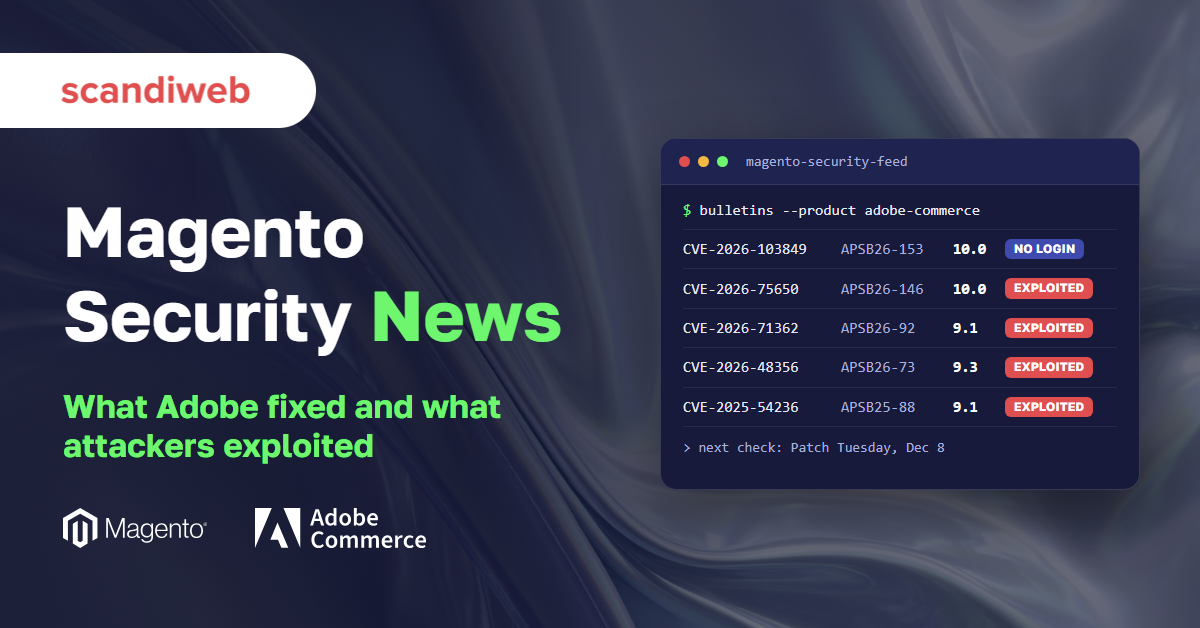

Magento security news usually reaches you as a headline: a new flaw was found in Magento (Adobe Commerce), and stores should patch now. You read it and assume it’s about your store, and that the alarm in the headline is the alarm Adobe is raising. The headline can’t confirm either. It leaves out whether your version is affected, whether anyone is attacking the flaw yet, and whether Adobe’s own urgency rating matches the risk.
Those details are in the security bulletin, Adobe’s notice that lists the security holes it fixed and the versions affected. So every headline leaves the same two questions open: is my store affected, and how urgent is this one really?
Latest Magento security news: vulnerabilities and fixes
As of November 16, 2026, the newest Magento vulnerability, or security hole, that Adobe has fixed is CVE-2026-103849, in security bulletin APSB26-153 of October 13, 2026. It scores 10.0 out of 10 and needs no login. The newest one confirmed as exploited, meaning attackers used it against real stores, is PolyShell, which CISA listed on October 27, 2026. Adobe’s November 10 Patch Tuesday had no Adobe Commerce bulletin.
This table is the short version of Magento security news today. It lists every Magento vulnerability in CISA’s Known Exploited Vulnerabilities catalog, plus the newest one Adobe fixed and PHP2Shell, a PHP flaw fixed by a server update. Each vulnerability has a CVE ID, the reference number it is published under, and the scores are Adobe’s CVSS scores, a severity rating out of 10. None of them needs a login to use.
Last updated: November 16, 2026. Next scheduled check: December 8, 2026, Adobe’s next Patch Tuesday.
| Date | Vulnerability | Adobe bulletin | Score (out of 10) | On CISA’s exploited list | Fixed in |
|---|---|---|---|---|---|
| Oct 21, 2026 | PHP2Shell (a PHP flaw, not Magento code): CVE-2026-109618, CVE-2026-109619 | PHP security release | – | Oct 26, 2026 | PHP releases of Oct 21, 2026 |
| Oct 13, 2026 | Template injection, unnamed: CVE-2026-103849 | APSB26-153 | 10.0 | Not listed | 2.4.4–2.4.9 “-2026-oct” releases |
| Sep 7, 2026 | StyleSmuggler: CVE-2026-75650 | APSB26-146, out of band | 10.0 | Sep 8, 2026 | Hotfix VULN-39341 for 2.4.4–2.4.9 |
| Aug 11, 2026 | Incorrect authorization, unnamed: CVE-2026-71362 | APSB26-92 | 9.1 | Sep 24, 2026 | 2.4.4–2.4.9 “-2026-aug” releases |
| Jul 14, 2026 | PolyShell: CVE-2026-48356 | APSB26-73 | 9.3 | Oct 27, 2026 | 2.4.4–2.4.9 “-2026-jul” releases |
| Sep 9, 2025 | SessionReaper: CVE-2025-54236 | APSB25-88 | 9.1 | Oct 24, 2025 | Hotfix, then 2.4.4-p16 to 2.4.8-p3 (Oct 2025) |
| Jun 11, 2024 | CosmicSting: CVE-2024-34102 | APSB24-40 | 9.8 | Jul 17, 2024 | 2.4.4-p9 to 2.4.7-p1, isolated patch ACSD-60241 |
| Feb 13, 2022 | Input validation: CVE-2022-24086 | APSB22-12 | 9.8 | Feb 15, 2022 | Patches MDVA-43395 and MDVA-43443 |
Which patch your store needs, and the steps to install it, are in our guide on how to apply a Magento security patch.
Key findings
scandiweb counted every vulnerability in Adobe’s Magento security bulletins from 2019 to November 16, 2026, 451 in total, and matched each one against CISA’s Known Exploited Vulnerabilities catalog and Adobe’s own bulletin pages, which gave the six findings listed below.
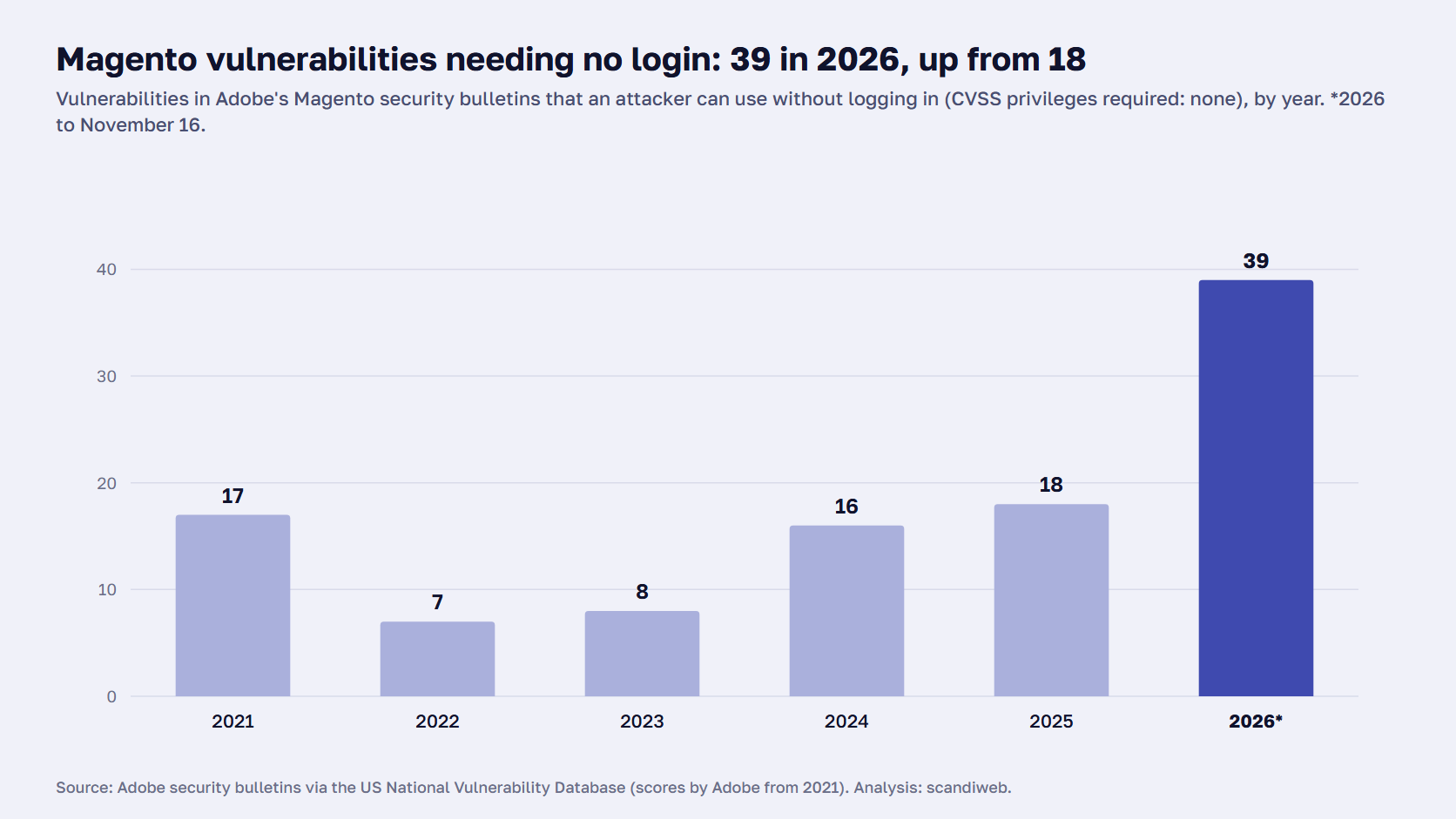
- scandiweb’s count of Adobe’s Magento security bulletins found 39 vulnerabilities in 2026, to November 16, that an attacker can use without logging in, more than double any year since Adobe began scoring its own Magento vulnerabilities in 2021.
- Three Magento vulnerabilities joined CISA’s Known Exploited Vulnerabilities catalog in 2026, as many as in all earlier years since the catalog began in November 2021, according to scandiweb’s review of the catalog.
- All six Magento vulnerabilities in CISA’s exploited catalog score 9.0 or higher out of 10 and need no login, scandiweb’s analysis of 451 Magento vulnerabilities published since 2019 found.
- None of the six exploited Magento vulnerabilities had Adobe’s top priority rating before attacks were known: scandiweb’s review of Adobe’s bulletins found four were first published at priority 2 or 3.
- Adobe fixed 75 Magento vulnerabilities in seven bulletins in 2026, to November 16, the most in any year since 2019, scandiweb’s count shows.
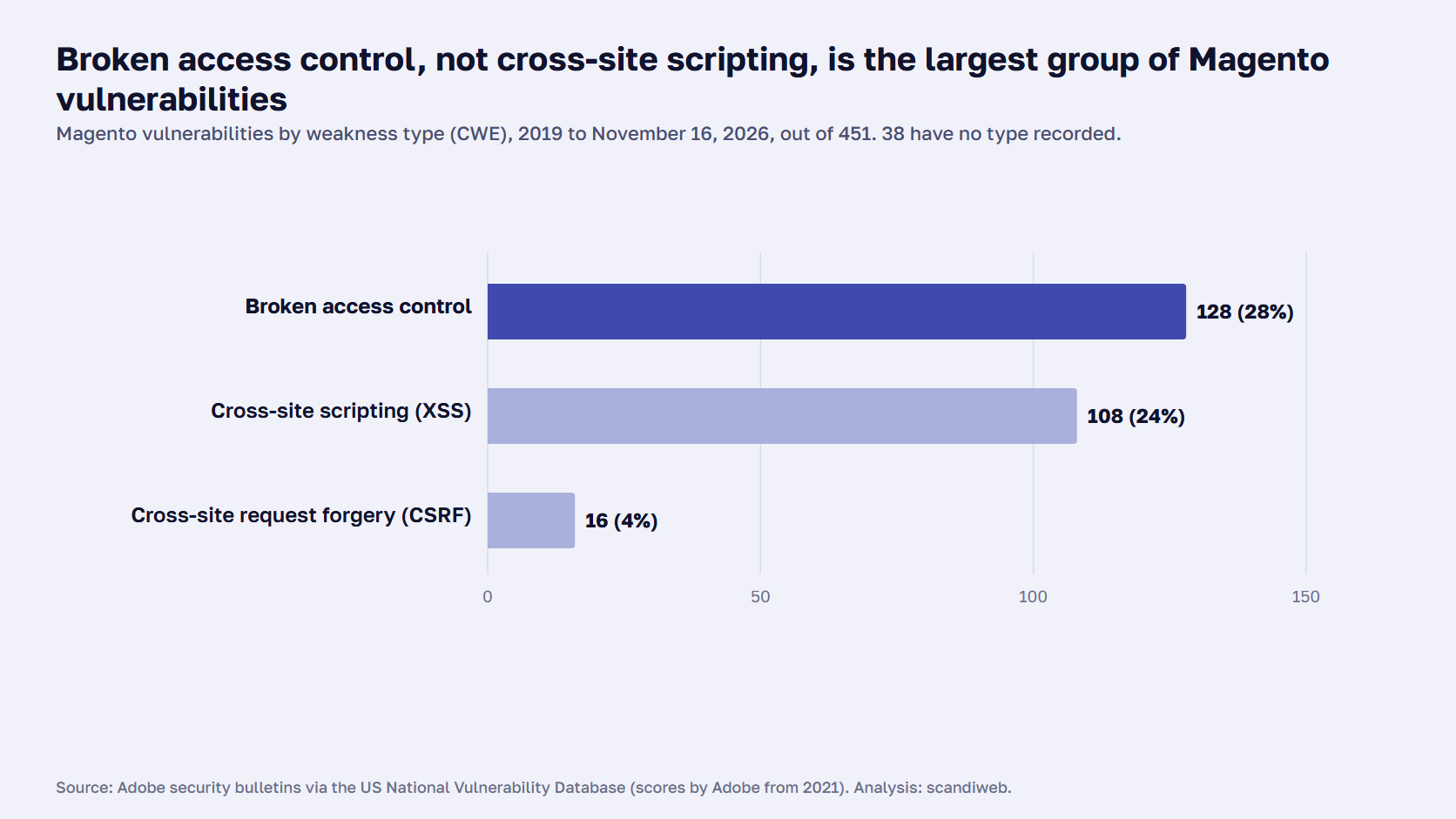
- Broken access control, not cross-site scripting, is the largest group of Magento vulnerabilities since 2019, with 128 of 451 (28%) against 108 (24%), scandiweb’s analysis found.
How scandiweb counted Magento vulnerabilities
scandiweb counted every vulnerability that an Adobe security bulletin for Adobe Commerce and Magento Open Source lists from 2020 onward, and for 2019 every one in Magento’s own security advisories. The data runs to November 16, 2026, and holds 451 vulnerabilities, drawn from four sources.
- The US National Vulnerability Database, for scores, whether a login is needed, and the weakness type
- CISA’s Known Exploited Vulnerabilities catalog, version 2026.11.13
- Adobe’s bulletin pages, read on November 16, 2026, for dates, priority ratings, and exploitation statements
- Sansec’s research pages, for when attacks were first seen
Third-party extensions and Magento 1 are excluded. “No login needed” means the “privileges required” value in the score is none, and “exploited” means listed in CISA’s catalog. A second reviewer re-ran every number before publishing, and the full dataset, one row per vulnerability, is in a spreadsheet.
How many Magento vulnerabilities did Adobe fix in 2026?
Adobe fixed 75 Magento vulnerabilities in seven security bulletins in 2026, to November 16, the most in any year since 2019, according to scandiweb’s count of Adobe’s bulletins. scandiweb counted 39 Magento vulnerabilities in 2026, to November 16, that need no login, more than double any year since 2021.
| Year | Vulnerabilities fixed | Bulletins | Score 9.0 or higher | No login needed | 9.0+ and no login | Added to CISA’s exploited list |
|---|---|---|---|---|---|---|
| 2019 | 129 | 6 | 7 | 39 | 7 | 0 |
| 2020 | 36 | 4 | 14 | 24 | 13 | 0 |
| 2021 | 52 | 4 | 18 | 17 | 0 | 0 |
| 2022 | 13 | 4 | 3 | 7 | 2 | 1 |
| 2023 | 28 | 4 | 2 | 8 | 0 | 0 |
| 2024 | 63 | 6 | 7 | 16 | 4 | 1 |
| 2025 | 55 | 6 | 2 | 18 | 2 | 1 |
| 2026 (to Nov 16) | 75 | 7 | 11 | 39 | 9 | 3 |
The no-login comparison starts at 2021 because the US National Vulnerability Database scored 2019 and most of 2020, and Adobe has scored its own Magento vulnerabilities since 2021. Of 2026’s 39, 28 need no action from a victim either, against 16 in 2025.
🚀 Quick takeaway
In 2026, to November 16, 39 of the 75 Magento vulnerabilities Adobe fixed (52%) need no login. In 2025 it was 18 of 55.
Which Magento vulnerabilities have attackers exploited?
Attackers have exploited six Magento vulnerabilities, going by CISA’s Known Exploited Vulnerabilities catalog. All six score 9.0 or higher out of 10 and need no login, scandiweb’s analysis of 451 Magento vulnerabilities published since 2019 found. Three of them joined the catalog in 2026.
StyleSmuggler (CVE-2026-75650) scores 10.0. Security firm Sansec disclosed it on Saturday, September 5, 2026, while no fix existed. Adobe released a hotfix, a small emergency patch for one flaw, in bulletin APSB26-146 on September 7 at priority 1, stating it was aware of exploitation in the wild. CISA listed it the next day. We published scandiweb’s rapid response to StyleSmuggler on September 7, and our StyleSmuggler patch guide covers which versions Adobe’s fix reaches and how to apply it.
PolyShell (CVE-2026-48356) scores 9.3 and lets attackers with no login upload executable files. Sansec’s PolyShell research came out on March 17, 2026, and Sansec saw the first attacks on March 19. Magento 2.4.9 had the fix at release on May 12, 54 days after those attacks, and versions 2.4.4 to 2.4.8 got it in APSB26-73 on July 14, 117 days after. Adobe’s score assumes a victim opens a crafted link, while Sansec describes uploads with no login.
CVE-2026-71362 has no public name. It’s an incorrect authorization flaw (privilege escalation) fixed in APSB26-92 on August 11, 2026, scoring 9.1 out of 10, and CISA listed it on September 24.
The SessionReaper Magento vulnerability (CVE-2025-54236) scores 9.1 and allows customer account takeover and, under certain conditions, code execution. Adobe’s hotfix bulletin APSB25-88 came out on September 9, 2025. Sansec’s SessionReaper write-up dates the first attacks to October 22, and CISA listed the flaw on October 24.
CosmicSting (CVE-2024-34102) scores 9.8. Bulletin APSB24-40 came out on June 11, 2024, Sansec’s CosmicSting write-up puts the first attacks on June 23, and CISA listed the flaw on July 17.
CVE-2022-24086, an input validation flaw, scores 9.8. Adobe published APSB22-12 on February 13, 2022, at priority 1, stating that the flaw was “exploited in the wild in very limited attacks.” Attacks came before the fix, and CISA listed it on February 15.
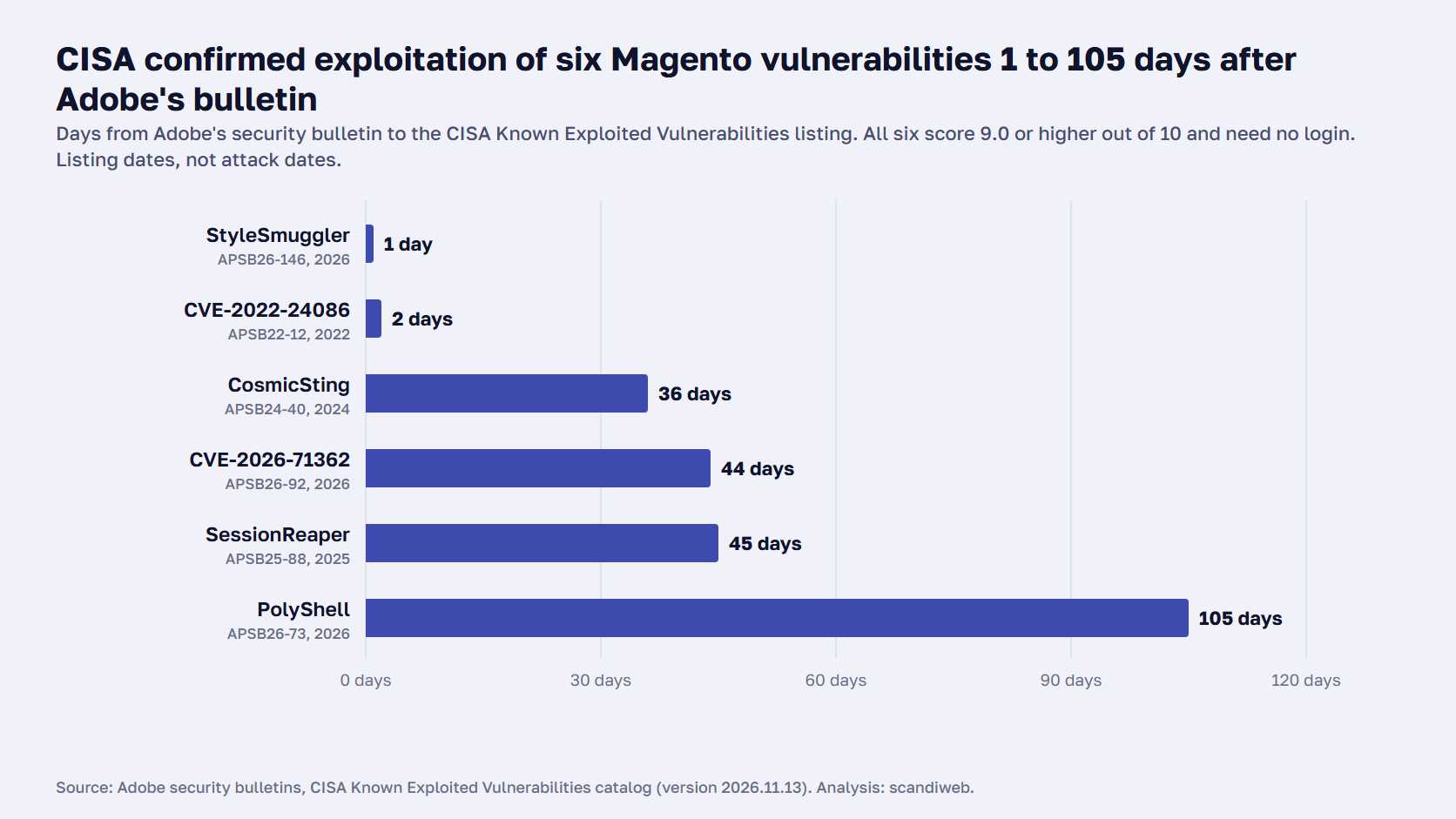
From Adobe’s bulletin to CISA’s listing, StyleSmuggler took 1 day, CVE-2022-24086 2, CosmicSting 36, CVE-2026-71362 44, SessionReaper 45, and PolyShell 105. These are the dates CISA confirmed exploitation, and attacks can start earlier, as PolyShell’s did.
🚀 Quick takeaway
Since 2021, 17 Magento vulnerabilities have scored 9.0 or higher with no login needed, and 6 of them (35%) were later confirmed as exploited.
Does Adobe’s priority rating tell you when to patch?
Adobe’s priority rating describes what Adobe knows on the day a Magento bulletin goes out. None of the six exploited Magento vulnerabilities had Adobe’s top priority rating before attacks were known: scandiweb’s review of Adobe’s bulletins, read on November 16, 2026, found four were first published at priority 2 or 3.
Adobe defines three priority levels on the Adobe Trust Center.
- Priority 1, “Act as soon as possible,” for vulnerabilities “being actively exploited or are at higher risk of exploitation”
- Priority 2, “Act within 30 days,” where “There are currently no known active exploits”
- Priority 3, “Act at your admin’s discretion,” where “Active exploitation is unlikely”
CVE-2022-24086 and StyleSmuggler were priority 1 at release, and both were already being attacked. CosmicSting started at priority 3 on June 11, 2024, and was raised to 2 on June 26 and to 1 on July 8. SessionReaper started at 2 on September 9, 2025, and was raised to 1 on October 24. PolyShell and CVE-2026-71362 were published at priority 2.
As of November 16, 2026, Adobe’s bulletins APSB26-73 and APSB26-92 carry priority 2 and state that Adobe is not aware of any exploits in the wild for the issues they fix. CISA added PolyShell (CVE-2026-48356, from APSB26-73) to its exploited catalog on October 27, 2026, and CVE-2026-71362 (from APSB26-92) on September 24, 2026.
A score of 9.0 or higher with no login needed is visible before any attack is known.
🚀 Quick takeaway
Four of the six exploited Magento vulnerabilities were first published at priority 2 or 3. The two published at priority 1 were already being attacked.
What kinds of Magento security issues come up most?
Broken access control is the largest group of Magento vulnerabilities since 2019, with 128 of 451 (28%) against 108 (24%) for cross-site scripting, scandiweb’s analysis to November 16, 2026 found. The first means the store lets someone do something their account, or lack of one, shouldn’t allow. The second means an attacker gets their own script to run in another user’s browser, often an admin’s.
| Weakness group | Vulnerabilities | Share of 451 |
|---|---|---|
| Broken access control (incorrect authorization, improper access control, authorization bypass) | 128 | 28% |
| Cross-site scripting (XSS) | 108 | 24% |
| Cross-site request forgery (CSRF) | 16 | 4% |
Sansec’s guide to Magento core vulnerabilities says, “Most vulnerabilities are of the ‘XSS/CSRF’ type.” In scandiweb’s count, cross-site scripting is the most common single type, and together with cross-site request forgery it makes up 124 of 451 (27.5%), less than a third. Another 38 have no weakness type recorded. Even if all 38 were cross-site scripting, the share would be 36%.
In 2026, access control accounts for 28 of the 75 vulnerabilities, and 18 of the 39 no-login vulnerabilities are “incorrect authorization.”
🚀 Quick takeaway
Since 2019, 128 of 451 Magento vulnerabilities are broken access control, against 108 for cross-site scripting.
Is my Magento store affected?
To see whether your Magento store is affected, compare your exact version and patch level with the “Affected versions” table of each bulletin. Your developer or host can confirm the version, and the bulletin names the fix. The check has five steps.
- Find your exact Magento version and patch level, for example 2.4.7-p6.
- Open the bulletin on the Adobe Trust Center and find your release line in its “Affected versions” table.
- If your version is listed as affected, the bulletin’s “Solution” table names the release, isolated patch, or hotfix that fixes it.
- If your version is older than any line the bulletin lists, Adobe no longer fixes it. Your options are an upgrade or a fix built by your own developers. For StyleSmuggler, we published a fix for older Magento versions, from 2.2.0 to 2.4.3-p3. Our Magento end of life dates show which versions still get fixes.
- Run Adobe’s free Security Scan Tool weekly. It checks the pages it can load for known malware, known security risks, and out-of-date software. Our post explains what the Security Scan Tool checks.
What to do when Adobe announces a new Magento vulnerability
When Magento vulnerability news reaches you, check Adobe’s bulletin the same day. Any vulnerability in it that needs no login and scores 9.0 or higher out of 10 is urgent, whatever its priority. None of the six steps needs a purchase.
- Watch for Adobe’s bulletins on Patch Tuesday, the second Tuesday of each month. Out-of-band bulletins can come any day.
- Read the score and the “Authentication required to exploit?” field for each vulnerability, as well as the priority.
- Treat any vulnerability that scores 9.0 or higher and needs no login as urgent, even at priority 2.
- Apply the hotfix or isolated patch first if the full release isn’t ready.
- Check CISA’s catalog for “Adobe Commerce” entries every week. A listing means exploitation is confirmed.
- After an exploited flaw, follow the bulletin’s knowledge base steps. For StyleSmuggler, they included rotating the encryption key and every credential it protects. If attackers already got in, start with what to do first after a Magento security breach.
Who applies the patch is your choice. Your own developers know the code best, but patches compete with feature work. A host or agency on a support plan can patch out of hours, but check that the contract names a response time. Our free security check, under Related services above, starts with a consultation, and our engineers inspect the store for malicious files and suspicious activity. It’s a one-off check, so it doesn’t replace patching.
For a deeper review, we offer a Magento security audit. Our Magento security best practices cover the time between bulletins.
🚀 Quick takeaway
Out-of-band bulletins can land on any day. Adobe released the StyleSmuggler bulletin APSB26-146 on Monday, September 7, 2026, a day before that month’s Patch Tuesday.
Limitations of this count
This count has eight limits that affect how to read the numbers. It covers Magento vulnerabilities in Adobe’s bulletins and CISA’s catalog as read on November 16, 2026, and it depends on how each source scores and dates its entries.
- The scores are CVSS scores out of 10, a different rating from Adobe’s “Critical / Important / Moderate” labels, which cover more
- The scorer changed: the US National Vulnerability Database scored 2019 and most of 2020, and Adobe scored 2021 onward, so no-login comparisons start in 2021
- 2026 is not finished, and the December 8 bulletin may add more
- CISA’s catalog is a floor: it lists only exploitation CISA has confirmed, only since November 2021, and by listing date, which can be after attacks began
- Adobe’s bulletin wording and priority are quoted as read on November 16, 2026
- Sansec, a security vendor, is the only public source for when attacks on PolyShell and SessionReaper began
- The count includes the B2B module and the webhooks plugin when an Adobe Commerce bulletin lists their vulnerabilities
- The count covers the platform and doesn’t show how many stores have patched
How this page is updated
We update this page and its data file after each Adobe Patch Tuesday, the second Tuesday of the month, and after each out-of-band bulletin. The next check is December 8, 2026. For background beyond Adobe Commerce Magento security news, read our Magento 2 security guide.
Frequently asked questions
What is the latest Magento vulnerability?
As of November 16, 2026, the newest fixed Magento vulnerability is CVE-2026-103849 in APSB26-153 (October 13, 2026), a template injection flaw scoring 10.0 with no login needed. The newest one confirmed as exploited is PolyShell, listed by CISA on October 27, 2026. Adobe’s November 10 Patch Tuesday had no Adobe Commerce bulletin.
Is my Magento store affected?
Your store is affected if the bulletin’s “Affected versions” table lists your exact Magento version and patch level, for example 2.4.7-p6. The “Solution” table then names the fix. If your version is older than any line listed, Adobe no longer fixes it.
Where does Adobe publish security bulletins?
Adobe publishes Magento security bulletins on the Adobe Trust Center. The 2026 bulletins are there, and older ones are on Adobe’s HelpX pages. For Magento security update news from the source, check it on Patch Tuesday, the second Tuesday of each month.
How fast should I patch after a bulletin?
Adobe’s definitions say to act “as soon as possible” at priority 1 and “within 30 days” at priority 2. We advise patching any vulnerability that scores 9.0 or higher and needs no login the same week, because four of the six exploited Magento vulnerabilities started at priority 2 or 3.
Which Magento vulnerabilities have been exploited?
CISA’s Known Exploited Vulnerabilities catalog, version 2026.11.13, lists six Magento vulnerabilities. They are StyleSmuggler, PolyShell, CVE-2026-71362, SessionReaper, CosmicSting, and CVE-2022-24086. All six score 9.0 or higher out of 10 and need no login, and three of them were added in 2026.
What does “no login needed” mean for a vulnerability?
“No login needed” means an attacker can use the flaw without an account on your store or its admin, just by sending requests to it. In scandiweb’s count to November 16, 2026, 39 of 2026’s 75 Magento vulnerabilities are like this.
Cite this research
To cite this research, use the citation below and keep its date, because the count changes after each Adobe bulletin. Each finding in the “Key findings” section names its source, its sample, and its date, so it can be quoted alone.
scandiweb, “Magento Security News: Current Vulnerabilities, Fixes, and What Attackers Exploited,” November 16, 2026. https://scandiweb.com/blog/magento-security-news/
Main takeaway
Magento security news is most useful when you read it at the source, Adobe’s security bulletin, on the day it comes out, and check your version against its “Affected versions” table. There has been more to check this year: Adobe fixed 75 Magento vulnerabilities in 2026, to November 16, and 39 of them need no login.
Judge urgency by the score and the login requirement as well as Adobe’s priority. All six Magento vulnerabilities in CISA’s exploited catalog score 9.0 or higher out of 10 and need no login, and four were first published at priority 2 or 3. When a bulletin lists one like that for your version, patch it the same week. Adobe’s next Patch Tuesday is December 8, 2026.
To have your store's version checked against the latest bulletins, contact our Magento team.





























Share on: