
If you are weighing Magento against PrestaShop, you have probably already heard that PrestaShop is the cheaper choice because the license is free. That’s a misleading framing. PrestaShop and Magento Open Source are both free to download, so the cost difference lies in what happens once traffic spikes and your catalog and store grow.
In this comparison, we’ll treat both platforms as serious open-source contenders, then separate them on the criteria that change total cost of ownership at growth: scalability, B2B depth, ecosystem maturity, and the engineering effort each demands over several years.
🚀 Quick takeaway
PrestaShop fits small catalogs and single-market stores that value simplicity. Magento (Adobe Commerce) fits brands with large catalogs, complex B2B rules, multi-store operations, and high traffic, where its depth lowers the cost of every future change.
Magento vs PrestaShop: the key differences
Both platforms are PHP-based, self-hosted, and open source, which means you control the code and choose your own hosting. PrestaShop is built to get a focused store live quickly with minimal engineering effort. Magento is built to model complex commerce, scale to large catalogs and high traffic, and grow with an enterprise without forcing a replatform.
Magento also offers a paid edition, Adobe Commerce, that layers managed cloud hosting, B2B modules, AI-driven merchandising, and enterprise support on top of the same open-source core. Our guide to Adobe Commerce vs Magento Open Source breaks down how the two editions differ. PrestaShop has no equivalent enterprise tier, so its upper limit is defined by how much custom engineering you are willing to fund.
| Category | Magento (Adobe Commerce) | PrestaShop |
|---|---|---|
| License | Open Source free, Adobe Commerce paid (roughly $22,000 to $125,000+ per year) | Free, open source, no paid enterprise tier |
| Best fit | Large catalogs, high traffic, B2B and multi-store brands | Lean catalogs, single-market and SMB stores |
| Catalog scale | Hundreds of thousands of SKUs with proper hosting | Comfortable into the low thousands of SKUs |
| B2B features | Native in Adobe Commerce: company accounts, quotes, price lists | Module-dependent, no native B2B suite |
| Multi-store | Native multi-store, multi-site, multi-language from one install | Multistore supported but lighter in scope |
| Ecosystem | Large global marketplace and deep specialist agency network | Sizable module marketplace, smaller enterprise agency pool |
| Engineering need | Higher upfront, lower cost of change at scale | Lower upfront, rising cost of change as complexity grows |
| Hosting | Self-hosted or Adobe-managed cloud | Self-hosted |
Is PrestaShop really cheaper than Magento over time?
Not reliably. A free license only removes one line item. Over three to five years, the total cost of ownership is dominated by hosting, development, third-party modules, maintenance, and the engineering hours spent working around a platform’s limits. PrestaShop wins the first year for a simple store. Magento often wins the multi-year total once requirements get serious.
The hidden cost in PrestaShop appears when you push it past its comfort zone. Heavy catalogs, complex pricing, multi-store setups, and high concurrent traffic frequently require custom module development and performance tuning, which can erode the early savings. With Magento, much of that complexity is already built into the platform, so you pay for the capabilities you do not have to rebuild later.
Adobe Commerce is a different budget conversation. Its annual license is significant, but it bundles B2B, cloud hosting, and enterprise support that you would otherwise assemble and maintain yourself. For brands at that scale, the comparison is rarely PrestaShop versus Adobe Commerce. It is PrestaShop versus Magento Open Source, with Adobe Commerce as the upgrade path once the open-source edition is no longer enough.
Pricing and total cost of ownership
Start from the truth that both downloads are free, then build the real picture from the layers that follow.
PrestaShop. Expect costs for hosting, a commercial theme, and paid modules. Many essentials that arrive built into Magento, such as advanced SEO controls or richer catalog rules, are available as paid PrestaShop modules. Individually, they are inexpensive, but stacked across a growing store, the module bill and the cost of keeping them compatible across upgrades add up.
Magento Open Source. Higher hosting requirements and more specialized development talent push the entry point up. In return, you get native multi-store, advanced catalog and pricing logic, and a deep extension ecosystem, which means fewer paid add-ons for core commerce needs.
Adobe Commerce. Adobe does not publish fixed-list pricing, and credible industry estimates put the annual license roughly in the $22,000 to $125,000 range, depending on gross merchandise value, with managed cloud and B2B included. This is enterprise territory and should be evaluated against the revenue it protects.
A five-year cost example
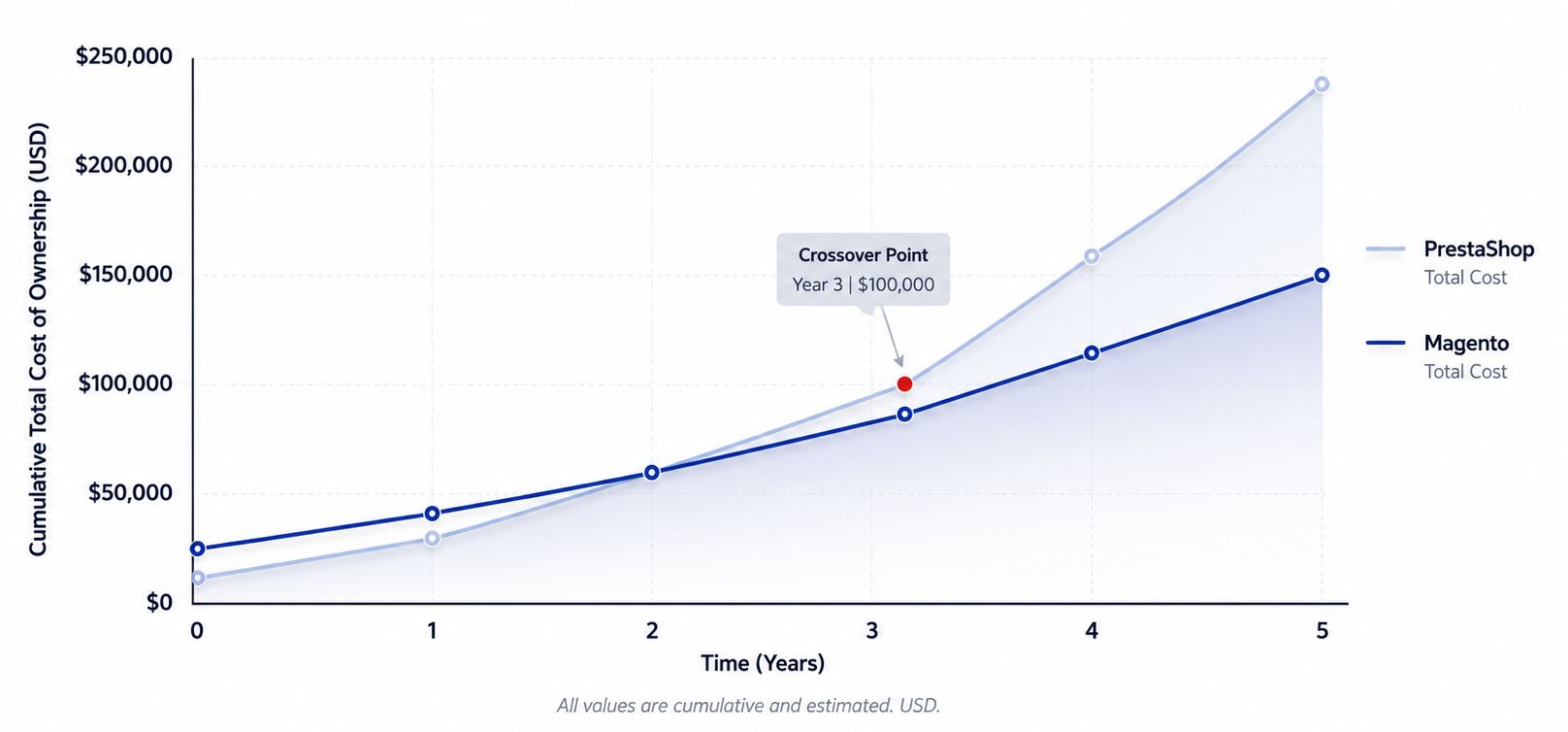
Treat the figures below as illustrative planning ranges, since real costs vary by region, agency rates, and store complexity.
Picture a mid-size catalog of around 5,000 SKUs that grows steadily, with one B2B segment emerging by year three. On PrestaShop, year one looks light: shared or modest cloud hosting in the range of $40 to $150 a month, a commercial theme around $200 to $400 once, and a starter stack of paid modules for SEO, performance, and checkout that lands somewhere near $1,500 to $3,000. Initial build and customization might run 120 to 200 developer hours.
By years three to five, as the catalog deepens and the B2B segment needs tiered pricing and quote workflows, PrestaShop typically requires more custom module work, override maintenance, and performance tuning. Module renewals, upgrade-compatibility fixes, and bespoke development tend to push annual maintenance hours up rather than down, and the running module bill keeps climbing as you add capability the platform does not cover natively.
On Magento Open Source, stronger hosting is in the range of $150 to $600 a month, and an initial build often runs 250 to 450 developer hours because the platform is more complex to configure. The payoff arrives later. Native multi-store, advanced catalog rules, and B2B foundations mean fewer paid extensions and far less rebuilding when requirements grow, so maintenance hours tend to flatten rather than spiral.
PrestaShop usually wins year one on raw outlay. Somewhere around year three, as complexity and traffic rise, the cumulative lines tend to cross, and by year five the platform that looked more expensive at launch is frequently the cheaper one to own.
Scalability and performance
This is where the platforms separate most clearly. Magento is engineered for scale – it handles large catalogs, supports full-page caching, Elasticsearch or OpenSearch-powered search, and Redis-backed sessions, and it is designed to keep performing as SKUs and traffic climb. With well-provisioned hosting, Magento stores routinely run hundreds of thousands of SKUs and absorb peak-season traffic spikes.
Magento also gives growth-stage brands a path that PrestaShop does not match: a decoupled frontend. When raw speed becomes a competitive lever, a Magento store can move to a headless setup that serves a fast, app-like storefront against the same commerce backend. Our overview of headless eCommerce explains when that architecture is worth the added engineering.
PrestaShop performs well for lean stores and can be tuned to handle respectable traffic. Its ceiling is lower. As catalog size and concurrent users grow, PrestaShop typically needs more hand-tuning and custom optimization to stay fast, and there is a practical point where the engineering effort to keep it performant rivals what a more scalable platform would have asked for in the first place. If you anticipate aggressive catalog or traffic growth, designing for that ceiling early is cheaper than hitting it unprepared. Our breakdown of Magento and WooCommerce covers a similar lightweight-versus-scalable tradeoff in more depth.
Customization and flexibility
Magento uses a modular architecture with a formal extension framework, dependency injection, and clear upgrade pathways. Customizations are meant to live in discrete modules that survive core updates, which lowers the long-term cost of maintaining a heavily tailored store. The tradeoff is a steeper learning curve and the need for genuinely experienced Magento engineers.
That structure pays off most when several teams touch the codebase over years. Because logic is isolated in plugins and service contracts rather than patched directly into core files, one team’s change is far less likely to break another’s, and platform upgrades stay manageable even on a heavily extended store. For a brand that expects a long, active roadmap, that discipline is a cost saver.
PrestaShop is friendlier for smaller customizations, and its override system lets developers adjust behavior quickly. That same flexibility can become fragile at scale, where stacked overrides and many third-party modules raise the odds of conflicts during upgrades.
Payments and checkout
Both platforms connect to the major gateways, so the question is about how much control you have over the checkout that converts it.
Magento has a flexible checkout and a broad set of payment integrations, including PayPal, Stripe, Adyen, Klarna, and most regional providers through official or community extensions. The checkout is fully customizable, which matters for brands that want to test layouts, add one-page or accelerated flows, or enforce B2B-specific rules such as purchase orders and credit terms. Adobe Commerce adds native B2B payment methods and tighter control over how different customer groups check out.
PrestaShop also supports the main gateways and offers solid out-of-the-box payment modules, which is plenty for a straightforward direct-to-consumer store. The constraint shows up when you need a heavily customized or rules-driven checkout. Big changes usually mean buying or building modules and then maintaining them through upgrades, which is the same pattern that drives PrestaShop’s cost up as complexity grows.
Hosting and DevOps
Because both platforms are self-hosted, your hosting and operations setup is part of the real comparison.
PrestaShop is comfortable on modest hosting. A small store can run well on shared or entry-level cloud hosting, and day-to-day operations stay simple, which keeps both cost and required expertise low. That accessibility is one of PrestaShop’s genuine strengths for smaller merchants.
Magento expects more from its environment. It performs best on tuned cloud infrastructure with adequate memory, plus supporting services such as Varnish, Redis, and a search engine, and it benefits from a proper deployment pipeline rather than editing files on a live server. That is more to stand up, but it is also what lets Magento maintain performance under load. Many brands hand this to a partner so the platform is provisioned, monitored, and patched correctly, which is the focus of dedicated eCommerce hosting and DevOps work built around Magento. Adobe Commerce removes much of this burden by bundling managed cloud hosting, automated scaling, and infrastructure support into its license.
B2B and multi-store capabilities
If you sell business-to-business or run multiple storefronts, this section likely decides the comparison on its own.
Magento treats both as first-class. A single Magento install can run multiple stores, websites, languages, and currencies from one admin, with shared or separate catalogs. Adobe Commerce adds a native B2B suite: company accounts with buyer hierarchies, negotiable quotes, customer-specific price lists, and credit limits, all without third-party modules.
PrestaShop supports multistore and can be extended toward B2B through modules, but there is no native enterprise B2B suite. Recreating company accounts, tiered pricing, and quote workflows means assembling and maintaining modules, which works for simpler cases and grows costly as B2B rules deepen. The further your wholesale logic departs from standard retail checkout, the more that module-stacking approach strains under maintenance.
Migration effort and timeline
If you already run PrestaShop and are feeling the ceiling, the practical question is what moving to Magento actually involves. The honest answer is that it is a structured data-and-rebuild project, and treating it that way is what keeps it smooth.
The bulk of the work is migrating data and preserving search equity. Products, categories, customers, order history, and SEO assets such as URLs, redirects, and metadata all need careful mapping from PrestaShop’s structure into Magento’s. Theme and frontend work is effectively a rebuild rather than a port, since the two platforms render differently, and any PrestaShop modules you depend on need a Magento equivalent or a custom build.
Timelines vary with catalog size and customization, but a typical small-to-mid migration runs in the range of two to four months from discovery to launch, while large or heavily customized stores can take longer. The phases are consistent: discovery and data audit, environment and theme build, data migration with validation, SEO mapping and redirect planning, then staged testing before cutover. Planning the SEO mapping early is what protects rankings through the switch. Our Magento migration guide walks through how to sequence this without disrupting the business.
SEO and marketing
Both platforms have credible SEO foundations: editable URLs, metadata control, sitemaps, and clean markup are available on each. Magento offers more granular control out of the box, including canonical tag management and richer catalog-level SEO settings, which matters once you manage thousands of indexable pages. PrestaShop covers the essentials and exposes deeper SEO controls through modules.
On marketing, Magento’s native promotion engine, customer segmentation, and built-in tooling are more extensive, and Adobe Commerce layers AI-driven product recommendations on top. PrestaShop handles core promotions and discounts well and leans on its module marketplace for advanced campaigns. Whichever you choose, technical SEO health depends heavily on implementation quality.
Ecosystem, security, and support
Magento benefits from a large global marketplace and a deep bench of specialist agencies and certified developers, which matters when you need to hire, replace a partner, or scale a team. According to 6sense usage data, Magento holds a low single-digit share of the tracked eCommerce platform market and ranks among the more widely adopted self-hosted platforms, while PrestaShop holds a smaller share, indicating a real but more concentrated enterprise talent pool. BuiltWith-tracked data shows both platforms power well over a hundred thousand live stores each, so neither is a niche bet.
That talent gap is easy to underrate until you need it. With Magento, you can realistically run a competitive procurement, swap agencies, or build an in-house team, because certified developers exist in most major markets. PrestaShop’s enterprise-grade talent is thinner and more regionally concentrated, which can slow hiring and reduce your leverage when a partner relationship is not working.
On security, both publish patches and rely on the operator to apply them promptly, since self-hosting puts patch discipline on you. Adobe Commerce adds managed security and compliance support as part of its license. On support, PrestaShop and Magento Open Source are community-supported, so your real safety net is your hosting partner and development agency. Adobe Commerce includes vendor SLAs.
Which platform should you choose?
The decision comes down to where you are headed.
Choose PrestaShop if you run a lean catalog, sell primarily in one or two markets, want to launch quickly with modest engineering, and your roadmap does not include heavy B2B logic, large multi-store operations, or aggressive catalog growth. For a focused store that values simplicity and lower upfront cost, PrestaShop is a sound, capable choice.
Choose Magento (Adobe Commerce) if you manage a large or fast-growing catalog, need native B2B or multi-store capability, expect high or seasonal traffic, and want a platform whose depth lowers the cost of every future change. Magento asks for more upfront, in both hosting and engineering, and returns a higher ceiling and a more durable foundation.
If neither extreme describes you, weigh trajectory over current size. A store that is small today but headed toward complex pricing, multiple markets, or wholesale will usually save money by starting on the platform it will grow into, rather than paying twice to replatform later.
Frequently asked questions
Is Magento the same as Adobe Commerce?
They share one core. Magento Open Source is the free, self-hosted edition. Adobe Commerce is the paid edition that adds managed cloud hosting, native B2B, AI merchandising, and enterprise support on top of that same codebase.
Is PrestaShop free?
Yes. PrestaShop is free to download and self-host, exactly like Magento Open Source. Your real costs are hosting, themes, paid modules, development, and maintenance, not the license.
What are the main disadvantages of Magento?
Magento demands more from your team. It needs stronger hosting, specialized developers, and disciplined patching, which raises the entry cost. That investment buys scalability, depth, and a lower cost of change as your store grows.
Can PrestaShop handle a large catalog and high traffic?
It can be tuned to perform well, but its practical ceiling is lower than Magento’s. As catalog size and concurrent traffic climb, PrestaShop typically needs more custom optimization to stay fast.
Which platform is better for B2B?
Magento, clearly. Adobe Commerce includes a native B2B suite with company accounts, quotes, and price lists. PrestaShop relies on modules, which works for simpler B2B but grows costly as rules deepen.
How long does it take to migrate from PrestaShop to Magento?
A small-to-mid store typically takes two to four months from discovery to launch, while large or heavily customized stores take longer. Data migration, theme rebuild, and SEO mapping drive the timeline, and planning redirects early protects your rankings.
How does Magento compare to other platforms like Shopify?
Shopify is fully hosted and faster to launch but less customizable at the code level. For a full breakdown, see our comparison of Magento and Shopify.
Outgrowing your free open-source store and weighing the move to Magento? Plan your move up with scandiweb and get a clear, business-first path from PrestaShop to a platform built for scale.