
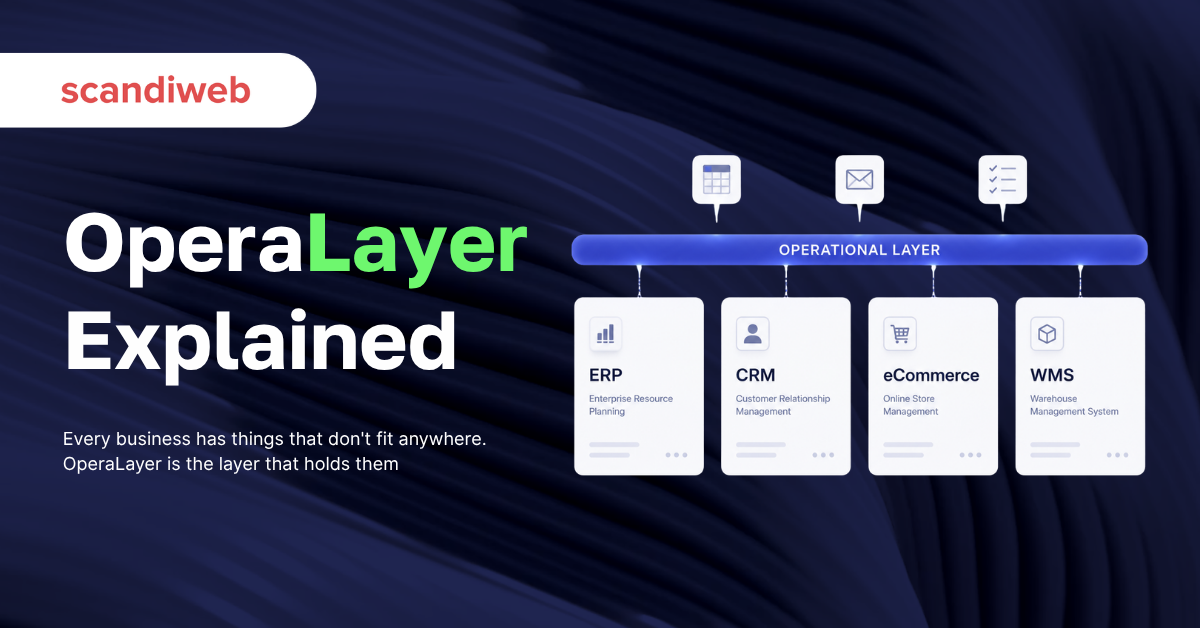
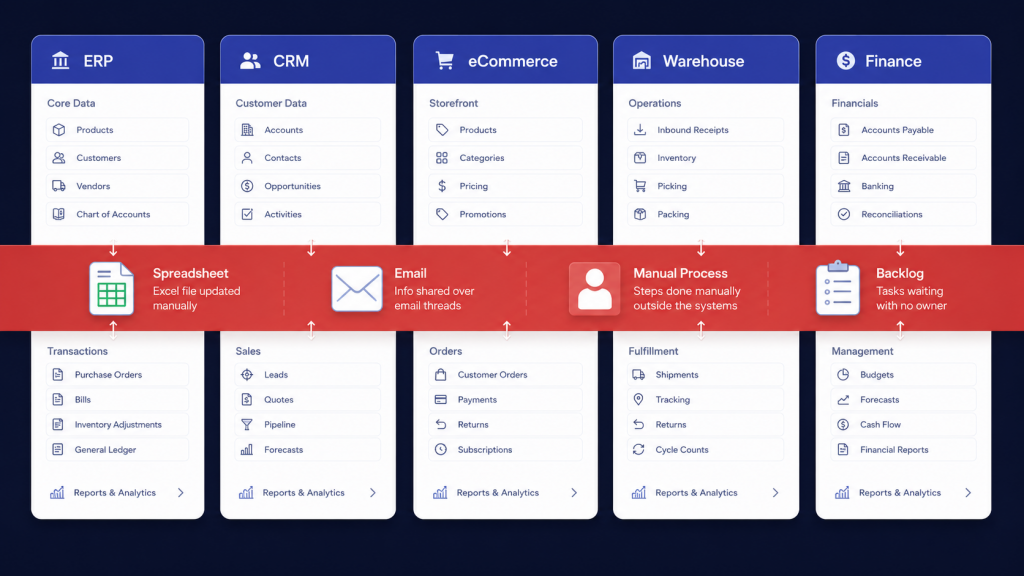
Every business at a larger scale has an ERP, a CRM, an eCommerce system, accounting software, a warehouse system. And each one handles its core domain well. But something always falls between them, ending up in a spreadsheet, a manual process, a wishlist, someone’s email, very old software nobody wants to touch, or in a backlog item that never gets prioritized, you name it.
OperaLayer is the layer that closes this gap.
Next, I’ll explain what OperaLayer, our operational layer, is, how it differs from iPaaS and a data warehouse, how it gets built without replacing anything you run, and how to tell whether it is the right move for your business.
The gap every business already has
Each of the core platforms already handles its own domain well – the ERP runs the books, the CRM holds the customers, the eCommerce platform runs the storefront, while the warehouse system tracks stock. The gap is the work that falls between them.
It is easy to recognize once you look for it. The same shape of problem shows up in every department:
- Month-end close takes days because someone reconciles numbers between the ERP and the data warehouse by hand
- The same customer has three different IDs across the CRM, the eCommerce platform, and support, and nobody owns the fix
- A process the team runs every Monday has been on the automation backlog for two years
- Regional pricing is in a spreadsheet that one person maintains, and nothing changes price when they are on holiday
- Buyers match supplier invoices to purchase orders by hand because every supplier sends a different PDF format
- The dashboard the board asked for requires data from five systems, so building it has been “next quarter” for three quarters in a row.
🚀 Quick takeaway
The gap for OperaLayer to fix is a hundred small handoffs that no single system owns, and each one quietly costs time and margin.
Why the gap is structural
The gap is not there because a system is broken, but because of how the systems are organized. The data already exists, spread across the platforms you have paid for. Same with processes, your team runs them every week. The systems work, each doing the job it was designed to do. What is missing is anything built to connect them around the specific thing your business needs right now.
That is why the usual fixes do not hold. Even a clean set of system integrations keeps the data flowing without deciding who owns the weekly process that runs on top of it. The structural gap does not shrink on its own, and it does not belong to any one vendor, which is exactly why it keeps ending up on someone’s plate instead of in a system.
🚀 Quick takeaway
Buying another platform does not solve the core issue. The gap belongs to no vendor, which is why it keeps landing on your team.
What OperaLayer is
OperaLayer by scandiweb is an operational layer – a thin software layer that runs across the systems you already use, consolidates their data into one model, and hosts focused apps that close specific gaps between them. It connects to your ERP, CRM, eCommerce platform, and warehouse system, reads from them, and replaces none of them.
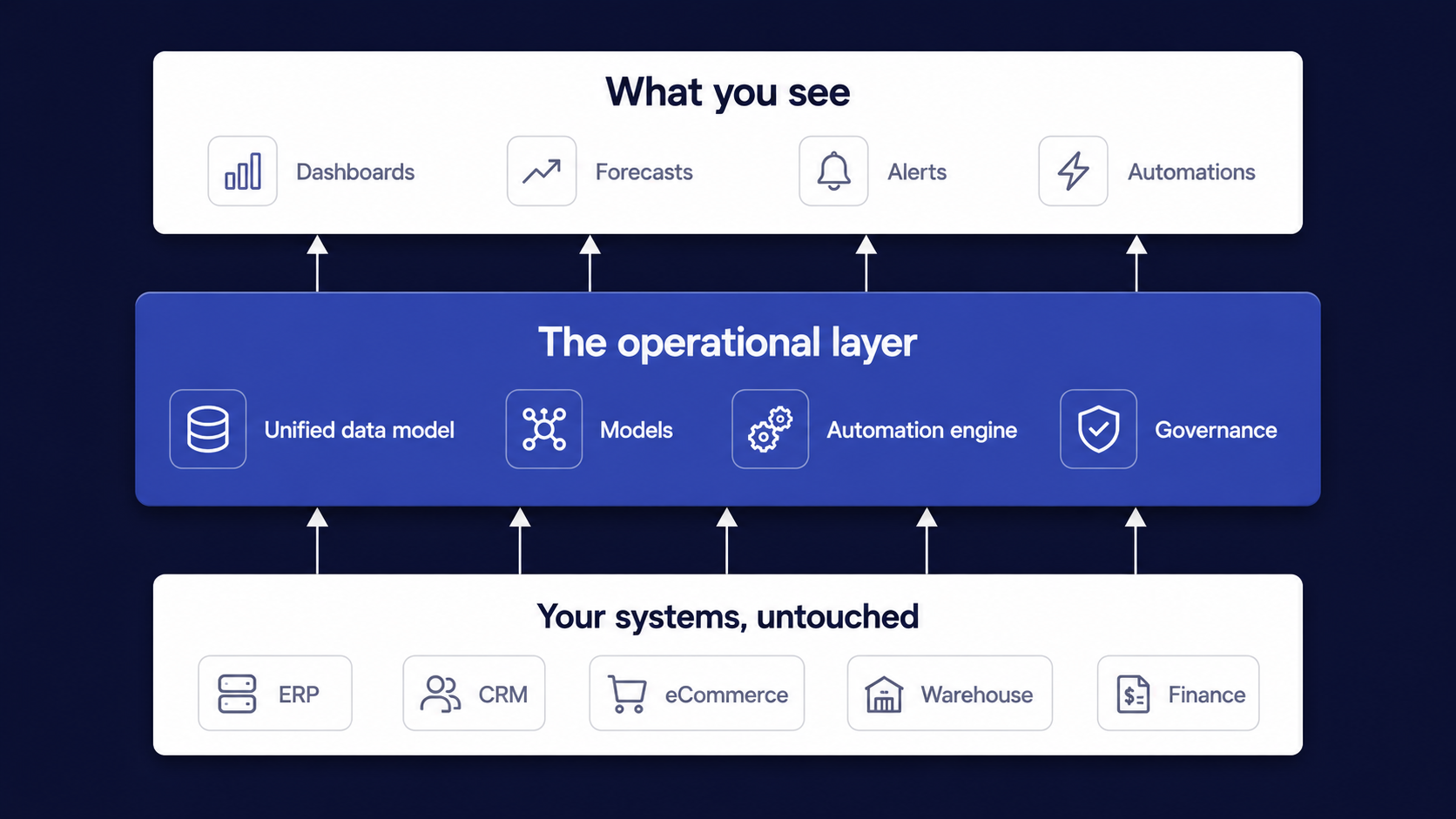
Worth a quick clarification, because the word “layer” gets crowded. This is not an AI or API orchestration layer in the developer sense, which coordinates models or microservices. It is a business operations layer. It is also not a rip-and-replace platform, but adds the missing capability on top of what you run.
An operational layer has three main capabilities:
Visibility
Visibility is the operational view you cannot build today because the data behind it is spread across three systems with three different definitions. It is the single customer view that finally reconciles the same person across the CRM, the eCommerce platform, and support, or the executive dashboard, where every number is defined once instead of five slightly different ways. It is also the department-level drill-down nobody can produce right now, because the data it needs never lands in one place.
Prediction
Prediction is the forward-looking signal your team already produces by hand on a Friday afternoon, surfaced early enough to actually act on. That covers demand and inventory forecasts, churn and revenue risk, and the kind of margin or anomaly alert that stays quiet until something genuinely looks wrong, then routes itself to the person who can deal with it.
Automation
Automation takes the decision that repeats every week and currently needs a person just to run it, and runs it for them. Think reorder and replenishment drafts, cross-system matching and sync, or approval routing. People stay in the loop wherever judgment is needed, and step out of the parts that were only ever manual because no system owned them.
How an operational layer differs from iPaaS, a data warehouse, or another platform
These categories get confused often, and the difference is practical. An operational layer is where the operational app actually is, built on top of connected data, while the other tools each solve a narrower piece.
- iPaaS and middleware move data between systems and get System A talking to System B, but they do not give a planner a ranked queue to act on.
- A data warehouse or BI tool stores and reports on the data, tells you what happened, but it does not run the weekly decision or the cross-system workflow.
- Another platform replaces a system you already have, which means migration, retraining, and a new set of edge cases to manage.
An operational layer uses the middleware and the warehouse where they help, then adds the view, the prediction, or the automated decision on top, without replacing anything underneath.
How it gets built without replacing anything
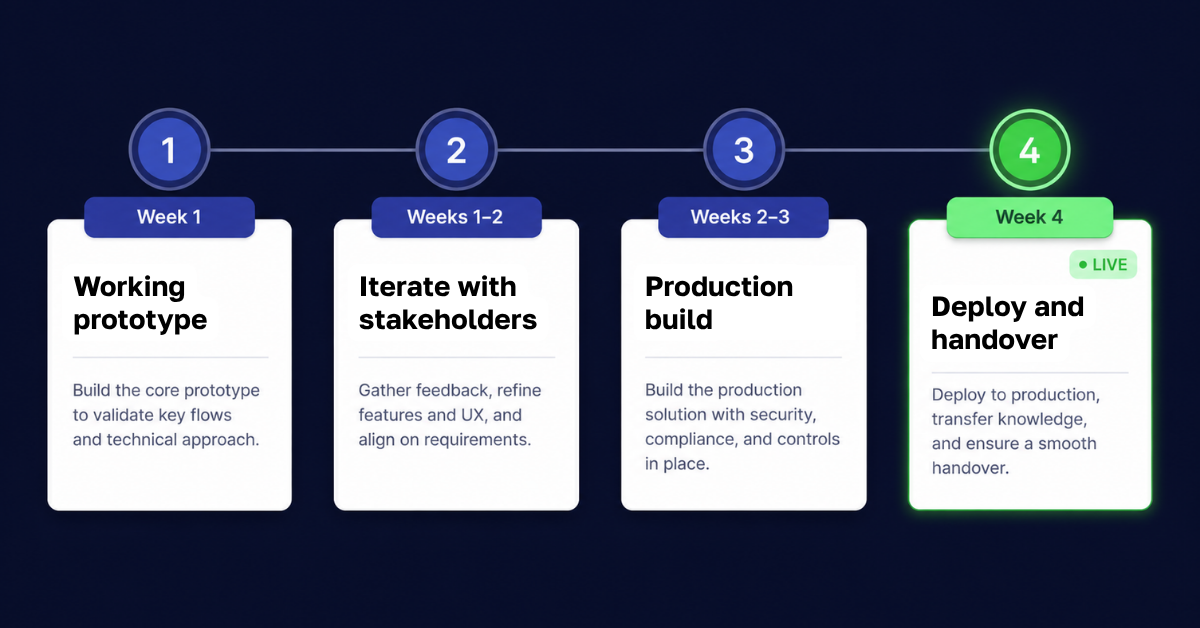
The delivery model is what makes an operational layer not extend into a multi-year program. It is a single module, built on a short, fixed timeline.
We deliver a working prototype in week one, on real data and the real workflow, so your team can see the right thing being built before it is fully built. Next, iterate with the people who will use it. The production build connects to your existing systems with governance, access, and an audit trail from the start. The module is live in four weeks, with training and post-launch support included. Nothing gets migrated, and your team does not learn a new platform.
The first module sets up the foundation: the systems connected, the data model unified, the first views and the first prediction. Every module after that is faster and cheaper, because the foundation is already paid for. You add capabilities in the order your business actually needs them, not in the order a transformation roadmap dictates.
What OperaLayer looks like in practice
Case 1: Business Central handled the books, but not 50+ supplier brands
A Baltic sports and apparel retailer with more than €100 million in revenue ran its books in Microsoft Business Central. Business Central did not handle 50-plus supplier brands, seasonal commitments, and invoice variance flags, and none of that deserved a full ERP customization. The operational layer gave buyers live supplier purchasing intelligence, with €34 million of one season’s purchasing tracked across every brand and 52 invoice discrepancies caught before goods reached shelves.
Case 2: Magento handled the storefront, but not 50-state pricing
A US specialty retailer selling direct to consumers across 50 states ran its storefront on Magento 2. Magento was never going to handle state-by-state pricing logic with multiple margin types, and a spreadsheet was never going to scale to it. The operational layer took pricing live across all 50 states and recalculated eight margin types per state, eliminating the manual formulas at the source.
Case 3: Navision handled the orders, but not the 100 PDF invoice formats
A B2B electrical and industrial supplier with around 100 vendors ran orders through Microsoft Dynamics NAV. Navision did not handle 100 different PDF invoice formats and line-by-line purchase order matching. The operational layer reached an 87% auto-match rate and surfaced only the exceptions for a human to review, instead of two people matching invoices by hand every morning.
🚀 Quick takeaway
Notice the pattern: in each case the core system stayed exactly as it was. The operational layer closed the one gap it was never built to handle.
When an operational layer is the right move
Consider an operational layer if:
- Work keeps falling between your systems into spreadsheets, email, and manual routines
- You do not want to replace systems that otherwise do their job well
- You need a view, a prediction, or an automation that no single platform you own can produce
- You have already tried “another report” or “another platform” and the gap is still there
- You want to prove value on one real problem before committing to anything larger.
Frequently asked questions about the operational layer
What is an operational layer?
An operational layer is a thin software layer that runs across the systems a business already uses, unifies their data, and hosts focused apps that close specific gaps between them. It connects to systems like the ERP, CRM, eCommerce platform, and warehouse system, and replaces none of them. Its job is visibility, prediction, and automation that no single platform produces on its own.
How is an operational layer different from iPaaS or middleware?
iPaaS and middleware are the pipes that move data between systems. An operational layer uses those pipes, then adds the operational app on top: the unified view, the forecast, or the automated decision a team acts on. Middleware gets System A talking to System B. An operational layer turns that connected data into a workflow someone actually uses.
Does an operational layer replace my ERP or CRM?
No. An operational layer is additive. It reads from your existing systems and leaves them in place, so there is no migration and no retraining on a new platform. The ERP keeps running the books and the CRM keeps holding the customers. The layer only adds the capability that currently falls between them.
What is OperaLayer?
OperaLayer is scandiweb’s operational layer. It connects to the systems a business already runs, unifies their data, and hosts focused apps that close specific gaps, built on a roughly four-week rhythm per module without replacing any existing system. The supply-chain and pricing tools scandiweb has shipped are individual modules built on it.
How long does it take to build an operational layer?
A single module follows a short, fixed rhythm: a working prototype in week one and a live, production module in about four weeks, including training and handover. The first module also stands up the shared foundation. Every module after that is faster, because the systems are already connected and the data model already exists.
Is an operational layer only for large enterprises?
No. The gap it closes shows up at any size where a business runs several systems that do not talk to each other about a specific process. Because the work is delivered one focused module at a time rather than as a single large program, a mid-sized business can start with one gap and add more only when each one earns its place.
The gap does not close on its own
The systems you have already do their jobs. The work that falls between them does not belong to any of them, so it keeps costing time and margin until something is built to hold it. OperaLayer is that something: additive, fast to prove, and created around the specific gaps your business has.
We have spent twenty years building the layer between platforms. If the work falling between your systems is starting to add up, that is exactly the kind of gap we close. Let’s chat and, in four weeks, you will have one module running on your real data, closing one specific gap that currently costs your team time every week.