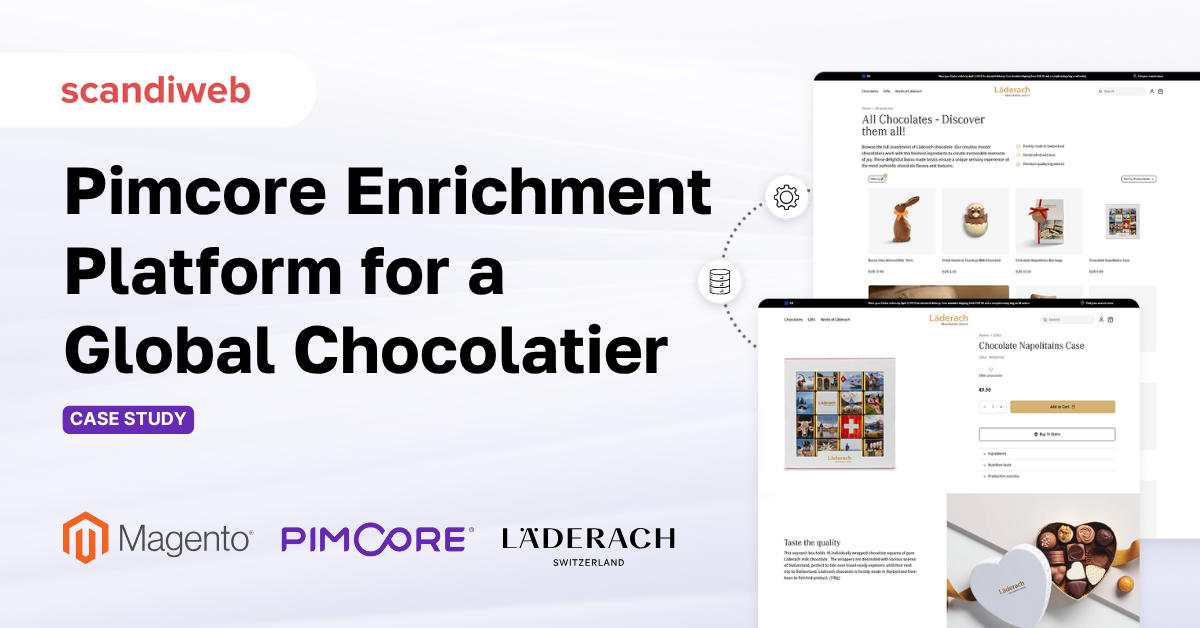
Läderach sells premium Swiss chocolate in over 250 stores worldwide. Behind that experience is a complex product data operation spanning multiple markets, languages, and systems. We built the infrastructure to manage it properly.
About
Läderach is a Swiss chocolate and confectionery manufacturer crafting premium chocolate. With 250+ stores worldwide, its own chocolate museum, and a growing international presence in Europe, North America, Asia, and beyond, Läderach is one of the most recognized names in artisan chocolate.
scandiweb has been Läderach’s long-term digital partner. In this case study, we’ll focus on the implementation of Pimcore as a dedicated product enrichment platform, which marked a foundational step in modernizing Läderach’s product data management and distribution.
Also read:
Case Study: Elevating the Digital Chocolate Experience with Läderach’s Transformation Journey
Project goals
Läderach’s product catalog is sold across multiple markets, each with its own language, regional assortment, and SKU structure. Historically, all product data was in Comarch, an ERP system built for operations, not content enrichment. The main goal of this project was to implement Pimcore as a dedicated PIM layer between Comarch ERP and Magento 2, transforming it into the single source of truth for product content, while keeping existing operational flows in Comarch and storefront logic in Magento intact.
- Introduce a new product structure in Pimcore that merges market-specific duplicate SKUs into unified parent products, allowing enrichment to happen once and inherit across all relevant markets and languages
- Transfer product data management from the ERP to PIM, creating the ability to manage merchandising data, digital assets, and categories that were previously constrained by ERP limitations
- Integrate Pimcore bidirectionally with ERP and Magento 2, replacing legacy SOAP-based connections with a more maintainable architecture
- Enable faster product onboarding and lay the groundwork for expansion into new markets and languages
Problem
Läderach’s existing setup had Comarch ERP as the base of all product operations – inventory, pricing, order processing, and product data. While Comarch handled the operational side well, it was never designed for product content enrichment.
Every product sold online required detailed descriptions, images, translations, and merchandising attributes. All of that had to be manually entered directly into Comarch, and because Läderach sells the same products across multiple markets, each with its own regional SKU, the same data had to be entered repeatedly. In practice, a single product could require 10 to 20 manual data entries.
Duplicate SKUs by design
The root of the duplication was a technical constraint. Comarch requires separate SKUs per market to generate country-specific product labels, and Magento’s order structure had to mirror that same SKU layout to keep refunds and order management working correctly. That meant every product existed as multiple records in the system, and every piece of content had to be managed for each one individually. There was no way to enrich a product once and have it apply across markets.
ERP constraints
Due to ERP constraints, some products simply couldn’t be published online at all. The direct Comarch–Magento pipeline left no room to add enrichment data, merchandising values, or category assignments that didn’t already exist in Comarch. If the ERP didn’t support it, Magento couldn’t show it.
With Läderach expanding into new markets and languages, the existing approach had to change. Adding a new market meant multiplying an already heavy manual workload, with no mechanism for inheritance, reuse, or automation. The team was spending time on repetitive data tasks rather than on product development.
Solution
scandiweb introduced Pimcore as an intelligent enrichment layer between Comarch and Magento. Comarch would remain the source of truth for inventory, pricing, and order data. Magento would remain the storefront. Pimcore would own everything in between. We held a three-week discovery process, including on-site workshops, to lay the foundation for every architectural decision that followed.
A new product structure
The solution centered on a custom parent–child product structure designed specifically around Läderach’s multi-market reality. Rather than managing each market SKU as a fully independent product, Pimcore now groups them under a single unified parent. Enrichment occurs at the parent level (descriptions, images, merchandising attributes, translations) and is automatically inherited down to each market-specific child SKU.
Child products can still be overridden individually and can revert to inheriting from the parent at any time. This single change eliminated the need to repeat enrichment work across every market variant, reducing what previously took hours to a matter of minutes per product.
Importantly, the SKU structure pushed to Magento remains unchanged, meaning order management, refunds, and the Comarch integration all continue to work exactly as before.
Pimcore–Magento 2 integration
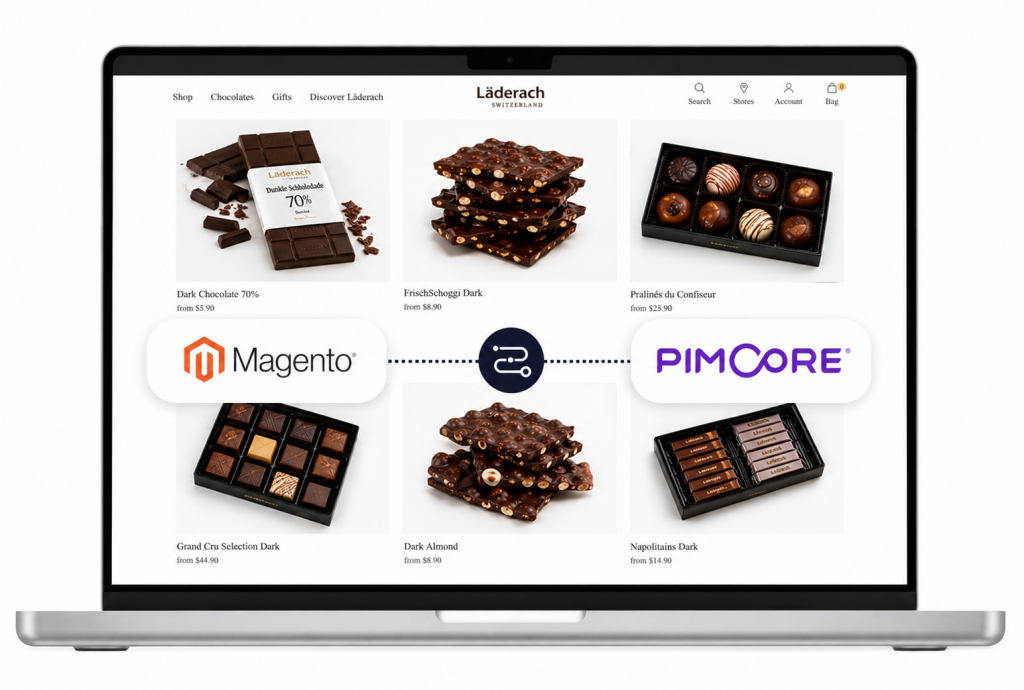
We built and maintained the integration between Pimcore and Magento 2, handling the full product and category data sync. The connector required significant custom development and troubleshooting during delivery, with several issues identified and resolved in parallel with feature development.
Data flows from Pimcore to Magento automatically on a scheduled basis, using a delta sync approach that pushes only what has changed, keeping the integration efficient and the storefront up to date.
Also read:
Get to Know The Pimcore Connector for Magento 2 by scandiweb
Comarch ERP integration
We built the receiving endpoint within Pimcore to accept product data pushed from Comarch. Pimcore applies validation rules during ingestion, which introduces a data quality layer that didn’t exist before, reducing the risk of incomplete or inconsistent product records reaching the storefront.
Custom interfaces and workflow tools
Beyond the core data architecture, we delivered a suite of purpose-built interfaces to support the enrichment team’s day-to-day work:
- Custom image management interface with inheritance support
- Product position management tool for controlling category display order
- Category assignment rule setup interface
- Structured product enrichment workflow to bring approvals and process visibility into the platform
- CSV import profiles for products and categories to support bulk operations
- KPI reporting dashboards to give the team visibility into data completeness and enrichment progress.
Results
With Pimcore set up, Läderach can add new markets and languages without multiplying the manual workload. The architecture supports multi-language inheritance out of the box, and the first expansion is already underway as part of ongoing development.
Product enrichment went from hours to minutes
The most direct outcome of the new parent–child structure is the time saved on enrichment, with a task that used to take hours now takes minutes, regardless of how many markets a product is sold in.
More products can go online
Products that were previously blocked from the online catalog due to ERP constraints can now be published. Pimcore enables the team to add merchandising values, digital assets, and category assignments independently, expanding what’s available to customers online without requiring changes to the ERP.
A single platform across markets
Pimcore serves as the central hub for all product content, with changes flowing automatically to Magento. The team no longer needs to access Magento directly for product updates, and content entered in Pimcore is never lost during ERP imports or Magento deployments.
This project is another chapter in an ongoing long-term partnership between Läderach and scandiweb. With the PIM layer now in place, the foundation exists for further automation and continued expansion, and we’re already there to support it.
Ready to take control of your product data? As an official Pimcore Platinum Solution Partner with a range of PIM implementations across B2B and B2C, scandiweb has the certified expertise to integrate a product enrichment platform that fits your business. Let’s talk about what’s possible.