
Most teams shopping for PIM software start by asking which tool is “the best.” That is the wrong first question. The best PIM is the one that matches your catalog size, your channel mix, and the way your team already works. Pick on brand reputation alone, and you can end up paying enterprise rates for capabilities you never switch on.
Is managing product data across platforms starting to feel heavy? Are you trying to expand into new markets while keeping a large catalog accurate? Choosing the right product information management (PIM) software is central to growing an online store while keeping data accurate and your team’s workload manageable.
This guide breaks down what to look for in a PIM solution as your business and catalog grow. It covers what PIM does, the features that matter, how the leading platforms compare, a step-by-step way to choose, and the mistakes that derail most rollouts, whatever your industry or size.
🚀 Quick takeaway
A PIM pulls all your product data into one place so every channel shows accurate, current information. When you choose one, weigh scalability, integrations with your existing systems, ease of use, and total cost of ownership. Akeneo, Pimcore, and inRiver all handle the core job well, they differ in the features built around it.
What is product information management (PIM), and what does it do?
What is PIM software?
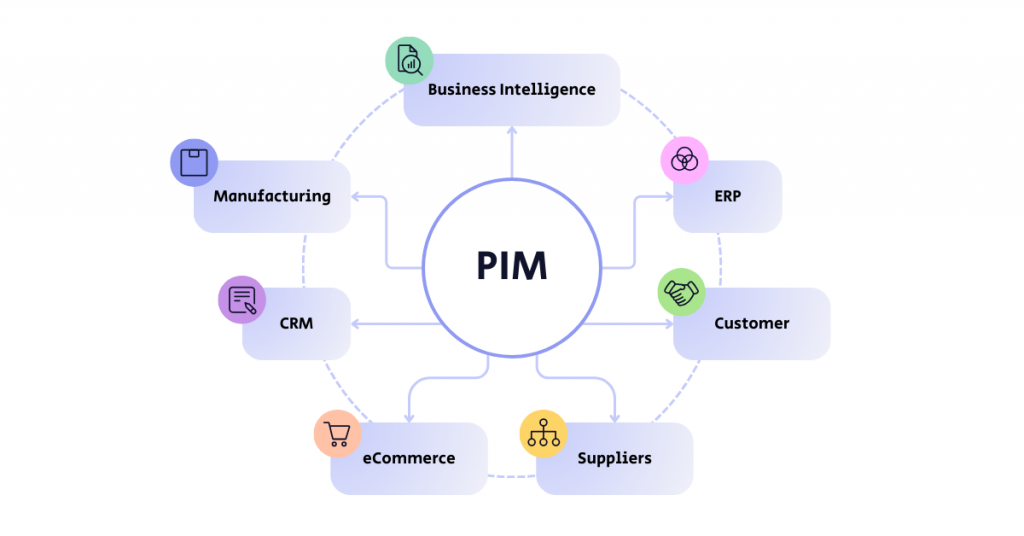
Product information management is the central hub for all your product data. A PIM collects, organizes, and distributes product information across every sales channel so the data stays accurate and current. It becomes the one reliable record for your catalog, which matters for both the customer experience and daily operations, keeping product details consistent, updates fast, and time-to-market short.
PIM benefits for eCommerce
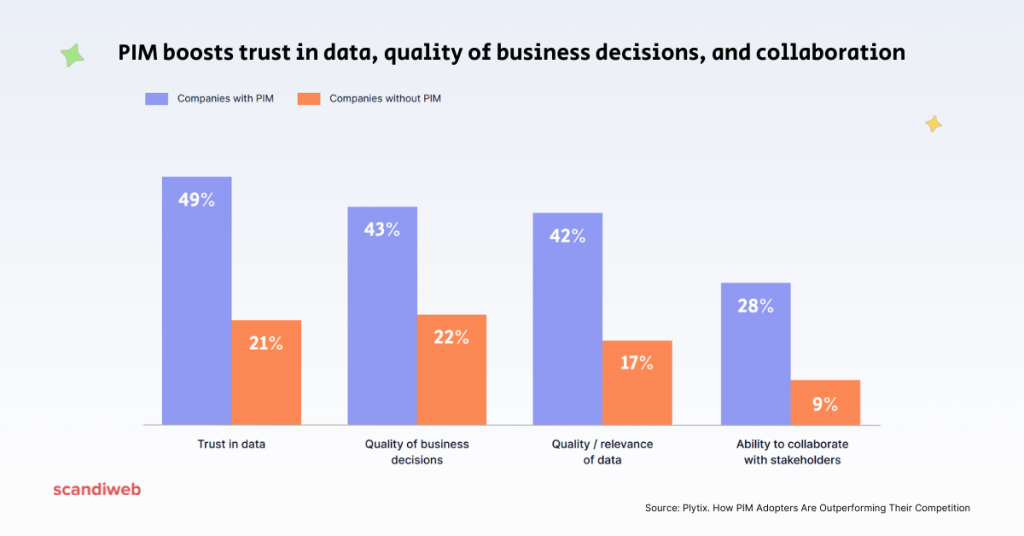
A PIM brings concrete gains in eCommerce, operations, and marketing, including:
- Centralized data management that keeps large catalogs consistent across every platform
- Faster product launches, cutting time-to-market by up to 60%
- Real-time updates that keep data quality high and stale information out
- A better customer experience built on accurate, current, personalized product details
- Simpler SKU additions and integration with eCommerce platforms as you scale
- Faster localization, translating product information up to 70% faster for new markets
- Quicker customer quote generation, improving response time by around 67%
- Less manual work for product teams, which frees them for higher-value tasks
- Cleaner product data that improves search rankings and drives more traffic
With a working PIM in place, a business can respond to demand faster, run leaner, and stay flexible. For a deeper look at how PIM fits an eCommerce stack, download the free guide on PIM and eCommerce integration.
Is PIM the right choice for your business?
PIM vs ERP, MDM, CMS, CRM: understanding the differences
Many companies assume they already run software that does what a PIM does. They often confuse PIM with enterprise resource planning (ERP), master data management (MDM), a content management system (CMS), or customer relationship management (CRM).
Each one serves a distinct purpose:
- PIM manages and centralizes product-specific data so the customer experience stays consistent across channels
- ERP handles operational data such as finance, inventory, and HR to run day-to-day processes
- MDM manages all types of business data, like customer and supplier records, to keep one shared view across the organization
- CMS organizes website content such as articles and media so everything looks cohesive across digital platforms
- CRM manages customer interactions, tracking sales, service, and outreach to strengthen relationships
A PIM acts as the backbone of eCommerce operations, connecting product data from CRM, ERP, suppliers, and sales channels into one centralized record. It keeps product-specific information accurate, consistent, and accessible everywhere, from ERP to CRM to CMS. That single source cuts data duplication, holds consistency in place, and keeps systems in sync. The result: faster product launches, smoother operations, and a better customer experience across channels.
🚀 Quick takeaway
PIM does not replace ERP, MDM, CMS, or CRM. It works alongside them and owns one job: product data. If your other systems already disagree about a product’s specs, price, or images, that is the gap a PIM closes.
When to consider a PIM system
A PIM system is worth a serious look if your business is:
- Struggling with inconsistent product data across platforms
- Handling a high volume of SKUs
- Trying to keep frequent product updates accurate in real time
- Aiming for a consistent omnichannel experience to raise customer satisfaction
The global PIM software market is in strong double-digit growth, with several research firms putting the market in the high-teens to mid-twenties USD billions by 2026 and compound annual growth in the range of roughly 13 to 19% through the early 2030s, depending on scope and methodology (Mordor Intelligence, Fortune Business Insights, and SkyQuest PIM market reports). The direction of travel is clear even where the absolute figures vary: more catalogs, more channels, and more pressure on clean product data.
PIM features every eCommerce business should consider
Scalable PIM for a growing store
As your online store grows with new products and markets, a strong PIM should grow with it without slowdowns. Look for solutions that absorb rising SKU counts and new channels while holding speed and reliability.
Customization with open-source PIM platforms
Open-source PIM platforms like Pimcore and Akeneo give you room to tailor the software to your needs without vendor limits. If you have unusual requirements or an in-house development team, open-source can be the right fit. For teams that want help, our guide to Akeneo PIM for eCommerce walks through what a tailored build looks like in practice. For the best result, work with an agency that knows PIM development and support so every detail fits your business.
Integration capabilities for clean data flow
A PIM with broad third-party integration options, such as Sales Layer or Akeneo, connects directly to ERP, CRM, and eCommerce platforms. That keeps data moving across channels and every department working from the same numbers.
API-first PIM for real-time updates
If you need real-time data sharing across platforms, look for API-friendly PIMs like Informatica Product 360. This setup lets the PIM talk to other tools directly, which makes automated updates and workflows straightforward.
Multi-tenant capabilities for distributed teams
Multi-tenant PIMs let many users access and manage data at once, which matters for global brands. Teams in different locations can work in parallel without losing speed or accuracy.
🚀 Quick takeaway
Do not buy for the feature list, buy for the two or three capabilities your catalog actually depends on. A small DTC brand with 800 SKUs and a single store needs different things than a multi-region retailer with 60,000 products and a dozen channels.
Pricing: SaaS vs on-premises PIM
SaaS PIMs like Salsify ProductXM and Sales Layer suit businesses that want easy scalability and low maintenance. On-premises solutions give more control but usually carry higher setup and upkeep costs. A SaaS model simplifies budgeting by bundling hosting, licensing, and updates into one subscription. Even so, a PIM rollout is involved and can add costs: data migration, complex integrations, or customization can introduce extra fees, especially with specialized workflows or large data volumes.
Enterprise PIM is almost always custom-quoted. Annual contract values typically run from around $25,000 to $90,000 or more, and year-one implementation can match or exceed the license fee (inRiver, “How much does PIM software cost? A complete pricing guide”). Budget for the work, not just the seat.
Digital asset management (DAM) integration for rich media
If your business leans on visuals, choose a PIM with DAM capabilities. That lets you store and organize images, videos, and other media inside the PIM, holding a consistent brand look across channels.
Governance and data quality control
PIMs with governance features let you enforce data quality standards and assign user roles to keep records consistent. This helps large operations and businesses in regulated industries where data accuracy is non-negotiable.
Localization and multi-language support
If you are going global, choose a PIM that supports localization and multi-language content. This handles translations, regional pricing, and tailored product descriptions so your brand reads naturally to customers in every market.
How leading PIM solutions compare
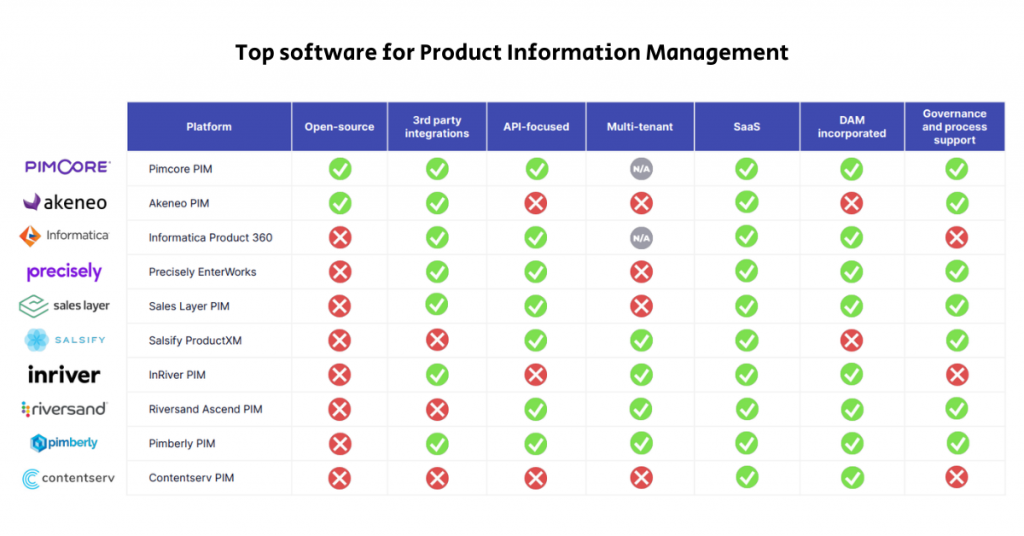
Whatever the brand, most PIM systems aim to centralize and simplify product data. Where they differ is in the features built around that core: customization, integration options, scalability, and support for specific needs such as digital asset management and multi-tenant setups. Implementation detail sits on the Pimcore Magento integration and BigCommerce Pimcore integration pages.
Here is a quick read on standout options for different needs:
- For high flexibility, open-source platforms like Pimcore and Akeneo let you shape the software to your requirements
- For businesses leaning on ERP and CRM, Sales Layer and Akeneo offer strong third-party connectivity for clean data flow
- For real-time data sharing, Pimcore and Informatica Product 360 have strong API support, useful for syncing across a wider tech stack
- For multi-region teams, Salsify ProductXM and inRiver offer multi-tenant capabilities so teams manage data from one source
- For low-maintenance scale, SaaS options like Salsify ProductXM and Sales Layer give cloud scalability with lighter upkeep
- For visual-heavy catalogs, Pimberly and Contentserv ship DAM features for storing media right inside the PIM
- For regulated industries, Salsify and Akeneo lead on governance
If you want a wider view of the discipline before committing, our notes on product catalog management cover the data-hygiene work that pays off no matter which platform you pick. As of this writing, the “best PIM software” search results are led by review aggregators and vendors such as G2, Gartner reviews, Akeneo, and inRiver, which confirms this is a comparison-and-decision search, not a single-answer one (Google SERP data, G2 best PIM software listings).
How to choose the right PIM solution, step by step
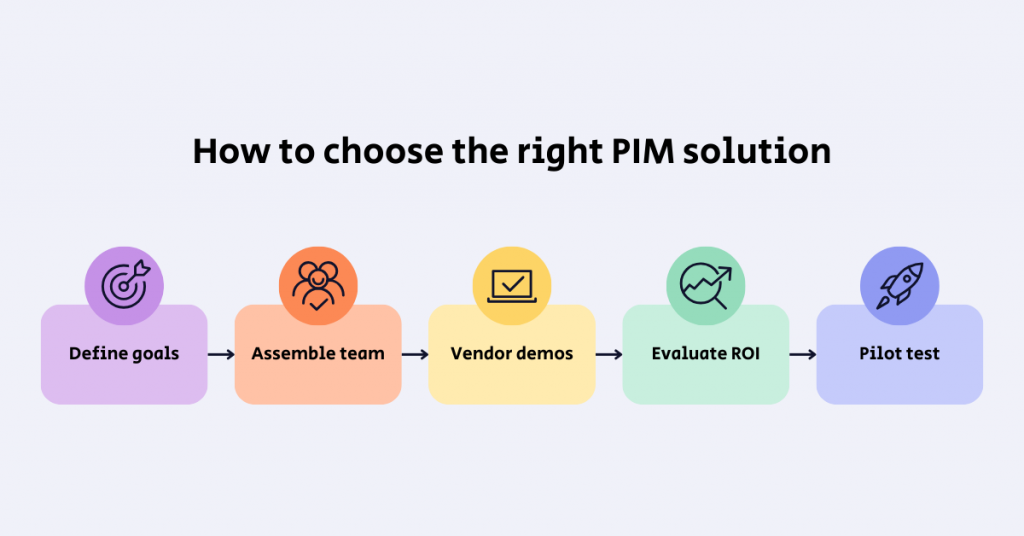
Step 1: Define your eCommerce goals and data requirements
Start by writing down exactly what you want from a PIM. Clear goals keep the choice anchored to your day-to-day needs. Consider:
- The scale of your product data
- Your omnichannel requirements
- The level of customer personalization you need
Step 2: Assemble your cross-functional team
Get input from every key department, including marketing, sales, IT, and product management. This team helps identify which features serve each area and makes adoption across the business easier.
Step 3: Shortlist PIM vendors and schedule demos
With goals set, shortlist the vendors that meet your criteria. Use the comparison above as a starting point, or if you are still unsure, book a free consultation with one of our eCommerce specialists. Request demos and ask pointed questions, for example:
- How does your PIM handle product information for multiple channels?
- What integrations are available with our current ERP or CRM?
- Can it be customized to manage our data the way we need?
Step 4: Evaluate ROI and total cost of ownership
Look at every cost: subscription fees, support, training, and extras. Weigh those against the return, whether that is better data accuracy, faster time-to-market, or higher efficiency. That comparison tells you whether the investment makes sense.
Step 5: Run a pilot or test implementation
Before you commit fully, run a test phase. A pilot lets your team see how the PIM behaves in a real setting, surfaces issues early, and confirms the solution fits your eCommerce needs.
🚀 Quick takeaway
The biggest cost in a PIM project is rarely the license, it is the data migration and integration work. Audit your product data before you shortlist vendors, because a clean catalog makes every later step cheaper and faster.
Common PIM mistakes and how to avoid them
Not prioritizing user training and change management
Rolling out a new PIM without a structured training program and change-management plan leads to friction. If users are not trained or ready for the switch, adoption stays low and efficiency suffers. Put a solid training program in place for everyone who will use the PIM. Clear guidelines and ongoing support go a long way toward a smooth transition across teams.
Choosing a one-size-fits-all solution
Every business is different, so a generic setup may not fit your needs. Look for a platform with customization options so you can adjust features to your industry and demands. That way the PIM supports your specific goals rather than covering only the basics.
Ignoring data migration complexity
Moving product data into a new PIM can be tricky and slow if it is not planned. Migration without preparation produces incomplete or inconsistent records that disrupt operations. Plan ahead: check data quality, confirm format compatibility, and test integration with other sources. A little preparation upfront makes the migration far smoother.
How to future-proof your PIM choice for eCommerce
As eCommerce changes, choosing a PIM that can grow is the difference between a system you keep and one you replace in two years. A few capabilities decide whether your PIM stays useful over time.
Cloud-based PIMs
Cloud-based PIMs are hosted online, so you get real-time updates and scale on demand: add SKUs, reach data from any device, and grow without hard limits. As the catalog expands, the PIM expands with it, keeping multichannel access steady.
Artificial intelligence and machine learning
AI now works like a fast assistant inside the PIM, automating repetitive tasks such as categorizing products or flagging inconsistencies. Recent industry analysis points to AI-assisted enrichment and predictive product content as the defining PIM trend, with a large share of companies using predictive tools to tune product content to customer behavior (AtroPIM, “Product information management trends shaping the market”). Machine learning also helps you understand customers, which supports more personalized experiences.
Product experience management (PXM)
PXM is about delivering consistent, tailored product content. It lets you control how product details appear on every channel, from social platforms to your store, so the brand stays cohesive wherever customers meet it.
Multi-domain support
If you manage more than product data, multi-domain support is worth considering. It lets you handle product, supplier, and customer data in one place, which saves time and keeps procurement, marketing, and other teams working from the same current information.
Composable and headless architectures
Composable and headless setups let you adapt quickly to new channels and technology shifts. Instead of being locked into one monolith, you get modular components you mix and match as needs change, which keeps you flexible in a fast-moving market.
How to implement PIM for successful eCommerce operations
Rolling out a PIM can look like a big task, but a clear plan keeps it manageable. Here is a practical step-by-step way to get a PIM up and running: For Shopify stores, the Shopify Plytix integration and Shopify Salsify integration pages cover what the connection involves.
- Audit your existing product data sources to remove inaccuracies and standardize information for consistency
- Identify the core PIM features your goals require, such as data management and multichannel distribution, to pick the right solution
- Connect the PIM to ERP, CRM, eCommerce platforms, and other channels for clean data flow across tools
- Train users on PIM functionality and data workflows to lift adoption and efficiency
- Run a pilot, gather feedback, refine the setup, then tune for performance before a full launch
Launching a PIM is involved, and doing it right makes a real difference. Working with experienced PIM specialists can simplify the process with tailored advice, guidance through each phase, and help tuning the setup for the biggest impact on your operations.
Case studies: how PIM software drives real results
Not sure a PIM will move the needle for your business? Here is how scandiweb helped clients reach new results with tailored PIM solutions.
Technodom: real-time updates for a successful Black Friday
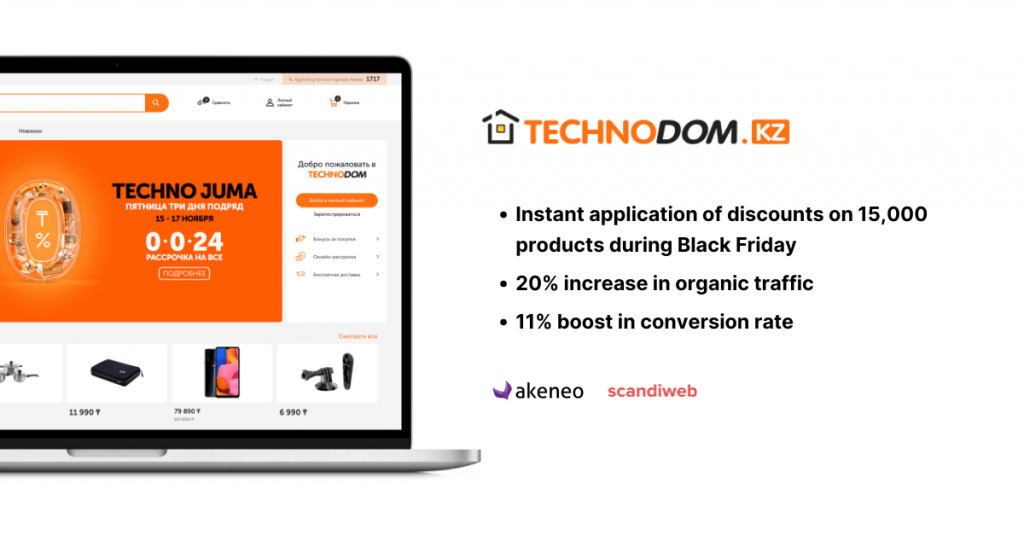
Technodom, a top electronics retailer in Central Asia, needed a way to manage a vast catalog across multiple channels: 60,000 products, 15,000 attributes, and 4,000 categories. Implementing Akeneo PIM let Technodom run real-time updates and apply rapid price changes across the catalog for time-sensitive events like Black Friday. The result:
- Real-time updates applied discounts to 15,000 products instantly during Black Friday
- 20% increase in organic traffic from improved SEO and data consistency
- 11% lift in conversion rate from more accurate, timely product data
Byggmax: building customer trust with reliable stock and pricing
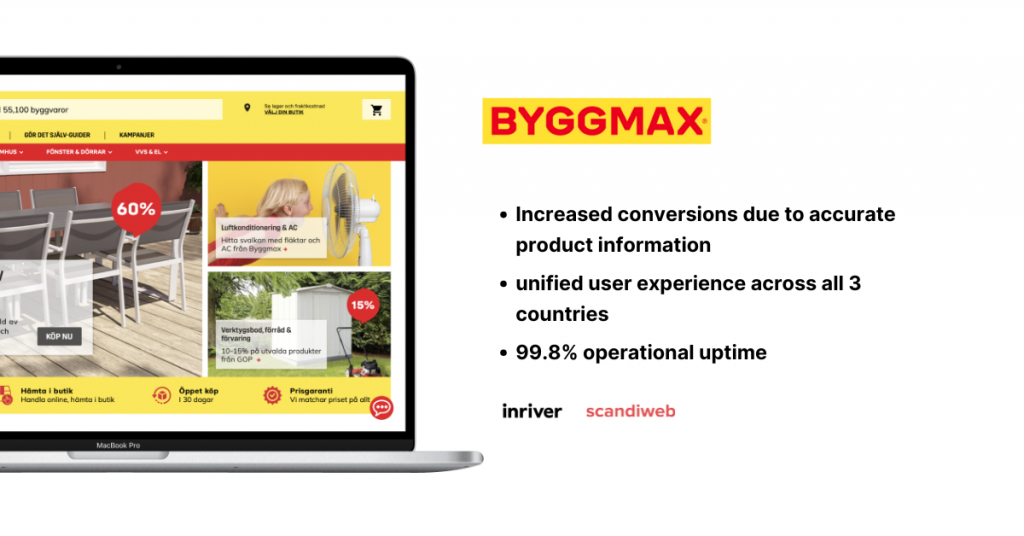
Byggmax, a major DIY retailer operating across three Nordic countries, needed a reliable PIM to give customers accurate stock and pricing on the website. With inRiver PIM, Byggmax gave customers real-time access to current product details, improving the experience and driving conversions. The result:
- Accurate product information raised conversions as customers trusted the data they saw
- A unified experience across all three countries for products, services, and support
- 99.8% operational uptime, backed by scandiweb’s 24/7 support across every channel
Rockar: pioneering online car sales with custom PIM
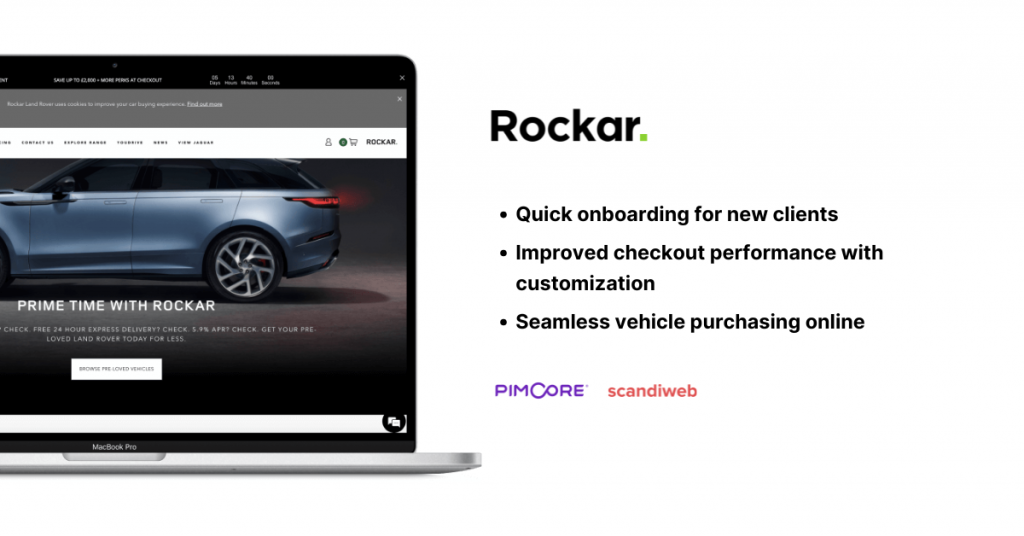
Rockar, an innovator in online car sales, needed a way to offer a fully online car-purchase journey for both manufacturers and dealers. scandiweb’s custom Pimcore-based platform let Rockar onboard clients quickly and offer flexible, multi-tenant checkout journeys without separate code bases. The result:
- Multi-tenant functionality enabled fast onboarding for new clients on a single code base
- Customizable checkout options improved the experience across diverse client needs
- Stronger platform efficiency supported a smooth online vehicle-purchase process, setting a new industry bar
🚀 Quick takeaway
The same PIM engine fits very different problems: Akeneo handled 60,000 SKUs and instant Black Friday repricing for Technodom, inRiver kept stock and pricing trustworthy for Byggmax across three countries, and a custom Pimcore build gave Rockar multi-tenant online car sales. Match the platform to the job, not the brand name.
Conclusion
Choosing the right PIM software changes how an eCommerce business runs. It brings cleaner data management, more consistent customer experiences, and steady distribution across every sales channel. Pick a PIM that maps to your business goals and you are set up to scale, reach new markets, and stay competitive. Implementation can get complex, so expert guidance helps a great deal: it keeps the setup smooth, protects your return, and positions you for the long term.

Frequently asked questions
What is the best PIM software?
The best PIM depends on your needs. Akeneo is known for ease of use and multi-language support. Pimcore is flexible with open-source options, and Salsify is strong on integrations for complex workflows. Match the choice to your catalog size, channels, and team.
How much does PIM software cost?
PIM pricing varies widely. Entry-level SaaS tools start around $99 a month, while enterprise contracts are custom-quoted and often run from roughly $25,000 to $90,000 or more a year, with year-one implementation that can match the license fee.
What is the difference between PIM and CRM?
A PIM manages product data, things like specs, attributes, images, and descriptions, so every channel shows consistent information. A CRM manages customer data and interactions across sales and service. They solve different problems and often work side by side.
What does a PIM do?
A PIM (product information management) system centralizes, enriches, and syncs product data across sales and marketing channels so information stays consistent and accurate everywhere customers see it.
Are there hidden costs with PIM software?
Yes. Extra costs can include data migration, support, and integrations. Cloud-based SaaS options usually include maintenance, while on-premises setups may add costs for setup and upkeep.
How do you implement PIM?
Start with an audit of your product data, define your goals for consistency, and decide which systems, such as ERP or CRM, you will integrate. Run a pilot to test compatibility, then train your team to manage and update the PIM. Partnering with experts streamlines the setup and helps every feature work together.
About scandiweb
scandiweb is an eCommerce agency offering full-service solutions, from web development and digital strategy to PIM implementation. With over 18 years of experience and a team of 500+ specialists, scandiweb has helped companies worldwide tighten operations, clean up product data, and improve customer experiences. scandiweb is an award-winning Akeneo partner and a recognized Platinum Partner of Pimcore.

Ready to put product data on a footing that scales with your catalog? Plan your PIM with scandiweb and choose a platform that fits your channels, your team, and your growth.