
If your product data lives in five spreadsheets and a team re-keys it into Magento, the marketplace feed, and the print catalog by hand, you already know where the bottleneck is. Every new market, channel, or product line multiplies the manual work, and a single wrong spec ends up copied everywhere before anyone catches it.
That is the problem a product information management system solves, and Akeneo is one of the most widely used in eCommerce. This guide covers what Akeneo PIM does, the AI features it added for 2026, how its editions and pricing work now, and how to implement it so it actually pays off.
Overview
- Akeneo PIM centralizes product data into one source of truth, so a change made once flows to every channel instead of being re-keyed by hand.
- Its 2026 releases added a GenAI layer: AI content generation with brand context, AI data classification, and an in-product assistant, which makes clean product data more valuable, not less.
- The free open-source Community Edition is no longer actively developed. Akeneo now centers on its Product Cloud editions, priced on request.
🚀 Quick takeaway
A PIM does not just tidy your data. It turns “update this in eight places” into “update this once,” which is where the time and the error rate both drop.
What is Akeneo PIM?
Akeneo PIM is a product information management application that centralizes, enriches, and distributes product data across every sales channel. It is built for retailers and brands with large or complex catalogs, where the same product has to appear, correctly and in the right language, on a website, a marketplace, a mobile app, and a print catalog at once. Instead of maintaining each of those separately, teams manage one record in Akeneo and publish it everywhere.
The result is consistency: the spec, the description, and the assets a customer sees are the same on every channel, which is what product experience management means in practice.
How Akeneo PIM improves product data quality
Data quality is where a PIM earns its keep, and Akeneo built tooling specifically for it.
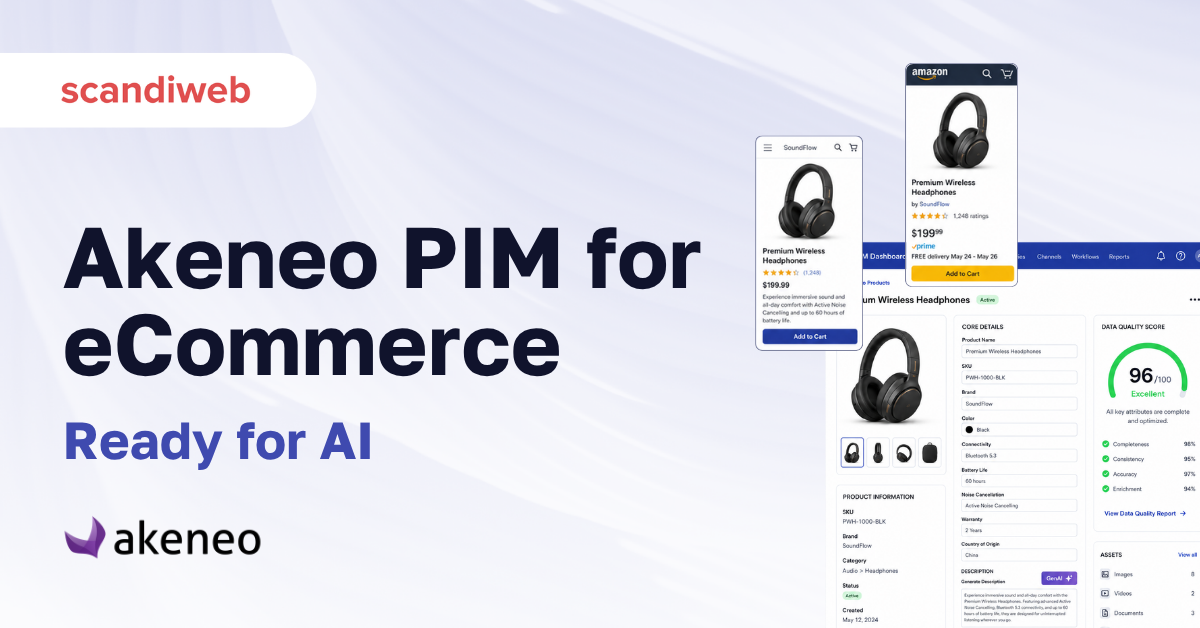
The data quality insights dashboard scores your catalog and shows where attention is needed. You can filter the catalog by quality score to focus on the families and categories that need work, and Akeneo’s recommendations point to the specific gaps, missing attributes, inconsistent values, incomplete fields, so improvement is targeted rather than guesswork.
The asset manager handles images, videos, and documents with the same discipline. Asset families define a reusable structure, naming conventions auto-populate attributes, and product-link rules attach the right assets to the right products automatically. For a large catalog, that automation is the difference between assets that stay organized and a media library nobody can find anything in.
🚀 Quick takeaway
You cannot improve what you cannot see. The quality dashboard turns “our data is probably fine” into a score you can actually work down.
Akeneo’s AI and GenAI features in 2026
This is the biggest change since most PIM guides were written. Akeneo’s recent releases added a GenAI layer that sits on top of clean product data, and it is the reason getting your catalog into a PIM matters more now, not less.
- GenAI content generation with brand context. Akeneo can generate, translate, and enrich product descriptions at scale, and it injects your brand context, tone of voice, and regulatory requirements, so the output reads like you rather than generic AI text. You can use Akeneo’s models or bring your own.
- AI data classification. Incoming product data is categorized automatically, cutting the manual sorting that slows down onboarding from suppliers.
- Responsive catalog modeling. Akeneo analyzes retailer requirements, rejection logs, and search trends to suggest the attributes and values your catalog is missing for a given marketplace.
- Ask Ziggy. An in-product AI assistant that answers questions about your configuration, workflows, and catalog data in context.
The common thread: every one of these features works only as well as the data underneath it. AI generation on a messy catalog produces messy output faster. That is why the order matters: structure the data first, then let the AI work on it.
🚀 Quick takeaway
GenAI does not replace a PIM. It raises the payoff of having one, because clean, structured data is what the AI needs to produce something usable.
Why product data quality matters more in the age of AI search
There is a second reason to care about structured product data in 2026: it is increasingly what AI answers read. As shoppers ask AI assistants and search engines’ AI overviews to compare and recommend products, the systems pull from structured, machine-readable product information. A catalog with complete, consistent attributes is far more likely to be surfaced and quoted than one with gaps. This is the same shift behind agentic commerce, and it makes a PIM part of your answer engine optimization, not just your operations.
🚀 Quick takeaway
Clean product data used to be about your storefront. Now it is also about whether an AI recommends you at all.
Integrating Akeneo with ERP, Magento, and your stack
A PIM only helps if it connects to where data comes from and where it goes. Akeneo is built to sit in the middle of an existing stack, with connectors for ERP, CRM, eCommerce platforms, marketplaces, POS, and print, all available through the Akeneo Product Cloud and its marketplace of extensions.
It supports the formats real integrations need, including CSV, XLSX, and API-based exchange, so data moves cleanly between an ERP and the storefront. For Magento (Adobe Commerce) specifically, the connection is well-trodden: see our walkthrough of the Akeneo PIM and Magento 2 connector, and our four-part Akeneo crash course for a hands-on look at setup, export, and data handling.
🚀 Quick takeaway
The PIM is only as useful as its connections. A clean catalog that cannot reach your storefront automatically is just a tidier silo.
Akeneo editions and pricing in 2026
Akeneo’s structure has changed, so older guides are a poor reference here. The free, open-source Community Edition is no longer actively developed, and Akeneo now centers on its Product Cloud editions, commonly Growth, Enterprise, and the fully managed Serenity tier, each with different features, support, and scale. Pricing is not published publicly and depends on catalog size, channels, and edition, so it requires a quote from Akeneo or an implementation partner. Deployment options include SaaS, PaaS, and on-premise to fit different IT strategies.
The practical takeaway: do not budget from a number you read in a 2023 article. Akeneo’s editions and the move to the Product Cloud have shifted what you get at each tier.
🚀 Quick takeaway
If your PIM plan is based on the free Community Edition, it is out of date. Scope against the current Product Cloud editions instead.
Scaling and choosing the right Akeneo setup
Akeneo’s data model is built to grow with a catalog, which is why it suits businesses expanding product ranges or entering new markets. Choosing the right setup is a structured exercise, not a feature checklist. Weigh:
- Your KPIs and what “good product data” has to achieve
- Catalog size, complexity, and how fast it is growing
- The data model and how attributes and families should be structured
- Which systems it has to integrate with, and in what direction data flows
- Asset volume and how it is managed today
- Team maturity and who will own the PIM day to day
Selecting and scoping a PIM typically takes from a week to around six weeks, and the choices made up front decide most of the implementation cost. Our guide to choosing the best PIM software goes deeper on the comparison if you are still weighing options.
How scandiweb implements Akeneo PIM
scandiweb is an Akeneo partner, and we treat a PIM project as a data and integration project, not a software install. That means modeling the catalog around how your business actually works, building the connectors to your ERP and storefront, and migrating data cleanly so the PIM is a real source of truth from day one.
The results show up in the catalog. For Scicon, custom Akeneo synchronization kept a complex catalog consistent across channels, and for Technodom, Akeneo helped manage a very large SKU range with faster time-to-market. Across more than 2,100 eCommerce projects since 2003, including catalogs with tens of thousands of structured product records, the pattern holds: the businesses that get value from a PIM are the ones that model and integrate it well, not just the ones that buy it.
🚀 Quick takeaway
A PIM project succeeds or fails on the data model and the integrations, both decided in the first weeks. The software is the easy part.
Frequently asked questions
What is Akeneo used for?
Akeneo is a product information management (PIM) tool that centralizes, enriches, and distributes product data across sales channels. eCommerce businesses use it to keep product information consistent and complete across their website, marketplaces, apps, and print.
What is a PIM used for?
A PIM manages product data as a single source of truth for marketing, sales, and operations. It handles complex product information and digital assets so every channel pulls from the same accurate record instead of separate, drifting copies.
Does Akeneo have AI features?
Yes. Akeneo’s 2026 releases added GenAI content generation with brand context, AI-powered data classification, responsive catalog modeling, and an in-product AI assistant. These features rely on clean, structured product data to work well.
Is Akeneo Community Edition still free?
The free, open-source Community Edition is no longer actively developed. Akeneo now focuses on its Product Cloud editions, which are priced on request and offer different features, support, and scale.
How does Akeneo integrate with Magento?
Akeneo connects to Magento (Adobe Commerce) through a connector that syncs product data, attributes, and assets between the two. Data moves via the connector or API, keeping the PIM as the source of truth and the store as the channel.
How long does an Akeneo PIM implementation take?
Selecting and scoping a PIM usually takes one to six weeks, and a full implementation depends on catalog size, integrations, and data quality. The data model and integration decisions made early drive most of the timeline and cost.
If your product data is scattered across spreadsheets and channels, the first step is mapping how it actually flows. Tell us about your catalog and we will show you where Akeneo fits and what implementing it would take.
About this guide
Maintained by the scandiweb PIM team. Reviewed by the scandiweb Akeneo specialists. Last updated May 2026.