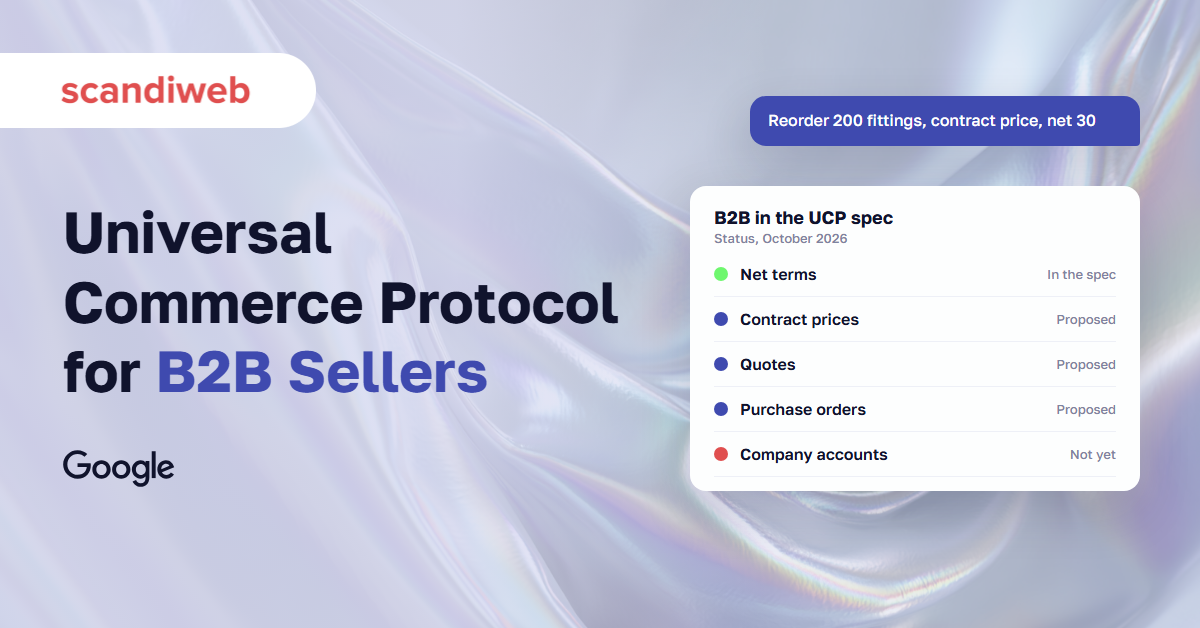
If Google, a platform vendor, or your own leadership has told you to get ready for the Universal Commerce Protocol, and most of your revenue comes from business buyers on negotiated terms, you need to know which parts of UCP apply to you. The protocol launched in January 2026 to let AI agents shop and check out on consumer stores. Payment terms such as deferred payment arrived in August. Quotes, contract prices, approvals, and purchase orders are still proposals, and the main B2B ones were filed this month.
This guide explains what UCP is, how it compares with ACP, AP2, and MCP, what it supports for B2B today, and what B2B sellers should build now while the B2B pieces take shape. We build Magento (Adobe Commerce) stores, MCP servers, and AI agents for manufacturers and distributors, so the advice comes from that side of the order. For the wider picture, see our B2B eCommerce trends for 2027.
What is the Universal Commerce Protocol?
The Universal Commerce Protocol (UCP) is an open standard that lets AI agents and platforms discover products, build a cart, check out, and manage orders with a business in a common format. Google announced it on 11 January 2026, co-developed with Shopify, Etsy, Wayfair, Target, and Walmart. It powers buying directly in Google’s AI Mode and Gemini, and the business stays the merchant of record.
The idea is simple. Without a shared standard, every AI assistant would need its own integration with every store. UCP gives them one language. An agent that speaks UCP can ask any store that supports it for products, prices, delivery options, and a checkout, without a custom connection to each one.
Google is no longer the only backer. The UCP site now lists Amazon, Microsoft, Meta, Salesforce, and Stripe among the co-developers of its shopping specification, with payment companies such as Adyen, Visa, and Mastercard as endorsers. It has also started expanding beyond retail, with draft specifications for lodging and food ordering.
How UCP works
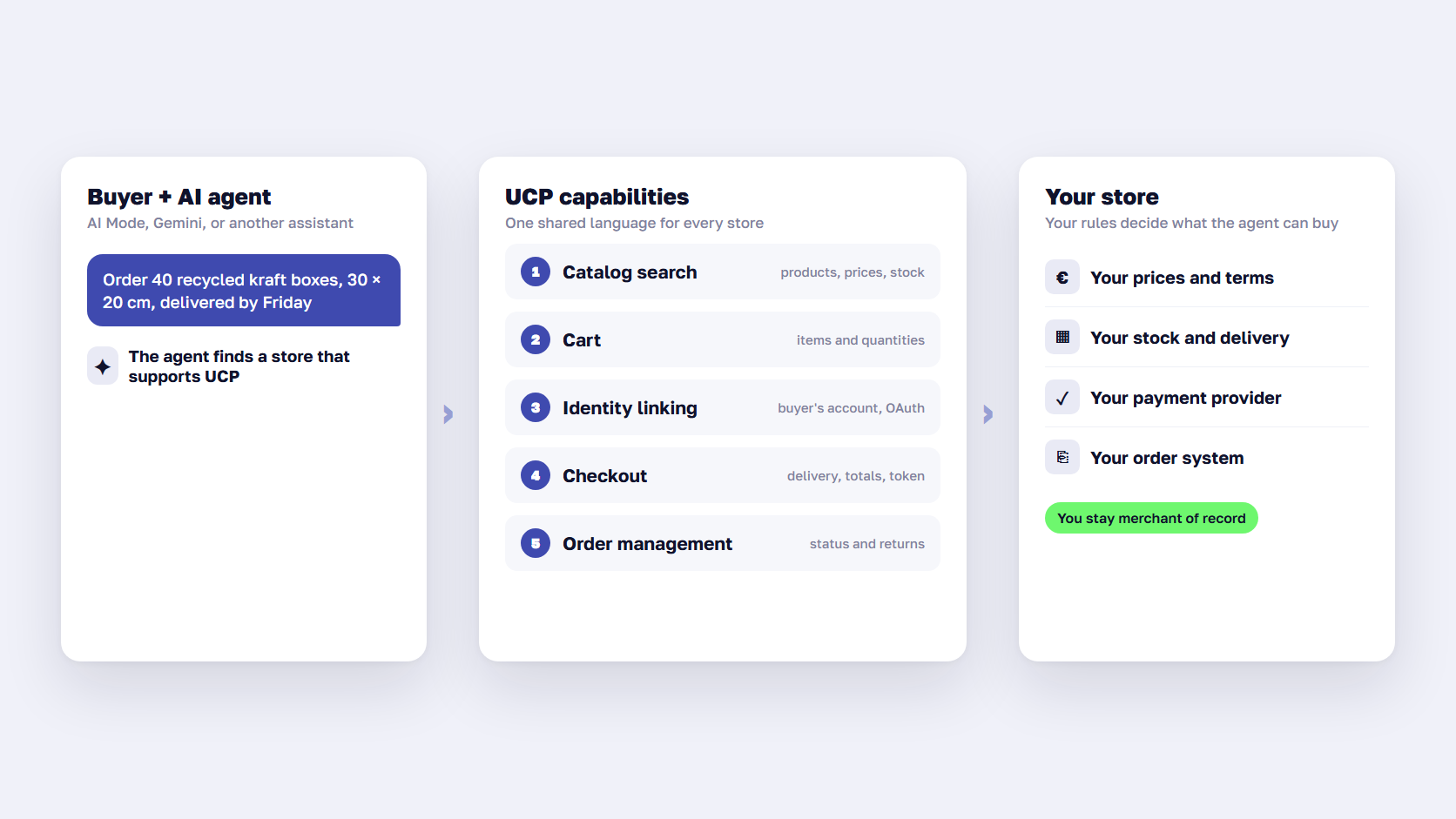
UCP describes commerce as a set of capabilities that a business can support, plus extensions that add detail. An AI agent reads which capabilities a store offers and uses them to complete a purchase on the shopper’s behalf.
| Capability | What it lets an agent do |
|---|---|
| Catalog search and lookup | Find products, check prices and availability |
| Cart | Build and update a basket |
| Identity linking | Connect the shopper’s account with the store, using OAuth 2.0 |
| Checkout | Confirm delivery, totals, and payment, then place the order |
| Order management | Track the order after purchase |
A few design choices matter for merchants:
- You keep the customer relationship. The business remains the merchant of record, so the order, the payment, and the customer data stay with you.
- It runs over familiar technology. UCP works over REST and JSON-RPC, with built-in support for MCP, Google’s Agent2Agent protocol (A2A), and its Agent Payments Protocol (AP2).
- Payments use tokens. The agent never needs the raw card details. UCP passes tokenized payment credentials through payment handlers, and an AP2 mandates extension records what the shopper authorized.
- Google reads your existing feeds. To appear in AI Mode and Gemini, merchants use their existing Merchant Center shopping feeds and join a waitlist for checkout.
The specification is moving fast. Since launch there have been three releases. The April 2026 version added the cart capability. The August 2026 version added payment terms and schedules, split payments across several instruments, a policies snapshot for returns and warranties, and a loyalty extension.
🚀 Quick takeaway
UCP sends the agent to your store’s own checkout logic. Your prices, stock, and order rules still decide what the agent can buy, so their quality decides how well it works.
UCP vs ACP vs AP2 vs MCP
UCP, ACP, AP2, and MCP solve different parts of the same problem. MCP connects an AI model to tools and data. AP2 proves that a person authorized an agent’s payment. ACP and UCP both standardize how an agent checks out with a merchant, ACP for ChatGPT and UCP for Google’s surfaces and a wider group of platforms.
| Protocol | Who launched it | What it does | Status in October 2026 |
|---|---|---|---|
| UCP (Universal Commerce Protocol) | Google with Shopify, Etsy, Wayfair, Target, Walmart, January 2026 | Product discovery, cart, checkout, and orders between agents and businesses | Live in Google AI Mode and Gemini, B2B extensions proposed |
| ACP (Agentic Commerce Protocol) | OpenAI and Stripe, September 2025 | Checkout inside ChatGPT | In-chat Instant Checkout scaled back in March 2026, purchases moved to merchants’ own checkouts |
| AP2 (Agent Payments Protocol) | Google, September 2025 | Signed mandates that prove the user authorized a payment | Used as an extension inside UCP |
| MCP (Model Context Protocol) | Anthropic, November 2024 | Lets AI models call tools and read data from any system | Widely used, UCP can run over it |
For a store owner, the practical reading is this: MCP is how an agent talks to your systems, and UCP is a standard set of commerce actions it can perform through that connection. If you want the background, our guides cover MCP and agentic commerce, and our ChatGPT shopping guide explains what changed when OpenAI moved checkout back to merchant sites. OpenAI now points merchants toward ChatGPT apps instead.
🚀 Quick takeaway
You don’t have to pick one protocol. A store with a clean catalog, one pricing API, and an MCP server can add UCP and ACP adapters as each one matures.
Does UCP support B2B?
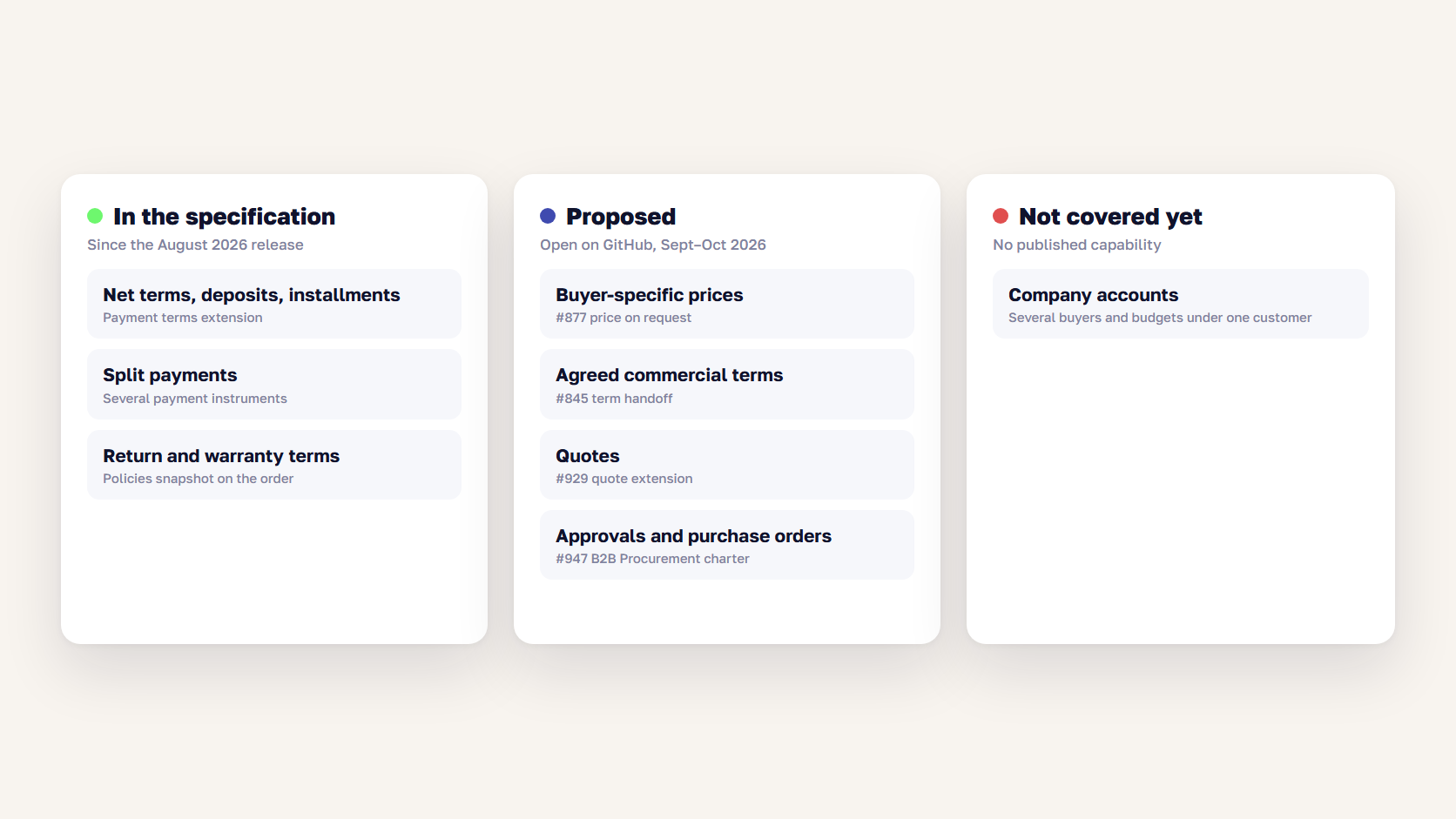
UCP supports some B2B needs today, mainly payment terms, and the rest is in proposals. Deferred payment, deposits, installments, and split payments became part of the specification in August 2026. Quotes, contract prices, approvals, and purchase orders are open proposals on the protocol’s GitHub, most of them filed in September and October 2026.
| B2B requirement | Status in UCP (15 October 2026) |
|---|---|
| Net terms, deposits, installments | In the specification since August 2026 (payment terms extension) |
| Split payment across instruments | In the specification since August 2026 |
| Return and warranty terms on the order | In the specification since August 2026 (policies snapshot) |
| Products with no public price, buyer-specific prices | Proposal #877, filed 29 September 2026 |
| Carrying agreed commercial terms into checkout | Proposal #845, filed 19 September 2026 |
| Quotes | Proposal #929 from Google, filed 11 October 2026, with a draft implementation |
| Requisitions, approvals, purchase orders, invoices | B2B Procurement charter #947, filed 14 October 2026, awaiting review |
| Company accounts with several buyers and budgets | No published capability yet |
The quote proposal shows the direction. It describes a quotation as a time-bound, fixed price for the items in a cart or checkout, issued by the business and accepted by the buyer. That fits how B2B buying works: the seller sets the price, and the agent works within it.
The procurement charter matters even more for distributors. It names procurement platforms such as SAP, Zip, and Procurify among its backers, and plans to cover requisitions, approvals, purchase orders, invoices, and reconciliation. Approval authority stays with people and the buyer’s own systems, so an agent can prepare a purchase but not approve it.
🚀 Quick takeaway
The B2B parts of UCP are being written right now. If your business depends on contract prices and approvals, plan for them to reach the specification over the next year, and keep your portal and procurement integrations for contract buying until then.
Who supports UCP
UCP has broad backing from platforms, retailers, and payment companies, and early merchant adoption is concentrated on consumer stores. Shopify is a co-developer, and Adobe has announced that Adobe Commerce will support both UCP and ACP. Adobe also released an MCP server for Adobe Commerce at Summit 2026, which exposes catalog, cart, pricing, checkout, and orders to AI agents.
Adoption is growing quickly but is still early. UCP Checker, a third-party directory that verifies stores, counted more than 8,000 verified UCP stores in June 2026. A live UCP profile means an agent can shop the store. It doesn’t yet mean every payment or identity feature is in place.
B2B platforms are moving too. Shopware already runs quotes through its own UCP vendor extension, ahead of the standard.
What B2B sellers should do now
B2B sellers should prepare the parts UCP will rely on, product data, pricing, and APIs, and put AI agents to work on their own side of the order while the B2B extensions are written. These steps pay off whatever the final standard looks like.
- Separate your B2C and B2B channels. If you also sell to consumers, the D2C store can join Google’s UCP waitlist now. Your B2B portal can wait for quotes and approvals to reach the specification.
- Make your catalog readable by agents. Agents start with discovery. Complete product attributes, public specs, and clean Merchant Center feeds decide whether an assistant can find and recommend you. Product structured data helps with the same job on your own pages.
- Put your price logic behind one API. UCP’s B2B proposals assume the business decides the price for each buyer. That only works if customer-specific prices come from one place, usually the ERP, through an authenticated API. Our guide to eCommerce ERP integration covers how to set that up.
- Give agents a door into your store. An MCP server for Magento or Adobe Commerce lets AI agents read your catalog, prices, and orders under your own rules today, and UCP can run over the same connection later. For other platforms, see how to build your own MCP server.
- Automate your own order work first. Order intake from email and PDF, invoice matching, and quotes are where agents already save money for B2B sellers.
- Watch the B2B proposals. Proposals #929 and #947 will decide how quotes and purchase orders work. Your platform partner should follow them, or take part.
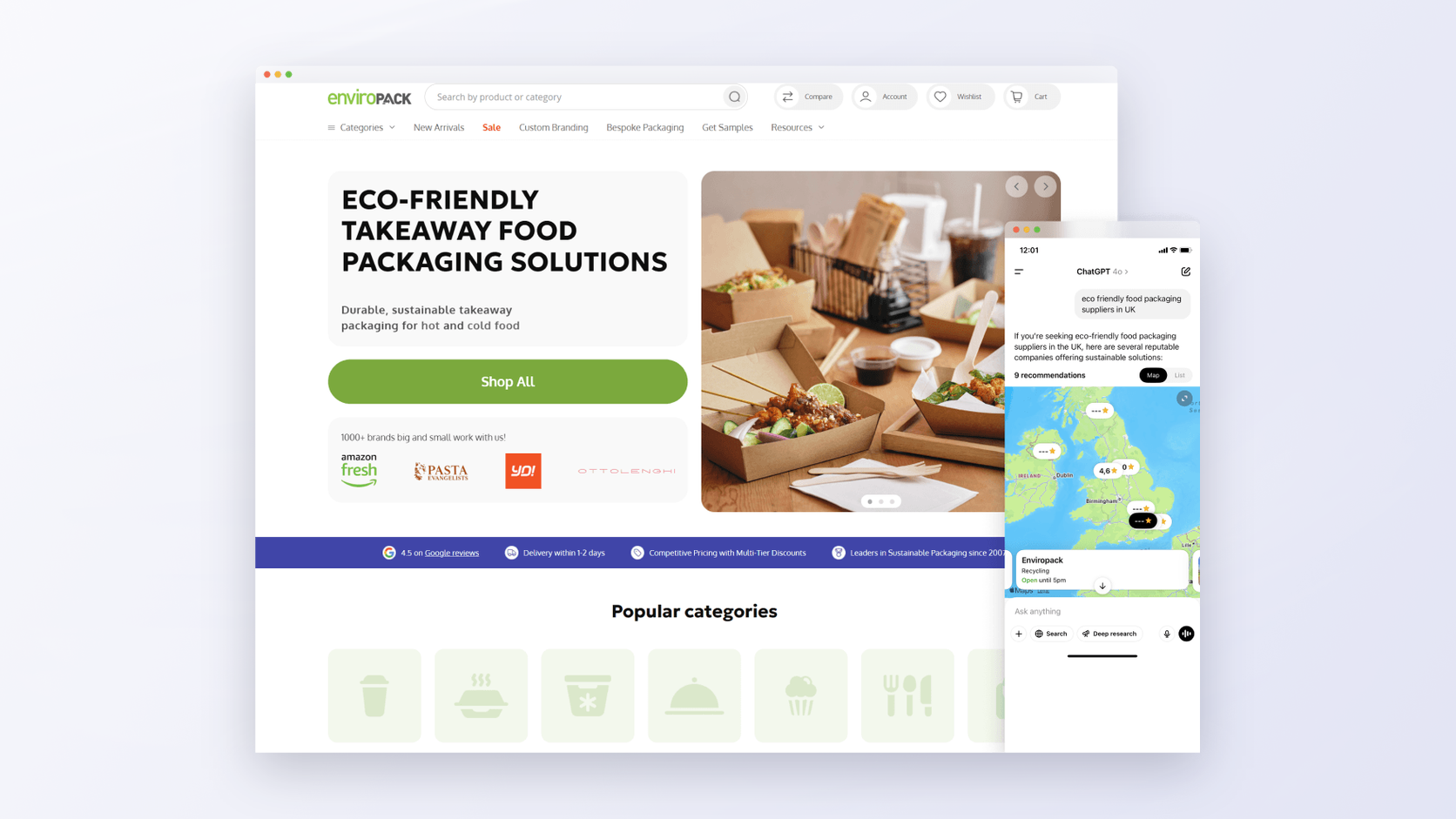
Step 2 is where AI already moves revenue. Enviropack, a UK supplier of eco-friendly food packaging, aligned its SEO and Google Business Profile copy with the words buyers use when they shortlist suppliers. It started appearing in ChatGPT and Perplexity answers for prompts such as “eco-friendly food packaging suppliers in the UK,” and sessions from ChatGPT grew 110% in three months.
Read more: How AEO Helped Enviropack Become a Top AI Pick for Sustainable Packaging
Step 5 is where agents already earn their keep inside the business. One wholesaler we work with on Microsoft Dynamics NAV now matches 87% of supplier invoices to purchase orders with nobody touching them, using OperaLayer, and staff only review the exceptions. The same approach works for email orders and quote requests.
🚀 Quick takeaway
For a B2B seller, being ready for UCP means clean product data, one source of truth for prices, and an API agents can call. The checkout button is the last piece, and the standard isn’t ready for it yet.
FAQ about the Universal Commerce Protocol
Is the Universal Commerce Protocol only for Google?
No. Google launched UCP and uses it for buying in AI Mode and Gemini, but it is an open standard with co-developers that include Shopify, Amazon, Microsoft, Meta, Salesforce, and Stripe. Any platform or AI agent can implement it, and a store that supports UCP can be used by agents beyond Google’s.
Does the Universal Commerce Protocol support B2B purchases?
Partly. Since August 2026, UCP supports payment terms such as deferred payment, deposits, and installments. Quotes, buyer-specific prices, approvals, and purchase orders are open proposals filed in September and October 2026. Until they are adopted, B2B buying with contract terms still needs your own portal or procurement integrations.
What is the difference between UCP and ACP?
Both standardize how an AI agent checks out with a merchant. ACP was launched by OpenAI and Stripe in September 2025 for checkout in ChatGPT, and OpenAI scaled back in-chat checkout in March 2026. UCP was launched by Google and retail partners in January 2026, powers buying in AI Mode and Gemini, and has a wider group of co-developers.
How do AI agents pay with UCP?
The agent passes a tokenized payment credential, not raw card details, through a payment handler that the merchant already uses. UCP can carry AP2 mandates, signed records that prove the user authorized the purchase. The business stays the merchant of record and processes the payment through its own provider.
Do I need UCP if my store runs on Magento or Adobe Commerce?
Not yet for B2B. Adobe has announced support for UCP and ACP in Adobe Commerce and released an MCP server for AI agents. For a B2B store, the useful work today is clean product data, one source of truth for prices, and an API or MCP server agents can call.
How does UCP relate to MCP?
MCP is a general way for AI models to connect to tools and data. UCP defines commerce actions, such as catalog search, cart, checkout, and orders, and can run over MCP as well as REST or JSON-RPC. A store’s MCP server can be the connection UCP uses.
Getting B2B commerce ready for the Universal Commerce Protocol
The Universal Commerce Protocol already works for consumer checkout in Google’s AI surfaces, and its B2B pieces, quotes, buyer-specific prices, and purchase orders, are being written in the open right now. B2B sellers who clean up product data, centralize pricing, and give agents an API will be ready when those pieces land, and will get value from AI agents in the meantime.
Wondering how much of your B2B store an AI agent could use today? Tell us what platform and ERP you run, and we'll map what an agent can already do with them.