
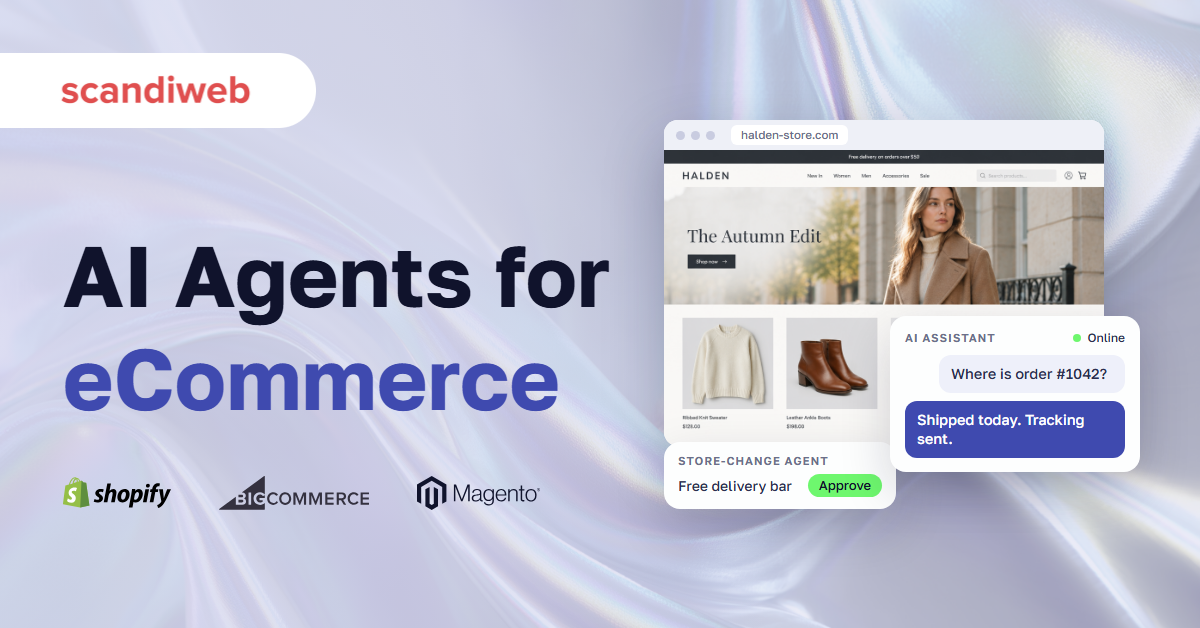
AI agents for eCommerce now arrive with the platform itself: Shopify and BigCommerce both include an AI assistant in the store admin at no extra cost, and both apply a change only after someone on your team approves it. An AI agent is software that carries out a task in your store after you ask, such as answering a customer or updating an order.
That leaves a store team with two decisions: which jobs to hand to an agent, and which agent fits each job on your platform. The job sets the access: an agent that answers a shopper’s question reads your catalog, while one that edits your theme changes your code, and each needs its own review step. Every price and platform list here was read on the vendor’s own site on November 2, 2026.
What AI agents for eCommerce do for a store team
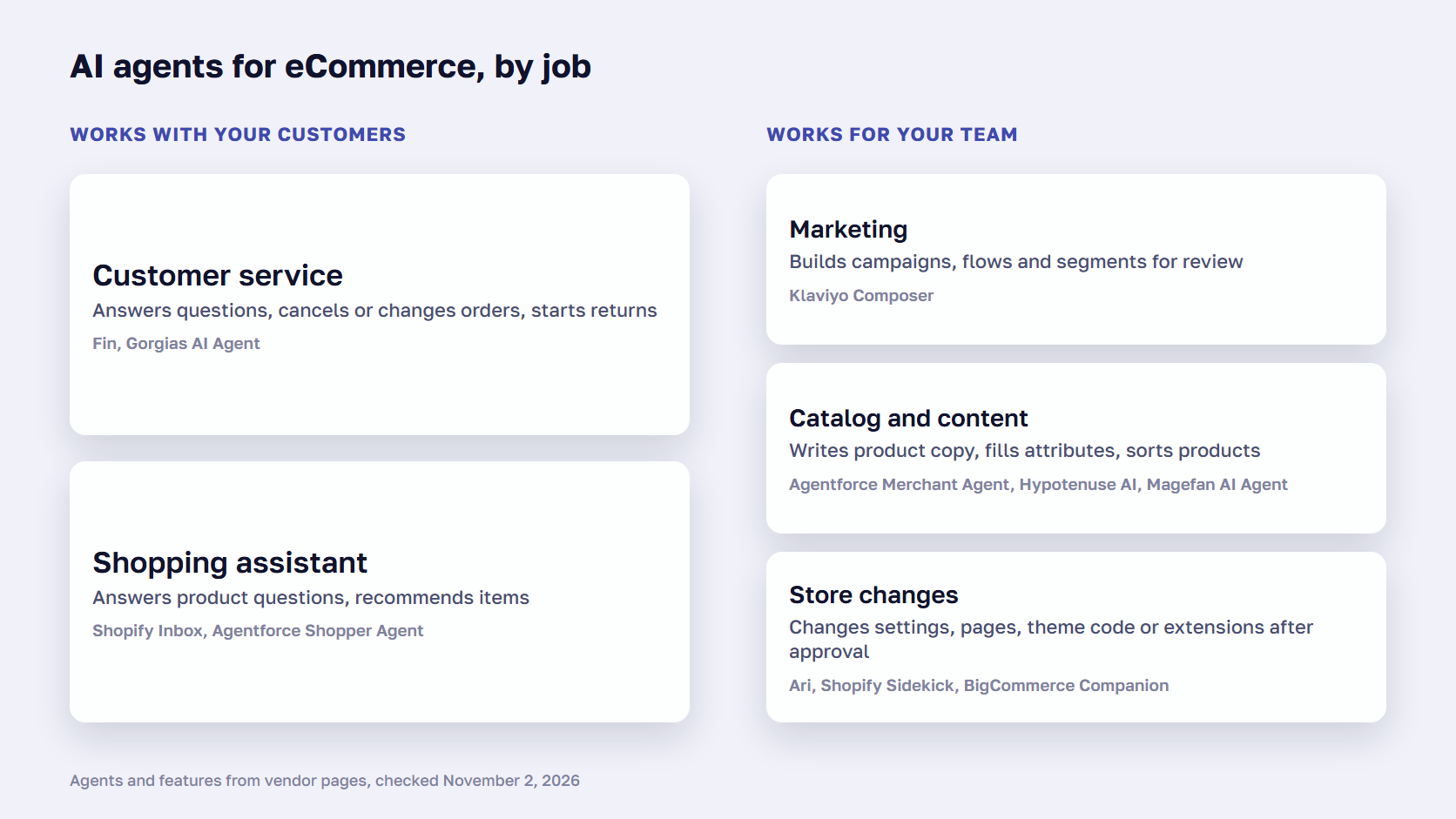
AI agents for eCommerce are software a store team gives a task in plain words, and the agent carries it out in the store’s systems. They answer customers, help shoppers choose, build campaigns, write catalog content and make store changes. Each job needs different access, from reading orders to editing the theme, so choose agents by job.
Agents that buy for shoppers are covered in our guide to agentic commerce, and companies that build custom agents in our list of AI agent development companies. The table lists the eleven eCommerce AI agents below by job, with the platforms each one runs on.
| # | Agent | Vendor | Job | Platforms | Price |
|---|---|---|---|---|---|
| 1 | Fin | Intercom | Customer service | Intercom or another helpdesk, a Shopify app, other systems by API | $0.99 per outcome |
| 2 | AI Agent | Gorgias | Customer service, shopper chat | Shopify, BigCommerce, Magento, WooCommerce | $0.90 to $1.00 per automated interaction, plus a helpdesk plan |
| 3 | Shopify Inbox | Shopify | Shopping assistant | Shopify | Free |
| 4 | Shopper Agent (Agentforce Commerce) | Salesforce | Shopping assistant, checkout in chat | Salesforce Commerce Cloud | Agentforce list price $2 per conversation |
| 5 | Composer | Klaviyo | Marketing campaigns, flows, segments | Klaviyo (connects to Shopify, BigCommerce, Adobe Commerce, Salesforce Commerce Cloud and more) | Free and paid access |
| 6 | Merchant Agent (Agentforce Commerce) | Salesforce | Catalog and merchandising | Salesforce Commerce Cloud | Not published |
| 7 | Hypotenuse AI | Hypotenuse | Product content and attributes | Shopify, BigCommerce, Salesforce Commerce Cloud, PIMs, API | Custom quote |
| 8 | Magento 2 AI Agent | Magefan | Admin and catalog edits in chat | Magento 2.3.0 to 2.4.9, all editions | €134 one-time |
| 9 | Agent for Magento (Ari) | scandiweb | Store changes, built on a copy | Magento Open Source and Adobe Commerce | From €99 a month per store |
| 10 | Sidekick | Shopify | Store changes, admin tasks | Shopify | Included in Shopify plans |
| 11 | Companion | BigCommerce | Admin tasks, store changes | BigCommerce | Included |
Prices as listed on each vendor’s site on November 2, 2026.
Customer service AI agents
A customer service agent answers customers in chat, email or other channels and takes actions such as checking an order’s status, cancelling an order or starting a return. It works inside your helpdesk and reads your store’s order data. Most charge per resolved conversation, so the bill grows with the share of tickets the agent closes.
1. Fin by Intercom
Fin answers customers in chat, email, voice and social channels, and takes actions such as refunds and partial or full cancellations once it has verified the order. Fin Voice covers calls, for stores that want an AI voice agent for eCommerce support.
Best for: stores with a busy support inbox that want the agent inside the helpdesk they already use.
Key features:
- Runs in Intercom’s helpdesk or in Salesforce, Zendesk, HubSpot, Freshdesk and others
- Shopify app that reads order status and tracking, plus no-code connectors for other systems with an API
- Invalid order IDs and orders that need attention go to your team
- A testing suite before you set changes live
Price (November 2, 2026): $0.99 per outcome, at most once per conversation. With another helpdesk, a $49 a month minimum that includes 50 outcomes. On Intercom, $19 per seat a month plus outcomes. Fin Voice is $1.99 per voice outcome, through sales.
Works with: Shopify through its app, other systems through data connectors.
2. Gorgias AI Agent
Gorgias AI Agent answers support questions, chats with shoppers before they buy, and handles returns and order tracking. On Shopify it can cancel an order, edit the shipping address, remove or replace an item, reship an order for free and add an order note.
Best for: Shopify, BigCommerce or Magento (Adobe Commerce) stores that want support and pre-sale chat in one helpdesk.
Key features:
- Asks the shopper to confirm an address change or item removal before it makes it
- Checks that an order is unfulfilled before it cancels or edits it
- Hands the ticket to your team when a replacement raises the order total
- Cancellations don’t reach third-party logistics apps
Price (November 2, 2026): on every Gorgias plan, at $0.90 per automated interaction on an annual contract or $1.00 monthly, then $1.50 past the plan’s limit, on top of a helpdesk plan priced separately.
Works with: Shopify, BigCommerce, Magento, WooCommerce.
🚀 Quick takeaway
Customer service agents bill per result: Fin charges $0.99 per outcome, and Gorgias charges $0.90 to $1.00 per automated interaction. A busy month costs more, so check the minimums too, such as Fin’s $49 a month when it runs on another helpdesk.
Shopping assistant agents for your storefront
A shopping assistant agent talks to shoppers on your storefront before they buy. It answers product questions from your catalog, recommends items and, on some platforms, takes the shopper through checkout in the chat. Assistants built by the commerce platform use its catalog and order data directly, while helpdesk tools add shopping chat to their support agent.
For the types of AI shopping assistants and what each costs per conversation, see our guide to AI shopping assistants.
3. Shopify Inbox
Shopify Inbox is Shopify’s free chat app, and it gives shoppers an AI sales associate: “Buyers can ask questions and get help finding the right products from your catalog.” It is a quick way to add an AI agent for your website’s storefront chat.
Best for: Shopify stores that want to try an AI shopping assistant before paying for one.
Key features:
- Product recommendations
- Replies that use preferences and purchase history for shoppers signed in with Shop
- Live chat and chat assignment for your team
Price (November 2, 2026): free.
Works with: Shopify.
4. Salesforce Agentforce Commerce Shopper Agent
The Agentforce Commerce Shopper Agent is Salesforce’s storefront agent. In Salesforce’s words, it “carries the customer conversation from discovery through checkout and into service” in your brand’s voice, and Salesforce made it generally available in June 2026.
Best for: brands on Salesforce Commerce Cloud that want one agent from product discovery to after-sale service.
Key features:
- Visual product search and answers to store and product questions
- Checkout in the chat with Apple Pay or Google Pay
- Connected to the catalog, inventory and orders
Price (November 2, 2026): Salesforce lists Agentforce at $2 per conversation for customer-facing agents, or by Flex Credits. Commerce Cloud editions are priced on request.
Works with: Salesforce Commerce Cloud.
🚀 Quick takeaway
On Shopify, Shopify Inbox is a free way to test an AI shopping assistant. Salesforce lists Agentforce at $2 per conversation for customer-facing agents, so estimate your monthly conversations before you compare it with a flat-fee tool.
AI marketing agents
A marketing agent builds campaigns from a goal you describe. It picks the audience, drafts the emails or messages and plans the send, using your customer and sales data. Klaviyo’s Composer, the example below, builds campaigns, flows and segments inside Klaviyo and lets your team review customer-facing work before it goes live.
5. Klaviyo Composer
Klaviyo Composer is Klaviyo’s AI marketing agent. You give it a goal, and it builds campaigns, flows, messages and segments inside Klaviyo from your own customer data.
Best for: teams that already send email or SMS from Klaviyo and want campaigns drafted from their own customer data.
Key features:
- Builds and refines segments and audiences
- Gives your team “the opportunity to review customer-facing work before it goes live”
- Klaviyo also sells a Customer Agent for order tracking, returns and recommendations
Price (November 2, 2026): free and paid access, depending on your account and usage. The free plan includes $5 of Composer usage a month.
Works with: Klaviyo, which connects to Shopify, BigCommerce, Magento, Salesforce Commerce Cloud, WooCommerce and Wix. Our Klaviyo vs Mailchimp comparison covers the email platform itself.
Catalog and product content agents
A catalog agent writes and fixes product data: titles, descriptions, attributes, categories and sort orders, often for thousands of products at once. Some work inside the commerce platform and edit the catalog directly. Others work in a separate product content tool and send the results to your store. Read a sample before you run one on the whole catalog.
Catalog agents do more than an AI product description generator, because they also fill attributes and sort products, and teams that keep product data in PIM software can run them there.
6. Salesforce Agentforce Commerce Merchant Agent
The Agentforce Commerce Merchant Agent runs the back office side of Salesforce Commerce Cloud: your team organizes catalogs, sorts products and responds to trends by describing what they want in plain language instead of clicking through admin menus. Salesforce made it generally available in June 2026.
Best for: Salesforce Commerce Cloud merchandisers who spend hours on catalog rules and sort orders in admin menus.
Key features:
- Rules for which products rise or drop in results
- Category sort orders
- Related Agentforce Merchandising features write product descriptions and SEO metadata, including in local languages
Price (November 2, 2026): not published. Commerce Cloud is priced on request.
Works with: Salesforce Commerce Cloud.
7. Hypotenuse AI
Hypotenuse AI is an AI product information platform with “Specialized AI agents for catalog work, alongside your team”. It writes titles and descriptions in your brand voice, fills missing attributes and edits the catalog in bulk.
Best for: large catalogs that sell on a store and on marketplaces and need consistent product data in many languages.
Key features:
- Bulk generation of titles and descriptions
- Fills attribute gaps from the web, UPC data, spec sheets and product images
- 40+ languages
- Custom integrations with PIM, ERP and eCommerce platforms on the Enterprise plan
Price (November 2, 2026): custom quote for both plans.
Works with: Shopify, BigCommerce, Salesforce Commerce Cloud, Akeneo and other PIMs, plus an API.
8. Magefan Magento 2 AI Agent
Magefan Magento 2 AI Agent adds an AI chat to the Magento admin that can “View, create, update and delete store entities”, including products, categories, orders, cart price rules, CMS pages and blocks, and customers.
Best for: Magento admin users who want catalog edits, lookups and routine admin work done by asking in chat.
Key features:
- Respects each user’s admin permissions (ACL), with an option to limit the AI further
- Also handles invoices, shipments, credit memos and newsletter subscribers, plus cache and indexer actions
- Uses the Claude API
- Compatible with the Hyvä theme
Price (November 2, 2026): €134 one-time, with 365 days of updates and support.
Works with: Magento 2.3.0 to 2.4.9 (Open Source, Adobe Commerce, Adobe Commerce Cloud, B2B).
🚀 Quick takeaway
Run a catalog agent on one category first and read what it writes before you let it change the whole catalog. Product copy goes straight to your storefront and to Google, so one bad pattern repeated across a thousand products is hard to undo.
Agents that change the store itself
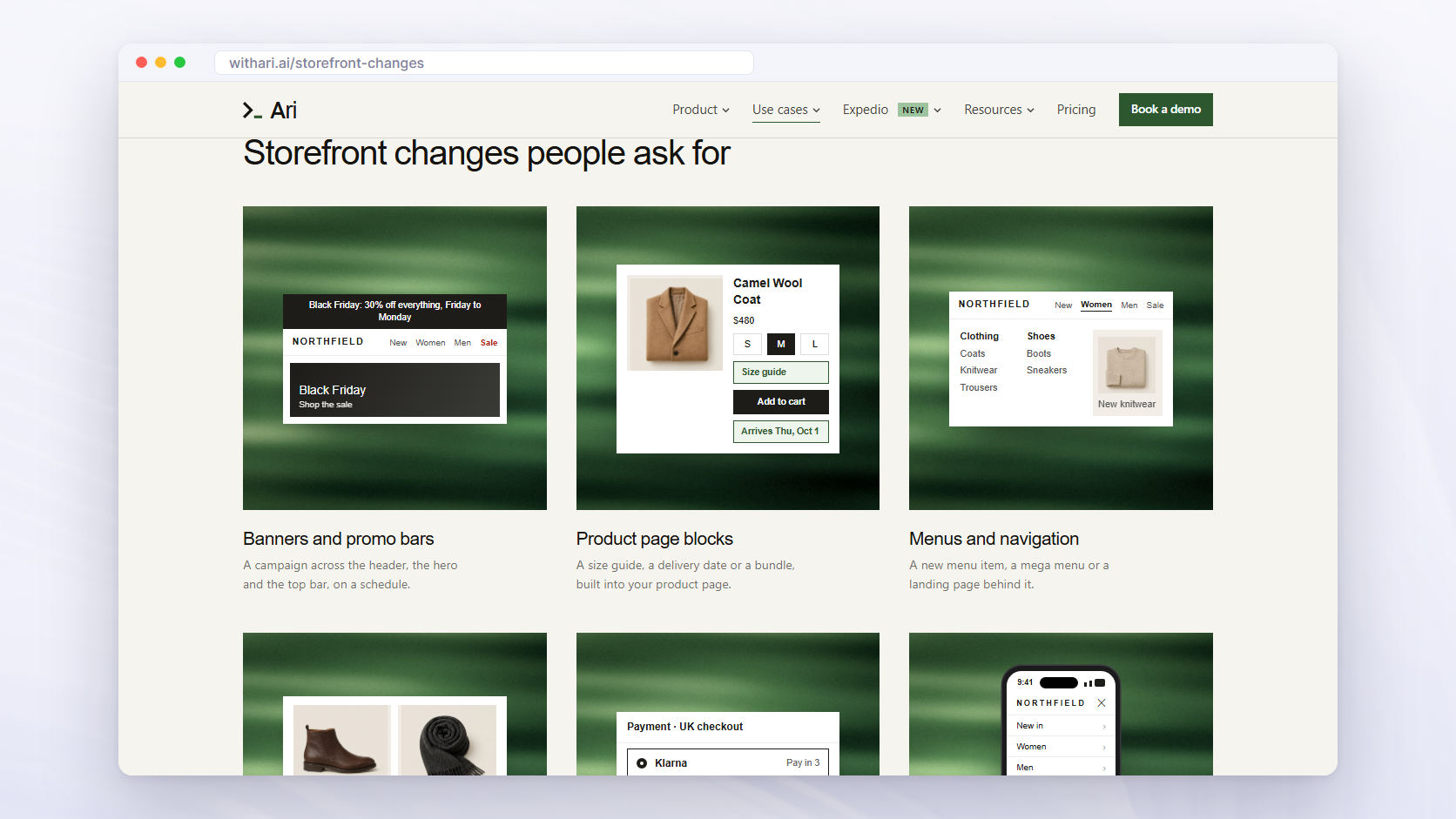
A store-change agent changes the store itself from a chat: settings, orders, pages, theme code or extensions. Shopify and BigCommerce include admin assistants that apply a change only after you approve it. Magento (Adobe Commerce) stores add third-party agents, from admin chat extensions to agents that build code changes on a copy of the store for a person to release.
9. Agent for Magento (Ari) by scandiweb
Ari, the AI agent for Magento, takes store changes you describe in chat and builds them on a copy of the store with customer data removed. Your team checks each change on a preview store, and a person approves it and releases it as a pull request.
Best for: Magento Open Source and Adobe Commerce teams with frontend, backend and extension work waiting for a developer.
Key features:
- Frontend and backend changes, extension installs and conflict fixes
- Magento version upgrades and security patches
- ERP, PIM and carrier integrations
- Hyvä theme and checkout rebuilds
Ari’s security page sets out what Ari can and can’t access: no access to the live store, the servers or customers’ data, approval only by your team, and no training on the data sent to the OpenAI and Anthropic services it uses.
Price (November 2, 2026): from €99 a month per store, unlimited seats. Ari Agency (€299 a month) adds Ari engineers for review and release, and Enterprise plans are on request.
Works with: Magento Open Source and Adobe Commerce.
10. Shopify Sidekick
Shopify Sidekick is the Shopify AI agent included in every Shopify admin. Shopify rebuilt it on October 28, 2026 so it can write code, with the merchant approving its changes. Our post on what Sidekick can and can’t do covers that release.
Best for: Shopify merchants who want theme, checkout and admin changes drafted in chat and reviewed before they go live.
Key features:
- Stages storefront changes in a draft and tests them with AI-simulated shoppers
- Customizes checkout and customer account settings
- Builds Shopify Flow automations and writes product descriptions
- Shopify says it “can’t change your live store without your approval” and doesn’t talk to your customers
Price (November 2, 2026): included with your Shopify plan, with features and usage limits that vary by plan.
Works with: Shopify, within each staff member’s admin permissions.
11. BigCommerce Companion
BigCommerce Companion is the AI assistant inside the BigCommerce control panel. It answers how-to questions, shows store data as charts, takes you to any admin page and makes changes, such as marking an order fulfilled or issuing a store credit.
Best for: BigCommerce teams that want answers and routine admin updates without leaving the control panel.
Key features:
- “Companion does not apply a change without your approval.”
- Rechecks an order before it updates it
- Works only within the signed-in user’s permissions
- Built for your team, with shopper chat left to App Marketplace apps
Price (November 2, 2026): included with every BigCommerce store, on free trials and paid plans.
Works with: BigCommerce.
Adobe Commerce developers also have Adobe’s Commerce Developer Agent, which writes App Builder extension code from a plan a developer approves first. Adobe calls it “a starting-point generator, not a fully autonomous developer.”
🚀 Quick takeaway
Shopify Sidekick and BigCommerce Companion come with the platform at no extra cost, and both apply a change only after someone on your team approves it. Shopify also says Sidekick can’t talk to your customers, so it doesn’t replace a support agent.
What to check before an AI agent acts on your store
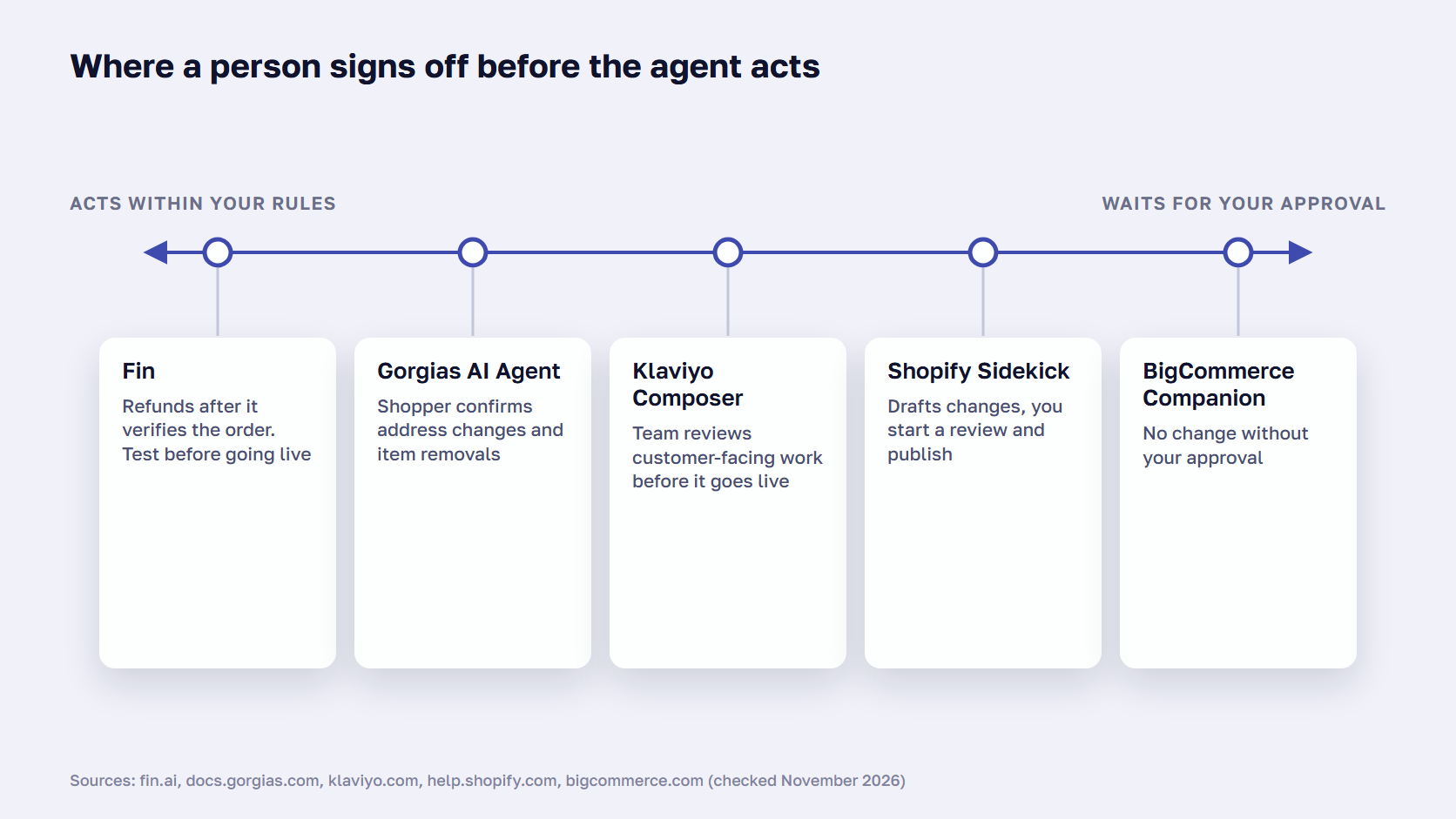
Before an AI agent acts on your store, check what it can change without a person, who approves the rest, how the price grows with volume and where your store data goes. Start with one action or read-only access, test it on real cases from your store, and widen the permissions only after the results hold up.
Here is what to look for in an eCommerce AI agent before you compare prices.
- What it can do without a person. Gorgias AI Agent can cancel an unfulfilled Shopify order or edit its shipping address, and it asks the shopper to confirm address changes and item removals first. Fin can issue a refund once it has verified the order. Decide which actions you allow before launch, and switch them on one at a time.
- Who approves the rest, and where. Klaviyo lets your team review customer-facing work before it goes live. Shopify Sidekick drafts store changes for you to review and publish, and BigCommerce Companion applies a change only after you approve it. An agent that changes code should build each change away from the live store and leave the release to a person.
- How the price grows with volume. Per-outcome and per-conversation prices, as with Fin, Gorgias and Agentforce, rise with traffic. Estimate a peak month before you compare them with tools included in your platform or with flat subscriptions.
- Where your store data goes. Every AI agent for eCommerce sends questions, orders or code to an AI provider. Ask which provider that is, whether it trains models on your data, and how much customer data the agent can read.
🚀 Quick takeaway
Ask every vendor two questions before launch: what can the agent change without a person, and where does the store data it reads go? The answers tell you how much testing the agent needs before it goes live.
How to choose AI agents for eCommerce by job
Choose AI agents for eCommerce by the job that costs your team the most time. A full support inbox calls for a customer service agent, unanswered product questions for a shopping assistant, slow campaigns for a marketing agent, thin product data for a catalog agent, and a backlog of small fixes for a store-change agent. Start with one job.
| Where the work piles up | Agent type | Entries |
|---|---|---|
| Order questions, returns and cancellations | Customer service agent | 1, 2 |
| Product questions before purchase | Shopping assistant | 3, 4 |
| Campaigns, flows and segments | Marketing agent | 5 |
| Product descriptions, attributes and sort orders | Catalog and content agent | 6, 7, 8 |
| Settings, orders, theme and extension changes | Store-change agent | 9, 10, 11 |
Which eCommerce AI agent to pick within a group then follows from your platform.
Choose a customer service agent if:
- Your support inbox fills with “where is my order” and return requests.
- You already run a helpdesk and want the agent to answer inside it.
Choose a shopping assistant if:
- Shoppers ask product-fit questions before they buy and leave without an answer.
- You want answers that come from your own catalog, in a chat on your storefront.
Choose a marketing agent if:
- Your campaign calendar slips because building segments and emails takes days.
- You want campaign drafts your team reviews before anything reaches customers.
Choose a catalog and content agent if:
- Hundreds of products have thin descriptions or missing attributes.
- You sell in several languages or regions and need product copy in each one.
Choose a store-change agent if:
- Small storefront and admin changes wait weeks for a developer.
- You want every change drafted, previewed and approved by a person before it goes live.
Frequently asked questions about AI agents for eCommerce
Which AI agents are best for eCommerce?
The best AI agent for eCommerce depends on the job. Fin and Gorgias AI Agent answer customers, Shopify Inbox and Salesforce’s Shopper Agent help shoppers choose, Klaviyo Composer builds campaigns, and catalog agents such as Hypotenuse AI write product content. For store changes, start with what your platform includes, such as Shopify Sidekick or BigCommerce Companion.
What is the difference between an AI agent and a chatbot?
A chatbot answers questions in a conversation, often from fixed scripts. An AI agent also takes actions: it looks up an order and issues the refund, drafts a campaign or updates a product page, using the systems you connect it to. That is why an agent needs permissions and an approval step, while a scripted chatbot mostly needs good answers.
How much do AI agents for eCommerce cost?
Prices follow the job. Customer service agents charge per resolved conversation: $0.99 per outcome for Fin, and $0.90 to $1.00 per automated interaction for Gorgias AI Agent. Salesforce lists Agentforce at $2 per conversation for customer-facing agents. Shopify Sidekick, Shopify Inbox and BigCommerce Companion come with the platform, and the rest are subscriptions, one-time licenses or quoted plans.
Can an AI agent change my online store without my approval?
It depends on the agent and your settings. Shopify says Sidekick can’t change your live store without your approval, and BigCommerce says Companion does not apply a change without it. Support agents can act on orders by themselves within the rules you set, so test each action, such as a cancellation or a refund, before you switch it on.
Do AI agents for eCommerce work with Magento (Adobe Commerce)?
Yes. Gorgias and Klaviyo both connect to Magento, so their agents can answer customers and build campaigns for a Magento store. In the admin, Magefan’s Magento 2 AI Agent creates and updates products, categories and CMS content from a chat, within each user’s admin role. For code and theme changes, look for agents built for Magento Open Source and Adobe Commerce.
Should we build our own AI agent or buy one?
Buy first if an existing agent covers the job, because it comes with integrations, testing tools and a price you can check today. Build when the work depends on your own rules and systems, such as B2B price lists or a custom catalog. A custom agent connects an AI model to your store through APIs or the Model Context Protocol, a standard way for AI tools to use other systems.
Are AI agents safe to use with customer data?
They can be, if you check before launch which AI provider processes your store’s data and whether that provider trains its models on it. Then give each agent only the access its job needs: a support agent needs order data, while a store-change agent needs your code, and neither should see more customer data than the task requires.
Where to start with AI agents for eCommerce
AI agents for eCommerce pay off when each one has one job and clear limits. Pick the job that takes your team the most hours today, choose an agent built for your platform, test it on real work with the narrowest access it needs, and add the next agent once the first one works the way you expect.
Prices and platform lists change, so open the vendor page again before you sign. For help deciding which jobs to hand to agents first, and how to connect them to your store with the right limits, talk to scandiweb about AI strategy consulting for eCommerce.
Tell us which job piles up first on your team, and we'll say which agent type fits it and what access it would need on your store.