If someone on your leadership team has asked for an AI shopping assistant, and every vendor demo you’ve seen since looks the same, the hard part is comparing what’s underneath. One vendor quotes per seat, another per resolution, a third per conversation, and a custom build gets quoted in tokens. None of them tells you which use case will move revenue on your store.
This guide maps the three types of assistant, ranks the use cases by impact, and puts the published prices side by side. It also covers what your catalog needs before launch and how to prove the assistant pays for itself.
What is an AI shopping assistant?
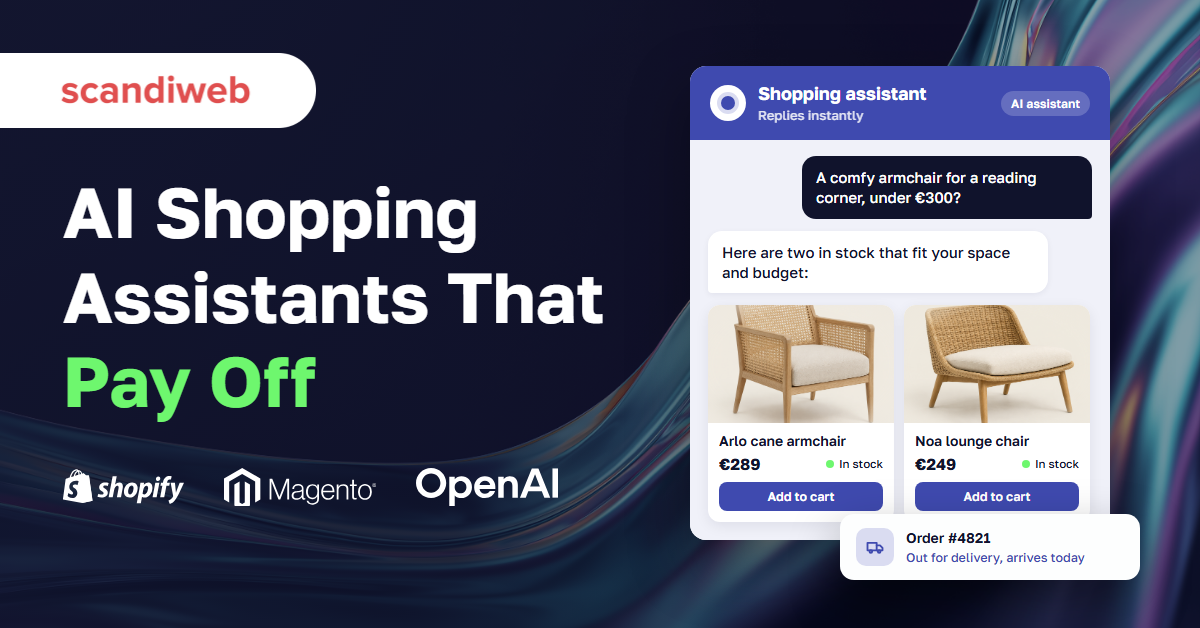
An AI shopping assistant is a chat interface on your store that uses a large language model to answer shoppers in plain language. It reads your catalog, prices, stock, and policies, then recommends products, answers questions, and handles tasks such as order tracking. Older eCommerce chatbots followed fixed scripts and button menus. A modern assistant understands open questions and replies with your own product data.
The term covers two different things, and search results mix them up. Consumer AI shopping agents such as ChatGPT shopping, Perplexity, and Amazon’s Rufus shop across many stores on the buyer’s behalf. This guide is about the assistant you run on your own store, in your app, or in WhatsApp, which only sells your products. If you want your products to show up in the consumer tools, our guide to ChatGPT shopping covers that side.
Shopper-facing assistants are also different from merchant tools. Shopify Sidekick, for example, helps your team run the Shopify admin and never talks to customers.
Three types of AI assistants for online stores
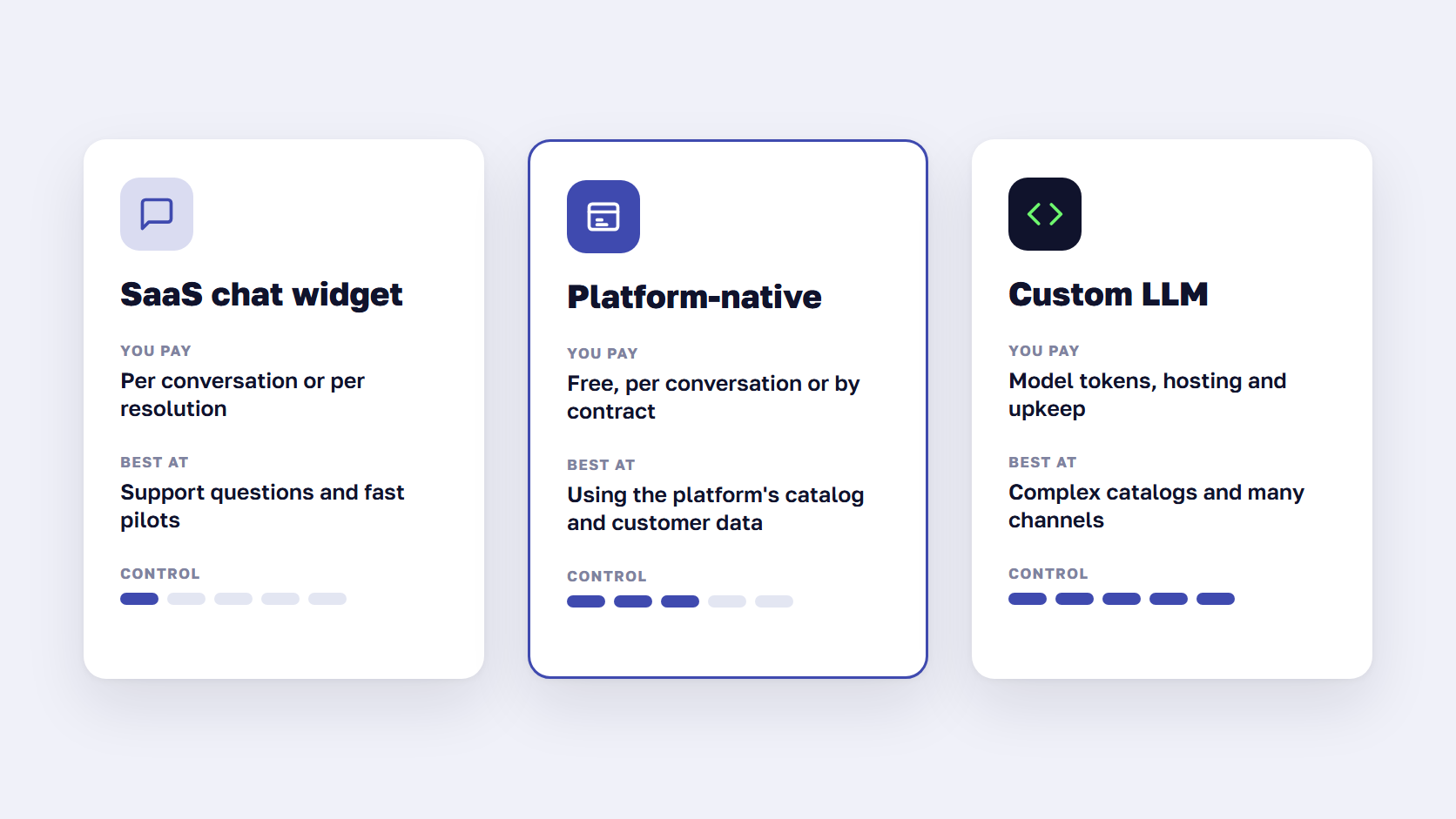
There are three types of AI shopping assistants. SaaS chat widgets install without a development project and charge per conversation or resolution. Platform-native assistants come with your commerce or search platform and use its catalog data directly. Custom LLM assistants are built on a model API and connected to your own systems, which costs more upfront but gives you full control over data, logic, and running costs.
| Type | Examples | Pricing unit | Best at | Main limit |
|---|---|---|---|---|
| SaaS chat widget | Tidio Lyro, Gorgias AI Agent, Intercom Fin, Zendesk AI agents | Per conversation or per resolution | Support questions, fast pilots | Shallow product logic, fees grow with volume |
| Platform-native | Shopify Inbox agent, Salesforce Agentforce, Adobe Brand Concierge, Algolia | Free, per conversation, or by contract | Using the platform’s own catalog and customer data | Tied to one vendor’s roadmap and limits |
| Custom LLM | Built on OpenAI, Anthropic, or open models, connected through APIs and MCP | Model tokens plus hosting and maintenance | Complex catalogs, many channels, custom rules | Upfront build and a team to run it |
SaaS chat widgets
Most eCommerce chatbot tools started as helpdesks and added an AI agent later. Tidio, Gorgias, Intercom, and Zendesk all install on Shopify through an app. They read your help center, policies, and product pages, answer questions, and pass the conversation to a human when they can’t help.
Their strength is speed, because you can switch one on without a development project. Their weakness is depth. A support-first AI chatbot for eCommerce answers “where is my order?” well and “which of these drills handles masonry?” less well, because it reads product pages as text and can’t query structured attributes.
Platform-native assistants
Your commerce platform may already include one. Shopify Inbox is free and, in Shopify’s words, “puts an AI-powered sales associate on your storefront.” It learns from your catalog, policies, and store content, and it personalizes answers when the shopper signs in with Shop. For many stores, it is the cheapest way to test an AI chatbot for Shopify before paying for anything else.
Salesforce sells Agentforce for customer-facing agents at $2 per conversation, or through Flex Credits. Adobe has made Brand Concierge generally available and announced an integration with Adobe Commerce, so check its status for your edition before you plan around it. Search vendors such as Algolia offer shopping assistants that generate answers from the live catalog, which suits stores that already run their site search on them.
Platform-native assistants use your platform’s data model, so they see prices, stock, and customer accounts without a separate integration. In return, you get the logic the vendor built, on the vendor’s timeline.
Custom LLM assistants
A custom assistant uses a model from OpenAI, Anthropic, or an open-source family, and your developers connect it to the store: product search, live stock and price, customer accounts, order management, and the CMS. Platforms now make this easier. Shopify exposes catalog and cart tools to AI agents through the Model Context Protocol (MCP), and BigCommerce opened its Storefront MCP to every live store in 2026. Our guides on what MCP is and how to build an MCP server explain how this works, and the Magento MCP server shows it on Magento (Adobe Commerce).
A custom build makes sense when the catalog needs reasoning on top of lookup: project-based shopping, configurable products, B2B price lists, or one assistant across the website, WhatsApp, and physical stores. scandiweb’s own Chat to Buy is built this way, and our conversational commerce services cover custom assistants built around your catalog.
🚀 Quick takeaway
The type you pick decides how you pay, and that matters as much as what the assistant can say. SaaS tools and Agentforce bill per conversation or resolution, a custom build bills per token, and the gap widens as volume grows.
AI shopping assistant use cases ranked by impact
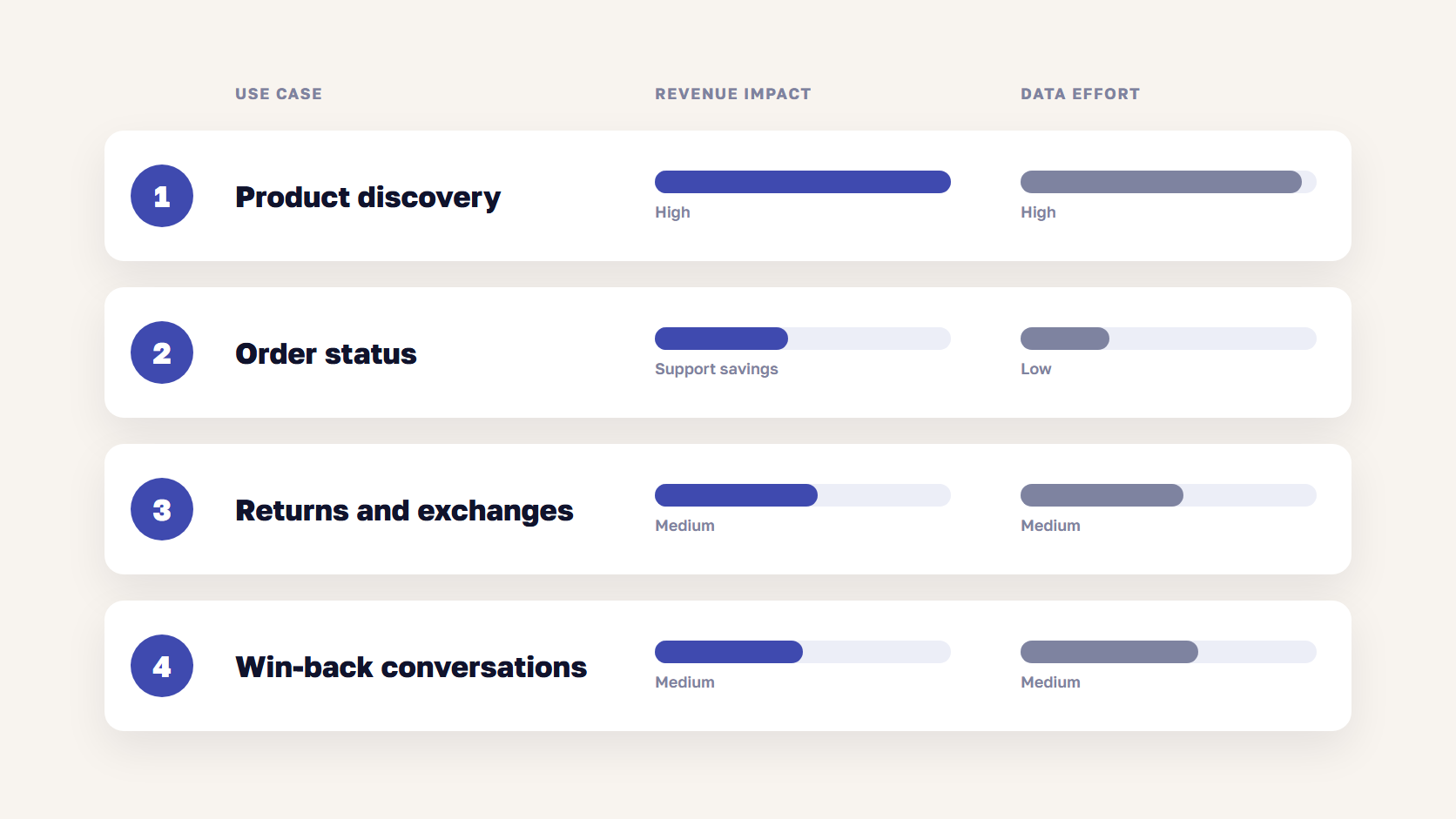
Shopping assistant use cases rank by impact in this order for most stores: product discovery and guided selling, order status questions, returns and exchanges, and win-back conversations with past customers. Discovery moves revenue but needs the cleanest product data. Order status and returns cut support load quickly and are easier to measure. Start where your data is ready and the volume is high.
1. Product discovery and guided selling
A shopper types “I’m building a deck, 12 square meters, what do I need?” and gets a list of boards, screws, and quantities. A search box would have returned 400 results. This is AI product recommendations in conversation form, and it pays most in catalogs where shoppers don’t know the product names: DIY, electronics, beauty, sports gear, and B2B parts.
We built this kind of assistant for a Nordic DIY retailer, trained on common projects and connected to its full catalog. As our conversational commerce guide describes, the project led to 95% higher average order value and a 68% increase in conversions.
The largest public example is Amazon’s Rufus. Amazon said in its Q3 2025 earnings call that customers who use Rufus during a shopping trip are 60% more likely to complete a purchase, and that Rufus is on track to add over $10 billion in annualized sales. Read the 60% carefully. It compares people who chose to use Rufus with people who didn’t, and the first group was probably closer to buying anyway.
2. Order status
“Where is my order?” is among the most repetitive questions in eCommerce support, and one of the easiest to automate well. The assistant asks for an order number or uses the logged-in account, calls your order management system or carrier API, and answers with the real status. It sells nothing, but every resolved chat is a ticket your team doesn’t handle, so the saving is easy to count.
3. Returns and exchanges
Returns are expensive. The NRF and Happy Returns put US returns at $849.9 billion in 2025, with 19.3% of online sales sent back. An assistant helps on both sides of the purchase. Before it, the assistant answers the sizing and compatibility questions that lead to wrong orders. After it, the assistant starts a return or offers an exchange. This use case needs your return rules written down precisely, because the assistant will quote them.
4. Win-back conversations
The assistant can also start the conversation, much like a win-back email flow. For a pet food retailer, we built a WhatsApp sales concierge that contacted lapsed customers with messages based on their order history and recommended products from the catalog. In the first few weeks, 31% of contacted customers replied and 4% bought.
Read more: Case Study: Conversational Commerce Brings 31% of Churned Customers Back
🚀 Quick takeaway
Order status is the safest first launch because it has one right answer and a clear cost saving. Product discovery has the bigger upside, so plan it as phase two once your attributes are clean.
How much does an AI shopping assistant cost?
An AI shopping assistant costs from nothing to tens of thousands of dollars a month, depending on type and volume. SaaS agents charge about $0.90 to $2.00 per resolved conversation. Shopify’s Inbox agent is free. A custom build costs mainly integration work upfront, then model usage that is often a few cents per conversation, plus hosting and maintenance.
Licence and usage fees
These are the published prices on each vendor’s pricing page in October 2026:
| Vendor | AI pricing | What else you pay for |
|---|---|---|
| Shopify Inbox | Free | Nothing extra, Shopify stores only |
| Tidio Lyro AI Agent | From $32.50 a month for 50 conversations | Higher conversation tiers, base plan |
| Gorgias AI Agent | $0.90 per automated interaction (annual), $1.00 (monthly) | A Gorgias helpdesk plan |
| Intercom Fin | $0.99 per outcome | Monthly minimum, seats for human agents from $29 |
| Zendesk AI agents | $1.50 per automated resolution (committed), $2.00 pay as you go | Suite plans from $55 per agent a month |
| Salesforce Agentforce | $2 per conversation, or $0.10 per action with Flex Credits | Salesforce licences |
Check the unit before the headline price. A per-resolution fee charges only for chats the AI closes without a human. A per-conversation fee charges for every chat, including the ones that end with “let me get a colleague.”
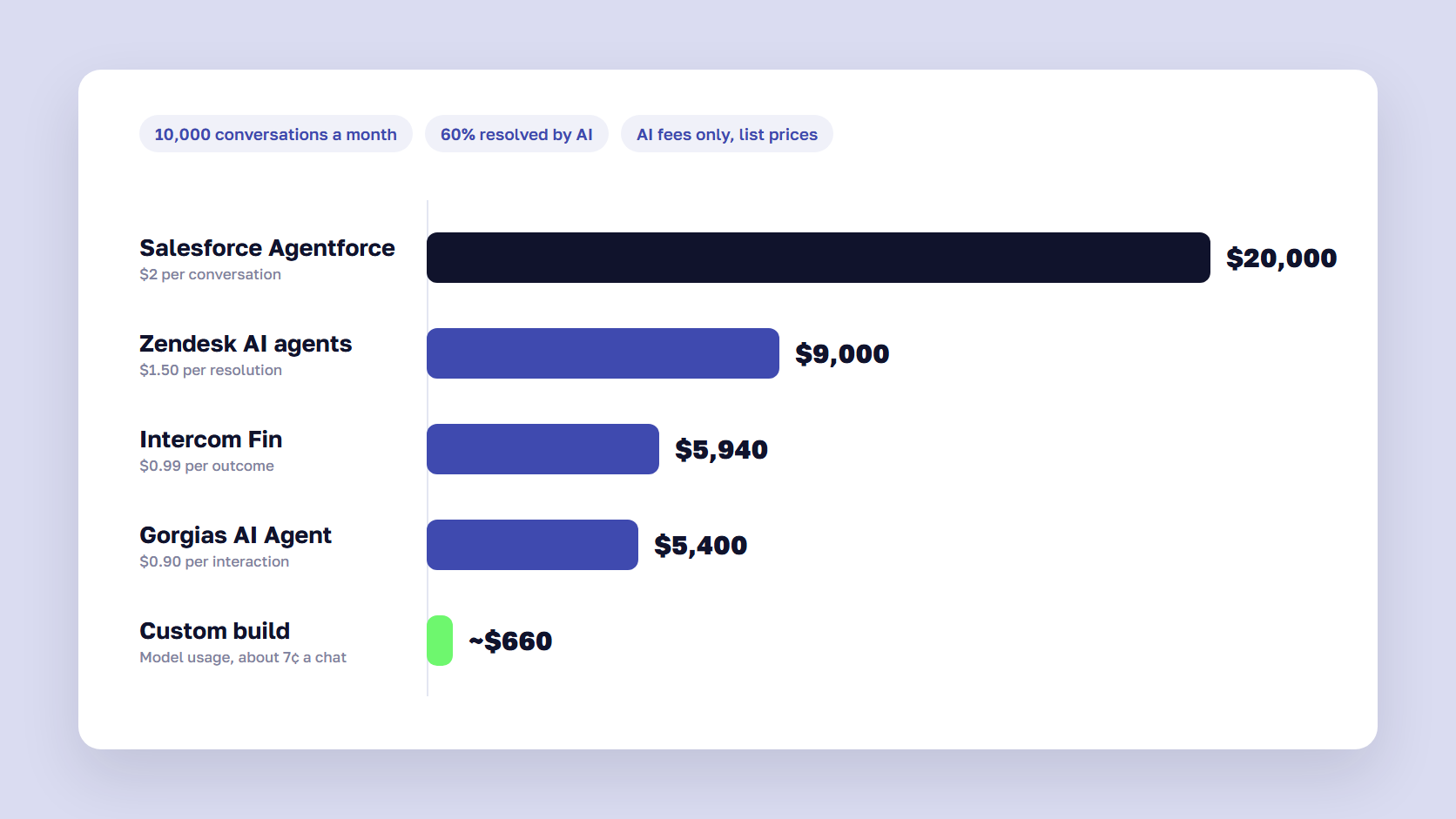
Take a store with 10,000 assistant conversations a month, where the AI resolves 60% without a human. At list prices, the AI fees alone come to about $5,400 on Gorgias, $5,940 on Intercom, $9,000 on Zendesk with committed resolutions, and $20,000 on Agentforce’s per-conversation model. Helpdesk plans and seats come on top.
Integration work
Vendors talk about this cost least. A widget that only reads your help center needs almost no integration. An assistant that recommends products, checks stock, and looks up orders needs connections to the catalog or PIM, the inventory source, the order management system, and customer accounts. On Shopify, most of that comes through the platform’s APIs. On Magento (Adobe Commerce) with custom modules, an ERP for stock, and a PIM for attributes, each connection is real development work. Ask every vendor which of your systems their assistant can query live, and which it only reads as crawled text.
Running costs of a custom build
A custom assistant pays for model usage per token. On OpenAI’s standard prices in October 2026, gpt-6-sol costs $2 per million input tokens and $10 per million output tokens, and the smaller gpt-6-luna costs $0.10 and $0.50. Picture a six-message shopping conversation that sends about 4,000 tokens of instructions, product data, and history per message and gets 300 tokens back each time. It uses about 24,000 input and 1,800 output tokens, which is roughly 7 cents on gpt-6-sol and under half a cent on gpt-6-luna.
At 10,000 conversations, model usage comes to about $660 a month on the larger model. Add hosting, a vector search index for the catalog, monitoring, and a developer who updates prompts and integrations. Over a year, that developer time usually costs more than the tokens.
🚀 Quick takeaway
Per-resolution pricing looks cheap in a pilot and expensive at scale. Run your own conversation volume through each vendor’s unit before you compare demos.
Data and catalog prerequisites
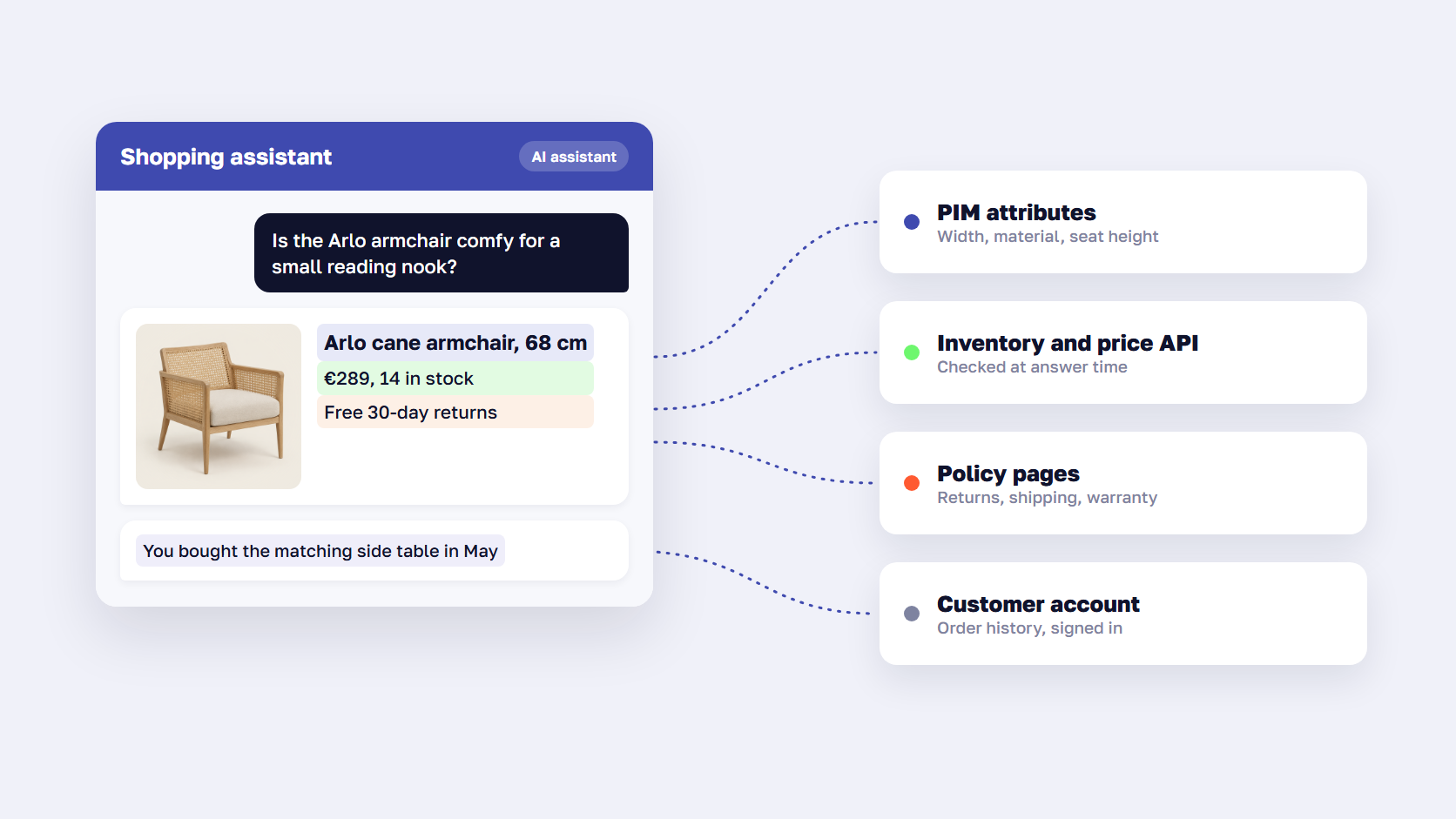
An AI assistant on your store needs structured product attributes, live price and stock data, written policies, and access to order data. Attributes such as size, material, and compatibility must be stored as fields, because a sentence in a description is hard to query. Prices and availability must come from an API at answer time. If the data is thin, the assistant guesses or says it doesn’t know, and both cost sales.
Check these before you sign anything:
- Attributes as fields. “Works with masonry” in a description is hard to filter on, and a “material compatibility” attribute is easy. A PIM helps here, and our PIM software guide compares the options.
- Live price and stock. The assistant must call your systems when it answers. A model that remembers yesterday’s price will quote it.
- Policies in writing. Shipping times, return windows, and warranty terms need to be on pages the assistant reads, current and unambiguous.
- Order and account access. Order status and returns need authenticated access to order data, with the shopper’s identity checked first.
- Every language you sell in. If your Finnish catalog has half the attributes of your English one, the Finnish assistant will be half as useful.
The same data work pays twice. Clean attributes and live feeds also decide whether your products appear in ChatGPT and Google AI Mode, and our product catalog management guide covers how to organize them.
🚀 Quick takeaway
Ask for a demo on your own catalog with your ten hardest product questions. A vendor’s demo store has perfect data, and yours probably doesn’t.
How to measure the ROI of an AI shopping assistant
Measure the assistant with a holdout test. Show the assistant to most visitors, hide it from a random 10–20%, and compare conversion rate, average order value, and revenue per visitor between the two groups. Comparing chat users with everyone else overstates the effect, because shoppers who choose to chat are often more motivated already.
Track four groups of numbers:
- Revenue: conversion rate, average order value, and revenue per visitor for the exposed group against the holdout.
- Support: resolution rate, tickets per order, and how often the assistant hands over to a human.
- Quality: a weekly sample of transcripts checked for wrong answers, especially prices, stock, and policies.
- Cost: licence, usage, and maintenance per resolved conversation, tracked monthly as volume changes.
The ROI math is then straightforward: incremental gross margin from the holdout test, plus support hours saved, minus licence, usage, hosting, and maintenance. Send assistant events into GA4, such as chat opened, product recommended, and product added to cart from chat, so you can follow the path to purchase. Test design is part of our CRO and UX work if you want a second pair of eyes on it.
🚀 Quick takeaway
Agree on the holdout before launch. Once the assistant is live for everyone, you lose the cleanest way to prove it sells.
Guardrails to set before launch
An assistant that sounds confident and is wrong costs more than no assistant. In February 2024, a Canadian tribunal held Air Canada liable after its website chatbot gave a passenger wrong information about bereavement fares. The airline argued that the chatbot was a separate entity responsible for its own answers. The tribunal said it was “still just a part of Air Canada’s website.”
Set these rules before go-live:
- Live data for prices, stock, and policies. The model writes the sentence, and your systems supply the facts.
- Limits on what it can promise. No custom discounts, delivery dates, or exceptions unless a rule allows them.
- A visible way to reach a human, with the conversation passed along so the shopper doesn’t repeat themselves.
- An AI label. Since 2 August 2026, the EU AI Act requires AI systems that talk to people to make clear they are AI. Our EU AI Act guide for eCommerce explains who is responsible.
- Logging and review of conversations, with personal data handled under your privacy policy.
- Protection against prompt injection, so a shopper can’t talk the assistant into ignoring its rules.
How to choose the right AI shopping assistant
Pick the type that fits your catalog and your volume. A SaaS widget suits stores whose main problem is support load. A platform-native assistant suits stores whose platform already holds clean catalog and customer data. A custom build suits complex catalogs, several channels, and high volumes, where per-resolution fees would exceed what the model costs to run.
Choose a SaaS chat widget if:
- Most of your chat volume is order status, shipping, and returns questions
- Your catalog is small enough that product pages describe it well
- You have no developer time for an integration this quarter
- You want a pilot running within a month
Choose a platform-native assistant if:
- You run on Shopify, Salesforce Commerce Cloud, or a search platform that already holds your catalog
- You want the assistant to use the platform’s customer accounts and order data without a separate integration
- You accept the vendor’s logic and roadmap in exchange for less maintenance
- Your team already works in that vendor’s admin every day
Choose a custom LLM assistant if:
- Your products need reasoning, such as projects, bundles, configurable items, or B2B price lists
- You run Magento (Adobe Commerce) with custom modules, an ERP, and a PIM
- You sell in several markets and languages from one catalog
- Your conversation volume makes per-resolution fees more expensive than model usage
- You want one assistant across the website, app, WhatsApp, and stores
Not sure which group you’re in? Our AI strategy consulting starts with that question and your own conversation data.
Frequently asked questions about AI shopping assistants
What does an AI shopping assistant do?
An AI shopping assistant answers shoppers’ questions in chat using your own store data. It recommends products based on what the shopper describes, compares options, checks stock and prices, explains shipping and return policies, and tracks orders. More advanced assistants also build carts, start returns, and contact past customers with personal recommendations.
What is the difference between an AI chatbot for eCommerce and an AI shopping assistant?
The terms overlap. An AI chatbot for eCommerce usually means a support tool that answers questions from your help center. A shopping assistant also sells: it queries the catalog, recommends specific products, and helps the shopper decide. Many tools do both, so judge each one by the data it can query live.
Is there a free AI shopping assistant for online stores?
Yes, for Shopify stores. Shopify Inbox is a free app that adds an AI sales associate to your storefront, trained on your catalog, policies, and store content. Most other tools charge per conversation or per resolution after a small entry tier, and a custom build costs development time even when model usage is cheap.
Do AI shopping assistants increase conversion?
They can, mainly through product discovery. A scandiweb-built assistant for a Nordic DIY retailer led to 95% higher average order value and 68% more conversions, and Amazon reports that shoppers using Rufus are 60% more likely to buy. Your own result depends on data quality, so prove it with a holdout test before a full rollout.
Do you have to tell shoppers they are talking to AI?
In the EU, yes. Since 2 August 2026, the EU AI Act requires AI systems that interact with people to make it clear they are AI, unless that is obvious from the context. A short line at the start of the chat, such as “I’m an AI assistant,” covers it. Check that your vendor’s widget shows one.
Can you add an AI chatbot or shopping assistant to Magento (Adobe Commerce)?
Yes. Some SaaS helpdesks, such as Gorgias, offer a Magento 2 integration, and a custom assistant can use Magento’s GraphQL API for catalog, cart, and customer data. scandiweb’s open-source MCP server for Magento connects AI tools to the store for your own team. Adobe has also announced a Brand Concierge integration for Adobe Commerce.
Start with one use case and a holdout
An AI shopping assistant pays off when it answers from live data, starts with the use case your data can support, and is measured against shoppers who never saw it. For most stores, that means order status first and product discovery second, on whichever type matches your catalog and volume. If you want to see how a custom assistant would handle your products, our conversational commerce team can build a demo with your catalog and typical customer questions.
Comparing AI assistant demos and getting four different price units? Send us your monthly chat volume, and we'll show you what each option would cost on your store.